How we make this list: we compare pricing pages, product documentation and public user reviews. Ratings come from G2, Capterra or Trustpilot, with the date we checked them.
Key takeaways
- Wiz and Orca lead on agentless cloud visibility, with fast deployment and attack-path prioritization.
- Aqua leads on runtime control, stopping attacks at execution rather than only reporting them.
- Falco is the free open-source runtime detection engine that Sysdig itself created and later donated to the community.
- Microsoft Defender for Cloud is the value pick for Azure-first teams, with free and paid tiers.
Quick comparison
Is your product missing or out of date?
We review this list regularly. Vendors can request a listing, send updated pricing or ask about featured placement.
The best Sysdig alternatives

#1Wiz
Best for: Agentless CNAPP4.7/5 on
G2 (863 reviews, checked Oct 2026)
Visit wiz.io
Starting priceSee website
Free planNo
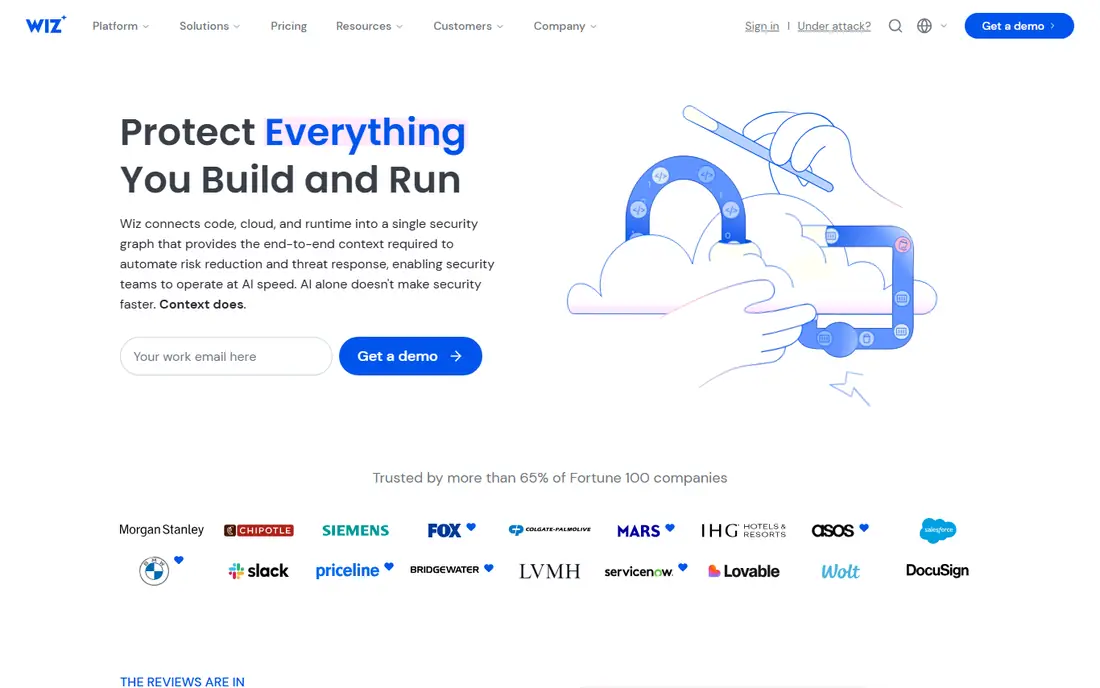
Wiz is the agentless CNAPP pick. Its homepage presents AI cybersecurity for cloud and AI applications, connecting code, cloud, and runtime into a single security graph that automates risk reduction and threat response. It reports trust from more than 65 percent of Fortune 100 companies, with AI agents for attack simulation, autonomous investigation, and precision remediation, plus claims of information within 60 minutes of connection.
The trade-off is depth versus speed: agentless scanning reads state on a schedule and can miss short-lived process activity that a kernel sensor catches. Published comparisons rank Wiz first overall for multicloud CNAPP and first for attack-path prioritization. For teams that want fast, broad cloud visibility, Wiz is the strongest Sysdig alternative here.
What we like- Agentless API scanning
- Single security graph across code, cloud, and runtime
- Trusted by 65 percent-plus of Fortune 100
Watch out for- Quote-based pricing
- Agentless depth misses some in-memory activity
Starting priceSee website
Free planNo
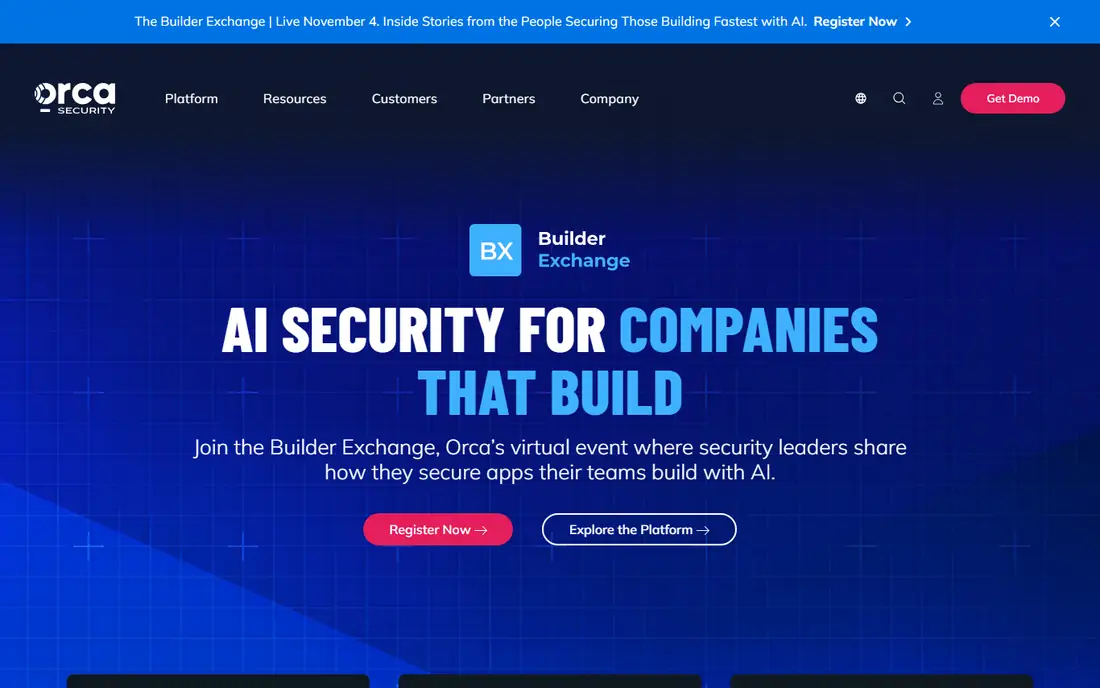
Orca Security is the agentless visibility pick. Its homepage presents an AI-powered cloud security platform and CNAPP covering code, cloud, runtime, and AI, with side-scanning that begins automatically after a three-step account connection, delivering a full inventory and scored risks within 24 hours, with no agents and no friction. It reports a 198 percent return on investment in a representative case, 75 percent lower alert volume, and ratings of 4.6 on G2 and 4.8 on Capterra.
The trade-off is pricing predictability: published comparisons note that consumption-based pricing can complicate forecasting. For teams that want the broadest agentless coverage across clouds, Orca's side-scanning is the best fit here.
What we like- SideScanning with no agents
- Full visibility in 24 hours
- Attack-path prioritization
- 75 percent alert reduction claimed
Watch out for- Quote-based pricing
- Consumption pricing can complicate budgeting
Starting priceSee website
Free planNo
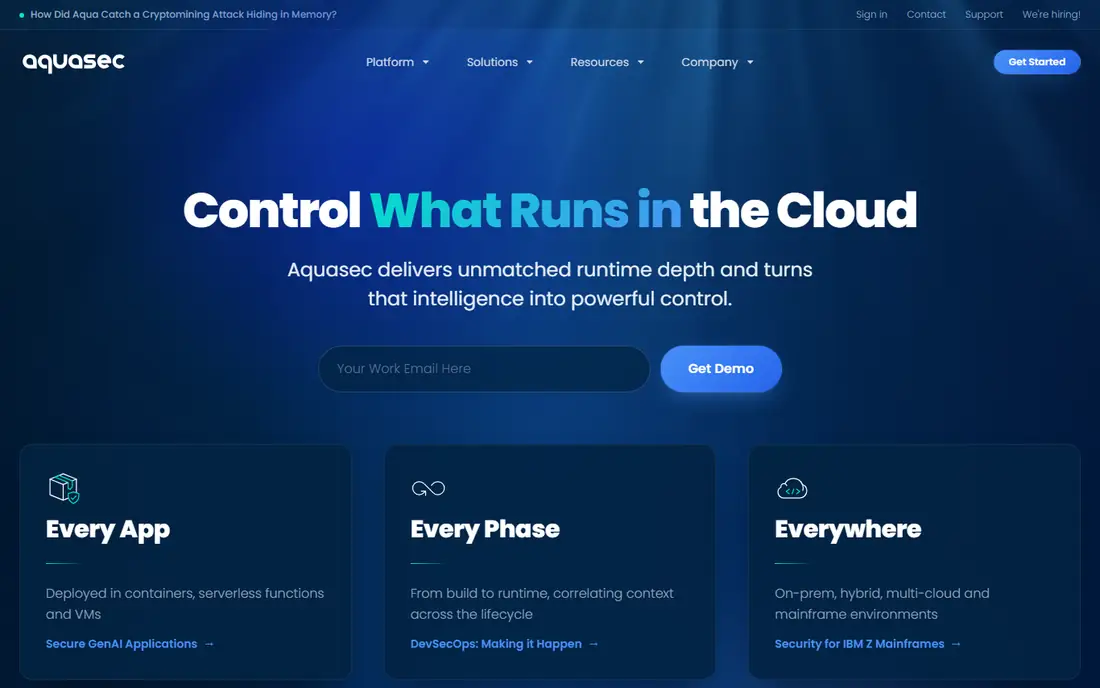
Aqua Security is the runtime control pick and the closest to Sysdig's runtime strength. Its homepage presents control as the difference between seeing and stopping, with runtime intelligence connected back to code, risk ranked by live workload behavior, inline enforcement that denies unauthorized actions at execution, and compensating controls that contain attacks without waiting for a patch. It reports 17-plus patents, 577,000-plus runtime threats blocked across 146 production environments, and trust from more than 40 percent of the Fortune 100.
The trade-off is deployment: Aqua's agent-based architecture delivers deeper enforcement than agentless tools but needs installation and maintenance. For teams whose top priority is stopping runtime attacks rather than only finding them, Aqua is the strongest pick here.
What we like- Deepest runtime enforcement
- Blocks attacks at execution
- Works disconnected or air-gapped
- 577,000-plus threats blocked
Watch out for- Agent-based architecture needs deployment effort
- Quote-based pricing
Starting priceSee website
Free planNo
Cortex Cloud, formerly Prisma Cloud, is Palo Alto Networks' cloud security platform and the pick for its existing customers. Published comparisons rank it joint third overall for cloud security platforms and best for Palo Alto Networks estates, with enterprise-scale posture management, workload protection, and compliance across complex cloud setups. The vendor homepage confirms Palo Alto's AI-driven security operations platform with 700-plus integrations and 480 billion endpoints scanned daily.
The trade-off is ecosystem fit, as with other Palo Alto products: integration is smoothest inside its own stack, and pricing is quote-based per node and workload. For Palo Alto customers, Cortex Cloud's unified platform is the natural Sysdig replacement.
What we like- Unified CNAPP from Palo Alto
- Posture plus workload protection
- Deep Fortinet-free ecosystem fit for Palo Alto shops
Watch out for- Best inside Palo Alto estates
- Product detail sits deeper than the vendor homepage
Starting priceSee website
Free plan30-day trial
Microsoft Defender for Cloud is the Azure value pick. Its product page presents an integrated cloud-native application protection platform protecting applications and infrastructure across hybrid and multicloud environments, with cloud security posture management, workload protection, and DevOps security from code to runtime. It offers both free and paid tiers, a free 30-day trial, pay-as-you-go pricing, and up to 22 percent savings when pre-purchasing Defender for Cloud Commit Units.
The trade-off is multicloud depth: published comparisons rank it joint third overall and best value for Azure-first teams, but Wiz and Orca cover more clouds more deeply. For Azure-heavy organizations, Defender for Cloud's native integration and free tier make it the best-value Sysdig alternative.
What we like- Integrated CNAPP
- CSPM plus workload and DevOps security
- Free tier
- Up to 22 percent savings with commit units
Watch out for- Deepest value inside Azure
- Multicloud coverage thinner than Wiz or Orca
Starting priceSee website
Free planFree trial
CrowdStrike Falcon Cloud Security is the endpoint-plus-cloud pick. Published comparisons rank it joint sixth overall and best for Falcon endpoint customers, with unified agent-based and agentless protection and strong threat intelligence. The vendor homepage presents the Falcon platform as one unified platform combining security data, AI intelligence, and automation, with a free trial and bundles from $7.99 per device a month for Falcon Go, though cloud security pricing sits on higher bundles.
The trade-off is platform scope: Falcon Cloud Security shines for existing Falcon customers, while standalone cloud teams may prefer Wiz or Orca. For organizations already running Falcon endpoints, its shared data and intelligence are a real advantage.
What we like- Unified agent-based and agentless protection
- Falcon threat intelligence
- Free trial
Watch out for- Cloud security is part of a larger endpoint platform
- Quote-based pricing
Starting priceSee website
Free planFree tier
Snyk is the developer-first pick. Its homepage presents an AI security platform that validates AI-generated code, governs development agents, and secures AI-native applications, with integrations for GitHub, GitLab, Docker, Kubernetes, Terraform, and Visual Studio Code, plus AI coding assistants including Claude Code, Cursor, and Codex. Snyk Container scans images for vulnerabilities and fits naturally into developer pipelines.
The trade-off is scope: Snyk shifts security left into code and pipelines but offers less runtime and posture depth than full CNAPPs. For teams whose main Sysdig use is container image scanning in CI, Snyk's developer experience is the best fit here.
What we like- Developer-first workflows
- Container scanning
- AI code validation
- IDE and CI integrations
Watch out for- More AppSec than runtime
- CNAPP depth thinner than Wiz or Orca
Starting priceFree
Free planYes
Falco is the free open-source pick, and it has a special relationship with Sysdig: it is the runtime detection engine Sysdig created and donated to the CNCF. Its homepage presents a cloud-native security tool providing runtime security across hosts, containers, Kubernetes, and cloud environments, using custom rules on Linux kernel events through eBPF, with plugins for cloud services like GitHub, Okta, and AWS CloudTrail, and alert forwarding to more than 50 systems including SIEMs and data lakes. It runs on x64 and ARM, deploys via an official Helm chart, and costs nothing to start.
The trade-off is scope: Falco gives detection rules and alerts and nothing else, with no posture management, vulnerability scanning, or managed UI. For teams with operations skills that want free runtime detection, Falco is the best-value Sysdig alternative, often paired with another tool for posture.
What we like- Free and open source
- Real-time eBPF detection
- 50-plus integrations
- CNCF graduated project
Watch out for- Detection only, no posture or remediation platform
- Needs operations skill
How we chose
We compared these tools on cloud visibility, runtime depth, attack-path prioritization, developer experience, deployment effort, and pricing transparency. We opened each vendor's homepage to confirm the product exists today and matches its description, and we used published comparison guides where homepage pricing was not shown. We did not claim hands-on testing. Where a price could not be verified from the vendor, we wrote See website rather than guessing.
What to verify in a trial
Start with your riskiest cloud account, not a demo environment. Connect it to each candidate and compare time to first findings, alert volume after prioritization, and whether the top findings are genuinely exploitable. Bring security, platform, and developer teams into the trial together, since each group experiences the tool differently and the buying decision affects all three. Next, test runtime behavior with a simulated attack, since agentless tools and agent-based tools differ most under live conditions. Finally, check the real cost at your asset and workload count, since per-asset and per-workload pricing diverge fast at scale. Also confirm which clouds and regions each tool covers, since some platforms support a narrower set of providers than their marketing suggests, and check whether on-premises or private cloud workloads are included in the quote.
Also confirm agent overhead during trial, since heavy agents slow the very workloads they monitor.
Frequently asked questions
What is Sysdig?
Sysdig is a cloud and container security platform known for runtime visibility and Kubernetes security, built on the Falco detection engine. Teams often look for alternatives over deployment complexity, cost, or agentless coverage.
Is Falco the same as Sysdig?
No. Falco is the open-source runtime detection engine Sysdig created and donated to the CNCF. Sysdig's commercial platform bundles Falco-based detection with posture management, vulnerability scanning, and a managed UI. Running Falco alone gives detection rules and alerts only.
Which Sysdig alternative works without agents?
Wiz and Orca scan through cloud APIs and snapshots, so nothing installs on hosts. The trade-off is depth: agentless scanning can miss in-memory or short-lived activity that a kernel sensor catches.
Which is best for Kubernetes runtime security?
Aqua and Sysdig itself lead on runtime depth, with Falco as the free detection option. Wiz and Orca add runtime context but are primarily posture and visibility platforms. If runtime blocking matters most, prioritize Aqua and test its enforcement under a simulated attack before you commit.
How much do these tools cost?
Most are quote-based per asset or workload. Microsoft Defender for Cloud offers a free tier and pay-as-you-go pricing, Falco is free, and Snyk offers a free tier. Request quotes at your exact asset count for comparison, and ask whether data retention, support, and training are included or billed separately.
Should I combine tools?
Many teams do: an agentless CNAPP for visibility plus Falco or Aqua for runtime depth, or Snyk for developer scanning plus Wiz for posture. The right mix depends on whether your biggest risk is misconfiguration, vulnerable images, or live attacks. Keep the stack as small as you can, since every extra tool adds alert routing and maintenance work.
Sources we checked (8)
- https://www.wiz.io
- https://orca.security
- https://www.aquasec.com
- https://www.paloaltonetworks.com
- https://azure.microsoft.com/en-us/products/defender-for-cloud
- https://www.crowdstrike.com
- https://snyk.io
- https://falco.org
Is your product missing or out of date?
We review this list regularly. Vendors can request a listing, send updated pricing or ask about featured placement.

Shihab Mia · Founder, Rankite
Shihab has 5+ years in B2B and SaaS SEO. He writes Rankite's software buying guides from pricing pages, documentation and public user reviews. More about Shihab.
 Orca Security
 Aqua Security
 Cortex Cloud
 Microsoft Defender for Cloud
 CrowdStrike Falcon Cloud Security
 Snyk
 Falco