How we make this list: we compare pricing pages, product documentation and public user reviews. Ratings come from G2, Capterra or Trustpilot, with the date we checked them.
Key takeaways
- LinearB is the closest workflow-focused Swarmia alternative, with pull request automation and AI code review tracking.
- Jellyfish suits leadership teams that need engineering effort tied to budgets, hiring plans and strategic initiatives.
- Waydev and Haystack are the budget-friendly picks, with free tiers or low per-member prices and no large seat minimums.
- DX is the best choice when developer experience surveys matter as much as delivery data.
- Swarmia itself is free for teams under 10 developers, so small teams should compare its free plan against paid rivals before switching.
Quick comparison
| Tool | Best for | Starting price | Free plan |
|---|
 LinearB | PR workflow automation | $29 per user per month | Free trial |
 Jellyfish | Engineering and finance alignment | See website | No |
 Waydev | Git analytics with a free tier | $29 per contributor per month | Yes |
 DX | Developer experience measurement | See website | No |
 Haystack | Lightweight DORA reporting | $20 per member per month | Free trial |
 Axify | AI adoption and cost tracking | $29 per contributor per month | Free trial |
 Allstacks | Delivery forecasting | $400 per contributor per year | Free trial |
 Pluralsight Flow | Enterprise flow tracking | $50 per user per month | No |
Is your product missing or out of date?
We review this list regularly. Vendors can request a listing, send updated pricing or ask about featured placement.
The best Swarmia alternatives
Starting price$29 per user per month
Free planFree trial
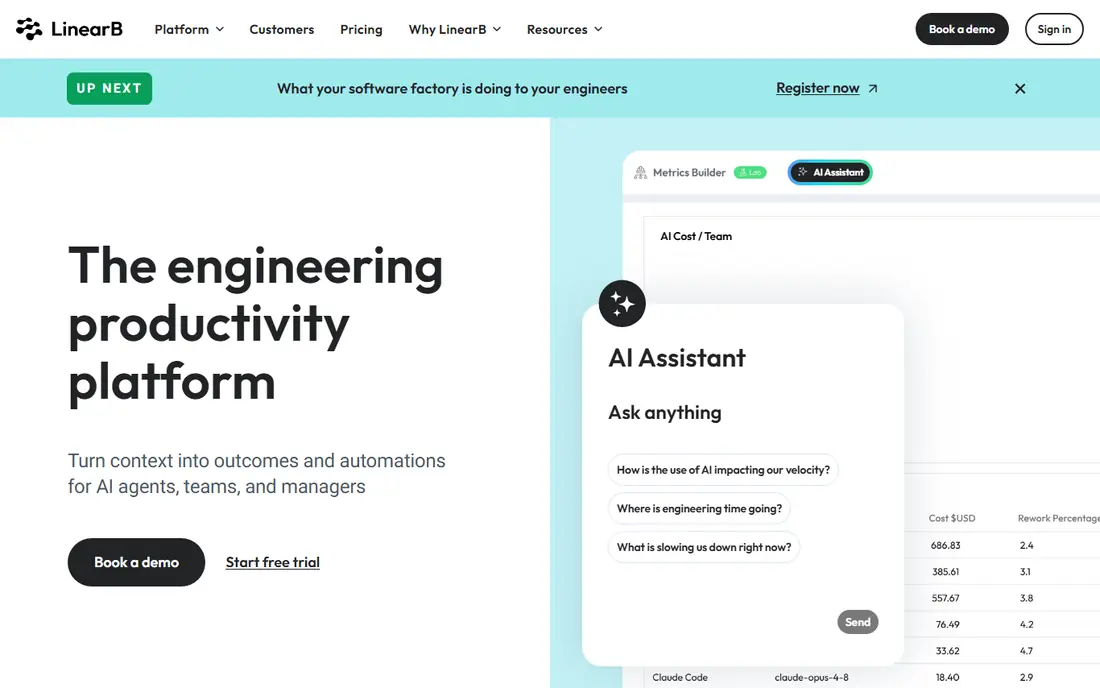
LinearB is the most direct Swarmia rival for teams that care about pull request flow. Its gitStream feature applies rules you write in code to route reviewers, label risky changes and enforce merge policies automatically. That automation saves senior engineers from routine review chores and keeps cycle time visible without manual tracking. AI impact measurement shows how coding assistants change throughput and review load.
Pricing starts near $29 per contributor per month for Essentials, or $59 for Enterprise, billed annually. The catch is seat minimums: 50 seats on Essentials and 100 on Enterprise, which prices out small teams. For a team above that threshold, LinearB's workflow depth is hard to match. Smaller teams should look at Waydev or Haystack instead.
What we like- GitStream automates pull request work
- AI impact tracking
- Strong DORA reporting
Watch out for- Essentials needs 50 seats
- Enterprise needs 100 seats
Starting priceSee website
Free planNo
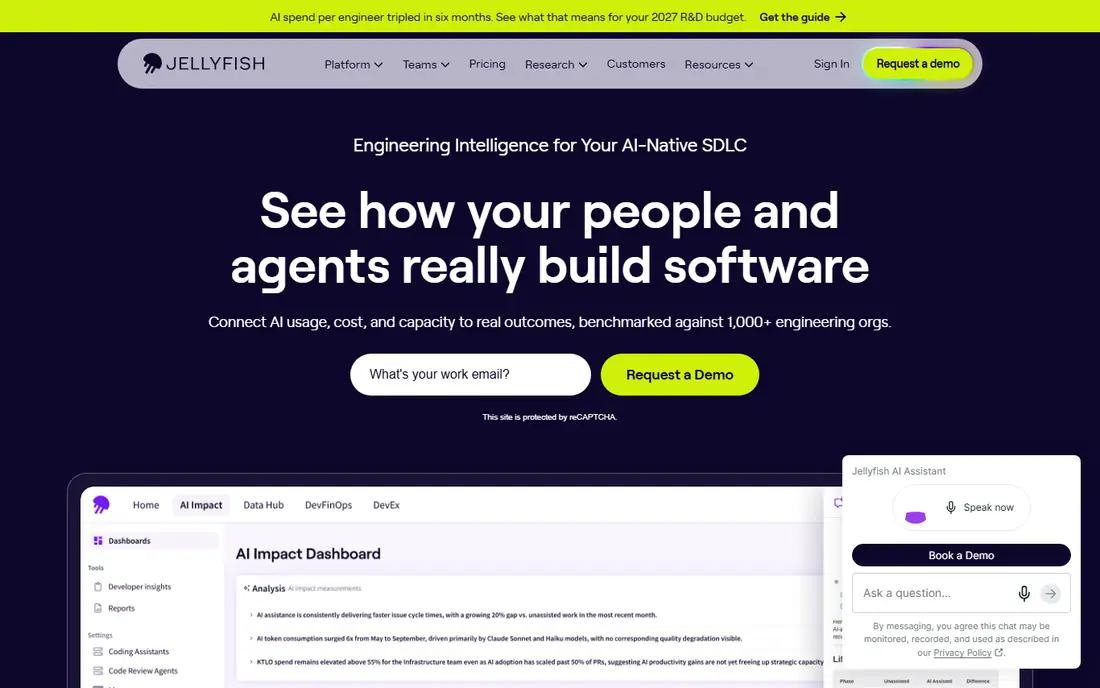
Jellyfish answers the questions engineering leaders get from finance: where did effort go, what did it cost, and how does AI spending change output. It maps work to initiatives with allocation percentages, connects that to headcount and cost data, and now tracks token usage by model against delivery changes. That makes it a strong choice for organizations that need audit-ready R&D reporting.
Pricing is quote-based, set by seats and modules, so you will go through a sales process before seeing a number. Setup also takes longer than a lightweight tool, since the value comes from connecting many systems cleanly. Teams that only need DORA charts will find Jellyfish more than they need. Teams that defend budgets to a board will find it worth the effort.
What we like- Allocation and R&D cost reporting
- AI spend tracking
- Executive-ready dashboards
Watch out for- Quote-only pricing
- Heavier setup than lighter tools
Starting price$29 per contributor per month
Free planYes
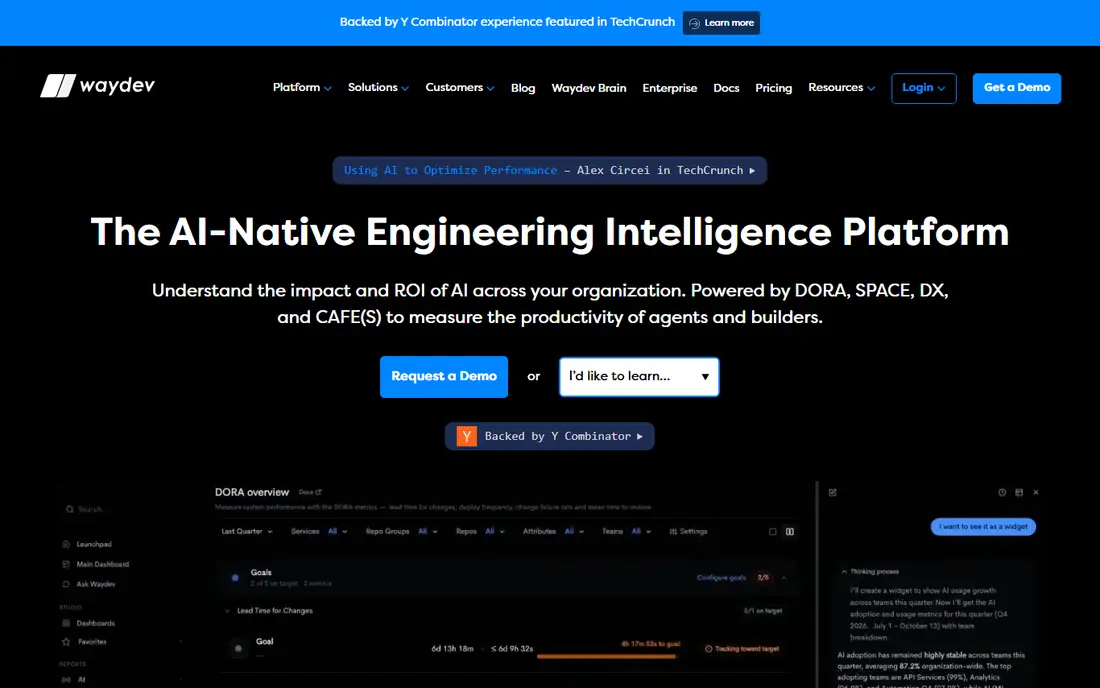
Waydev gives teams deep Git analytics with DORA, SPACE and DX Core reporting, plus newer AI adoption tracking that calculates cost per pull request. It connects to GitHub, GitLab, Bitbucket and Azure DevOps, and it offers a self-hosted deployment for teams with strict data rules. A free tier makes it easy to start without a purchase order.
Paid plans start near $29 or $49 per contributor per month depending on tier. The interface packs a lot of charts into each view, which some managers love and others find crowded. For teams that want Swarmia-style visibility with a free starting point and room to grow, Waydev is one of the most practical picks.
What we like- Free tier available
- Code-level analytics
- Self-hosted option
Watch out for- Interface feels dense
- Some features need higher tiers
Starting priceSee website
Free planNo
DX comes from the researchers behind the DORA, SPACE and DevEx frameworks, and that pedigree shapes the product. It pairs developer surveys with delivery telemetry, then turns friction into a Developer Experience Index that estimates hours lost per engineer. Leaders get both numbers and reasons: a slow pipeline shows up in data, and the survey explains why engineers feel blocked.
Pricing is not published, so expect a sales-led evaluation. DX also needs internal commitment, since surveys only help if engineers answer honestly and leaders act on results. For organizations where developer experience is a stated priority rather than a side metric, DX is the most credible option. Teams that only want delivery charts should pick a simpler tool.
What we like- Built by DORA and SPACE researchers
- Survey plus telemetry in one view
- Developer Experience Index
Watch out for- Quote-only pricing
- Survey program needs internal buy-in
Starting price$20 per member per month
Free planFree trial
Haystack keeps the focus tight: delivery trends, capacity signals and planning data from Git and Jira, with minimal configuration. At $20 per member per month on an annual commitment, it is the lowest published price among the serious options here, and it has no seat minimum. Small teams that found Swarmia's paid tiers steep often land here.
The trade-off is breadth. Haystack does not run developer surveys or track AI token spend in depth, and its forecasting is simpler than Allstacks. If your main need is clean DORA reporting that a team can adopt in days, that narrow focus is a strength. If you need finance alignment or AI cost analysis, pair it with another tool or pick Jellyfish or Axify.
What we like- Lowest list price here
- Fast setup
- No seat minimum
Watch out for- Narrower feature set
- No developer surveys
Starting price$29 per contributor per month
Free planFree trial
Axify is built around the question every engineering leader now faces: what are AI coding tools actually doing to delivery and cost. It tracks adoption, token cost by tool and model, and impact on throughput and quality, then adds value stream mapping to show where work stalls. Pro pricing starts near $29 per active contributor per month billed annually, which is transparent compared with quote-only rivals.
The product does not include developer experience surveys, so teams that need sentiment data must add another tool. Axify is also a newer brand than LinearB or Jellyfish, which matters for buyers who want a long vendor track record. For teams whose main problem is AI spend and impact, it is a focused and fairly priced choice.
What we like- AI cost by tool and model
- Value stream mapping
- Clear Pro pricing
Watch out for- No developer surveys
- Newer brand than LinearB or Jellyfish
Starting price$400 per contributor per year
Free planFree trial
Allstacks stands out for forecasting. It trains machine learning models on your own delivery history and flags risks weeks before a date slips, which helps leaders replan before a deadline fails. Its context graph links activities, teams, costs and objectives, so executives can see how a delay in one team affects a portfolio goal. Growth pricing starts near $400 per contributor per year.
Forecasting is only as good as the history behind it, so new teams or teams with messy data will get weaker predictions at first. Some enterprise features also sit behind custom quotes. For organizations that repeatedly miss dates and need early warnings rather than another dashboard, Allstacks is the strongest fit on this list.
What we like- Forecasts trained on your own history
- Risk alerts
- Portfolio planning
Watch out for- Forecasting needs history to work well
- Quote elements beyond Growth
Starting price$50 per user per month
Free planNo
Pluralsight Flow, formerly GitPrime, is one of the oldest names in engineering analytics. It tracks pull request flow, cycle time and DORA metrics at enterprise scale, and it pairs naturally with Pluralsight's skills platform for teams that already buy training there. Published pricing sits near $50 per user per month billed annually for the standard tier.
There is no free tier, and enterprise deals still involve sales conversations. Flow's AI reporting is also thinner than newer rivals such as Axify or Jellyfish. For large organizations that already use Pluralsight and want a stable, well-supported flow tool, it remains a safe choice. Smaller teams will get better value from Waydev or Haystack.
What we like- Mature flow metrics
- Pairs with Pluralsight skills content
- Enterprise support
Watch out for- Quote-heavy enterprise sales
- No free tier
How we chose
We compared tools on DORA coverage, AI impact reporting, survey support, pricing transparency and seat minimums, since those factors decide most Swarmia replacements. We used vendor pricing pages and recent comparison guides for rates, and we favored tools with published prices where available. We did not claim hands-on testing. Instead we weighed what each tool measures best, who it is built for, and what it costs at team scale, so buyers can match a tool to their actual reporting need.
Start by naming the decision the tool must support. If the problem is slow reviews, LinearB's automation matters most. If the problem is budget defense, Jellyfish's allocation reporting matters most. If the problem is AI spend, Axify or Waydev matter most. Buying a general dashboard when you have a specific problem leads to pretty charts that change nothing.
Next, check seat minimums and data connections before a trial. LinearB's 50-seat floor rules it out for small teams no matter how good the product is, while Waydev and Haystack welcome small teams. Confirm that the tool connects to your Git host and issue tracker, since a tool that cannot read your data cannot report on it. Finally, run the trial with real team data for at least two sprints, and judge it by whether managers change a decision based on what they see.
Frequently asked questions
Is Swarmia free?
Swarmia offers a free plan for teams up to 9 developers, with paid modules from about $5 per developer per month in some listings and higher per-developer rates in others. Confirm the current plan on Swarmia's pricing page, since modular pricing has changed over time.
What is the cheapest Swarmia alternative?
Haystack is the cheapest published option here at $20 per member per month on an annual plan, with no seat minimum. Waydev's free tier is cheaper still for teams that fit within its limits, and Swarmia's own free plan covers teams under 10 developers.
Do these tools replace Jira or GitHub?
No. Engineering analytics tools read data from Git hosts, issue trackers and CI systems, but they do not replace them. They add reporting, forecasting and workflow automation on top of the systems teams already use.
How long does setup take?
Lightweight tools such as Haystack and Waydev can connect to Git and Jira within a day. Enterprise tools such as Jellyfish and DX take longer, since they need more data sources connected and, in DX's case, a survey program launched before results are useful.
Which tool is best for measuring AI coding impact?
Axify and Jellyfish lead here, since both tie token spend by tool and model to delivery changes. LinearB also tracks AI code review impact, while Waydev calculates cost per pull request. Pick based on whether you need finance-grade reporting or team-level visibility.
Sources we checked (8)
- https://linearb.io/pricing/
- https://jellyfish.co
- https://waydev.co/pricing/
- https://getdx.com
- https://www.usehaystack.io
- https://axify.io
- https://www.allstacks.com
- https://www.pluralsight.com/product/flow
Is your product missing or out of date?
We review this list regularly. Vendors can request a listing, send updated pricing or ask about featured placement.

Shihab Mia · Founder, Rankite
Shihab has 5+ years in B2B and SaaS SEO. He writes Rankite's software buying guides from pricing pages, documentation and public user reviews. More about Shihab.