How we make this list: we compare pricing pages, product documentation and public user reviews. Ratings come from G2, Capterra or Trustpilot, with the date we checked them.
Key takeaways
- Erlang is the closest alternative to Elixir, since Elixir runs on the Erlang virtual machine and shares its actor model and fault tolerance ideas.
- Go suits teams that want simple concurrency and fast hiring, while Rust suits teams that need raw speed and strict memory safety.
- Scala and Clojure suit teams already on the JVM, since they reuse existing libraries, tooling, and operations knowledge.
- Gleam is the newest option here, and it targets the same virtual machine as Elixir with a stricter type system, but its ecosystem is far smaller.
Quick comparison
| Tool | Best for | Starting price | Free plan |
|---|
 Erlang | Fault-tolerant telecom-style systems | Free | Yes |
 Go | Simple concurrent services | Free | Yes |
 Rust | Fast systems with memory safety | Free | Yes |
 Scala | JVM teams needing functional power | Free | Yes |
 Clojure | Lisp-style JVM development | Free | Yes |
 Haskell | Pure functional correctness | Free | Yes |
 F# | Functional work on .NET | Free | Yes |
 Gleam | Typed code on the Erlang VM | Free | Yes |
Is your product missing or out of date?
We review this list regularly. Vendors can request a listing, send updated pricing or ask about featured placement.
The best alternatives to Elixir
Starting priceFree
Free planYes
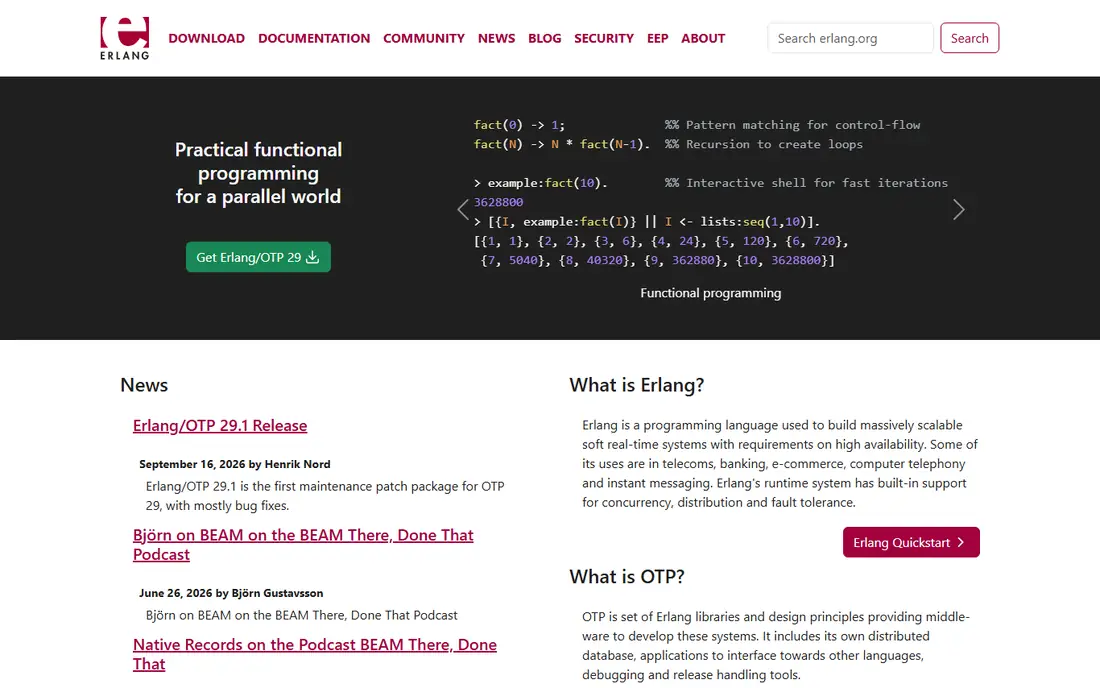
Erlang is the honest first alternative because Elixir was built on top of it. The two share the BEAM virtual machine, lightweight processes, message passing, and the "let it crash" approach to failure, where a supervisor restarts a failed process instead of trying to patch it mid-flight. A team moving from Elixir to Erlang keeps its runtime knowledge, its supervision trees, and much of its mental model, and only trades Elixir syntax for Erlang syntax.
The cost of that move is readability and hiring. Erlang syntax is older and more verbose, and far fewer developers write it day to day than write Go or Python. Tooling is solid but less polished than the Elixir ecosystem around Phoenix. Still, when fault tolerance matters more than fashion, Erlang is the closest and safest switch available.
What we like- Same virtual machine as Elixir
- Battle-tested actor model
- Hot code upgrades
Watch out for- Older syntax feels dated
- Smaller hiring pool than Go or Rust
Starting priceFree
Free planYes
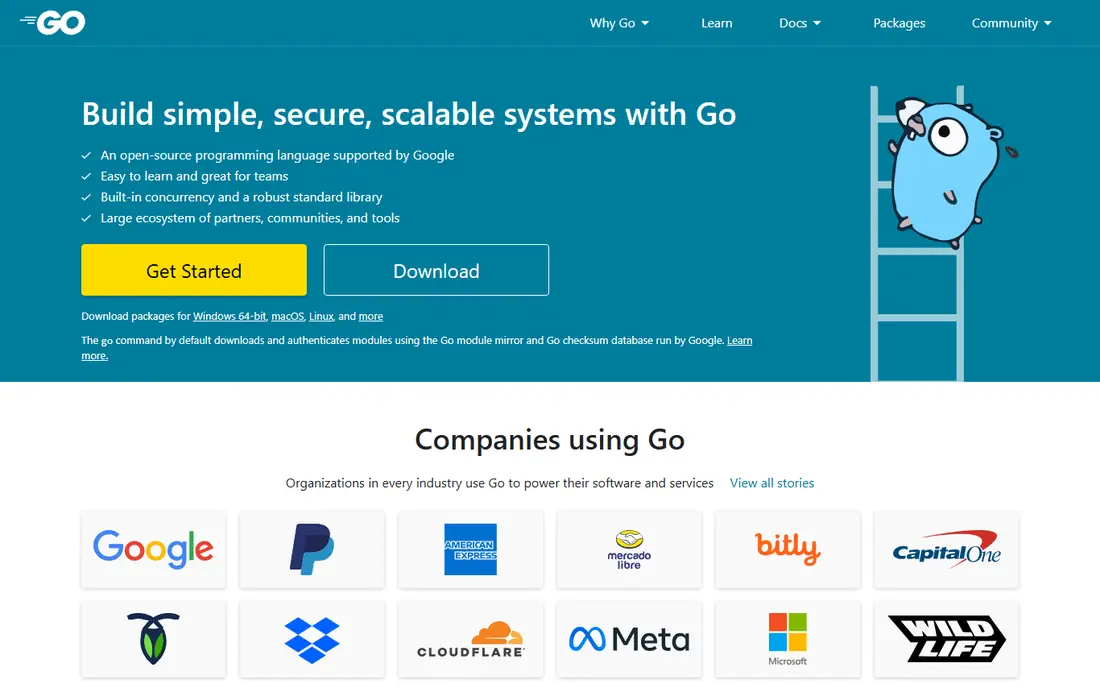
Go fits teams that liked Elixir concurrency but want a simpler language and a much larger hiring pool. Goroutines and channels give you cheap concurrent work without the actor model, and the standard library covers HTTP servers, JSON, and testing with little outside help. Builds are fast, binaries deploy as single files, and most cloud tooling already speaks Go.
What you give up is supervision. Go has no built-in supervisor tree, so a crashed goroutine does not restart itself with its state rebuilt the way a BEAM process does. Teams handle that with retries, health checks, and orchestration instead. Error handling is also wordy, since every fallible call returns an error to check. For straightforward web services and APIs, those trade-offs are usually worth it.
What we like- Goroutines make concurrency easy
- Fast builds
- Huge hiring pool
Watch out for- No actor supervision trees
- Error handling is verbose
Starting priceFree
Free planYes
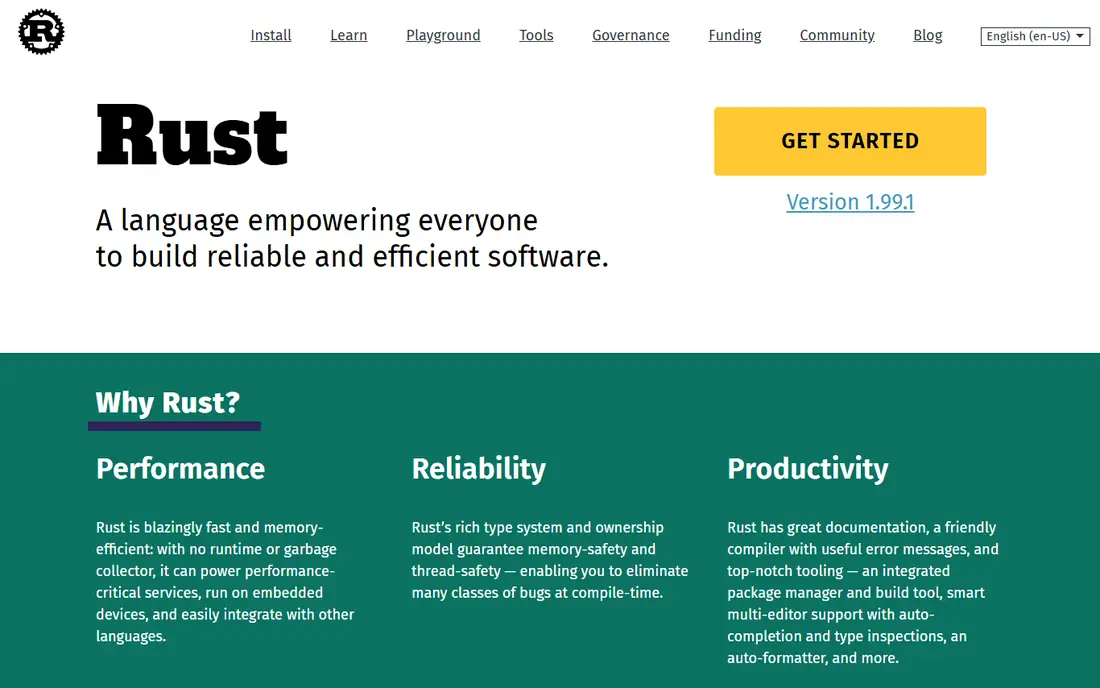
Rust suits teams that need Elixir-style reliability at much higher speed, or that build infrastructure where every millisecond counts. Its ownership system prevents whole classes of memory bugs at compile time, and its async ecosystem now covers web servers, databases, and messaging with mature crates. For a performance-critical service that Elixir cannot carry, Rust is the strongest replacement.
The price is development speed. Rust demands more upfront design, and its compiler errors, while helpful, slow down beginners for weeks. Hiring experienced Rust developers is also harder than hiring Go developers. Teams should pick Rust when performance or safety justifies that cost, not as a default for every web service.
What we like- Memory safety without a garbage collector
- Excellent speed
- Strong async ecosystem
Watch out for- Steep learning curve
- Slower to write than Elixir
#4Scala
Best for: JVM teams needing functional power4.1/5 on
G2 (30 reviews, checked Oct 2026)
Visit scala-lang.org
Starting priceFree
Free planYes
Scala is the natural pick for a team already running on the JVM. It mixes object-oriented and functional styles, and its Akka library brings actors and supervision concepts that feel familiar to Elixir developers. The JVM ecosystem adds proven libraries for data, streaming, and messaging, plus operations tooling that most companies already run.
Scala complexity is the honest catch. The language has many ways to do the same thing, which makes large codebases harder to read unless a team agrees on strict style rules. Compile times on big projects can also frustrate. For JVM shops that want functional ideas without leaving their platform, Scala still earns its place.
What we like- Runs on the JVM
- Akka actors echo Elixir ideas
- Strong type system
Watch out for- Complex language surface
- Compile times can be slow
Starting priceFree
Free planYes
Clojure appeals to developers who value interactive development and immutable data. Its REPL lets you reshape a running program as you work, which shortens the feedback loop for data-heavy services and prototypes. Because it runs on the JVM, it can call any Java library, and its core.async library adds channel-based concurrency similar in spirit to Go.
The barrier is syntax and culture. Parentheses-heavy Lisp code reads strangely to newcomers, and the job market is small compared with Go or Rust. Teams that adopt Clojure usually do so because a senior developer champions it, not because hiring is easy. For data transformation services and internal tools, it remains a productive choice.
What we like- Interactive REPL workflow
- Immutable data by default
- JVM library access
Watch out for- Lisp syntax divides teams
- Smaller job market
Starting priceFree
Free planYes
Haskell suits teams that prize correctness above all else. Its type system catches many errors before code runs, and pure functions make testing and reasoning about behavior far easier than in languages with hidden side effects. For compilers, financial logic, and data pipelines where a bug is expensive, Haskell delivers real value.
Learning Haskell takes real effort, especially around monads and lazy evaluation, and some libraries feel academic rather than production-ready. Hiring is also difficult outside a few hubs. Pick Haskell when correctness justifies a slower start, and keep the team small and senior.
What we like- Strong static types catch bugs early
- Pure functions aid testing
- Elegant concurrency
Watch out for- Hard to learn
- Ecosystem is academic in places
Starting priceFree
Free planYes
F# is the pragmatic functional option for .NET shops. It offers concise syntax, strong types, and async workflows, while still reaching the entire .NET library ecosystem for web, data, and cloud work. Teams on Azure or with existing C# code can mix F# in gradually, one service at a time, without a platform migration.
The community is the limit. F# has far fewer developers, books, and Stack Overflow answers than C#, so new hires need ramp-up time and senior guidance. Microsoft supports the language well, but the market has clearly favored C#. For .NET teams that want functional style without leaving their stack, F# is the right compromise.
What we like- Clean functional syntax
- Full .NET library access
- Good async support
Watch out for- Smaller community than C#
- Fewer learning resources
#8Gleam
Best for: Typed code on the Erlang VM4.2/5 on
G2 (27 reviews, checked Oct 2026)
Visit gleam.run
Starting priceFree
Free planYes
Gleam is the most interesting newcomer for Elixir developers who want static types. It compiles to both the Erlang VM and JavaScript, so BEAM teams can keep their runtime while gaining a type checker that catches errors early. Its compiler errors are famously friendly, and the language has no null values, which removes a whole class of runtime surprises.
Youth is the trade-off. Gleam libraries cover the basics but cannot match Elixir or Erlang depth for web frameworks, databases, and messaging. Hiring is nearly impossible, since few developers know it yet. Early adopters accept that gap in exchange for types and a modern feel, and they should plan to write more glue code themselves.
What we like- Runs on BEAM and JavaScript
- Friendly compiler errors
- No null values
Watch out for- Young ecosystem
- Fewer libraries than Elixir
How we chose
We compared language documentation, runtime models, and public ecosystem evidence, then favored languages with a real concurrency story and production use. Each pick was judged on how it replaces what Elixir teams actually miss: lightweight processes, fault tolerance, and a workable web story. Where a language is young or niche, we said so plainly instead of inflating its ecosystem. Pricing was not a deciding factor here, since every language on this list is free and open source, so the real costs are hiring, training, and the time to reach production quality.
How to pick the right replacement
Match the runtime first
If your system depends on BEAM supervision and hot upgrades, Erlang or Gleam keeps that model intact. Moving to Go or Rust means rebuilding failure handling with retries and orchestration, so budget for that work before you commit. That rebuild is not just code: dashboards, alerts, and runbooks all assume the old failure model, and each one needs updating when supervision moves out of the runtime. Budget review time for those operational pieces, not just for the service code itself.
Weigh hiring against power
Go and Rust hire fastest and cover the most ground, while Haskell, Clojure, and Gleam demand senior teams and longer onboarding. A language your team can staff beats a cleverer language you cannot hire for.
Prototype one real service
Port a small, stateful service, not a toy example, and measure build time, failure behavior, and deploy pain. That single experiment reveals more than any feature list, and it shows whether the new stack fits your operations.
Also check the library depth for your exact needs before you choose. A language can look strong in general and still lack a solid client for your database, your message broker, or your payment provider. List the five libraries your service cannot ship without, and confirm each one is maintained, documented, and used in production by someone other than its author.
Frequently asked questions
Is Erlang the best direct replacement for Elixir?
Yes, for runtime behavior it is the closest match, since both share the BEAM, actors, and supervision. The main change is syntax and tooling, not architecture, which makes migration far less risky than switching runtimes.
Should I pick Go or Rust instead of Elixir?
Pick Go when you want simple services, fast hiring, and easy deployment. Pick Rust when you need top speed or strict memory safety and can afford a slower development pace.
Can I run Elixir and its replacement side by side?
Yes, most teams migrate service by service behind APIs or message queues. That approach limits risk and lets you compare real performance before moving critical workloads.
Does Gleam work with existing Elixir code?
Gleam runs on the same virtual machine, so the two can interoperate at the BEAM level, but library and tooling gaps mean you should expect glue code. Treat Gleam as a new-service choice, not a drop-in rewrite path.
What if my team is on the JVM already?
Scala and Clojure both reuse JVM libraries and operations knowledge. Scala suits larger teams that want actors through Akka, while Clojure suits smaller teams that value interactive development.
Sources we checked (8)
- https://www.erlang.org
- https://go.dev
- https://www.rust-lang.org
- https://www.scala-lang.org
- https://clojure.org
- https://www.haskell.org
- https://fsharp.org
- https://gleam.run
Is your product missing or out of date?
We review this list regularly. Vendors can request a listing, send updated pricing or ask about featured placement.

Shihab Mia · Founder, Rankite
Shihab has 5+ years in B2B and SaaS SEO. He writes Rankite's software buying guides from pricing pages, documentation and public user reviews. More about Shihab.