How we make this list: we compare pricing pages, product documentation and public user reviews. Ratings come from G2, Capterra or Trustpilot, with the date we checked them.
Key takeaways
- Microsoft Sentinel is the natural pick for Microsoft 365 and Azure shops, with built-in SOAR and UEBA.
- Wazuh and Graylog are the open-source value picks, with free cores and paid cloud options.
- Google Security Operations suits teams with very high volumes and long retention needs.
- CrowdStrike and Palo Alto Cortex XSIAM suit teams already invested in those vendors' endpoint and network platforms.
Quick comparison
Is your product missing or out of date?
We review this list regularly. Vendors can request a listing, send updated pricing or ask about featured placement.
The best SIEM alternatives

#1Microsoft Sentinel
Best for: Microsoft estates4.4/5 on
G2 (298 reviews, checked Oct 2026)
Visit microsoft.com
Starting priceSee website
Free planNo
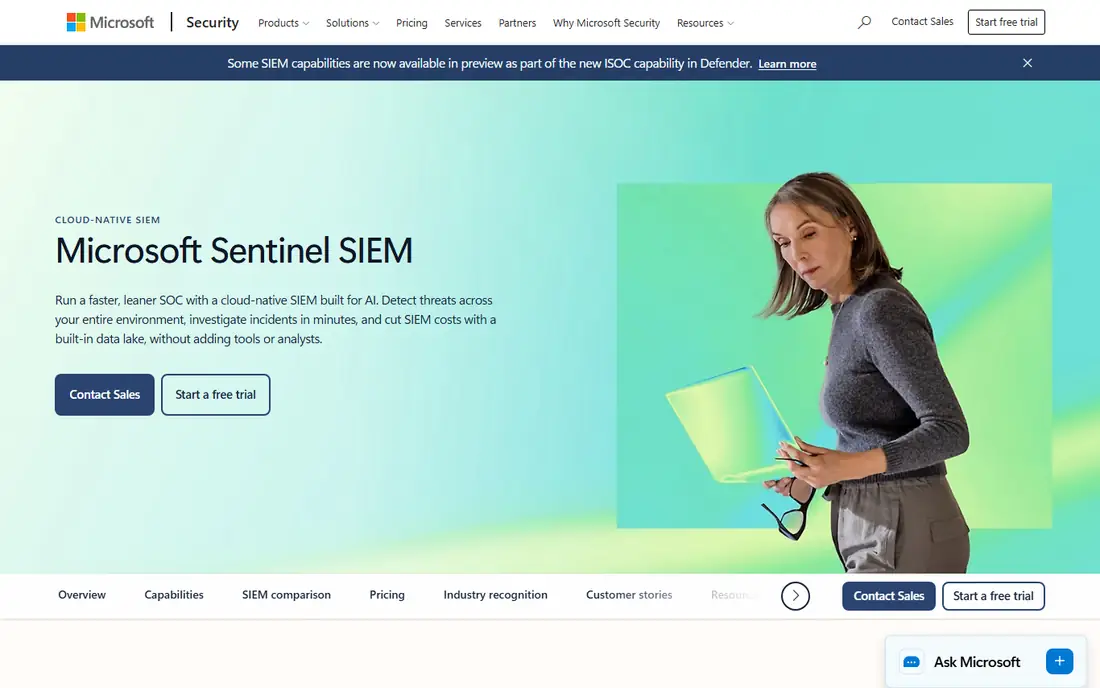
Microsoft Sentinel is the cloud-native pick for Microsoft shops. Its homepage presents a SIEM built for AI that detects threats across the entire environment, investigates incidents in minutes, and cuts costs with a built-in data lake, without adding tools or analysts. It includes SOAR, UEBA, threat intelligence, and case management built in, integrates with more than 450 solutions, and unifies with Microsoft Defender for one-incident workflows. Pricing is pay-as-you-go based on data ingested, stored, and consumed, with commitment tiers to lower costs.
The trade-off is volume pricing: published comparisons put pay-as-you-go around $4.30 per GB in East US, with some Microsoft sources free to ingest, while firewall logs are not. Note that Microsoft says Sentinel will no longer be supported in the Azure portal after March 31, 2027, moving fully into the Defender portal. For Microsoft 365 and Azure estates, Sentinel's native integration is unmatched.
What we like- Cloud-native SIEM
- Built-in SOAR, UEBA, threat intelligence, and case management
- 450-plus connectors
Watch out for- Per-GB pricing grows with firewall and network logs
- Azure subscription required

#2Splunk Enterprise Security
Best for: Large skilled teams4.3/5 on
G2 (248 reviews, checked Oct 2026)
Visit splunk.com
Starting priceSee website
Free planNo

Splunk Enterprise Security is the search-power pick. Its homepage now presents Splunk, owned by Cisco since March 2024, as a data platform for security, observability, and AI, with unified data, advanced threat detection and response, and AI agents for mitigation. Enterprise Security adds risk-based alerting that groups weak signals into fewer, stronger alerts, plus user behavior analytics and SOAR in the same ecosystem, running in Splunk Cloud or self-hosted.
The trade-off is cost and complexity: pricing is quote-only across ingest, workload, and activity models, and published comparisons put Splunk Cloud around $100 to $150 per GB per day per year negotiated. For large teams with Splunk skills and budget, its search flexibility remains the benchmark.
What we like- Most powerful search language
- 1,000-plus apps and add-ons
- Risk-based alerting
Watch out for- Quote-only pricing
- Needs dedicated Splunk expertise
- Costs scale with ingest
Starting priceSee website
Free planNo
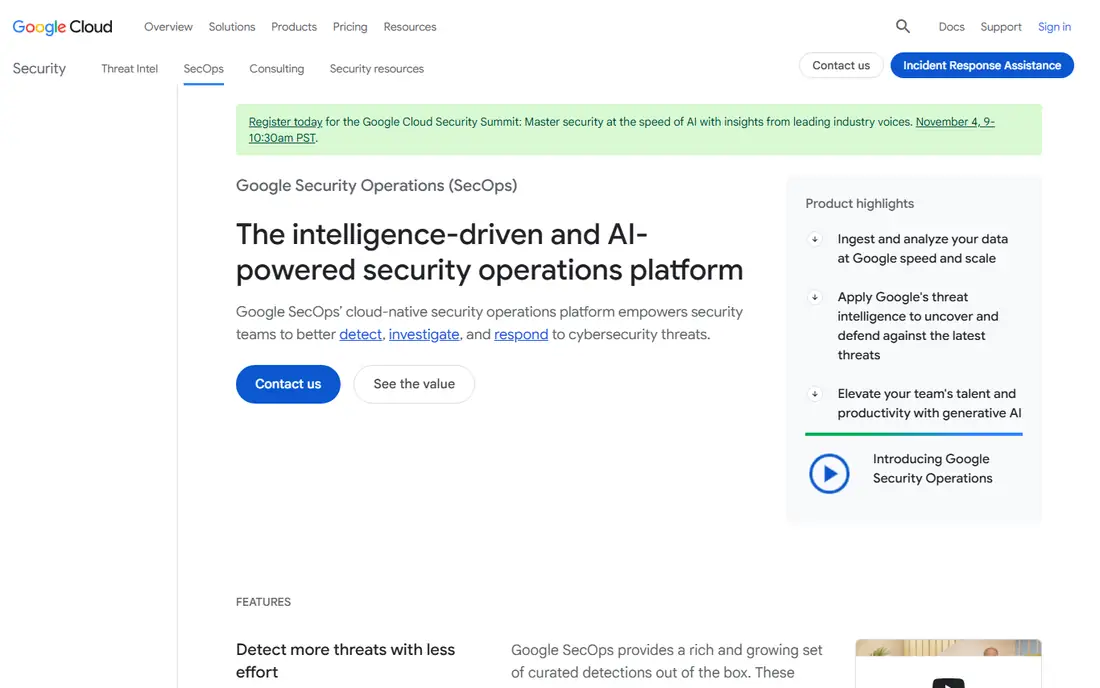
Google Security Operations, formerly Chronicle, is the high-volume pick. Its homepage presents an intelligence-driven, AI-powered security operations platform covering SIEM, SOAR, and threat intelligence in one experience, with curated detections maintained by Google researchers, natural-language search and detection creation through Gemini, custom detection authoring in YARA-L, and SOAR playbooks orchestrating more than 300 tools. Pricing is package-based on ingestion, with one year of security telemetry retention included at no extra cost.
The trade-off is packaging: Standard, Enterprise, and Enterprise Plus tiers differ in detection rule limits, threat intelligence depth, and data pipeline features, all quote-priced. For teams with very high log volumes and long retention needs, Google's retention and search speed are strong advantages.
What we like- One year of telemetry retention included
- Curated detections
- Gemini AI investigation
- 700-plus parsers
Watch out for- Quote-only pricing
- Detection rule limits vary by package
Starting priceSee website
Free planNo
Cortex XSIAM is Palo Alto Networks' AI-driven security operations platform, and the pick for teams already running its network and endpoint products. The vendor homepage presents an AI-driven SecOps platform with unified data, artificial intelligence, and automation, reporting 700-plus partner integrations and 480 billion endpoints scanned daily, with a claimed 90 percent reduction in mean time to respond across its platform. XSIAM replaces separate SIEM, XDR, and SOAR tools with one platform.
The trade-off is ecosystem fit: published comparisons note that integration is hardest without the full Palo Alto stack, and pricing is quote-based. For Palo Alto customers, XSIAM's unified data model is the main draw. For others, Sentinel or Google SecOps may integrate more easily.
What we like- AI-driven SecOps platform
- Unified data across network, endpoint, and cloud
- 700-plus integrations
Watch out for- Best inside Palo Alto estates
- Quote-only pricing

#5CrowdStrike Falcon Next-Gen SIEM
Best for: CrowdStrike customers4.5/5 on
G2 (44 reviews, checked Oct 2026)
Visit crowdstrike.com
Starting priceSee website
Free planFree trial
CrowdStrike Falcon Next-Gen SIEM is the endpoint-data pick. The vendor homepage presents the Falcon platform as one unified platform to secure the agentic enterprise, combining security data, AI intelligence, and automation, with a free trial and bundles from $7.99 per device a month for Falcon Go. Next-Gen SIEM appears as an add-on module on higher bundles and Falcon Complete, and CrowdStrike cites recognition in the IDC MarketScape Worldwide SIEM 2026 assessment.
The trade-off is that the SIEM is an add-on to an endpoint platform, so teams without Falcon endpoints get less of its advantage, and SIEM pricing is not shown separately. For existing CrowdStrike customers, Falcon data included in the SIEM removes a major ingestion cost. For others, a standalone SIEM may fit better.
What we like- Built on Falcon endpoint data
- AI-native platform
- Free trial
- Strong analyst recognition
Watch out for- SIEM is an add-on module
- Endpoint-first design
Starting priceSee website
Free planFree tier
Elastic Security is the search-first pick. The vendor homepage presents Elastic as a search database for AI, with a SIEM that ingests and stores data to detect threats on the same platform used for observability and search, deployable in cloud, on-premises, or serverless. Published comparisons put Elastic Cloud Standard around $99 a month and serverless ingest from $0.09 per GB, with a free Basic license for self-hosted use.
The trade-off is total cost: one published SIEM sizing study put a 50 GB per day deployment at $240,000 to $320,000 a year including license, infrastructure, and engineering time, far above the per-GB headline. For engineering-heavy teams that already run Elasticsearch, Elastic Security's openness and search power are compelling.
What we like- Search database foundation
- Free Basic license
- Cloud, on-prem, or serverless deployment
Watch out for- Total cost at scale can surprise
- Cluster tuning needs expertise

#7Wazuh
Best for: Open-source value4.5/5 on
G2 (71 reviews, checked Oct 2026)
Visit wazuh.com
Starting priceFree
Free planYes
Wazuh is the open-source value pick. Its homepage presents a unified XDR and SIEM platform for endpoints and cloud workloads, with real-time correlation, granular active responses including on-device remediation, and monitoring, detection, and alerting of security events. It reports 15 million-plus protected endpoints, 100,000-plus enterprise users, and 30 million-plus downloads per year, with a managed Wazuh Cloud service and free trial available.
The trade-off is operations: the core is free with no cap, but teams run their own infrastructure, and published comparisons put managed cloud from around $571 a month for small deployments and commercial support at a median around $16,234 a year. For budget-conscious teams with operations skills, Wazuh's cost at scale is roughly an order of magnitude below per-GB SIEMs.
What we like- Free open-source core
- Unified XDR and SIEM
- 15 million-plus protected endpoints
- Managed cloud option
Watch out for- Self-hosting needs operations effort
- Commercial support is separate

#8Graylog
Best for: Mid-market SIEM4.4/5 on
G2 (121 reviews, checked Oct 2026)
Visit graylog.org
Starting priceSee website
Free planFree tier
Graylog is the mid-market pick. Its homepage presents a SIEM and enterprise log management platform built for teams covering security, IT, and audit, with risk-scored alerts grouped into verified incidents, investigations that assemble themselves, pre-built detection content, and AI that explains its reasoning with evidence. It cites recognition in the 2025 Gartner Magic Quadrant for SIEM, a Leader and Outperformer rating in the GigaOm Radar for SIEM, and 86 percent of reviewers recommending it.
The trade-off is ecosystem size versus Splunk, and pricing: Graylog Open is free, while published comparisons put Cloud Operations around $1,250 a month for 10 GB per day and Cloud Security higher. For mid-size teams that want a full SIEM without per-GB shock, Graylog's fixed-style pricing and fast search stand out.
What we like- Open-source roots
- Risk-scored incidents
- Fast search
- Explainable AI
- Air-gapped deployment
Watch out for- Security tier pricing by quote
- Smaller ecosystem than Splunk
How we chose
We compared these tools on detection quality, search speed, retention, SOAR and UEBA inclusion, ecosystem fit, deployment options, and pricing transparency. We opened each vendor's homepage to confirm the product exists today and matches its description, and we used published comparison guides where homepage pricing was not shown. We did not claim hands-on testing. Where a price could not be verified from the vendor, we wrote See website rather than guessing.
What to verify in a trial
Start with a real incident, not a demo alert. Replay a known attack pattern through each candidate and measure time to detection, time to a complete timeline, and analyst effort, since those numbers decide whether a SIEM helps or just adds a queue. Next, measure ingestion cost at your real 30-day volume, including firewall and network sources, since per-GB pricing punishes noisy sources. Finally, test retention and retrieval for your oldest mandated period, since cheap ingest means little if old evidence is slow or costly to search. Also confirm data residency and compliance coverage for your industry, since retention rules and audit reports differ sharply between frameworks and regions.
Frequently asked questions
What is a SIEM?
A SIEM collects security logs from across an organization, correlates them, detects threats, and supports investigation and response. It differs from plain log management by adding detection rules, alerting, and case workflows, and modern SIEMs increasingly add automation and behavior analytics as standard features.
Which SIEM is cheapest?
Wazuh, with a free open-source core and infrastructure-only costs when self-hosted. Graylog Open is also free, and Elastic's Basic license is free for self-hosted use. Cloud SIEMs charge by volume, device, or package.
Which SIEM is best for Microsoft shops?
Microsoft Sentinel, for native integration with Microsoft 365, Entra ID, Defender, and Azure, plus built-in SOAR and UEBA. Budget carefully for non-Microsoft log sources.
Do I need SOAR and UEBA separately?
Not with most tools here: Sentinel, XSIAM, Google SecOps, and Graylog include automation and behavior analytics in their platforms. Splunk sells UBA and SOAR as separate purchases, which raises its total cost.
How much log volume should I plan for?
Measure your real 30-day ingestion per source, add growth, and check retention requirements before signing. Firewall, DNS, and cloud audit logs often dominate volume and cost, so filter noisy sources before ingest where your detection coverage allows it.
Can a small team run a SIEM?
Yes, with Wazuh or Graylog, or with a managed cloud SIEM. The key is pre-built detection content and grouped incidents, so a small team faces a short list of verified incidents rather than thousands of raw alerts. Managed detection and response services can also cover nights and weekends when a small team cannot staff around the clock.
Sources we checked (8)
- https://www.microsoft.com/en-us/security/business/siem-and-xdr/microsoft-sentinel
- https://www.splunk.com
- https://cloud.google.com/security/products/security-operations
- https://www.paloaltonetworks.com
- https://www.crowdstrike.com
- https://www.elastic.co
- https://wazuh.com
- https://www.graylog.org
Is your product missing or out of date?
We review this list regularly. Vendors can request a listing, send updated pricing or ask about featured placement.

Shihab Mia · Founder, Rankite
Shihab has 5+ years in B2B and SaaS SEO. He writes Rankite's software buying guides from pricing pages, documentation and public user reviews. More about Shihab.
 Google Security Operations
 Cortex XSIAM
 Elastic Security