How we make this list: we compare pricing pages, product documentation and public user reviews. Ratings come from G2, Capterra or Trustpilot, with the date we checked them.
Key takeaways
- Salesforce Commerce Cloud charges a share of gross merchandise volume, typically 1 to 3 percent, so its total cost scales with revenue in a way flat-priced rivals do not.
- Most brands leaving Salesforce land on Shopify or BigCommerce, which cover the same direct-to-consumer and B2B ground at a fraction of the implementation cost.
- Adobe Commerce and commercetools suit enterprises with deep customization needs, but both demand large engineering teams and implementation budgets.
- The right alternative depends on how deeply your business lives in Salesforce: if CRM and marketing data stay there, keep the integration cost in the comparison.
Quick comparison
| Tool | Best for | Starting price | Free plan |
|---|
 Shopify | Fast launches with a huge app ecosystem | $29 per month (Basic, billed annually) | Free trial |
 Shopify Plus | Enterprise brands on Shopify infrastructure | $2,300 per month (3-year term) | No |
 BigCommerce | B2B and multi-channel mid-market stores | $29 per month (Core, billed annually) | Free trial |
 Adobe Commerce | Enterprise custom catalogs and B2B | See website | No |
 WooCommerce | WordPress stores with developer support | $0 (plugin) | Yes (open-source plugin) |
 commercetools | Composable enterprise commerce | See website | No |
 Swell | API-first stores with subscriptions | $29 per month (Starter, billed annually) | Free trial |
 Wix | Small stores and concept testing | $17 per month | Free trial |
Is your product missing or out of date?
We review this list regularly. Vendors can request a listing, send updated pricing or ask about featured placement.
The best Salesforce Commerce Cloud alternatives
#1Shopify
Best for: Fast launches with a huge app ecosystem4.4/5 on
G2 (5,144 reviews, checked Oct 2026)
Visit shopify.com
Starting price$29 per month (Basic, billed annually)
Free planFree trial

Shopify is the default answer for most brands leaving Salesforce Commerce Cloud, and for good reason. A store can launch in days rather than months, hosting, PCI compliance and security are included on every plan, and the app ecosystem covers nearly every feature a direct-to-consumer brand needs. Basic starts at $29 per month on annual billing in Shopify's own comparison, with higher tiers to $299 and beyond, though some guides cite $39 as the entry rate, so confirm the current plan names before buying.
The cost to watch is the payment fee: using a third-party payment provider instead of Shopify Payments adds 0.2 to 2 percent depending on plan. Shopify fits brands up to roughly $2 million in revenue that want speed and simplicity, and it scales further with Shopify Plus below.
What we like- Easiest setup in this list
- More than 8,000 apps
- Hosting, PCI and compliance included
Watch out for- Third-party payment fee of 0.2 to 2 percent unless using Shopify Payments
- Advanced features need higher tiers
#2Shopify Plus
Best for: Enterprise brands on Shopify infrastructure4.4/5 on
G2 (873 reviews, checked Oct 2026)
Visit shopify.com
Starting price$2,300 per month (3-year term)
Free planNo

Shopify Plus is the enterprise tier for brands that outgrow standard Shopify but do not want Salesforce-scale implementation. It starts at $2,300 per month on a 3-year term, or $2,500 per month on a 1-year term in some comparisons, with revenue-based pricing above $800,000 in monthly GMV. B2B features, multi-storefront management and Plus-only tools come with it, on the same infrastructure that makes standard Shopify fast.
Total annual costs typically run $28,000 to $100,000 or more including apps, which is far below Salesforce Commerce Cloud totals for comparable revenue. Plus fits $2 million-plus brands, B2B sellers and multi-store operations that want enterprise power without an enterprise implementation project.
What we like- Enterprise tools on the same fast infrastructure
- B2B and multi-storefront support
- Lower total cost than Salesforce
Watch out for- Base price rises with revenue above $800,000 monthly GMV
- Still less customizable than composable platforms
#3BigCommerce
Best for: B2B and multi-channel mid-market stores4.2/5 on
G2 (580 reviews, checked Oct 2026)
Visit bigcommerce.com
Starting price$29 per month (Core, billed annually)
Free planFree trial
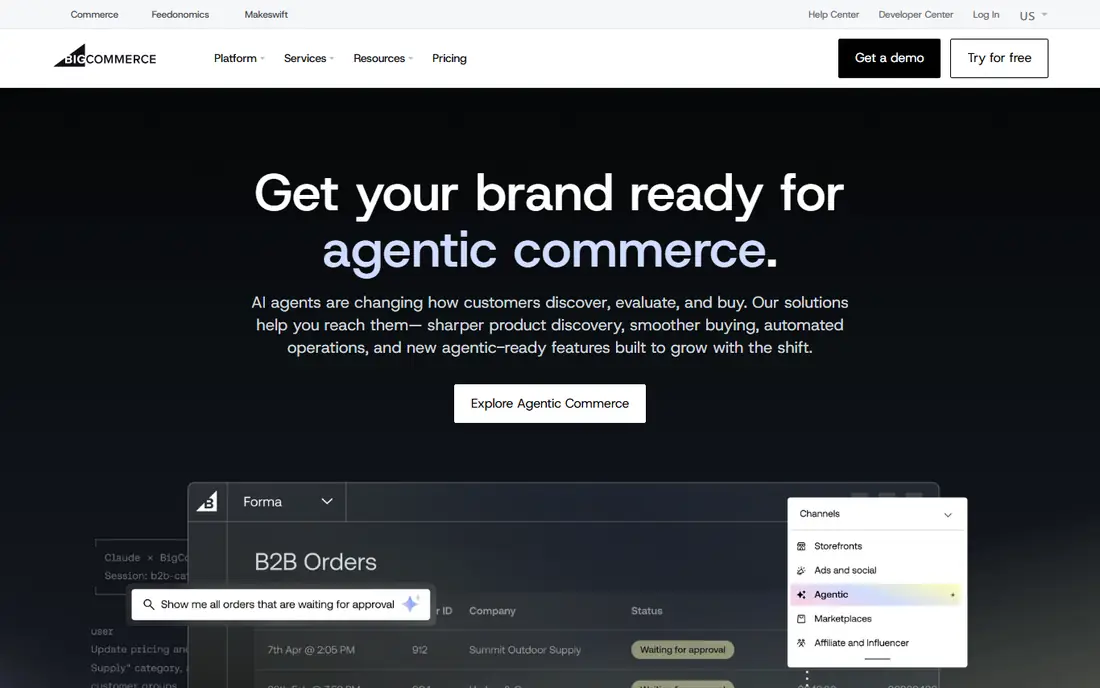
BigCommerce is the strongest second choice for mid-market stores, with B2B features, multi-channel selling and complex catalog support built in rather than bolted on. Core starts at $29 per month on annual billing, though some guides cite $39, and Enterprise is custom with estimates around $1,000 to $2,000 per month. Since a June 2026 plan update, self-serve plans auto-upgrade once trailing-12-month GMV passes $30,000 on Core or $100,000 on Growth.
Two limits need attention: a 0.6 to 2 percent Open Payment Provider fee applies to orders paid through gateways outside BigCommerce's embedded list, and each product caps at 600 SKUs. BigCommerce fits B2B distributors and mid-market stores that want pricing transparency and built-in B2B depth.
What we like- Strong B2B features
- No platform transaction fee on embedded providers
- Complex catalog support
Watch out for- Self-serve plans auto-upgrade at GMV thresholds
- Product cap of 600 SKUs per product
#4Adobe Commerce
Best for: Enterprise custom catalogs and B2B4.0/5 on
G2 (624 reviews, checked Oct 2026)
Visit adobe.com
Starting priceSee website
Free planNo
Adobe Commerce, formerly Magento, is the choice for enterprises with genuinely complex needs: multi-brand catalogs, custom ERP workflows and deep B2B requirements that SaaS platforms cannot model. Its agency ecosystem is mature, and Magento Open Source remains free to self-host for teams that want the code without the cloud licence.
The costs are enterprise-scale: licences cited at $22,000 to $125,000 or more per year, with implementation of $100,000 to $500,000 or more and a dedicated team to run it. Adobe Commerce fits fewer than 5 percent of brands considering it, namely those with large IT teams and customization needs no SaaS platform can meet. Everyone else should choose a SaaS option.
What we like- Deepest customization for complex catalogs
- Mature agency ecosystem
- Strong B2B features
Watch out for- Licence costs of $22,000 to $125,000 or more per year
- Implementation of $100,000 to $500,000 or more
#5WooCommerce
Best for: WordPress stores with developer support4.4/5 on
G2 (1,283 reviews, checked Oct 2026)
Visit woocommerce.com
Starting price$0 (plugin)
Free planYes (open-source plugin)
WooCommerce turns any WordPress site into a store with a free open-source plugin, and it is the budget route for WordPress-native brands. Hosting starts around $250 per year in comparisons, with paid extensions, SSL, security and development as the real costs. You own the code and the data completely, which appeals to teams that dislike SaaS lock-in.
The burden is operational: updates, security, backups and performance are your job, and extension quality varies widely. WooCommerce fits developers, WordPress-native brands and budget-constrained stores with the skills to run it. Teams without developer support should choose Shopify or BigCommerce instead.
What we like- Free open-source plugin
- Full ownership of data and code
- Huge WordPress ecosystem
Watch out for- You run hosting, updates and security
- Operational burden is real
- Extension costs add up
Starting priceSee website
Free planNo
commercetools is the composable option: an API-first commerce engine that large enterprises combine with their own storefront, search, content and checkout tools. That flexibility suits companies with five or more engineering staff dedicated to commerce, complex international requirements, or a need to build exactly the experience they want rather than accept a platform template.
Pricing is quote-only and order-based, with total costs cited at $100,000 to $300,000 or more including implementation. If you are asking whether you need composable commerce, you probably do not: it fits only enterprises with the team to build and run their own stack. Smaller brands get faster value from Shopify or BigCommerce.
What we like- API-first composable architecture
- Order-based pricing
- Built for large engineering teams
Watch out for- Quote-only pricing
- Total costs of $100,000 to $300,000 or more
- You assemble your own stack
Starting price$29 per month (Starter, billed annually)
Free planFree trial
Swell is an API-first commerce platform that covers direct-to-consumer, subscription, B2B and marketplace brands with a custom storefront. Starter costs $29 per month on annual billing for up to $50,000 in trailing-12-month sales, with subscriptions included on every plan and no surcharge for external gateways. Overage fees of 0.4 to 2 percent apply only on sales above a plan's ceiling.
The ecosystem is smaller than Shopify's, so teams needing an unusual integration should check availability first. Swell fits subscription brands and API-first teams that want custom storefronts without enterprise pricing, and that value the absence of gateway surcharges.
What we like- Subscriptions on every plan
- No surcharge for external gateways
- API-first with B2B and marketplace support
Watch out for- Smaller ecosystem than Shopify
- Plan ceilings trigger overage fees on high sales
#8Wix
Best for: Small stores and concept testing4.2/5 on
G2 (1,888 reviews, checked Oct 2026)
Visit wix.com
Starting price$17 per month
Free planFree trial
Wix suits side projects, concept tests and stores with under 100 SKUs, with entry plans cited at $17 to $49 per month. Setup needs no technical knowledge, and a small store can look professional quickly. For a brand testing an idea before committing to a real commerce platform, that low friction is the point.
Scale is the limit: Wix lacks the B2B depth, catalog complexity and ecosystem of Shopify or BigCommerce, and growing past the testing stage usually means migrating. Wix fits only the smallest stores in this list, and any brand with real growth plans should start on Shopify or BigCommerce instead.
What we like- Easiest builder for tiny stores
- Low entry price
- Fine for under 100 SKUs
Watch out for- Not built for scale
- Limited B2B and complex catalog features
How we chose
We compared tools on pricing model, total cost of ownership, B2B depth, catalog complexity, ecosystem size and the limits reviewers cite most often. Sources included vendor pages and independent comparisons checked in October 2026, including a seven-platform ecommerce pricing comparison and a B2B platform guide. Where prices conflicted across guides, the article uses the vendor-listed figure and notes the conflict. We did not claim hands-on testing, and enterprise totals are estimates that vary with implementation scope.
What to check before you sign
Start with total cost of ownership, not the monthly rate. Add licence or subscription fees, implementation, apps or extensions, payment fees and ongoing maintenance. Salesforce Commerce Cloud totals of $60,000 to $600,000 or more per year at 1 to 3 percent of GMV look very different from a $29 per month plan once implementation is counted, and the reverse is true for Adobe Commerce and commercetools.
Next, map your Salesforce dependence. If CRM, marketing and service data live in Salesforce, leaving Commerce Cloud adds integration work to keep that data flowing. Price that integration honestly, and compare it against staying on Salesforce for commerce while simplifying elsewhere.
Finally, test the storefront and admin experience with your real catalog, not a demo with ten products. Catalog limits, SKU caps, GMV auto-upgrades and payment provider fees only appear at realistic scale. Run a pilot with your actual products, prices and B2B rules before committing to a migration.
Frequently asked questions
What is the best Salesforce Commerce Cloud alternative?
For most brands, Shopify or BigCommerce: Shopify for speed and ecosystem, BigCommerce for B2B depth and pricing transparency. Enterprises with deep customization needs should consider Adobe Commerce or commercetools, and WordPress teams should consider WooCommerce.
How much does Salesforce Commerce Cloud cost?
Salesforce Commerce Cloud typically charges 1 to 3 percent of gross merchandise volume, with total annual costs cited at $60,000 to $600,000 or more including implementation. That GMV-based model scales with revenue in a way flat-priced platforms do not.
Is Shopify cheaper than Salesforce Commerce Cloud?
Usually yes, by a wide margin. Shopify plans start at $29 per month and Plus at $2,300 per month on a 3-year term, with typical annual totals of $28,000 to $100,000 or more including apps, against Salesforce totals that can reach six figures on platform fees alone at $10 million GMV.
Can I migrate from Salesforce Commerce Cloud without losing data?
Yes, but migration needs planning: products, customers, orders, pricing rules and content must transfer, and integrations with Salesforce CRM need rebuilding or replacing. Most platforms offer migration tools or partners, and a staged migration with parallel running is the safe path.
Should a small store use Adobe Commerce or commercetools?
No. Both demand large engineering teams and implementation budgets of $100,000 or more. Small and midsize stores get faster value from Shopify, BigCommerce, WooCommerce or Swell.
What is composable commerce?
Composable commerce means building a store from separate best-of-breed services, like a commerce engine, search, content and checkout, connected by APIs, instead of buying one all-in-one platform. It offers maximum flexibility at the cost of building and running your own stack.
Sources we checked (4)
- https://taylorsicard.com/blog/ecommerce-platform-comparison-2026
- https://www.swell.is/content/best-bigcommerce-alternatives
- https://elogic.co/blog/shopify-alternatives-explore-shopify-competitors-in-2025/
- https://rankite.com/blog/best-b2b-ecommerce-platforms
Is your product missing or out of date?
We review this list regularly. Vendors can request a listing, send updated pricing or ask about featured placement.

Shihab Mia · Founder, Rankite
Shihab has 5+ years in B2B and SaaS SEO. He writes Rankite's software buying guides from pricing pages, documentation and public user reviews. More about Shihab.