How we make this list: we compare pricing pages, product documentation and public user reviews. Ratings come from G2, Capterra or Trustpilot, with the date we checked them.
Key takeaways
- This article treats Pyro as the PyTorch-based probabilistic programming language, the meaning that fits the alternatives and examples in this topic.
- PyMC is the best general replacement, with the most examples and the gentlest path from model definition to diagnostics.
- Stan has the best-in-class NUTS sampler for complex custom models, while NumPyro wins on JAX speed for large models.
- Every tool here is free and open source, so the choice rests on backend, language, and example ecosystem rather than price.
Quick comparison
| Tool | Best for | Starting price | Free plan |
|---|
 PyMC | General Bayesian modeling in Python | Free, open source | Yes |
 Stan | Complex custom models | Free, open source | Yes |
 TensorFlow Probability | TensorFlow and JAX ecosystems | Free, open source | Yes |
 NumPyro | Fast JAX-based inference | Free, open source | Yes |
 Turing.jl | Julia probabilistic programming | Free, open source | Yes |
 BlackJAX | Composable JAX samplers | Free, open source | Yes |
 brms | Formula-based models in R | Free, open source | Yes |
 Bean Machine | PyTorch research models | Free, open source | Yes |
Is your product missing or out of date?
We review this list regularly. Vendors can request a listing, send updated pricing or ask about featured placement.
The best pyro alternatives
#1
PyMC
Best for: General Bayesian modeling in Python
Visit pymc.io
Starting priceFree, open source
Free planYes
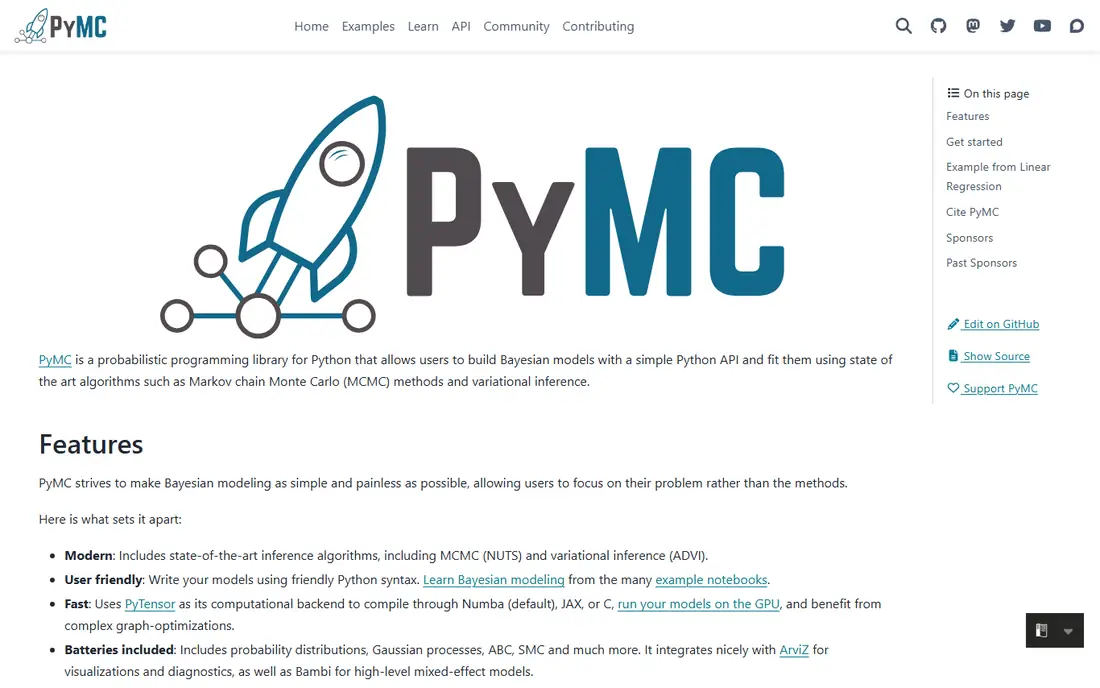
PyMC is the best general Pyro replacement for Python teams. Models are written in plain Python with distributions as random variables, and inference runs through modern MCMC samplers including NUTS, with JAX and NumPyro backends available for speed. Example coverage is broader than Pyro, with guides for regression, hierarchical models, time series, and causal inference.
PyMC backend has changed across versions, from Theano to PyTensor and now JAX options, so older tutorials may need updating. GPU use also needs JAX setup rather than working out of the box. PyMC fits Python data scientists who want the most examples and the gentlest path from model to diagnostics, and who do not need PyTorch neural network integration.
What we like- Largest example collection
- Intuitive Python syntax
- ArviZ diagnostics built in
Watch out for- Backend changes across versions
- GPU use needs JAX setup
- Large models need tuning
Starting priceFree, open source
Free planYes
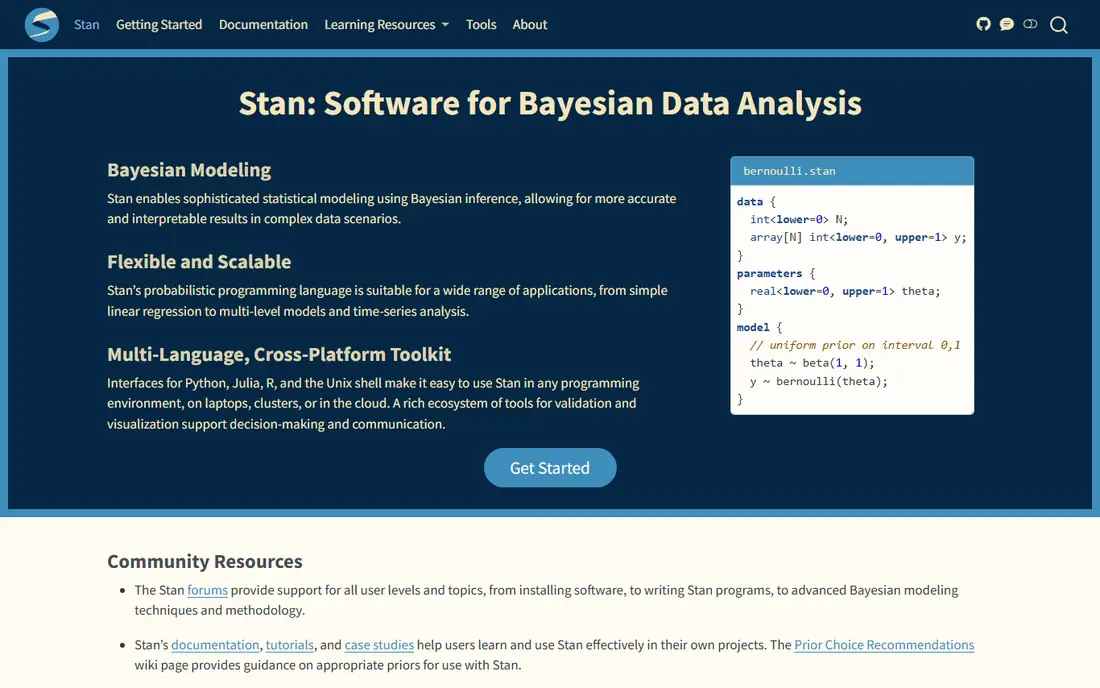
Stan is a dedicated probabilistic programming language with interfaces in Python, R, Julia, and the command line. Models are defined in blocks for data, parameters, model, and generated quantities, which matches the modeling workflow step by step. Its NUTS sampler is widely regarded as best in class, and diagnostics through ShinyStan are strong.
The separate model language is a learning curve, and every model compiles to C++ before sampling, which adds iteration time. Stan fits analysts and researchers with complex custom models, truncation, or measurement models where sampler quality matters more than Python-native syntax. Multi-language teams also benefit, since the same Stan model runs from any interface.
What we like- Best-in-class NUTS sampler
- Multi-language interfaces
- Strong diagnostics
Watch out for- Separate model language to learn
- Compilation step
- Steeper learning curve
Starting priceFree, open source
Free planYes
TensorFlow Probability wraps TensorFlow computations as generative functions, enabling scalable use of deep neural networks inside probabilistic models and proposal distributions. It supports variational inference, MCMC, and bijectors for transformed distributions, and it runs on TensorFlow and JAX backends. Production teams already on TensorFlow get a natural path from research model to serving.
The API is verbose and documentation is dense, so simple models take more code than PyMC or Stan equivalents. Example community is also smaller than PyMC. TensorFlow Probability fits teams already on TensorFlow that need deep probabilistic models at scale, rather than teams starting fresh in Python.
What we like- Deep learning integration
- Scalable variational inference
- Production TensorFlow path
Watch out for- Verbose API
- Documentation is dense
- Smaller example community than PyMC
Starting priceFree, open source
Free planYes
NumPyro is the JAX-based sibling of Pyro, sharing effect-handling ideas while running on JAX for speed. It supports NUTS, variational inference, and automatic vectorization, and it compiles models for CPU, GPU, and TPU. Large models that crawl under PyTorch can run much faster under NumPyro, and it doubles as a backend for PyMC.
JAX has a learning curve around functional transforms and compilation, and debugging compiled code is harder than debugging plain Python. NumPyro fits teams with large models or heavy compute needs, and Pyro users who want similar syntax with JAX speed. Small models gain little from the switch.
What we like- Very fast on JAX
- Pyro-like effect handling
- Automatic vectorization
Watch out for- JAX learning curve
- Debugging is harder
- Smaller community than PyMC
Starting priceFree, open source
Free planYes
Turing.jl brings probabilistic programming to Julia, with macro-based model syntax and a range of samplers including NUTS and Hamiltonian Monte Carlo. Julia speed helps for compute-heavy models, and the language suits researchers who already work in Julia for numerical computing. Turing.jl integrates with Julia plotting and data tools.
The Julia ecosystem is smaller than Python, so example coverage and third-party integrations lag PyMC and Stan. Package churn across versions also requires attention. Turing.jl fits Julia teams and researchers who value Julia speed and syntax, not Python teams looking for a drop-in Pyro replacement.
What we like- Julia speed
- Flexible macro syntax
- Growing ecosystem
Watch out for- Julia ecosystem is smaller
- Fewer examples than Python tools
- Package churn
Starting priceFree, open source
Free planYes
BlackJAX is a library of composable samplers and variational inference routines for JAX, rather than a full modeling language. Researchers build custom samplers from building blocks, mixing NUTS, Hamiltonian Monte Carlo, and other kernels with their own logic. JAX compilation gives speed on CPU, GPU, and TPU.
The lower-level API needs JAX knowledge and does not offer PyMC-style model syntax, so it suits researchers and library builders more than applied analysts. BlackJAX fits teams building novel inference methods, or production systems that need a custom sampler tuned to one model family.
What we like- Composable sampler building blocks
- JAX speed
- Research flexibility
Watch out for- Lower-level API
- Needs JAX knowledge
- Not a full modeling language
Starting priceFree, open source
Free planYes
brms lets R analysts fit Bayesian models with familiar formula syntax, such as outcome predicted by predictors with group effects, while running Stan underneath. That combination gives the gentlest learning curve in this list with best-in-class sampler quality. Diagnostics and plotting integrate with R tools, and the package handles multilevel, ordinal, and survival models through formulas.
Formula syntax limits custom models, and anything outside the formula framework needs raw Stan. brms is R only, so Python teams gain nothing from it. brms fits R analysts moving into Bayesian analysis who want Stan quality without learning Stan language first.
What we like- Gentlest learning curve
- Familiar R formula syntax
- Stan backend quality
Watch out for- Limited to formula models
- R only
- Custom models need raw Stan
Starting priceFree, open source
Free planYes
Bean Machine, from Meta, is a declarative probabilistic programming framework built on PyTorch, making it the closest PyTorch-native alternative to Pyro. It targets research models that mix deep learning with Bayesian inference, with a focus on composability and experimentation. PyTorch teams can reuse existing models and training code.
The community is smaller than PyMC or Stan, and the research focus means production tooling and examples are thinner. Bean Machine fits PyTorch research teams that want to stay in PyTorch while adding probabilistic modeling, and that can work with a smaller ecosystem.
What we like- PyTorch native
- Research-oriented
- Declarative modeling
Watch out for- Smaller community
- Research focus limits production use
- Docs are thinner
How we chose
We compared these tools on backend, sampler quality, language, example ecosystem, and production readiness. Comparison guides from 2026 shaped the shortlist, and we flagged every case where website fields point to project hosts rather than dedicated homepages, since several of these projects live on GitHub. We favored tools with broad example collections, since examples drive learning speed in this category.
We also weighed the Pyro buyer. Pyro users typically mix deep learning with Bayesian methods in PyTorch, so the closest replacements are Bean Machine for PyTorch loyalty, NumPyro for speed with similar ideas, and PyMC for general modeling with more examples. Stan and brms suit analysts who value sampler quality over neural network integration.
Run the same example model in each finalist
Fit a simple linear regression, with intercept, slope, and noise scale as priors, in each finalist before choosing. Compare syntax length, sampling speed, and diagnostic output. The example that reads clearest to your team will also be the easiest to extend when the real model gets complex.
Check sampler diagnostics, not just point estimates
Posterior means hide sampling problems. Check effective sample size, split R-hat, and divergent transitions for every model, and confirm the tool surfaces these diagnostics easily. PyMC with ArviZ and Stan with ShinyStan lead here, while lower-level tools need manual diagnostic code.
Confirm backend and hardware support
Match the backend to your hardware and stack. PyTorch teams should favor Bean Machine or Pyro itself, JAX teams should favor NumPyro or BlackJAX, and TensorFlow teams should favor TensorFlow Probability. A backend mismatch costs more in setup time than any sampler speed gain.
Check example and community depth
Probabilistic programming is learned through examples, so count worked examples for your model type before committing. PyMC leads on example depth, with guides for regression, hierarchical models, and time series, while Stan examples skew toward complex custom models. Check forum activity and recent release dates too, since a quiet project can leave you debugging sampler problems alone. A tool with ten examples close to your problem beats a faster tool with none. Ask whether the project shipped a release in the past year before adopting it.
Frequently asked questions
What is Pyro, in this article?
Pyro is a Python-based, PyTorch-supported probabilistic programming language for flexible deep probabilistic modeling, combining modern deep learning with Bayesian methods. This article covers alternatives to that Pyro. If your topic meant a different product named Pyro, the tools here will not fit, and the article should be re-scoped rather than padded.
Which Pyro alternative is easiest to learn?
brms is easiest for R users, since it uses familiar formula syntax on a Stan backend. For Python users, PyMC is easiest, with intuitive syntax and the largest example collection. Stan is more powerful but has the steepest learning curve in this list.
Is NumPyro the same as Pyro?
No, but they share ideas. NumPyro is a JAX-based library from the same team, with similar effect-handling concepts and faster JAX compilation. Pyro runs on PyTorch, while NumPyro runs on JAX, so code does not transfer directly, but concepts do.
Can these tools handle deep learning models?
Pyro, Bean Machine, and TensorFlow Probability handle deep probabilistic models best, since they integrate with PyTorch or TensorFlow neural networks. PyMC and Stan handle statistical models well but are weaker for large neural networks. Pick by model type, not by general reputation.
Are all of these tools free?
Yes, every tool here is free and open source. Costs come from compute time and engineering effort, not licenses. Large models on GPU or TPU still cost money to run, regardless of which free tool defines them.
Sources we checked (9)
- https://www.pymc.io
- https://mc-stan.org
- https://www.tensorflow.org
- https://github.com
- https://turinglang.org
- https://www.nelsontang.com/blog/python_ppls_compared/python-ppls-compared.html
- https://web.yuan.elementfx.com/articles/probabilistic-programming
- https://www.statstest.com/practical-bayes-pymc-stan-brms-real-analysis
- https://bayesiancomputationbook.com/markdown/chp_10.html
Is your product missing or out of date?
We review this list regularly. Vendors can request a listing, send updated pricing or ask about featured placement.

Shihab Mia · Founder, Rankite
Shihab has 5+ years in B2B and SaaS SEO. He writes Rankite's software buying guides from pricing pages, documentation and public user reviews. More about Shihab.