How we make this list: we compare pricing pages, product documentation and public user reviews. Ratings come from G2, Capterra or Trustpilot, with the date we checked them.
Key takeaways
- Playwright leads on free cross-browser parallel runs, so alternatives must beat it on experience, not price.
- Cypress fits JavaScript front-end teams best, with a live runner and time-travel debugging.
- Selenium, Puppeteer, WebdriverIO, Nightwatch, and Robot Framework keep license costs at zero.
- Katalon suits mixed-skill QA teams that need record-and-playback plus test management.
- Browser coverage, language support, and CI behavior matter more than headline speed claims.
Quick comparison
| Tool | Best for | Starting price | Free plan |
|---|
 Cypress | JavaScript front-end testing | $67 per user per month | Yes |
 Selenium | Large cross-browser suites | $0 open source | Yes |
 Puppeteer | Chrome and Firefox automation | $0 open source | Yes |
 TestCafe | Simple setup without WebDriver | $0 open source | Yes |
 WebdriverIO | Node.js web and mobile testing | $0 open source | Yes |
 Nightwatch | Node.js teams keeping WebDriver | $0 open source | Yes |
 Katalon | Mixed-skill QA teams | See website | Yes |
 Robot Framework | Readable keyword-driven tests | $0 open source | Yes |
Is your product missing or out of date?
We review this list regularly. Vendors can request a listing, send updated pricing or ask about featured placement.
The best Playwright alternatives
#1Cypress
Best for: JavaScript front-end testing4.7/5 on
G2 (107 reviews, checked Oct 2026)
Visit cypress.io
Starting price$67 per user per month
Free planYes
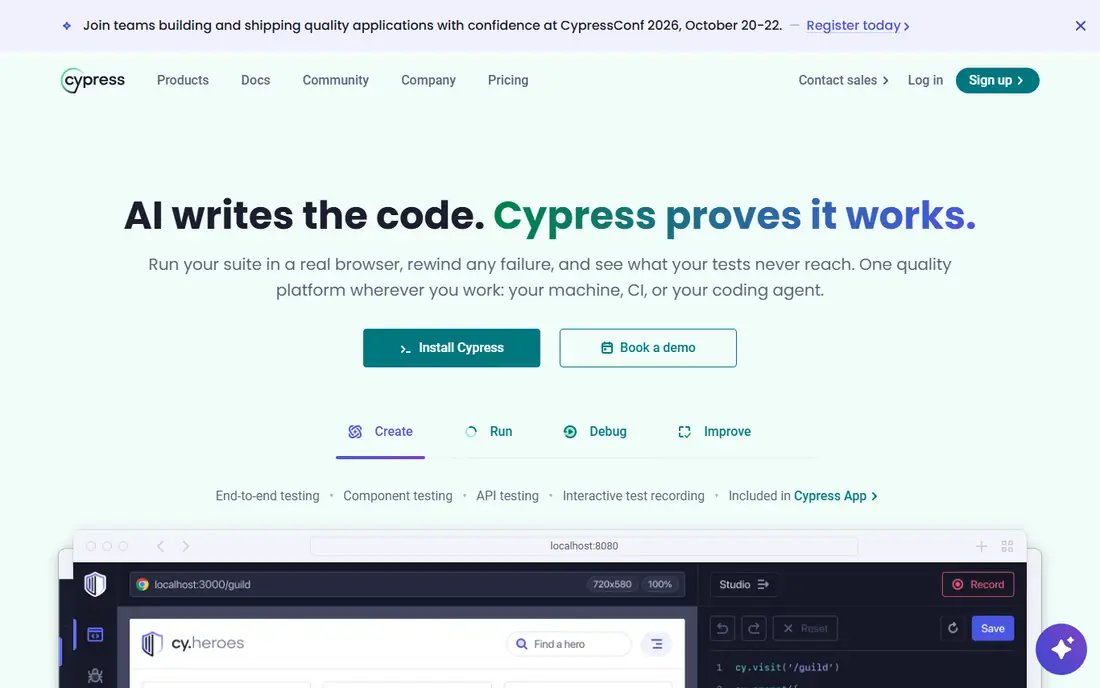
Cypress runs inside the browser, which gives front-end teams a live runner, real-time reloading, and time-travel debugging that still feels special. Automatic waiting removes most sleep calls, and the tool fits React, Vue, and Angular projects naturally. The open source app is free, and many teams start there. Component testing lets front-end developers test isolated pieces without a full page load, which shortens feedback during feature work.
Scale costs money. Cypress Cloud Team starts at $67 per user per month billed annually, and the free Cloud tier caps parallel results at 500 per month, which active teams burn through fast. Cypress also lacks a true Safari engine and multi-tab support. For a JavaScript front-end team that values debugging over breadth, Cypress is the top alternative.
What we like- Live runner with time-travel debugging
- Automatic waiting
- Strong React and Vue fit
Watch out for- Cloud Team costs $67 per user monthly
- Free Cloud caps at 500 results monthly
- No Safari engine
#2Selenium
Best for: Large cross-browser suites4.5/5 on
G2 (27 reviews, checked Oct 2026)
Visit selenium.dev
Starting price$0 open source
Free planYes
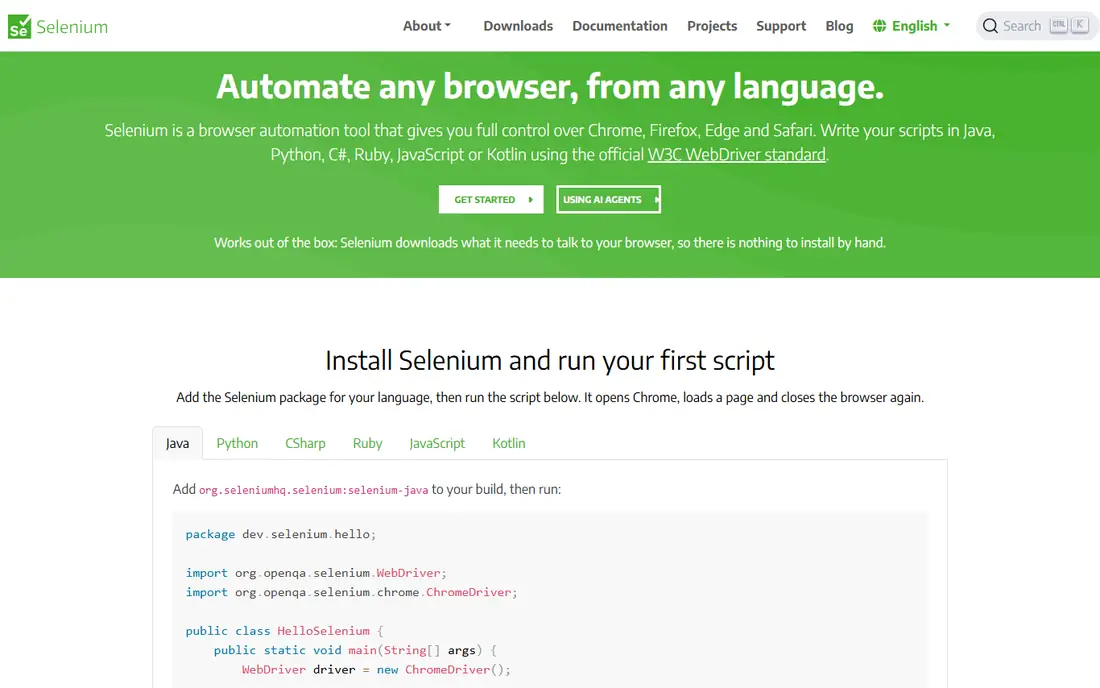
Selenium is the veteran of browser automation. It supports Chrome, Firefox, Safari, Edge, and older browsers, works in Java, Python, C#, Ruby, and JavaScript, and pairs with Selenium Grid for distributed runs. The ecosystem of drivers, libraries, and community answers is unmatched, and the license costs nothing.
The price is effort. Tests need more boilerplate, runs are slower than modern frameworks, and flaky tests need explicit waits or helper libraries. Teams with large legacy suites or strict browser coverage needs still pick Selenium first. Teams starting fresh usually compare it against Playwright and Cypress before committing.
What we like- Every major browser and language
- Selenium Grid for scale
- Huge community
Watch out for- More boilerplate code
- Slower runs
- Stabilization needs extra libraries
Starting price$0 open source
Free planYes
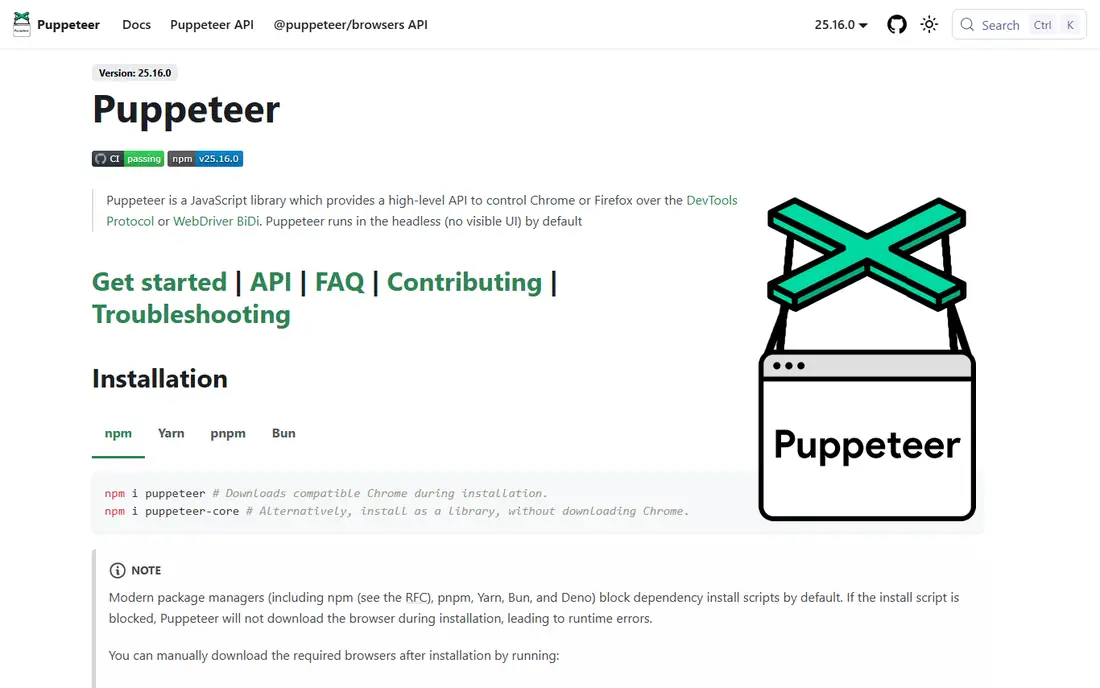
Puppeteer gives JavaScript developers direct control over Chrome and Firefox through a clean API. It excels at automation beyond testing: screenshots, PDFs, scraping, and performance monitoring all fit naturally. Speed in Chrome is strong, and the library is free open source.
Puppeteer is a browser-control layer, not a complete test framework. Teams assemble their own runner, assertions, reporting, and parallel execution, which adds work. Firefox support exists but Chrome remains the primary target. For a custom harness or a Chrome-centered job, Puppeteer is the most flexible free choice.
What we like- Free and fast in Chrome
- Fine-grained browser control
- Good for scraping and PDFs
Watch out for- Chrome-first focus
- You build runner and reporting
- Smaller test framework features
Starting price$0 open source
Free planYes
TestCafe removes the most annoying part of browser testing: driver setup. Its proxy-based design runs tests in any installed browser without WebDriver, and smart waits reduce flakiness. Installation is a single package, and parallel execution comes built in. The open source framework is free.
The ecosystem is smaller than Cypress or Selenium, and advanced features like visual testing need third-party tools. TestCafe Studio, the visual editor, runs on paid plans. For a team that wants stable tests with minimal setup friction, TestCafe is an underrated pick.
What we like- No WebDriver or drivers to install
- Smart waits built in
- Parallel runs included
Watch out for- Smaller ecosystem
- Fewer advanced features
- Studio paid plans add cost
Starting price$0 open source
Free planYes
WebdriverIO is the Node.js answer for teams that want one framework across web, mobile web, and native mobile through Appium. It builds on WebDriver with async support, plugins, and runners for Mocha, Jasmine, and Cucumber. The framework is free open source with a large plugin set.
WebDriver complexity does not vanish. Newcomers face many setup choices, and the documentation sprawls across protocols and services. Teams that already run WebDriver infrastructure get the most from WebdriverIO, since it modernizes the experience without abandoning the standard.
What we like- Web, mobile, and desktop coverage
- Plugin ecosystem
- Works with Appium
Watch out for- WebDriver complexity remains
- Setup choices overwhelm newcomers
- Docs sprawl
Starting price$0 open source
Free planYes
Nightwatch gives Node.js teams a tidy WebDriver framework with a built-in runner, assertions, and page objects. It covers web and native mobile through Appium, and its syntax reads cleanly for JavaScript developers. The framework is free under the MIT license.
The community is smaller than Selenium's, so answers and plugins take longer to find. Teams migrating from another framework should pilot Nightwatch on one suite first. Cloud device and browser costs sit outside the framework itself. For a Node.js team that wants WebDriver without Selenium's boilerplate, Nightwatch is a solid middle path.
What we like- Clean Node.js syntax
- Mobile via Appium
- Built-in test runner
Watch out for- Smaller community than Selenium
- Migration needs a pilot
- Cloud grid costs separate
#7Katalon
Best for: Mixed-skill QA teams4.4/5 on
G2 (226 reviews, checked Oct 2026)
Visit katalon.com
Starting priceSee website
Free planYes
Katalon suits QA teams with mixed coding skill. Testers record flows, reuse steps, and manage cases in one platform, while engineers can drop into script mode when needed. Test management and cloud execution sit in the same product, which reduces the tool sprawl that code-first stacks often create.
Pricing is quoted rather than published, and the platform feels heavier than a lean framework for developers who just want code. Advanced teams sometimes hit ceilings in customization. For a QA organization that needs everyone testing, not just engineers, Katalon earns its place.
What we like- Record-and-playback for non-coders
- Test management built in
- Cloud runs available
Watch out for- Pricing is quoted
- Heavier than code-first tools
- Advanced users hit ceilings
Starting price$0 open source
Free planYes
Robot Framework writes tests as readable keywords, which makes acceptance tests understandable to product managers and business analysts. It is free open source, works with SeleniumLibrary and Browser library for web testing, and fits teams where readability matters more than raw speed.
Speed trails Playwright and Cypress, and browser library setup takes care. Debugging feels older than the live runners in Cypress or Playwright. Keyword tests also age well, since a wording change in one keyword updates every test that uses it without editing each case separately. For acceptance testing and teams that value plain-language test cases, Robot Framework remains a strong, free choice.
What we like- Human-readable keyword tests
- Free open source
- Strong acceptance testing fit
Watch out for- Slower raw speed
- Browser library setup needed
- Less modern debugging
How we chose
We compared tools on browser coverage, language support, debugging experience, CI and parallel behavior, pricing transparency, and community strength. We used vendor pricing pages, product documentation, and published comparison guides. Where a vendor quotes privately, we wrote See website instead of repeating an unverified estimate. We also weighed how each tool handles mobile web testing, since many teams now test phones as carefully as desktops.
How to pick the right alternative
Start with your stack. JavaScript front-end teams get the most from Cypress or TestCafe. Polyglot teams and large legacy suites lean toward Selenium. Node.js teams that want WebDriver choose WebdriverIO or Nightwatch. Chrome-centered automation jobs suit Puppeteer. Mixed-skill QA teams need Katalon or Robot Framework more than another code framework.
Next, test CI behavior early. Playwright parallelizes free and unlimited, which is the bar every alternative must clear. Cypress Cloud Team at $67 per user per month buys parallel runs and analytics, while Selenium needs a self-hosted Grid or a cloud provider. Run your real suite in CI during the trial and measure wall-clock time, flake rate, and cost together.
Then check browser coverage against your users. If Safari matters, Cypress alone will not cover it. If legacy browsers matter, Selenium is the only safe pick. Finally, pilot on one suite before migrating everything. Rewrite locators first, then actions, and track maintenance time for a month. A framework that feels fast in a demo can still cost more in upkeep than the tool it replaced.
Flaky tests deserve attention from day one. Use auto-waiting locators instead of fixed sleeps, mock network calls that change between runs, and retry only after fixing the root cause. A suite that passes on retry but fails one time in five will erode trust in the whole pipeline, and teams soon start ignoring red builds. Track flake rate per test, quarantine the worst offenders instead of deleting them silently, and fix one flaky test per week as a standing habit. Stable suites ship faster than fast suites that nobody trusts.
Frequently asked questions
Is Cypress better than Playwright?
It depends on the team. Cypress wins on debugging experience for JavaScript front-end teams, with a live runner and time-travel. Playwright wins on free cross-browser parallel runs, Safari engine coverage, and multi-language support. Most code-first teams default to Playwright.
Is Selenium still worth learning in 2026?
Yes, for large suites and broad browser coverage. Selenium supports every major browser and language, and its ecosystem remains huge. New projects often pick Playwright or Cypress, but Selenium stays relevant for legacy suites and enterprise grids. Teams with Selenium skills in-house also keep hiring and training costs lower than a full rewrite would suggest.
Which Playwright alternative is free?
Selenium, Puppeteer, TestCafe, WebdriverIO, Nightwatch, and Robot Framework are all free open source frameworks. Cypress is also free as an app, but Cypress Cloud analytics and large-scale parallel runs require paid plans.
Does Cypress support Safari?
No, Cypress does not run a true Safari engine. It covers Chrome, Edge, Firefox, and experimental WebKit support, but teams that need real Safari testing should use Playwright, Selenium, or a cloud device provider.
What is the easiest alternative to set up?
TestCafe is the easiest, since it needs no WebDriver or browser drivers. Cypress is also quick for JavaScript teams, with a guided setup and a live runner that shows failures as they happen. Selenium and WebdriverIO need more setup, especially for grid or parallel runs, so budget a day for configuration and a first green run in CI before judging them.
Should non-coders use Katalon or Robot Framework?
Both serve non-coders, with different styles. Katalon offers record-and-playback inside a full platform, while Robot Framework offers readable keyword tests in plain text. Pick Katalon for an all-in-one platform and Robot Framework for readable acceptance tests.
Sources we checked (8)
- https://www.cypress.io/pricing
- https://www.selenium.dev
- https://pptr.dev
- https://testcafe.io
- https://webdriver.io
- https://nightwatchjs.org
- https://www.katalon.com/pricing
- https://robotframework.org
Is your product missing or out of date?
We review this list regularly. Vendors can request a listing, send updated pricing or ask about featured placement.

Shihab Mia · Founder, Rankite
Shihab has 5+ years in B2B and SaaS SEO. He writes Rankite's software buying guides from pricing pages, documentation and public user reviews. More about Shihab.