How we make this list: we compare pricing pages, product documentation and public user reviews. Ratings come from G2, Capterra or Trustpilot, with the date we checked them.
Key takeaways
- Open WebUI is free to self-host, but since version 0.6.6 it ships under the Open WebUI License, which is not OSI-approved open source and restricts branding removal above 50 users without an enterprise license.
- LibreChat is MIT licensed with no seat limits, no branding restrictions, and no commercial license upsell, making it the simplest choice for compliance teams.
- AnythingLLM suits document-heavy teams, with workspace-level retrieval isolation and a no-code agent builder, though its Business tier runs near $1,250 a month for 50 users.
- Dify Cloud suits teams that want a managed platform, near $590 a month base for 50 users, while LobeChat and Jan cover free self-hosted chat interfaces.
- ChatGPT Business, Claude Team, and Gemini in Workspace are the managed SaaS alternatives, priced per seat from $14 to $25 a month, for teams that do not want to self-host at all.
Quick comparison
Is your product missing or out of date?
We review this list regularly. Vendors can request a listing, send updated pricing or ask about featured placement.
The best Open WebUI alternatives
Starting priceFree
Free planYes
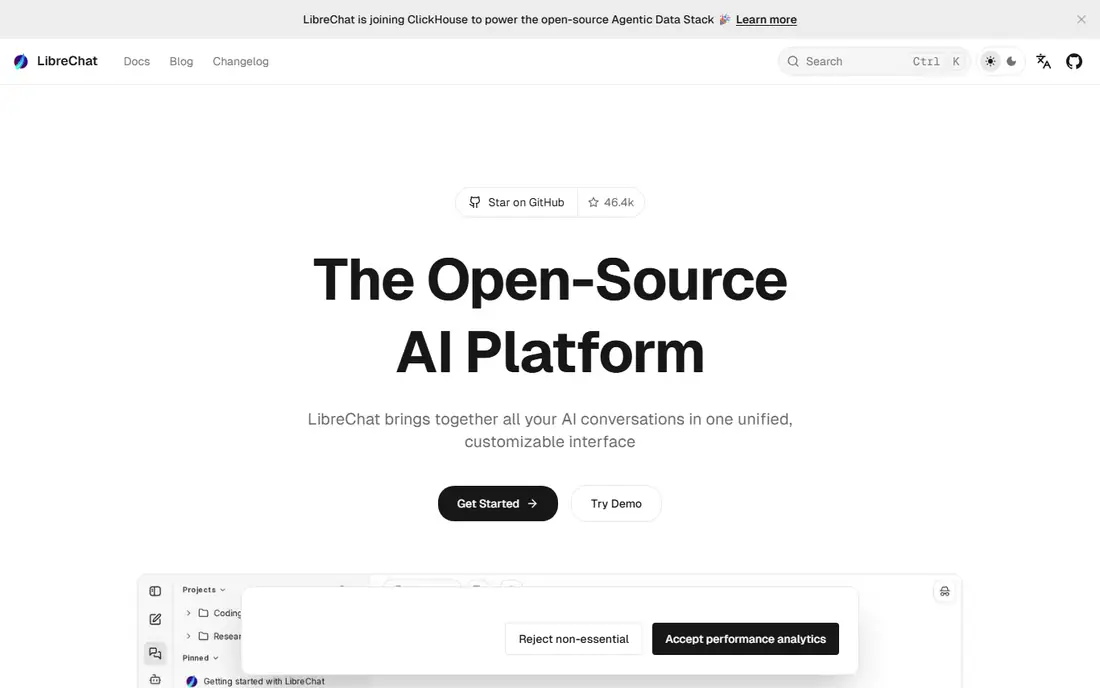
LibreChat is the leading Open WebUI alternative for teams that care about licensing. It is MIT licensed, meaning genuinely free for any use case including enterprise, with no commercial license upsell, no seat limits, and no branding restrictions. That simplicity matters for compliance review: there is no negotiation, no surprise cost, and no 50-user branding threshold. The project, now owned by ClickHouse since November 2025, remains open source with no change to licensing.
As a chat platform, LibreChat unifies models from OpenAI, Anthropic, Google, Azure, AWS Bedrock, Ollama, Groq, Mistral, and any OpenAI-compatible API in one interface, with model switching mid-conversation, presets, and team sharing. Self-hosting still needs someone to own patching: a typical 10-person team should budget $100 to $400 a month in infrastructure before labor for maintenance, updates, and incident response. For a team that wants a free, MIT-licensed, multi-provider chat UI, LibreChat is the first choice.
What we like- MIT licensed with no seat limits, no branding restrictions, and no commercial upsell
- Unifies OpenAI, Anthropic, Google, Azure, and local models in one interface
- 44,300 plus GitHub stars and 53.1 million Docker pulls
- Owned by ClickHouse since November 2025 with no licensing change
Watch out for- Self-hosting needs someone to own patching, updates, and backups
- No official paid cloud version
- SCIM support is not documented
- Third-party managed hosting runs $5 to $30 a month
Starting priceFree
Free planYes
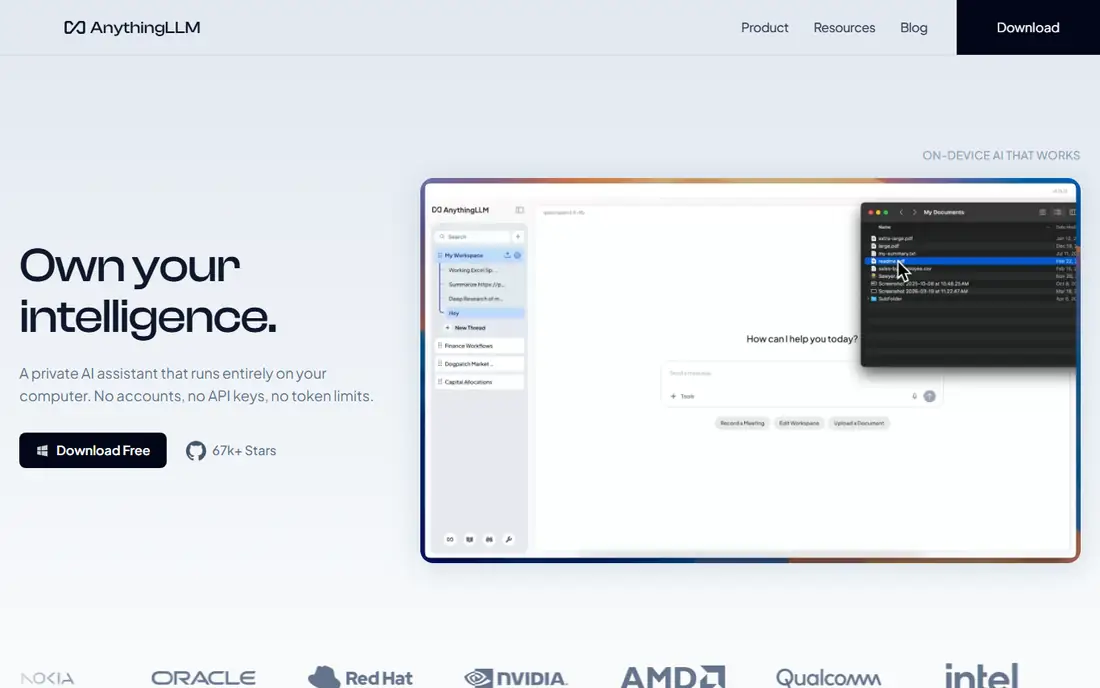
AnythingLLM suits teams whose main AI job is document chat. Its workspace-level retrieval isolation means a company docs workspace never leaks into a personal notes workspace, which is a real advantage at scale for teams querying large structured document collections daily. Its no-code agent builder chains document search, web browsing, and API calls without code, while Open WebUI's Pipelines require Python functions.
The self-hosted version is free, but the Business tier runs near $1,250 a month base for 50 users plus $200 usage, totaling near $1,450. Self-hosted setup is heavier than LibreChat's, with database, storage, and vector database costs. For a team that lives in documents and wants agents without code, AnythingLLM is the document-first pick. For general chat, LibreChat is simpler.
What we like- Workspace-level retrieval isolation for document collections
- No-code agent builder with web browsing and document search
- Self-hosted free tier
- Business tier for managed teams
Watch out for- Business tier near $1,250 a month base for 50 users plus usage, totaling near $1,450
- Self-hosted setup is heavier than LibreChat's
- Document focus means general chat is less polished
Starting priceSee website
Free planNo
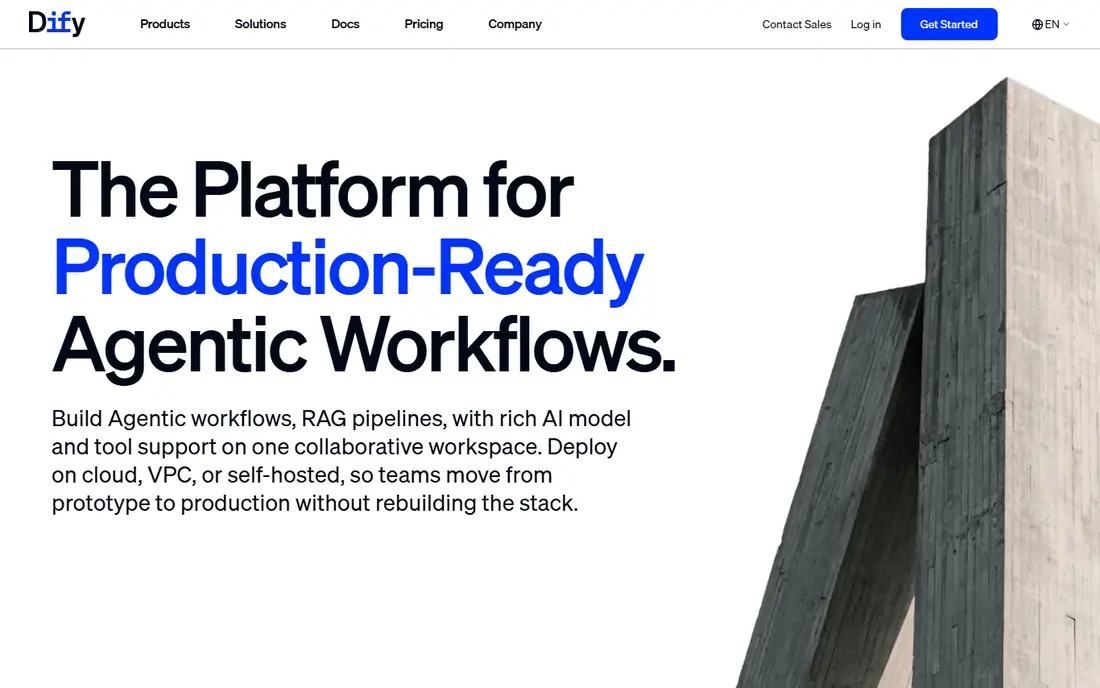
Dify Cloud suits teams that want an LLM app platform without self-hosting. It covers chatbot building, workflow automation, and knowledge-base retrieval in a managed service, so a team without DevOps capacity can still ship AI apps. Published cost models put Dify Cloud near $590 a month base for 50 users plus $300 usage, totaling near $890.
The trade is control: data residency depends on the vendor's hosting, and customization is bounded by the platform. For a team under 100 users, managed platforms often cost less than self-hosting when fully accounting for engineering time, since a self-hosted stack needs maintenance, updates, troubleshooting, and incident response. For a managed-first team, Dify is the platform pick.
What we like- Managed platform with no self-hosting burden
- LLM app building with workflows and knowledge bases
- Base near $590 a month for 50 users plus usage
Watch out for- Managed cost near $890 a month total for 50 users in published models
- Less control than self-hosting
- Data residency depends on the vendor's hosting
Starting priceFree
Free planYes
LobeChat is the free self-hosted chat UI alternative with a clean interface and multi-provider support. It covers the core Open WebUI job: a web chat frontend for many models, with plugins and a polished design that suits personal and small-team use.
The license needs care: LobeChat ships under the LobeHub Community License, which restricts modifying and redistributing the code, so teams planning to modify and redistribute should check the terms. SCIM support is not documented, and enterprise features trail LibreChat's. For a personal or small-team chat UI where licensing for redistribution does not matter, LobeChat is a solid free option.
What we like- Free self-hosted chat interface
- Multi-provider model support
- Plugin ecosystem
- Clean interface
Watch out for- LobeHub Community License restricts modifying and redistributing the code
- No SCIM documentation
- Smaller enterprise feature set than LibreChat
Starting priceFree
Free planYes
Jan suits individuals who want AI chat without the cloud. Its local-first desktop app runs models on your own hardware, so conversations never leave your machine when using local models, which is the strongest privacy story on this list. The interface is simple, and setup is lighter than a server deployment.
The limits are scope: Jan is a desktop app, not a team web platform, so it does not serve a whole company from one deployment. Local model quality depends on hardware, and heavy models need a strong GPU. For a privacy-focused individual who wants local chat, Jan is the local-first pick. For a team, LibreChat or AnythingLLM fits better.
What we like- Free and open source
- Local-first desktop app that runs models on your own hardware
- Privacy-focused with no cloud dependency for local models
- Simple interface
Watch out for- Desktop app, not a team web platform
- Local models need capable hardware
- No managed team features
- Model quality depends on local hardware
Starting price$20 per user per month
Free planNo
ChatGPT Business suits teams that do not want to self-host at all. At $20 per user per month billed annually or $25 monthly, with Premium at $100 or $125, it offers the familiar ChatGPT experience with team workspaces, shared chats, and admin controls, without any server to maintain. For a five-person team, seats cost roughly $100 a month versus roughly $10 hosting plus $10 to $30 of API usage on a self-hosted LibreChat setup, though the seat model wins for a heavy solo user who uses AI all day.
The gaps are SCIM, which requires Enterprise, and data residency, since data lives on OpenAI's infrastructure. For a team that wants managed chat without operations work, ChatGPT Business is the simplest SaaS pick.
What we like- Managed SaaS with no hosting burden
- $20 per user per month billed annually or $25 monthly
- Premium at $100 or $125
- Familiar ChatGPT experience with team workspaces
Watch out for- No SCIM on Business, Enterprise only
- Proprietary SaaS with data on OpenAI's infrastructure
- Per-seat costs scale linearly with headcount
Starting price$20 per user per month
Free planNo
Claude Team suits teams that prefer Claude's writing and analysis quality. At $20 per user per month billed annually or $25 monthly, with Premium at $100 or $125, it mirrors ChatGPT Business pricing while offering Claude's model family in a managed team workspace. Enterprise adds SCIM and custom retention for regulated teams.
Team lacks SCIM and some audit features that Enterprise covers, so regulated teams should evaluate Enterprise, which starts at $20 per seat billed annually plus usage at API rates with a 20-seat minimum. For a team that writes and analyzes with Claude and wants no hosting burden, Claude Team is the managed Claude pick.
What we like- Managed Claude access for teams
- $20 per user per month billed annually or $25 monthly
- Premium at $100 or $125
- Strong writing and analysis quality
Watch out for- No SCIM on Team, Enterprise only
- Regulated teams may need audit logs or custom retention that Team lacks
- Per-seat costs scale with headcount
Starting price$14 per user per month
Free planNo
Gemini in Workspace suits Google Workspace teams. At Business Standard $14 or Plus $22 per user per month, Gemini comes bundled with Workspace, with SCIM through Workspace identity management and native integration into Gmail, Docs, and Drive. That bundling makes the marginal AI cost low for a team already paying for Workspace.
Microsoft 365 shops get less value, and model choice is Google-only, so a team wanting Claude or GPT models needs another tool. For a Google Workspace team that wants AI inside its existing docs and email, Gemini in Workspace is the bundled pick.
What we like- Bundled with Google Workspace: Business Standard at $14 and Plus at $22 per user per month
- SCIM through Workspace
- Native Gmail, Docs, and Drive integration
Watch out for- Microsoft 365 shops get less value
- AI features are tied to Workspace licensing
- Model choice is Google-only
How we chose
We compared each tool against what Open WebUI actually offers: a self-hosted web chat interface for LLMs, with model switching, retrieval-augmented generation over documents, user management, and Pipelines for custom request handling. Pricing figures come from vendor pages and published comparisons checked in October 2026, and anything we could not confirm is written as "See website". We favored tools that serve US teams, and we flagged where a tool is self-hosted, managed, or SaaS, since that decides the real cost including infrastructure and labor.
What to check before you pick
Start with the hosting question. If you have someone to own patching, updates, and backups, self-hosted LibreChat or AnythingLLM costs roughly $100 to $400 a month in infrastructure for a 10-person team plus labor. If not, a managed platform or SaaS seat model is cheaper once engineering time is counted. Then check four things before committing: whether you need to rebrand the interface, since Open WebUI restricts branding removal above 50 users while LibreChat's MIT license allows it; whether you need SCIM and audit logs, which favor Enterprise tiers; whether document workspace isolation matters, which favors AnythingLLM; and whether token billing beats seat billing for your usage, since light-to-moderate teams pay a fraction of seat costs on API usage while heavy solo users may find a flat $20 seat cheaper. Set spending caps in provider dashboards rather than hoping, generate long random JWT secrets before first launch, and test with one model and one team before migrating everyone.
Frequently asked questions
Is Open WebUI really free?
Yes, for normal internal use with original branding intact. Since version 0.6.6, removing or altering branding above 50 users requires written permission or an enterprise license, and the license is not OSI-approved open source.
What is the best Open WebUI alternative?
LibreChat is the best general alternative, with MIT licensing, no seat limits, and multi-provider support. AnythingLLM is best for document-heavy teams, and Dify Cloud is best for managed deployment.
How much does self-hosting cost?
A typical 10-person team should budget $100 to $400 a month in infrastructure: database $20 to $100, vector database $50 to $500 depending on volume, hosting $50 to $300, and monitoring $20 to $100, before labor for maintenance and incident response.
Is token billing cheaper than seat billing?
For light-to-moderate teams, yes. A five-person team pays roughly $100 a month on seats versus roughly $10 hosting plus $10 to $30 of API usage self-hosted. For one heavy solo user all day, a flat $20 seat can beat token pricing.
Can I migrate conversations from Open WebUI to LibreChat?
Conversations can be exported from Open WebUI as JSON and imported into LibreChat, though format compatibility should be checked and users must be recreated, since there is no automatic migration.
Do I need to self-host to use AI chat?
No. ChatGPT Business, Claude Team, and Gemini in Workspace offer managed team chat with no hosting burden, priced per seat from $14 to $25 a month.
Sources we checked (8)
- https://librechat.ai/
- https://anythingllm.com/
- https://dify.ai/
- https://lobehub.com/
- https://jan.ai/
- https://openai.com/business
- https://claude.com/
- https://workspace.google.com/
Is your product missing or out of date?
We review this list regularly. Vendors can request a listing, send updated pricing or ask about featured placement.

Shihab Mia · Founder, Rankite
Shihab has 5+ years in B2B and SaaS SEO. He writes Rankite's software buying guides from pricing pages, documentation and public user reviews. More about Shihab.
 LibreChat
 AnythingLLM
 Dify Cloud
 LobeChat
 Jan
 ChatGPT Business
 Claude Team
 Gemini in Workspace