How we make this list: we compare pricing pages, product documentation and public user reviews. Ratings come from G2, Capterra or Trustpilot, with the date we checked them.
Key takeaways
- The best Moodle alternatives in 2026 split between institutional LMS platforms, corporate training platforms, and course-selling platforms.
- Canvas leads for higher education and collaboration, while Blackboard Learn leads for structured learning at large institutions.
- Google Classroom leads for simplicity in schools, while Schoology leads for K-12 education with gradebook and parent access.
- TalentLMS leads for small-team corporate training, while Docebo leads for enterprise learning with AI personalization.
- LearnDash leads for WordPress course sites, while Teachable leads for selling courses without a website build.
- This guide lists alternatives only. Moodle itself is not listed, since the question is what to use instead of it.
Quick comparison
| Tool | Best for | Starting price | Free plan |
|---|
 Canvas | Higher education and collaboration | See website | Yes |
 Blackboard Learn | Structured institutional learning | See website | No |
 Google Classroom | Simplicity in schools | Free | Yes |
 TalentLMS | Small-team corporate training | $119 per month | Yes |
 Docebo | Enterprise learning | See website | No |
 LearnDash | WordPress course sites | $199 per year | Free trial |
 Teachable | Selling courses | See website | Free trial |
 Schoology | K-12 education | Free | Yes |
Is your product missing or out of date?
We review this list regularly. Vendors can request a listing, send updated pricing or ask about featured placement.
The best Moodle alternatives
Starting priceSee website
Free planYes
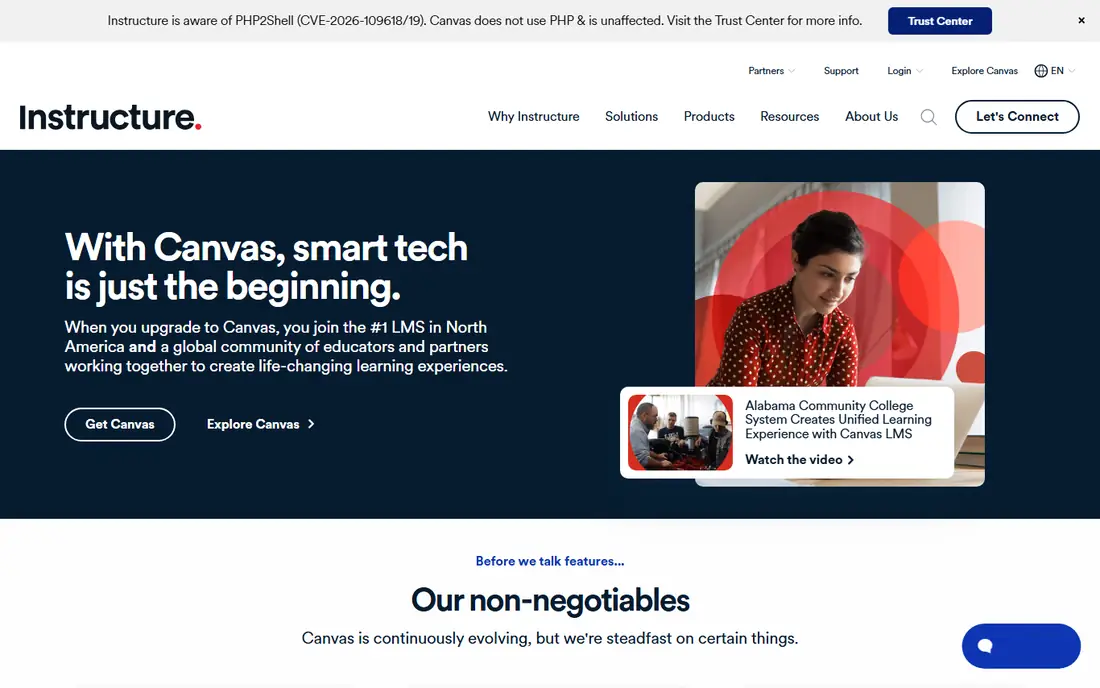
Canvas suits higher education and collaboration. Its dashboards, grading tools, and mobile access serve universities and large schools, and a free basic Lite account covers individual teachers and tutors. LTI and SIS integrations connect Canvas to student systems at institutional scale.
The trade is pricing opacity. Canvas uses custom quotes per full-time student per year, with estimates ranging from 5 to 30 dollars per student per year, so the starting price here is written as See website. For a school or university that wants a modern institutional LMS, Canvas leads.
What we like- Interactive dashboards and grading tools
- Mobile access
- Free basic Lite account
Watch out for- Institutional pricing is custom quote only
- Per-student costs vary widely
- Implementation takes planning
Starting priceSee website
Free planNo
Blackboard Learn suits large institutions that need structured learning at scale. Its assessment tools, group collaboration, detailed analytics, and SCORM support handle complex academic programs, and its gradebook and plagiarism detection cover academic integrity needs.
The limits are price transparency and commerce. Pricing is not publicly disclosed, with estimates near 20 to 40 dollars per user annually, and Blackboard does not suit selling paid course access. For a large institution that needs depth and scale, Blackboard Learn leads.
What we like- Advanced assessment tools
- Real-time collaboration
- Gradebook and plagiarism detection
- Scalable design
Watch out for- Pricing is not publicly disclosed
- Estimates suggest 20 to 40 dollars per user annually
- Commerce and course-selling features are limited
Starting priceFree
Free planYes
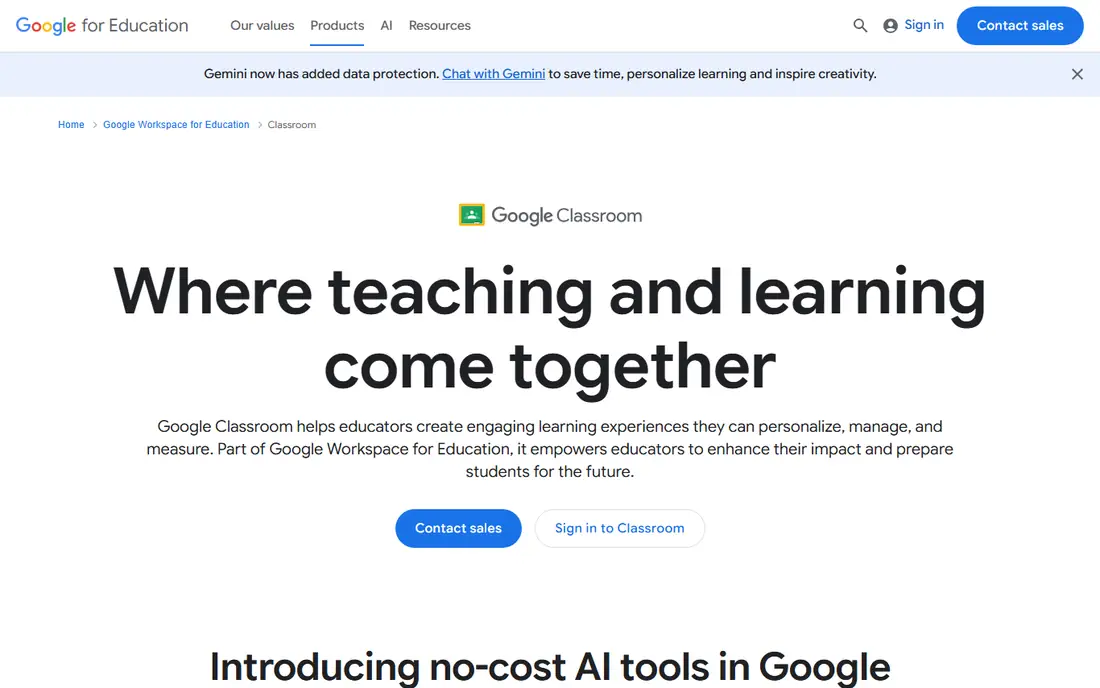
Google Classroom suits K-12 and nonprofit education that wants simplicity. It is free for qualifying schools, integrates with Google Docs, Drive, and Slides, and covers assignment workflows, classroom analytics, and originality reports. Teachers adopt it faster than any other tool here.
The trade is eligibility and depth. Businesses do not qualify for the free education edition, and advanced LMS features need paid Education Plus editions. For a school that already runs Google Workspace, Google Classroom is the simplest pick.
What we like- Free for qualifying schools
- Google Workspace integration
- Assignment workflows and originality reports
Watch out for- Businesses do not qualify for the free education edition
- Limited outside Google schools
- Advanced LMS features need paid editions
#4TalentLMS
Best for: Small-team corporate training4.6/5 on
G2 (813 reviews, checked Oct 2026)
Visit talentlms.com
Starting price$119 per month
Free planYes
TalentLMS suits small-team corporate training and onboarding. Its free plan covers 5 users and 10 courses, Core costs 119 dollars per month on annual billing for up to 100 users, and AI content generation, gamification, and SCORM support speed up course creation. Blended learning covers classroom and online together.
The limits are tier jumps and caps. Pricing steps up at 100, 500, and 1,000 users, and free plans cap file sizes. For a small training team that wants a hosted LMS fast, TalentLMS leads.
What we like- Free plan for 5 users and 10 courses
- AI content generation
- Gamification and SCORM support
- Blended learning
Watch out for- Tier jumps at 100, 500, and 1,000 users
- Core plan starts at 119 dollars per month on annual billing
- File limits on free plan
#5Docebo
Best for: Enterprise learning4.3/5 on
G2 (752 reviews, checked Oct 2026)
Visit docebo.com
Starting priceSee website
Free planNo
Docebo suits enterprise learning with AI personalization. Its personalized learning paths, auto-tagging, gamification, and compliance training serve large organizations that train thousands of employees, partners, or customers. Social learning options add community to formal courses.
The trade is price and complexity. Docebo requires a custom quote, enterprise modules add cost, and implementation needs planning. For a large enterprise that wants AI-driven learning at scale, Docebo leads.
What we like- AI personalization and auto-tagging
- Compliance training
- Social learning options
- Enterprise scale
Watch out for- Custom quote only
- Enterprise modules add cost
- Implementation needs planning
Starting price$199 per year
Free planFree trial
LearnDash suits course creators on WordPress. As a plugin rather than a hosted platform, it turns a WordPress site into a full LMS with an AI course outline builder, gamification, drip-fed content, and WooCommerce sales. The base licence starts at 199 dollars per year for one site, with a 30-day guarantee.
The limits are hosting and add-ons. LearnDash needs WordPress hosting, updates, and backups, and add-ons add cost for advanced features. For a WordPress site owner who wants to sell courses without leaving WordPress, LearnDash leads.
What we like- WordPress-native course plugin
- AI course outline builder
- Gamification and drip-fed content
- Sells via WooCommerce
Watch out for- Needs WordPress hosting and maintenance
- Add-ons add cost
- Annual licence renews yearly
Starting priceSee website
Free planFree trial
Teachable suits creators who want to sell courses without building a website. Its drag-and-drop builder, learner analytics, and course bundles cover self-paced and cohort courses, and hosting, payments, and delivery come included. A 30-day trial covers evaluation.
The trade is cost model and control. There is no free plan beyond the trial, pricing varies by plan and transaction fees, and customization is limited next to WordPress with LearnDash. For a creator who wants to sell courses fast, Teachable fits.
What we like- Drag-and-drop course builder
- Learner analytics
- Course bundles
- No website build needed
Watch out for- No free plan, trial only
- Pricing varies by plan and transaction fees
- Customization is limited next to WordPress
Starting priceFree
Free planYes
Schoology suits K-12 education. Its integrated gradebook, parent access, and collaboration tools serve schools that need family visibility alongside classroom work, and a free basic version covers individual teachers. Enterprise tiers near 10 dollars per student add advanced features.
The limits are tiering and polish. Advanced features need the enterprise tier, and the interface feels dated to some users next to Canvas. For a K-12 school that wants gradebook and parent access in one LMS, Schoology leads.
What we like- Free for basic use
- Integrated gradebook
- Parent access
- Collaboration tools
Watch out for- Enterprise pricing near 10 dollars per student
- Advanced features need enterprise tier
- Interface feels dated to some users
How we chose
We ranked platforms by ease of use, assessment depth, integrations, scalability, and value at entry level pricing. We favored institutional platforms for schools and universities, corporate platforms for training teams, and course-selling platforms for creators, since those jobs differ sharply. We gave extra weight to free options that still exist on vendor pages in October 2026, including Canvas Lite, Google Classroom for qualifying schools, TalentLMS free, and Schoology basic.
We also weighed pricing honesty. Where pricing is custom quote, such as Canvas, Blackboard, and Docebo, we wrote See website, and where published prices conflicted across sources, such as TalentLMS Core at 109 versus 119 dollars per month and LearnDash at 199 versus 259 dollars per year, we used the most commonly listed comparison figure. Confirm current terms on the vendor pricing page before buying.
Buying guide
Start by naming your institution type. Schools and universities suit Canvas, Blackboard, Google Classroom, or Schoology, corporate teams suit TalentLMS or Docebo, and course sellers suit LearnDash or Teachable. A platform built for enrolled students rarely fits a paid course business, and vice versa.
Next, build one short course for a few learners in your top two before rolling one out. Measure course creation time, grading effort, mobile experience, and reporting depth on real content, since demo courses hide friction. Check LTI and SIS integration needs early, since a platform that cannot connect to your student system costs more than a slightly pricier one that can.
Finally, model three-year cost, not entry price. Institutional per-user pricing scales with enrollment, flat tiers jump at user thresholds, and WordPress plugins add hosting and add-on costs. A free LMS means the software is free, not hosting, setup, or support, so budget for the full cost of running it.
Also confirm support and training before signing. Teachers and trainers adopt a platform faster when onboarding, help docs, and a responsive support team exist, while a powerful platform with weak support stalls after the first semester. Ask for a named contact and a training plan, not only a licence quote.
Frequently asked questions
What is the best Moodle alternative?
Canvas leads for higher education, Google Classroom leads for school simplicity, TalentLMS leads for small-team training, and LearnDash leads for WordPress course selling. The best pick follows institution type and learner count.
Is Moodle itself listed here?
No. This guide lists alternatives only, so Moodle is not listed as its own alternative. The comparison covers what to use instead of it.
Which alternative is free?
Google Classroom is free for qualifying schools, Schoology offers a free basic version, Canvas offers a free Lite account, and TalentLMS offers a free plan for 5 users and 10 courses.
Which alternative suits selling courses?
LearnDash suits WordPress course selling via WooCommerce, while Teachable suits selling courses without building a website. Institutional platforms suit enrolled students, not paid access.
Which alternative suits corporate training?
TalentLMS suits small-team training, while Docebo suits enterprise learning with AI personalization and compliance training at scale.
Sources we checked (0)
Is your product missing or out of date?
We review this list regularly. Vendors can request a listing, send updated pricing or ask about featured placement.

Shihab Mia · Founder, Rankite
Shihab has 5+ years in B2B and SaaS SEO. He writes Rankite's software buying guides from pricing pages, documentation and public user reviews. More about Shihab.