How we make this list: we compare pricing pages, product documentation and public user reviews. Ratings come from G2, Capterra or Trustpilot, with the date we checked them.
Key takeaways
- freeCodeCamp and The Odin Project offer full developer curricula free, which makes them the first stop before paying anything.
- Launch School is the most demanding alternative, with a mastery-based program at 199 dollars a month that takes most students over a year.
- Scrimba and Boot.dev keep learners engaged through interactive coding instead of passive video, which suits people who stall on lecture courses.
- Coursera and edX add university-backed certificates, which help when a hiring manager wants a recognizable credential.
- No alternative includes the cohort pressure and career coaching of a full bootcamp, so self-discipline matters more than the platform you pick.
Quick comparison
| Tool | Best for | Starting price | Free plan |
|---|
 freeCodeCamp | Free full curriculum with certifications | Free | Yes |
 The Odin Project | Free full-stack web development path | Free | Yes |
 Scrimba | Interactive frontend and fullstack paths | See website | Yes |
 Codecademy | Guided interactive courses plus live bootcamps | See website | Yes |
 Launch School | Mastery-based software engineering training | $199 per month | Yes |
 Boot.dev | Gamified backend and DevOps learning | See website | Yes |
 Coursera | University and company certificates | See website | Free trial |
 edX | University courses and degrees | See website | Yes |
Is your product missing or out of date?
We review this list regularly. Vendors can request a listing, send updated pricing or ask about featured placement.
The best boot camp alternatives
Starting priceFree
Free planYes
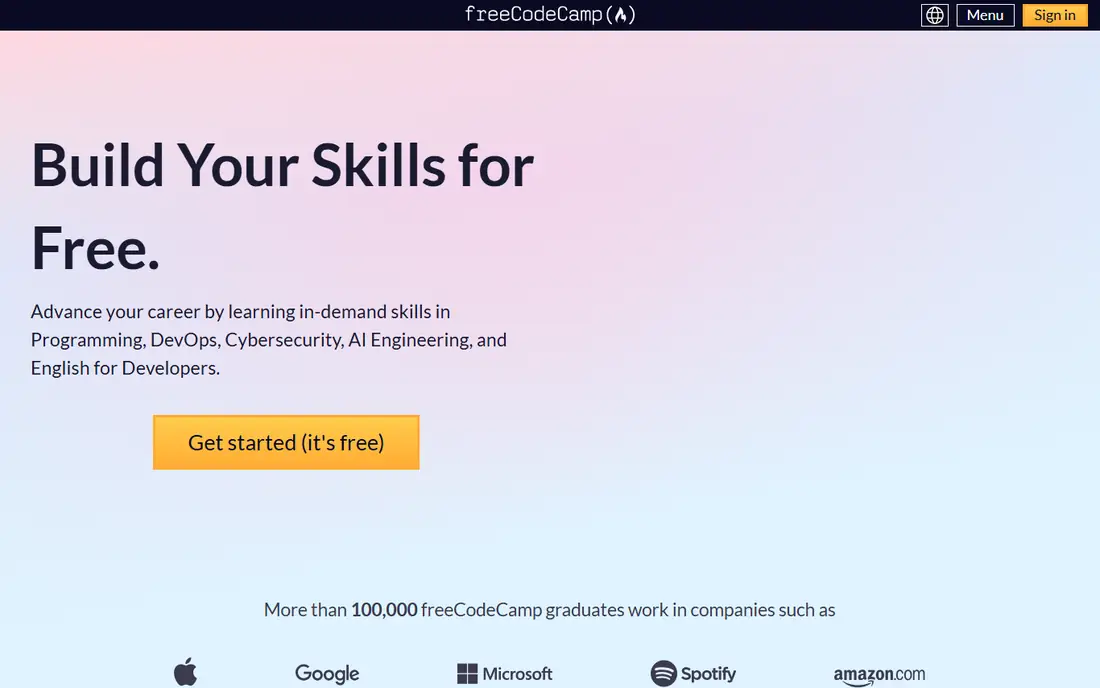
freeCodeCamp is the honest starting point for anyone considering a bootcamp. Its homepage states plainly that every course, project, and certification is free, funded by donors, and that more than 100,000 graduates work at companies of all sizes. The curriculum covers responsive web design, JavaScript, Python, data analysis, and more, with certifications earned by building five projects each.
The trade-off is structure without accountability. There is no cohort, no instructor checking your progress, and no career coach pushing you through a job search. Learners who finish usually pair freeCodeCamp with a study group or a mentor. For a beginner who wants to test whether coding fits before spending money, freeCodeCamp costs nothing and teaches real skills.
What we like- Entire curriculum and certifications are free
- Project-based learning in the browser
- Large community with local study groups
Watch out for- Self-paced structure demands strong discipline
- No cohort or career coaching
- Job search support is community-driven rather than staffed
Starting priceFree
Free planYes
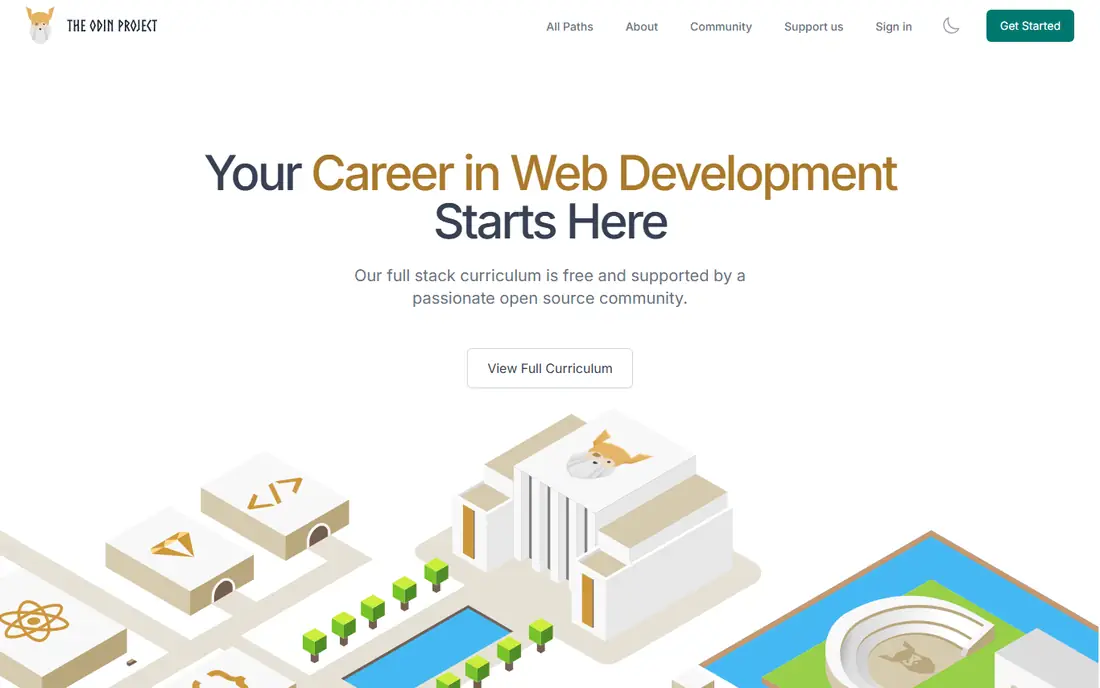
The Odin Project is the closest thing to a free web development bootcamp in scope. Its curriculum curates the best tutorials, blogs, and courses into one path, then asks learners to build dozens of projects on their own machines, from simple scripts to deployed websites. The homepage stresses that the program points you toward resources rather than walking you through every step, which builds the independent problem-solving employers want.
That independence is also the filter. Learners who need video lectures and hand-holding often stall, and there is no certificate at the end, only a portfolio. The paths cover full-stack JavaScript or Ruby on Rails, so a learner set on Python or data science should look elsewhere. For a disciplined beginner aiming at web development, The Odin Project is the strongest free alternative.
What we like- Complete full-stack curriculum free
- Project-heavy with portfolio-worthy builds
- Active community for help
Watch out for- Demanding pace that filters out casual learners
- No certificates with employer recognition
- Ruby on Rails or JavaScript paths only
#3Scrimba
Best for: Interactive frontend and fullstack paths4.7/5 on
G2 (12 reviews, checked Oct 2026)
Visit scrimba.com
Starting priceSee website
Free planYes
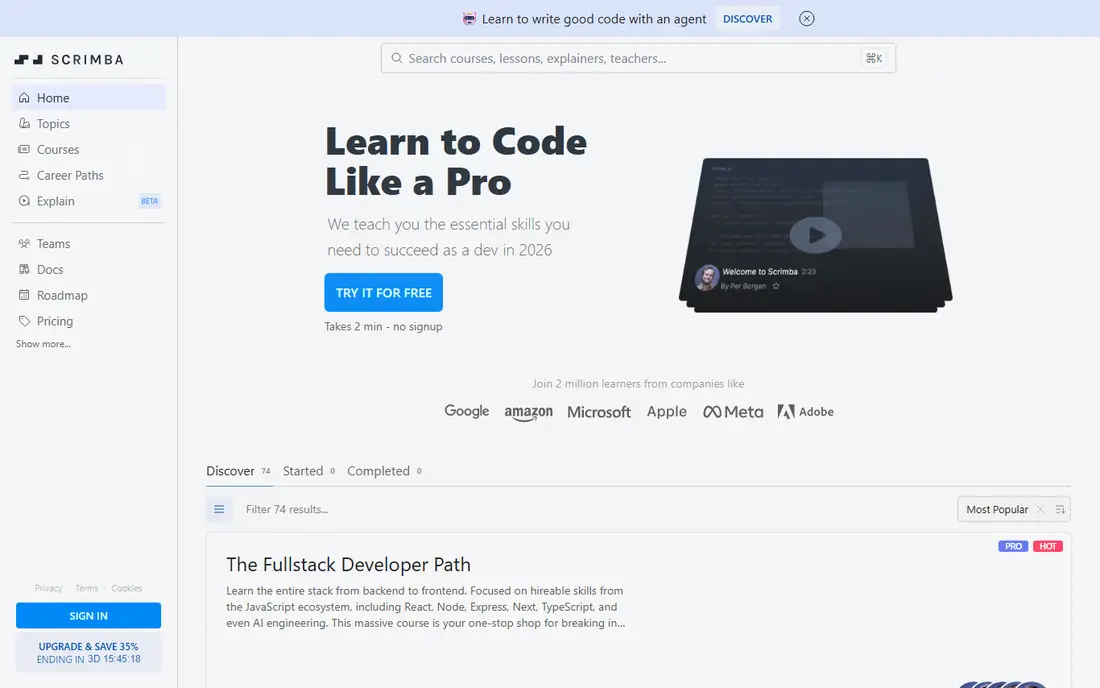
Scrimba solves the biggest failure mode of video courses: watching without doing. Its interactive screencasts pause so the learner can edit the instructor's code directly in the browser, which turns passive viewing into practice. The platform offers career paths in frontend, fullstack, backend, and AI engineering, plus free courses in React, JavaScript, HTML, and CSS built with Mozilla MDN.
The scope is narrow by design. Scrimba centers on the JavaScript ecosystem, so a learner targeting Python, Go, or data science will find less depth. Paid Pro opens up the full paths, while free access covers introductory courses. For a future frontend or fullstack developer who learns by doing, Scrimba is the most engaging bootcamp alternative.
What we like- Interactive screencasts let you edit the instructor's code mid-lesson
- Career paths for frontend, fullstack, backend, and AI engineering
- Free introductory courses
Watch out for- JavaScript ecosystem focus limits other languages
- Full paths require a paid Pro plan
- No job guarantee
#4Codecademy
Best for: Guided interactive courses plus live bootcamps4.3/5 on
G2 (169 reviews, checked Oct 2026)
Visit codecademy.com
Starting priceSee website
Free planYes
Codecademy sits between a free curriculum and a full bootcamp. Its interactive courses cover AI, data, coding, and cybersecurity, with guided paths for beginners and certification prep for industry exams. The platform also runs live bootcamps and workshops, plus an All Access Pass that bundles every bootcamp, workshop, and Pro content in one subscription, which gives learners a cohort option without bootcamp tuition.
The catch is that the free tier only goes so far. Full paths, certificates, and projects sit behind Pro, and the catalog's breadth means a learner must choose a path deliberately rather than drifting between topics. Career support is lighter than a dedicated bootcamp's coaching team. For a learner who wants structure plus the option of live classes, Codecademy is a flexible middle ground.
What we like- Large interactive course catalog with guided paths
- Live bootcamps and workshops for cohort learning
- Certificates and certification prep for AWS, Microsoft, and CompTIA
Watch out for- Paid Pro needed for full paths and certificates
- Catalog breadth can feel unfocused
- Career services are lighter than a dedicated bootcamp
Starting price$199 per month
Free planYes
Launch School is the serious student's alternative. Its homepage states a fundamentals-first philosophy: students must demonstrate mastery through assessments before advancing, and the Capstone program follows the core curriculum for career launch. Preparatory courses are free, and the paid program costs 199 dollars a month. The homepage reports an average starting salary of 115,766 dollars for 2024 Capstone graduates.
The price of that rigor is time. Most students take well over a year, so the total cost runs into thousands of dollars even at a modest monthly rate, and there is no fast track. Launch School suits a learner who values deep understanding over speed and who can commit to a long, steady program. For career switchers who want to be engineers rather than just job-ready, it is the most respected alternative here.
What we like- Mastery-based curriculum with assessments before advancement
- Preparatory courses free
- Strong reported outcomes for Capstone graduates
Watch out for- Slow, demanding pace that takes most students well over a year
- Monthly cost adds up over a long timeline
- No quick job-ready shortcut
#6
Boot.dev
Best for: Gamified backend and DevOps learning
Visit boot.dev
Starting priceSee website
Free planYes
Boot.dev targets the learners most bootcamps ignore: future backend and DevOps engineers. Its paths cover backend development, DevOps, and data analysis, teaching Python, Go, Linux, Docker, AWS, and SQL through coding exercises rather than video lectures. The homepage reports more than 1.4 million students, and the first chapters of every course are free, with a 30-day refund policy for paid memberships.
The focus is the limit. A learner aiming at frontend or mobile development will find little here, and the game-like format, while motivating for many, can feel distracting to others. Full interactive exercises require a paid membership. For a learner drawn to servers, data, and infrastructure rather than interfaces, Boot.dev is the best-priced serious alternative.
What we like- Gamified curriculum keeps motivation high
- Backend, DevOps, and data analyst paths
- First chapters free with a 30-day refund policy stated on its homepage
Watch out for- Backend focus means little frontend coverage
- Gamification suits some learners and distracts others
- Paid membership needed for full interactive exercises
#7Coursera
Best for: University and company certificates4.5/5 on
G2 (489 reviews, checked Oct 2026)
Visit coursera.org
Starting priceSee website
Free planFree trial
Coursera is the credential play among bootcamp alternatives. Its Professional Certificates from Google, IBM, and other employers are designed for career changers with no prior experience, covering data analytics, cybersecurity, UX design, and software engineering. The homepage notes free course previews, a 7-day free trial for Specializations and Coursera Plus, and financial aid options.
The catalog's size is both a strength and a weakness. Quality varies, and a learner must pick programs with employer recognition rather than random courses. Certificates require payment beyond free previews. For a career changer who wants a recognizable credential on a resume, Coursera offers the best-known certificates at a fraction of bootcamp tuition.
What we like- Certificates from Google, IBM, and top universities
- Job-ready Professional Certificates with no experience required
- Free course previews and a 7-day trial stated on its homepage
Watch out for- Quality varies across thousands of courses
- Certificates cost extra beyond free previews
- Self-paced format needs discipline
#8edX
Best for: University courses and degrees4.5/5 on
G2 (121 reviews, checked Oct 2026)
Visit edx.org
Starting priceSee website
Free planYes
edX brings university education to the bootcamp alternative list. Its homepage highlights courses from Harvard, Stanford, and Cambridge, with more than 100 million global learners, and programs ranging from single courses to full online degrees. Many courses offer a free audit track, so a learner can study university material without paying, then pay only for a verified certificate.
The academic framing is the trade-off. A computer science course from a top university teaches theory deeply but may move slower toward job-ready projects than a bootcamp-style path. Some programs follow academic schedules rather than self-paced study. For a learner who values a university name on a credential or who plans to continue toward a degree, edX is the strongest alternative.
What we like- Courses from Harvard, Stanford, Cambridge, and other leading institutions
- Free audit track on many courses
- Full degrees available online
Watch out for- University courses can feel academic rather than job-focused
- Certificates and degrees cost extra
- Pacing follows academic terms in some programs
How we chose
We compared learning platforms that career-switch guides name most often as coding bootcamp replacements, using vendor homepages, pricing pages, and public comparison guides. We opened each homepage to confirm it loads and belongs to the vendor named, and we marked prices as See website where the vendor does not publish a rate on its homepage. We favored platforms with distinct strengths, such as free curricula, mastery-based training, or university certificates, over near-identical course catalogs. Where a price could not be verified from the vendor, we wrote See website rather than repeating a third-party estimate.
What to decide before you pick a bootcamp alternative
Start with the job you want, not the platform. A frontend role points to Scrimba, The Odin Project, or freeCodeCamp, while a backend role points to Boot.dev or Launch School, and a data role points to Coursera certificates or Boot.dev's data path. Picking a platform first and a target second is how learners end up with certificates that do not match any job posting.
Test yourself for two weeks before paying
Use the free tier of your top two choices for two weeks, at the same daily study time you plan to keep. The platform that keeps you coding on day ten is the right one, regardless of reviews. If neither holds your attention, a paid bootcamp's cohort pressure may be worth the cost after all.
Build a portfolio from week one
Employers hire on proof, not certificates. Every project you build should go on GitHub with a clear readme explaining what it does and what you learned. A portfolio of three solid projects beats ten course completions, and it is the one asset every alternative on this list can produce.
Plan the job search separately
Bootcamps bundle career coaching, and alternatives mostly do not. Budget time for interview preparation, resume review, and networking alongside study, and consider a mentor or a community such as freeCodeCamp study groups or The Odin Project Discord. The learning platform gets you skills, but the job search is a second project that needs its own plan.
Frequently asked questions
Are coding bootcamps worth it in 2026?
Bootcamps can be worth it for learners who need cohort pressure, structured schedules, and career coaching, and who can afford tuition of 10,000 dollars or more. Self-paced alternatives deliver similar skills for far less money, but they demand more discipline and a self-managed job search.
Can I really learn to code for free?
Yes. freeCodeCamp and The Odin Project offer complete curricula free, and Boot.dev, Scrimba, Codecademy, and Coursera all offer free entry points. The cost is time and self-discipline rather than money, and most successful free learners take twelve months or more to become job-ready.
How long does it take to become job-ready without a bootcamp?
Most self-paced learners take nine to eighteen months of consistent part-time study, depending on the target role and prior experience. Launch School students often take longer due to its mastery model, while focused learners on Scrimba or freeCodeCamp can move faster with a clear target role.
Do employers respect freeCodeCamp or Coursera certificates?
Employers respect portfolios and interview performance more than any certificate. Coursera certificates from Google or IBM carry name recognition, and freeCodeCamp certifications verify completed projects, but neither replaces demonstrable coding skill in a technical interview.
Should I learn frontend or backend first?
Frontend suits learners who enjoy visible results and design, with strong demand for React and JavaScript skills. Backend suits learners who enjoy logic, data, and infrastructure, with strong demand for Python, Go, and cloud skills. Pick the one that keeps you coding, since both paths lead to real jobs.
What if I start and lose motivation?
Motivation loss usually means the format is wrong, not that you lack talent. Switch formats before quitting: try interactive coding on Scrimba or Boot.dev if videos bore you, join a study group for accountability, or pick a smaller project with a visible result. A two-week break with a planned restart beats a permanent stop.
Sources we checked (10)
- https://www.freecodecamp.org
- https://www.theodinproject.com
- https://scrimba.com
- https://www.codecademy.com
- https://launchschool.com
- https://boot.dev
- https://www.coursera.org
- https://www.edx.org
- https://coddy.tech/vs/free-coding-bootcamps
- https://dev.to/srdan_borovi_584c6b1d773/top-coding-bootcamp-alternatives-for-career-switchers-31g7
Is your product missing or out of date?
We review this list regularly. Vendors can request a listing, send updated pricing or ask about featured placement.

Shihab Mia · Founder, Rankite
Shihab has 5+ years in B2B and SaaS SEO. He writes Rankite's software buying guides from pricing pages, documentation and public user reviews. More about Shihab.