How we make this list: we compare pricing pages, product documentation and public user reviews. Ratings come from G2, Capterra or Trustpilot, with the date we checked them.
Key takeaways
- Merge.dev offers one unified API for HRIS, ATS, accounting, and other categories, but rivals beat it on integration count, pricing model, or category depth.
- Unified.to leads on integration count with over 1,700 integrations, while Apideck suits teams that want a broad marketplace with clear tier pricing.
- Nango is the cheapest path for developers who want to build their own integrations, with pay-as-you-go pricing from $50 a month.
- Kombo is the European alternative with strong HRIS and ATS coverage, while Finch is the specialist for US payroll integrations.
- The deciding factors are category coverage, integration count, pricing model, and whether you need a managed unified API or a toolkit to build your own.
Quick comparison
| Tool | Best for | Starting price | Free plan |
|---|
 Unified.to | Most integrations | $750/month | No |
 Apideck | Broad marketplace | $599/month | No |
 StackOne | Enterprise HR integrations | See website | No |
 Nango | Build your own integrations | $50/month | Yes |
 Kombo | European HRIS and ATS | See website | No |
 Finch | US payroll integrations | See website | No |
 Knit | HR and payroll APIs | $499/month | No |
 Paragon | Embedded integration platform | See website | No |
Is your product missing or out of date?
We review this list regularly. Vendors can request a listing, send updated pricing or ask about featured placement.
The best Merge.dev alternatives
Starting price$750/month
Free planNo
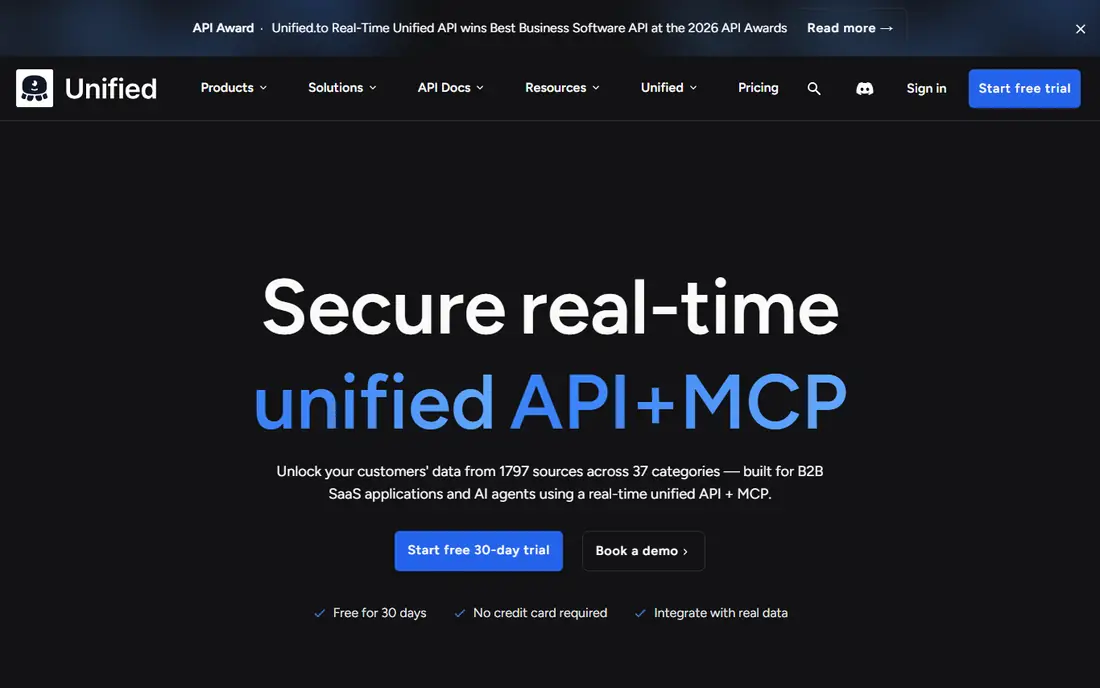
Unified.to is the integration-count leader among Merge.dev alternatives, with over 1,700 integrations across 36 categories in 2026 comparisons, far above Merge's 233 integrations. It covers HRIS, ATS, CRM, accounting, and more through one API, with real-time data sync that keeps customer data current without polling delays. Teams building multi-category products, such as an HR platform that also needs accounting data, get the broadest coverage here.
Pricing starts at $750 a month for 750,000 API calls, which is higher than developer toolkits but reasonable for a managed unified API. Call volume scales the bill, so model your usage. For a team that wants the widest integration net through one vendor, Unified.to is the best pick.
What we like- Over 1,700 integrations across 36 categories
- Real-time data sync
- Strong for multi-category products
Watch out for- Higher starting price than Nango
- Pricing scales with API calls
- Setup takes integration planning
Starting price$599/month
Free planNo
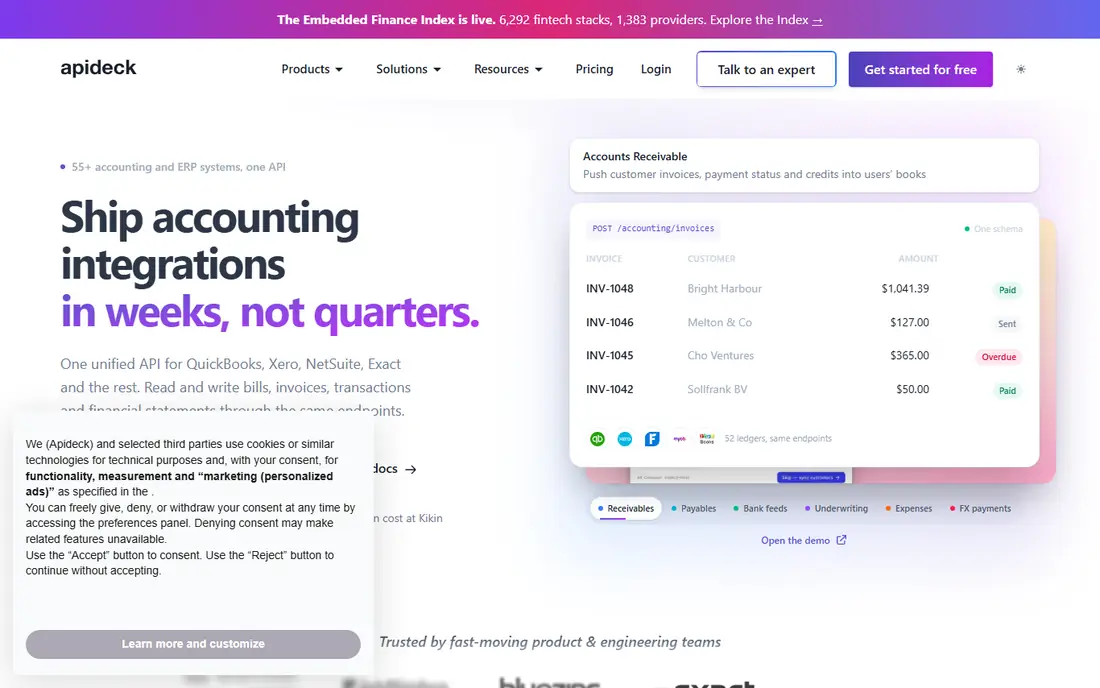
Apideck offers a broad unified API marketplace with clear tier pricing: the Launch plan costs $599 a month for 25 consumers, with higher tiers for larger volumes. It covers accounting, CRM, HRIS, and other categories, with a credential vault that handles OAuth connections securely and documentation that developers rate highly. Teams that want predictable tier pricing rather than pure usage billing appreciate the structure.
The Launch tier's 25-consumer limit means growing products move to higher tiers quickly, and HRIS depth trails Kombo's specialist focus. For a SaaS team that wants a broad marketplace with clear pricing and good docs, Apideck is a strong choice.
What we like- Broad integration marketplace
- Clear tier pricing
- Good documentation and vault for credentials
Watch out for- Launch tier covers 25 consumers
- Higher tiers needed for scale
- Smaller HRIS depth than Kombo
Starting priceSee website
Free planNo
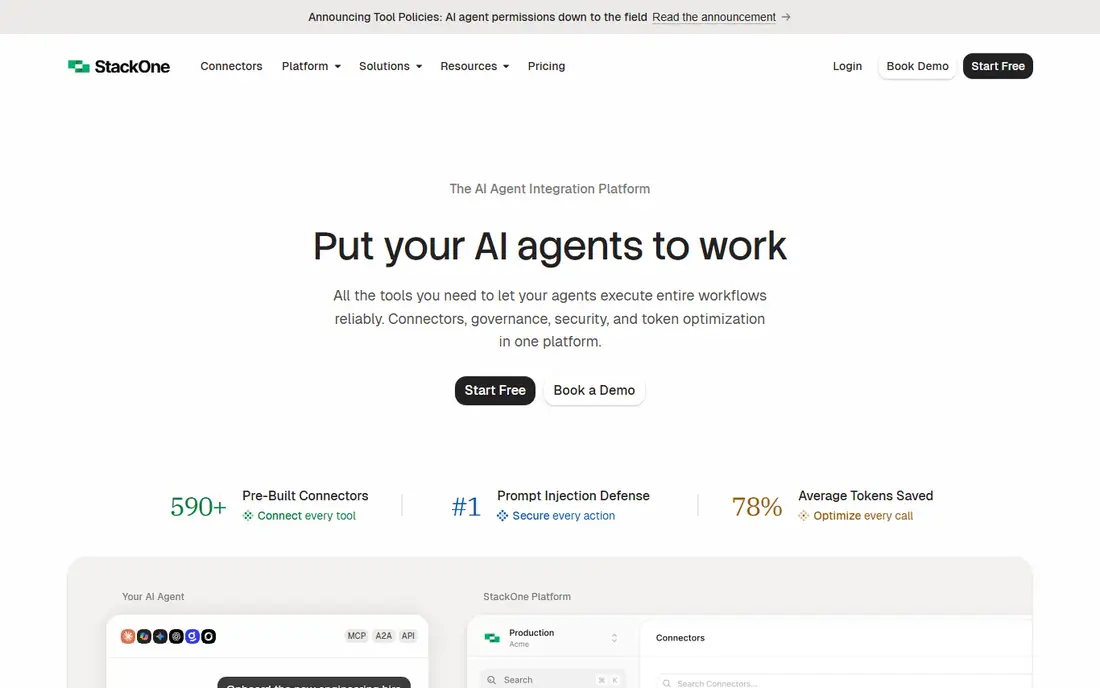
StackOne offers over 580 connectors with strong enterprise HRIS and ATS coverage, and it is popular with HR tech vendors that need reliable, compliant integrations for large customers. Security and compliance features suit enterprise buyers, and the platform handles the messy details of HR data normalization across vendors.
One flag: StackOne's unified APIs are now labeled legacy in some 2026 materials, so confirm the current product direction before committing, since the company may be steering new customers toward a different offering. Pricing is quote-based. For an enterprise HR vendor that needs deep, compliant integrations, StackOne is worth evaluating with that caveat in mind.
What we like- Over 580 connectors
- Strong enterprise HRIS and ATS coverage
- Good security and compliance posture
Watch out for- Unified APIs are now labeled legacy
- Pricing is quote-based
- Enterprise focus may over-serve small teams
Starting price$50/month
Free planYes
Nango is the developer toolkit alternative: rather than a fully managed unified API, it gives developers the infrastructure to build and maintain integrations themselves, with OAuth handling, syncing, and observability built in. Pricing is pay-as-you-go from $50 a month including $50 of credits, with a free tier covering 10 connections, which makes it the cheapest path in this guide for a technical team.
The trade-off is effort: you build more yourself, and pre-built unified data models are fewer than Merge's or Unified.to's. For a developer-led team that wants control, low cost, and the ability to build exactly the integrations it needs, Nango is the best fit.
What we like- Cheapest path for developers
- Pay-as-you-go pricing
- Build custom integrations on an open platform
Watch out for- You build more yourself
- Fewer pre-built unified models than Merge
- Needs developer skill
Starting priceSee website
Free planNo
Kombo is the European specialist among unified API providers, with over 250 integrations across HRIS, ATS, LMS, and assessment tools, and particular strength in European HR systems that US-focused vendors cover thinly. HR tech products serving European customers get better coverage of local HRIS and ATS vendors through Kombo than through Merge or Apideck.
Pricing is quote-based, the total integration count is smaller than Unified.to's, and US payroll depth trails Finch's specialist focus. For a European HR product, Kombo is the best regional fit. For a global product, pair it with a broader vendor or choose Unified.to.
What we like- Strong European HRIS and ATS coverage
- Over 250 integrations
- Good for EU-focused HR products
Watch out for- Pricing is quote-based
- Smaller total count than Unified.to
- US payroll depth trails Finch
Starting priceSee website
Free planNo
Finch is the specialist alternative for US payroll integrations, connecting to 265 US payroll providers with employment data and deduction write-back that general unified APIs do not match. Benefits, HR, and payroll products that need accurate, current employment data from many US payroll systems get the deepest coverage here.
Finch is payroll-focused, not a general unified API, so ATS, CRM, and accounting categories are limited or absent. Pricing is quote-based. For a product whose core need is US payroll data, Finch is the best specialist pick. For broader category needs, combine it with a general unified API.
What we like- Deepest US payroll coverage with 265 providers
- Deduction write-back
- Built for employment data
Watch out for- Payroll-focused, not a general unified API
- Pricing is quote-based
- ATS and HRIS depth is limited
Starting price$499/month
Free planNo
Knit offers HR and payroll APIs with clear startup pricing: the Start Up plan costs $499 a month, which suits early-stage HR products that need employment data without enterprise contracts. The API covers HRIS and payroll systems with a focus on developer experience and quick integration.
The category range is narrower than Unified.to's or Apideck's, and the startup tier has limits that growing products outgrow. For an early-stage HR product that needs HR and payroll data at a known price, Knit is a practical choice.
What we like- Clear startup pricing
- HR and payroll focus
- Good for early-stage HR products
Watch out for- Narrower category range than Unified.to
- Startup tier limits
- Smaller ecosystem
Starting priceSee website
Free planNo
Paragon is an embedded integration platform rather than a pure unified API: it lets your customers connect their own tools through your product's integration marketplace, with 124 integrations and a workflow builder for custom logic. SaaS products that want to offer an integration catalog to their customers, rather than just consuming unified data internally, get the most value.
The model differs from Merge's: Paragon is customer-facing integration infrastructure, not just a backend unified API, and pricing is quote-based. For a SaaS product building a customer-facing integration marketplace, Paragon is the best fit. For backend data sync only, a pure unified API like Unified.to or Apideck is simpler.
What we like- Embedded integrations your customers configure
- 124 integrations
- Good for SaaS products with integration marketplaces
Watch out for- Different model from a pure unified API
- Pricing is quote-based
- Fewer HRIS specialists than Kombo
How we chose
We compared unified API providers that replace Merge.dev's core job: giving a SaaS product one API to read and write data across many third-party systems, instead of building each integration separately. We weighed category coverage, integration count, pricing model, developer experience, and regional strength from vendor pages and 2026 unified API comparisons. We left out single-category integration tools and pure iPaaS workflow tools without unified data models. Where pricing is quote-based, we say so rather than guessing.
How to pick a Merge.dev replacement
Start with your categories and your build-versus-buy stance. If you need the widest coverage, shortlist Unified.to. If you want clear tier pricing, shortlist Apideck and Knit. If you want to build your own integrations cheaply, shortlist Nango. If you serve European HR customers, shortlist Kombo. If you need US payroll depth, shortlist Finch. If you want a customer-facing integration marketplace, shortlist Paragon. If you need enterprise HR depth, shortlist StackOne with its legacy caveat in mind. Then test the integrations you actually need, since headline counts hide gaps in specific vendors.
Test your top five integrations, not the catalog
Integration counts mislead: a vendor with 1,700 integrations may lack the one HRIS your largest customer uses, while a vendor with 250 may cover it perfectly. List your top five required integrations by customer demand, and test each one during the trial for field coverage, sync speed, and write support. A unified API that covers four of five is not a replacement.
Model cost at your real volume
Unified API pricing varies by consumers, API calls, or flat tiers, and the same product can cost twice as much on one model as another. Model your bill at your current customer count and call volume, and at three times that size, including overage rates. A cheap starter tier that caps consumers at 25 becomes expensive fast when you grow past it.
Frequently asked questions
What is a unified API?
A unified API gives your product one interface to connect to many third-party systems in a category, such as HRIS or accounting, instead of building a separate integration for each vendor. The provider normalizes data models, handles authentication, and maintains the integrations as vendors change their APIs, saving your team months of integration work.
Is Unified.to better than Merge.dev?
For integration count, yes: Unified.to lists over 1,700 integrations against Merge's 233 in 2026 comparisons. For category depth and developer experience, the answer depends on your specific vendors, so test your top integrations on both before deciding. Count is a starting point, not a verdict.
Should I build integrations with Nango instead?
If your team has developer capacity and wants control and low cost, yes. Nango's pay-as-you-go model from $50 a month is far cheaper than managed unified APIs, but you build more yourself. If your team lacks integration engineering time, a managed unified API saves more than it costs.
What is the cheapest Merge.dev alternative?
Nango is cheapest for developer-led teams, with a free tier for 10 connections and pay-as-you-go from $50 a month. Knit at $499 a month and Apideck at $599 a month are the cheapest managed options with published pricing. Quote-based vendors may negotiate lower for early-stage products, so ask.
Do unified APIs handle writes as well as reads?
It varies by vendor and integration. Most unified APIs read well across vendors, while write support, such as creating candidates in an ATS or updating payroll deductions, is thinner and vendor-specific. Test write operations for your top integrations during the trial, since read-only coverage is not enough for many products.
Sources we checked (8)
- https://unified.to
- https://apideck.com
- https://stackone.com
- https://nango.dev
- https://kombo.dev
- https://tryfinch.com
- https://getknit.dev
- https://useparagon.com
Is your product missing or out of date?
We review this list regularly. Vendors can request a listing, send updated pricing or ask about featured placement.

Shihab Mia · Founder, Rankite
Shihab has 5+ years in B2B and SaaS SEO. He writes Rankite's software buying guides from pricing pages, documentation and public user reviews. More about Shihab.