How we make this list: we compare pricing pages, product documentation and public user reviews. Ratings come from G2, Capterra or Trustpilot, with the date we checked them.
Key takeaways
- PostgreSQL is the strongest general MariaDB alternative, with advanced indexing, JSON support, and full-text search in one engine.
- MySQL Community Edition is the closest drop-in option for web apps, with the largest deployment base and talent pool.
- Percona Server for MySQL is a binary-compatible MySQL replacement with better InnoDB visibility and diagnostics.
- TiDB adds horizontal scaling to MySQL compatibility, suiting teams that outgrow single-node MySQL.
- CockroachDB offers distributed SQL with strong consistency across regions, though its license is not fully open source.
- MariaDB itself is free and open source under GPL, so alternatives compete on features, scaling, and ecosystem rather than license cost.
Quick comparison
Is your product missing or out of date?
We review this list regularly. Vendors can request a listing, send updated pricing or ask about featured placement.
The best MariaDB alternatives

#1PostgreSQL
Best for: General-purpose advanced SQL4.4/5 on
G2 (682 reviews, checked Oct 2026)
Visit postgresql.org
Starting priceFree
Free planYes
PostgreSQL is the strongest general MariaDB alternative for teams that want advanced SQL features in one engine. It offers advanced indexing, JSON support, full-text search, window functions, and common table expressions with a maturity that MySQL-family engines reached later. Extensions add PostGIS for spatial data, pgvector for embeddings, and dozens of other capabilities without switching databases.
PostgreSQL is free and open source under the PostgreSQL license, with managed options from every cloud and dedicated providers: published 2026 benchmarks list managed Postgres from about $5 per month on Aiven developer plans, $10 on Railway, $15 on DigitalOcean and Linode, $19 on Neon, and $25 on Supabase Pro. Replication setup takes more care than MySQL, and tuning habits differ, but teams that want one database for relational, document, search, and analytical work will find PostgreSQL the most capable MariaDB alternative.
What we like- Advanced indexing and extensibility
- Strong JSON and full-text search
- ACID compliance
- Huge extension ecosystem
Watch out for- Replication setup takes more care than MySQL
- Tuning differs from MySQL habits
- Managed costs rise with size

#2MySQL
Best for: Widely deployed web apps4.4/5 on
G2 (1,685 reviews, checked Oct 2026)
Visit mysql.com
Starting priceFree
Free planYes
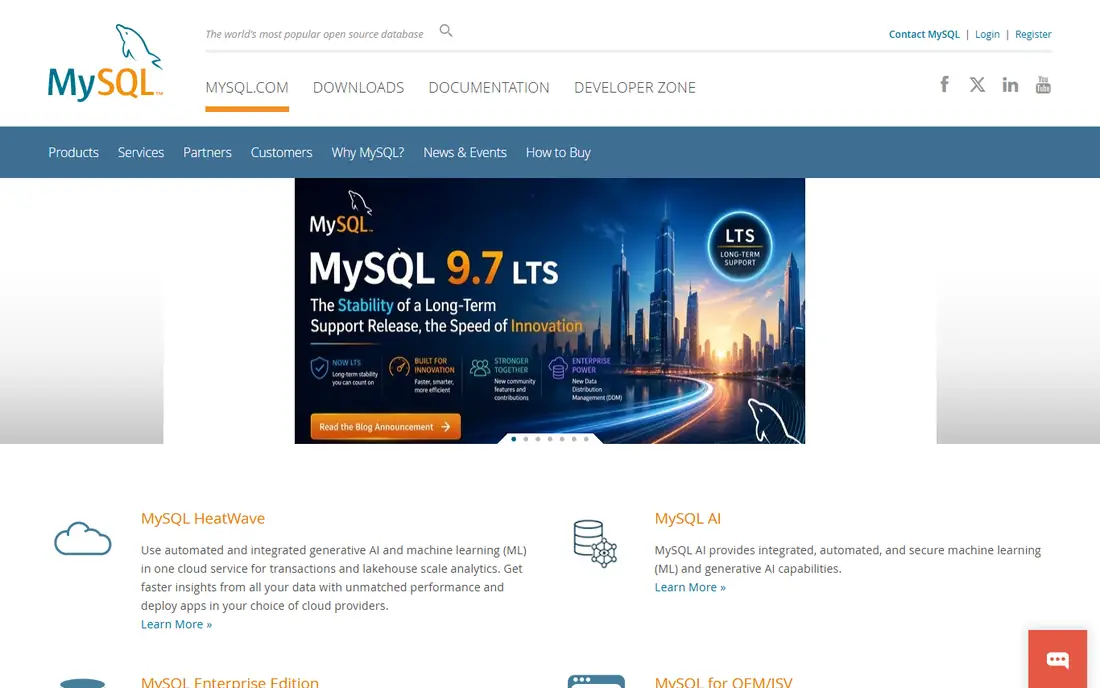
MySQL is the database of the commodity web, and that is a strength rather than a criticism. WordPress, Drupal, Magento, and countless custom PHP and Laravel apps run on it, which means nearly every shared host, VPS image, and deployment tutorial assumes MySQL. The Community Edition is free and open source, managed versions run on every cloud, and hiring is easy, since almost every backend developer has touched it.
The ecosystem is broad rather than deep: connectors, ORMs, and migration tools exist for everything, but window functions, common table expressions, and JSON handling arrived later than in Postgres. Oracle ownership makes some teams nervous about licensing direction, though the Community Edition remains free. For standard web apps and agencies shipping client sites, MySQL remains the path of least resistance and the closest MariaDB cousin.
What we like- Most widely deployed open-source SQL engine
- Huge talent pool
- Every host and CMS supports it
- Mature replication
Watch out for- Oracle ownership worries some teams
- Advanced features lag PostgreSQL
- Per-connection tuning bites at scale

#3
Percona Server for MySQL
Best for: MySQL drop-in with diagnostics
Visit percona.com
Starting priceFree
Free planYes
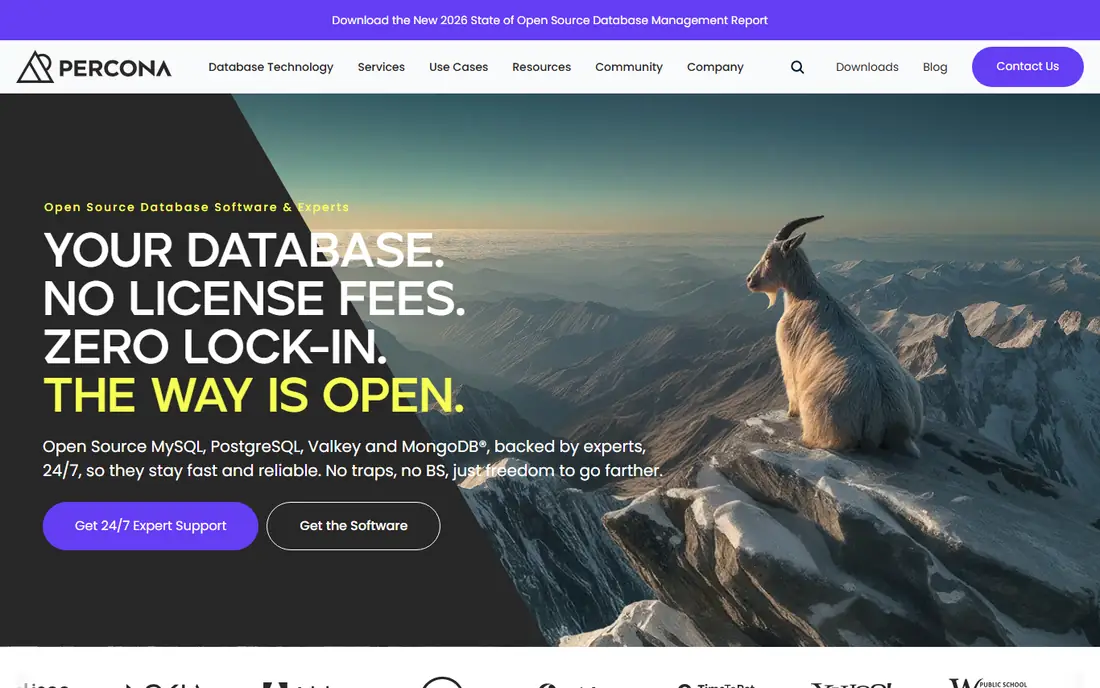
Percona Server for MySQL is a binary-compatible drop-in replacement for MySQL that adds performance improvements and observability without changing application behavior. It offers enhanced InnoDB metrics, adaptive hash index controls, and a thread pool, plus Percona XtraDB Cluster for synchronous multi-node replication. The Percona Monitoring and Management stack gives query analytics and diagnostics that standard MySQL lacks, and XtraBackup covers hot backups.
Percona Server is open source and free, with paid enterprise support and managed services available. Teams already familiar with MySQL can deploy it with no application changes, since it keeps MySQL SQL syntax and wire protocol. The vertical scaling limits of MySQL remain, and clustering adds operational complexity, but database teams that run MySQL and want better visibility without changing apps should pick Percona first.
What we like- Binary-compatible MySQL drop-in
- Enhanced InnoDB metrics
- Percona Monitoring and Management
- XtraBackup tooling
Watch out for- Same vertical scaling limits as MySQL
- XtraDB Cluster adds operational complexity
- No built-in analytical support

#4TiDB
Best for: MySQL-compatible horizontal scale4.6/5 on
G2 (67 reviews, checked Oct 2026)
Visit pingcap.com
Starting priceFree
Free planYes
TiDB is a distributed SQL database that stays MySQL-compatible while adding horizontal scaling. It separates compute from storage, so teams can scale reads and writes independently, and it supports distributed transactions with strong consistency. Hybrid transactional and analytical processing lets one cluster serve both operational queries and analytical workloads, which single-node MySQL cannot do well.
TiDB is open source under Apache 2.0, with managed TiDB Cloud available for teams that want a hosted service. Production deployments need at least 3 nodes, which raises the operational floor above single-node MySQL, and the community is smaller than MySQL. Teams that outgrow single-node MySQL but want to keep MySQL syntax and tooling will find TiDB the most scalable MariaDB alternative.
What we like- MySQL-compatible with horizontal scaling
- Distributed transactions
- HTAP for mixed workloads
- Apache 2.0 license
Watch out for- More complex to operate than single-node MySQL
- Needs at least 3 nodes for production
- Smaller community than MySQL
Starting priceFree
Free planYes
CockroachDB offers distributed SQL with strong consistency across nodes and regions, surviving machine and datacenter failures without manual failover. It is largely PostgreSQL-compatible, so many Postgres tools and drivers work with it, and it scales horizontally by adding nodes. Global teams that need data close to users in several regions get a single logical database instead of sharded Postgres clusters.
CockroachDB is free to use and self-host, but its license is the CockroachDB Software License rather than a fully open-source license, which matters for companies with strict open-source policies. Latency can run higher than single-node Postgres for some workloads, since consensus across nodes costs time. Teams that need global distribution and survival guarantees will find CockroachDB the most resilient MariaDB alternative.
What we like- Distributed SQL with strong consistency
- Survives node and region failures
- PostgreSQL-compatible
- Automatic scaling
Watch out for- CockroachDB Software License, not fully open source
- Higher latency for some workloads
- Operational learning curve

#6SQLite
Best for: Embedded and local apps4.3/5 on
G2 (261 reviews, checked Oct 2026)
Visit sqlite.org
Starting priceFree
Free planYes
SQLite is the embedded database that ships in every phone, browser, and operating system, and it suits local apps, mobile apps, testing, and small tools. It needs zero setup, runs as a library inside the application, and offers ACID compliance with JSON support and full-text search. The public domain license means no licensing cost or restriction anywhere.
SQLite has no network server, so it cannot serve many concurrent writers over a network, and it offers no horizontal scaling or replication. High-concurrency web back ends should not use it as a primary database. For embedded use, local storage, prototypes, and tests, SQLite is the simplest and most reliable MariaDB alternative, and it often complements a server database rather than replacing it.
What we like- Public domain license
- Zero setup
- Serverless and embedded
- ACID compliant
- Ships in every phone and browser
Watch out for- No network server
- Single-writer limits
- No horizontal scaling
- Unsuitable for high-concurrency web back ends

#7MongoDB
Best for: Flexible document data4.5/5 on
G2 (554 reviews, checked Oct 2026)
Visit mongodb.com
Starting priceFree
Free planYes
MongoDB suits applications whose data changes shape often, such as catalogs, content platforms, and user profiles with varied fields. Documents evolve without migrations, Atlas provides a managed service with a marketplace and drivers for every stack, and search, charts, and vector indexes live in one place. The Community Server is free, and Atlas offers a free tier for small projects.
Relational workloads with many joins fight the document model, and costs climb fast once data and traffic grow on Atlas, so teams should model storage and throughput before committing. MongoDB is not a drop-in MariaDB replacement for relational apps, but teams whose data is naturally document-shaped will find it the most flexible MariaDB alternative.
What we like- Flexible documents evolve with the product
- Atlas managed service
- Search, charts, and vector indexes in one place
Watch out for- Relational workloads and multi-document joins fight the model
- Costs climb fast once data and traffic grow

#8Microsoft SQL Server
Best for: Windows and enterprise shops4.4/5 on
G2 (2,288 reviews, checked Oct 2026)
Visit microsoft.com
Starting priceFree
Free planYes
Microsoft SQL Server suits Windows and enterprise shops that already run Microsoft infrastructure. Express edition is free for small databases, and paid editions add enterprise tooling, business intelligence, and high availability. Integration with Azure, Active Directory, and the Microsoft data stack is deep, which suits companies standardized on Microsoft.
Paid licensing costs are significant for larger deployments, and Linux support, while available, is thinner than Windows tooling. The ecosystem centers on Microsoft shops, so mixed-stack teams get less value. Enterprises that run Windows servers and need a vendor-supported database with strong tooling will find SQL Server a solid MariaDB alternative, while open-source-first teams should prefer PostgreSQL or Percona.
What we like- Strong enterprise tooling
- Express edition free
- Deep Windows and Azure integration
- Mature business intelligence stack
Watch out for- Licensing costs on paid editions
- Linux support thinner than Windows
- Ecosystem centered on Microsoft shops
How we chose
We compared MariaDB alternatives on SQL compatibility, scaling model, licensing, managed pricing, and fit for workload type. MariaDB itself is a community-led MySQL fork under GPL with advanced indexing, JSON support, and full-text search, so we weighted drop-in compatibility for MySQL-family tools and feature depth for Postgres-family tools. Managed database benchmarks from 2026 show entry costs from $0 on Cloudflare D1 free tier to $15 per month on DigitalOcean and Linode, with enterprise clouds far higher, so confirm managed pricing at your size before purchase.
How to choose the right MariaDB alternative
Start with your workload and team skills. Web apps with standard CRUD needs should default to MySQL or Percona Server, while teams that need advanced SQL, JSON, and search in one engine should pick PostgreSQL. Teams that outgrow single-node MySQL should test TiDB, and global teams that need survival guarantees should test CockroachDB.
Next, test migration with a real schema and data sample, including stored procedures, triggers, and character sets, since MySQL-family and Postgres-family engines differ in subtle ways. Check licensing too: PostgreSQL, MySQL Community, Percona, TiDB, and SQLite carry permissive or GPL licenses, while CockroachDB uses a business source license that some companies restrict. Finally, price managed hosting at your data size, since entry prices near $5 to $15 per month grow fast with storage, backups, and read replicas.
Frequently asked questions
What is MariaDB?
MariaDB is a community-led open-source relational database forked from MySQL, offering a drop-in MySQL-compatible engine with advanced indexing, JSON support, and full-text search under the GPL license.
Is there a free MariaDB alternative?
PostgreSQL, MySQL Community Edition, Percona Server, TiDB, SQLite, and MongoDB Community are all free and open source. Microsoft SQL Server Express is free for small databases.
Which MariaDB alternative is closest to MySQL?
Percona Server for MySQL is a binary-compatible MySQL drop-in, so applications need no changes. MySQL Community Edition itself is the other closest option, with the same syntax and tooling.
Is PostgreSQL better than MariaDB?
PostgreSQL offers more advanced indexing, extensibility, JSON handling, and full-text search in one engine, while MariaDB offers closer MySQL compatibility and a simpler operational model. Teams with complex queries usually prefer PostgreSQL, while MySQL-family shops prefer MariaDB or Percona.
Does TiDB replace MySQL at scale?
Yes, TiDB keeps MySQL compatibility while adding horizontal scaling and distributed transactions, which suits teams that outgrow single-node MySQL. Production needs at least 3 nodes, so operational costs are higher.
Can I migrate from MariaDB to PostgreSQL?
Yes, migration tools and manual schema conversion handle most tables, data, and queries, though stored procedures, triggers, and MySQL-specific functions need review. Test the migration with a full data sample before cutover.
Sources we checked (0)
Is your product missing or out of date?
We review this list regularly. Vendors can request a listing, send updated pricing or ask about featured placement.

Shihab Mia · Founder, Rankite
Shihab has 5+ years in B2B and SaaS SEO. He writes Rankite's software buying guides from pricing pages, documentation and public user reviews. More about Shihab.
 CockroachDB