How we make this list: we compare pricing pages, product documentation and public user reviews. Ratings come from G2, Capterra or Trustpilot, with the date we checked them.
Key takeaways
- Kombo is a people-data specialist, covering HRIS, payroll, ATS, assessment, and LMS through one normalized API.
- Merge is the broadest pick, with 233 integrations across eight categories, while Unified.to leads on raw integration count.
- Nango suits teams that want to build any integration themselves, with a free tier and usage-based pricing.
- The biggest choice is sync model: live pass-through reads versus a stored copy, and that choice shapes freshness and cost.
Quick comparison
| Tool | Best for | Starting price | Free plan |
|---|
 Merge | Broad unified API across categories | Free | Yes |
 Unified.to | Largest integration catalog | $750 per month | No |
 Apideck | Accounting-first unified API | $599 per month | No |
 StackOne | HR and AI agent actions | See website | No |
 Nango | Build-your-own integrations | $50 per month | Yes |
 Finch | US payroll and benefits depth | See website | No |
 Knit | HR-first managed unified API | $499 per month | No |
 Paragon | Embedded integrations for SaaS | See website | No |
Is your product missing or out of date?
We review this list regularly. Vendors can request a listing, send updated pricing or ask about featured placement.
The best Kombo alternatives
Starting priceFree
Free planYes
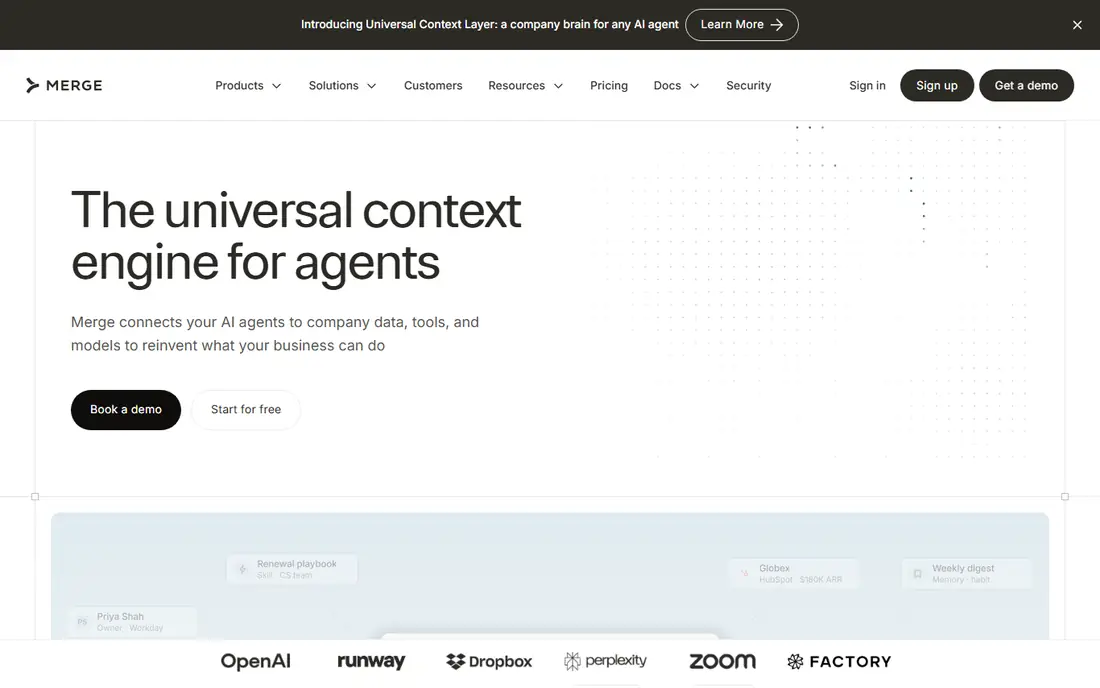
Merge is the default alternative for teams that want one vendor beyond people data. It covers HRIS and ATS alongside CRM, accounting, ticketing, and more, with 233 integrations counted in October 2026. The pricing starts friendly: the first 3 production linked accounts are free, then $650 per month covers up to 10, with $65 per extra account.
The limits show up in write depth. HRIS writes cover creating employees, time off, and timesheets, but deeper payroll actions are partial or read-only. Sync freshness also depends on plan, with daily syncs on the Launch tier. For products that read people data across many systems and want room to add categories later, Merge is the safest broad bet.
What we like- 233 integrations across eight categories
- First 3 linked accounts free
- Strong docs and tooling
Watch out for- Writes are partial in HRIS
- Sync runs on a schedule on lower plans
- Enterprise pricing is contract-based
Starting price$750 per month
Free planNo
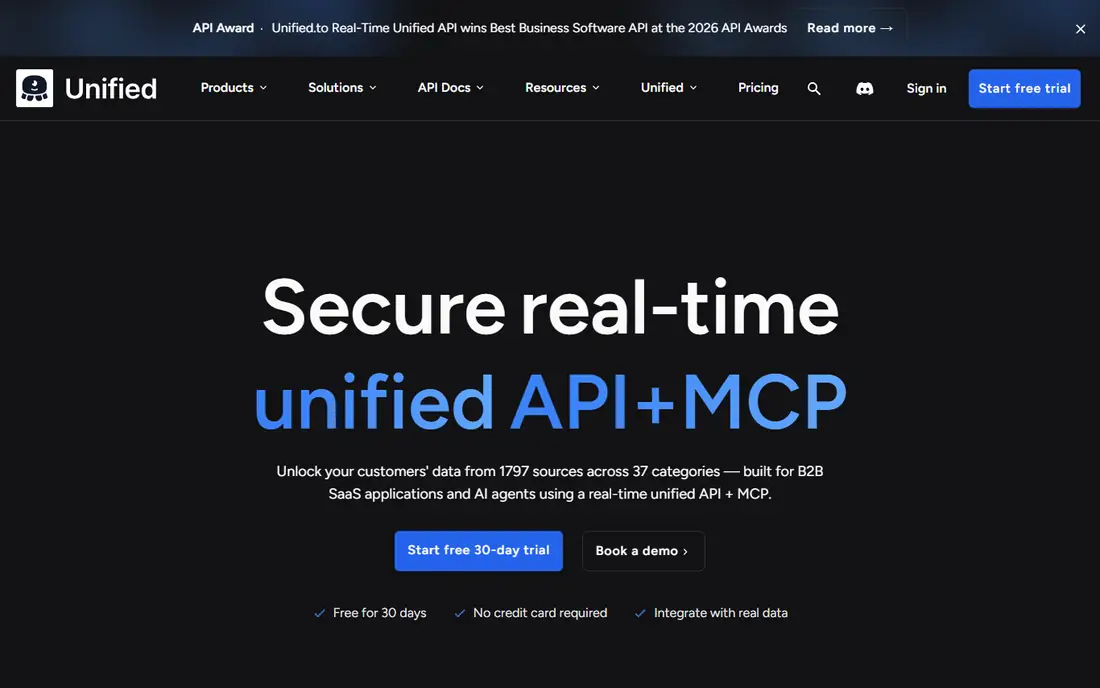
Unified.to wins on sheer catalog size, with 1,787 integrations across 36 categories as of October 2026. Its model is live pass-through: requests go to the source system in real time, so you read fresh data instead of a stored copy. Paid plans start at $750 per month for 750,000 calls with unlimited customer connections.
Watch the meter. Webhook events count toward the monthly request limit, so a chatty integration can burn through calls faster than expected. Depth also varies: a catalog this wide cannot go deep on every system. For teams that need many categories and fresh reads, and that can model their request volume, Unified.to is hard to match.
What we like- 1,787 integrations across 36 categories
- Live pass-through reads
- Unlimited customer connections on paid plans
Watch out for- Usage-based pricing counts webhook events
- No free tier
- Breadth can mean thinner depth per integration
Starting price$599 per month
Free planNo
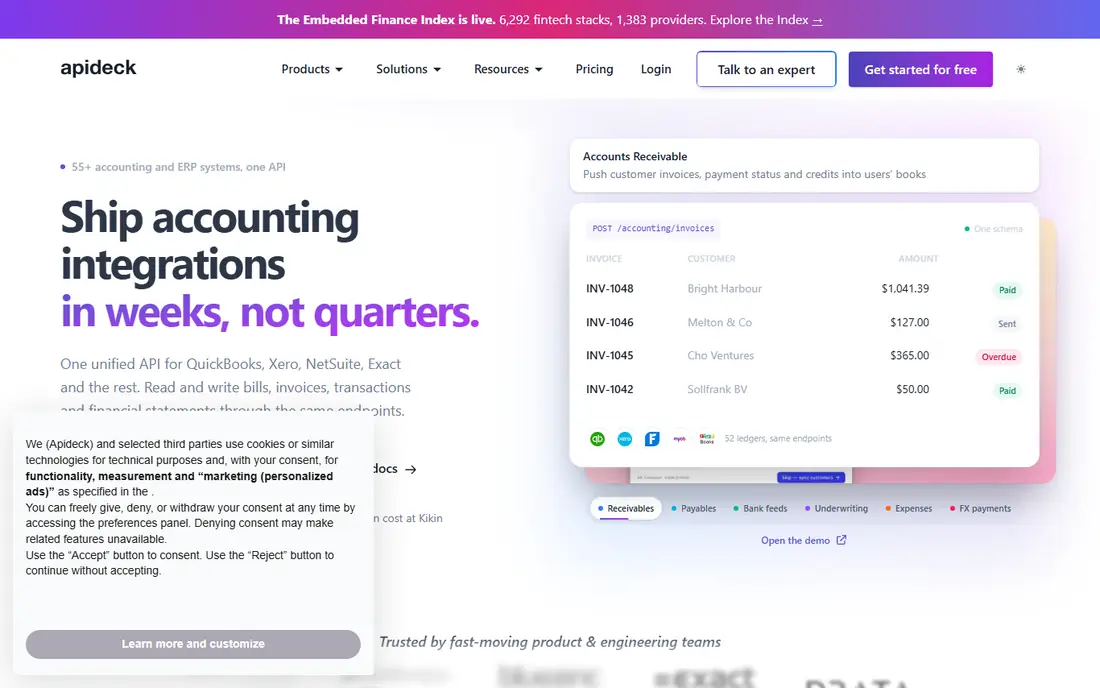
Apideck earns trust through transparency. Each integration page lists exactly which operations each object supports, so you know before building whether a field or action exists. Its Vault UI lets your customers connect their own accounts without you building that flow, and because it is pass-through, it stores no business records of yours.
The trade is scope. Its ATS model covers jobs, applicants, and applications only, with roughly 10 ATS integrations, and its HRIS coverage is partial on the big enterprise systems. Pricing starts at $599 per month for 25 consumers on Launch, rising to $1,299 for 100 on Scale. Pick Apideck when accounting is your core category and HR is a side need, not the other way around.
What we like- Transparent per-integration operation lists
- Embedded Vault UI for customer connections
- Pass-through, stores no business records
Watch out for- ATS model is narrow, only about 10 integrations
- Virtual webhooks poll daily by default
- HRIS coverage is partial
Starting priceSee website
Free planNo
StackOne positions itself for the AI agent era, with 580+ connectors and 36,000+ provider-native actions that agents can call directly. Its HRIS and ATS coverage is deep, which makes it a natural Kombo rival for recruiting and HR products that want actions, not just reads.
One wrinkle to check before signing: StackOne now labels its HRIS, ATS, CRM, LMS, and accounting unified APIs as legacy, which suggests the product direction is shifting toward agent actions. Pricing is quote-based, so get terms in writing. For teams building agent features on top of people data, StackOne is worth a serious evaluation.
What we like- 580+ connectors
- 36,000+ provider-native actions for AI agents
- Strong HRIS and ATS depth
Watch out for- Unified APIs now labeled legacy
- Pricing is quote-based
- Breadth is narrower than Unified.to
Starting price$50 per month
Free planYes
Nango is the builder's choice. Instead of only offering a fixed catalog, it lets you define integrations across 1,000+ APIs, with a free tier covering 10 connections and pay-as-you-go from $50 per month including $50 of credits. For agent and SaaS teams with unusual systems, that freedom matters more than a polished catalog.
Freedom has a cost in effort. You write more code, you own more maintenance, and some categories like payroll tools are not yet in the catalog. HR and ATS writes are possible but often need custom code beyond the standard model. If your team has engineering time and needs systems nobody else covers, Nango gives you the tools to do it.
What we like- Free tier with 10 connections
- Usage-based pricing
- You define any integration, not just the catalog
Watch out for- You build and maintain more yourself
- Payroll tools are not in the catalog yet
- HR writes need custom code
Starting priceSee website
Free planNo
Finch calls itself the unified API for payroll, HR, and benefits, and it goes deeper on US payroll than any generalist here, with 265 providers, mostly assisted. Its standout is deduction write-back: you can push benefit deductions into payroll systems, which most rivals cannot do. Pay statement reads round out a payroll-first product.
Finch has no ATS coverage at all, so recruiting products need a second vendor. It is also US-centered, which limits global teams. Data freshness runs 24 hours automated, or 7 days for assisted providers. If payroll and benefits are your core, Finch is the specialist to beat.
What we like- Deepest US payroll coverage, 265 providers
- Deduction write-back
- Strong compliance posture
Watch out for- No ATS coverage
- Mostly US-focused
- Assisted onboarding can take up to 7 days for some providers
Starting price$499 per month
Free planNo
Knit is an HR-first managed unified API with 71 apps and particular strength in APAC systems that US vendors cover thinly. Its writes are genuinely useful: create, update, and terminate employees through the API, not just reads. Pricing starts at $499 per month on Start Up, with Scale Up and Enterprise on request.
Sync freshness starts at 24 hours on Start Up and drops to 5 minutes from Scale Up, so real-time needs cost more. Connected accounts are also contract-based, which complicates budgeting. For HR products with APAC customers, or teams that need employee lifecycle writes, Knit is a strong regional specialist.
What we like- 71 HR apps with strong APAC coverage
- Employee create, update, and terminate writes
- Webhook push
Watch out for- Smaller catalog than Merge or Unified.to
- 24-hour sync on Start Up
- Connected accounts are contract-based
Starting priceSee website
Free planNo
Paragon is an embedded integration platform, which is a different shape from a pure unified API. Your customers build and manage their own integrations through workflows inside your product, across 124 integrations and 13 docs categories. That suits SaaS teams whose selling point is letting customers connect their own stack.
The trade is depth in people data. Paragon covers HRIS and ATS as part of a wider platform, not as a specialty, so field-level HR depth trails Kombo and Merge. Pricing is quote-based. Pick Paragon when embedded, customer-built integrations are the product, and use a specialist when people-data depth is the product.
What we like- Embedded integration platform with 124 integrations
- Workflow builder for customer-facing integrations
- 13 docs categories
Watch out for- Broader than people data, so HR depth is thinner
- Pricing is quote-based
- Smaller HRIS and ATS catalogs
How we chose
We compared vendors that do what Kombo does: normalize HR, payroll, ATS, or LMS data behind one API so a software team builds once instead of once per customer system. We checked integration counts, categories, sync models, write depth, and published pricing from vendor docs and October 2026 comparisons, and we left out tools that only cover one vendor or only sync files. Where pricing is contract-based, we list See website rather than guessing.
How to pick a unified API
Start with the data you actually need, not the catalog headline. List the exact objects, fields, and writes your product requires, then check each vendor's per-integration docs for those items. A catalog of 1,000 integrations means little if the one field you need is missing on the three systems your customers use. Run a proof of concept with real customer systems, not sandbox data, before you commit.
Sync model and freshness decide more than price
Live pass-through reads give you fresh data but cost per request and depend on the source system being up. Stored-copy sync gives you fast reads and resilience, but data can lag by hours or a day on lower plans. Match the model to the feature: payroll and compliance need freshness and audit trails, while directory listings can tolerate a daily sync. Check webhook support and event latency in the proof of concept, since polling every 24 hours feels very different from push events.
Budget for connections, not just the platform fee
Platform fees are only part of the bill. Per-linked-account, per-consumer, and per-request models behave very differently as customers grow. Model your cost at 10, 100, and 1,000 connections, including webhook volume and overage rates. A free tier with 10 connections is a fine start, but the price at 100 connections is the number that decides the contract.
Frequently asked questions
What is a unified API, in plain terms?
A unified API gives you one data model and one authentication flow for a whole category, such as HRIS or ATS, instead of a separate integration for each vendor. The provider builds and maintains the connectors behind it, so your team writes one integration and reaches many customer systems. The cost is that the normalized model may miss a field or action you need, which then requires custom code.
Is Kombo itself still a good choice?
Kombo remains a strong specialist, with 250+ integrations across HRIS, ATS, LMS, and assessment, and deep support for people-data edge cases. The alternatives here win on breadth, on payroll depth, or on builder freedom, not because Kombo is weak. If your product lives entirely in people data, Kombo is still a fair baseline to compare against.
How do I handle a field the unified model does not cover?
Most vendors offer passthrough or raw-data access for fields outside the normalized model, and some let you build custom actions in code. Check this before signing, because it decides whether a gap is a workaround or a blocker. Ask for a written list of which fields are mapped per integration, not a general promise.
What security and compliance checks matter for HR data?
HR data is sensitive, so ask for SOC 2 Type 2, ISO 27001, GDPR handling, and data residency options. Kombo and Merge both publish SOC 2, ISO 27001, HIPAA, and GDPR coverage, and several rivals match that set. Also check whether the vendor stores a copy of your customers' data or passes requests through, since that changes your own compliance story.
Can I switch unified API vendors later?
Switching is possible but costly, because your code depends on the vendor's data model and connection flows. You can lower the cost by keeping a thin adapter layer between the vendor API and your own code, and by exporting connection metadata early. Budget a migration project, not a weekend, especially if you have hundreds of connected customers.
Sources we checked (8)
- https://merge.dev
- https://unified.to
- https://apideck.com
- https://www.stackone.com
- https://www.nango.dev
- https://tryfinch.com
- https://www.getknit.dev
- https://useparagon.com
Is your product missing or out of date?
We review this list regularly. Vendors can request a listing, send updated pricing or ask about featured placement.

Shihab Mia · Founder, Rankite
Shihab has 5+ years in B2B and SaaS SEO. He writes Rankite's software buying guides from pricing pages, documentation and public user reviews. More about Shihab.