How we make this list: we compare pricing pages, product documentation and public user reviews. Ratings come from G2, Capterra or Trustpilot, with the date we checked them.
Key takeaways
- GitHub Actions is the best Jenkins alternative for teams already hosting code on GitHub, with CI defined beside the code.
- GitLab CI/CD suits teams that want one platform for code, CI, security scanning and deployment.
- CircleCI suits teams that want fast cloud builds with strong Docker and caching support.
- Buildkite suits teams that want cloud orchestration with their own build agents.
- Jenkins still wins on self-hosted flexibility and plugin breadth, so switch for maintenance and developer experience, not features alone.
Jenkins has been the default self-hosted CI server for years, with thousands of plugins and total control. Its alternatives trade some of that flexibility for less maintenance, better developer experience, or tighter integration with where code already lives. The eight below cover cloud-hosted, hybrid and self-hosted models, and all of them run pipelines defined as code.
Pricing usually runs by build minutes, users or concurrency, with free tiers for small teams and open-source projects. Prices below are marked "See website" where minute bundles and runner pricing change often. A trial pipeline on your real repository is the best test, since build speed and caching behaviour vary by stack.
Quick comparison
Is your product missing or out of date?
We review this list regularly. Vendors can request a listing, send updated pricing or ask about featured placement.
The best Jenkins alternatives
Starting priceSee website
Free planYes
GitHub Actions defines pipelines in YAML files stored in the repository, so CI changes go through the same pull request flow as code. The marketplace holds thousands of reusable actions for building, testing and deploying common stacks, and hosted runners cover Linux, Windows and macOS. Public repositories get generous free minutes, and private repos get a monthly allowance.
Self-hosting runners is possible but needs setup, and minute-based pricing can climb for heavy build loads. For a team already on GitHub, Actions removes a whole server to maintain and puts CI where developers already work.
What we like- Pipelines live beside code in YAML
- Huge marketplace of reusable actions
- Free minutes for public repos
Watch out for- Cloud-first, so self-hosted runners need setup
- Pricing by minutes can surprise heavy users
Starting priceSee website
Free planYes
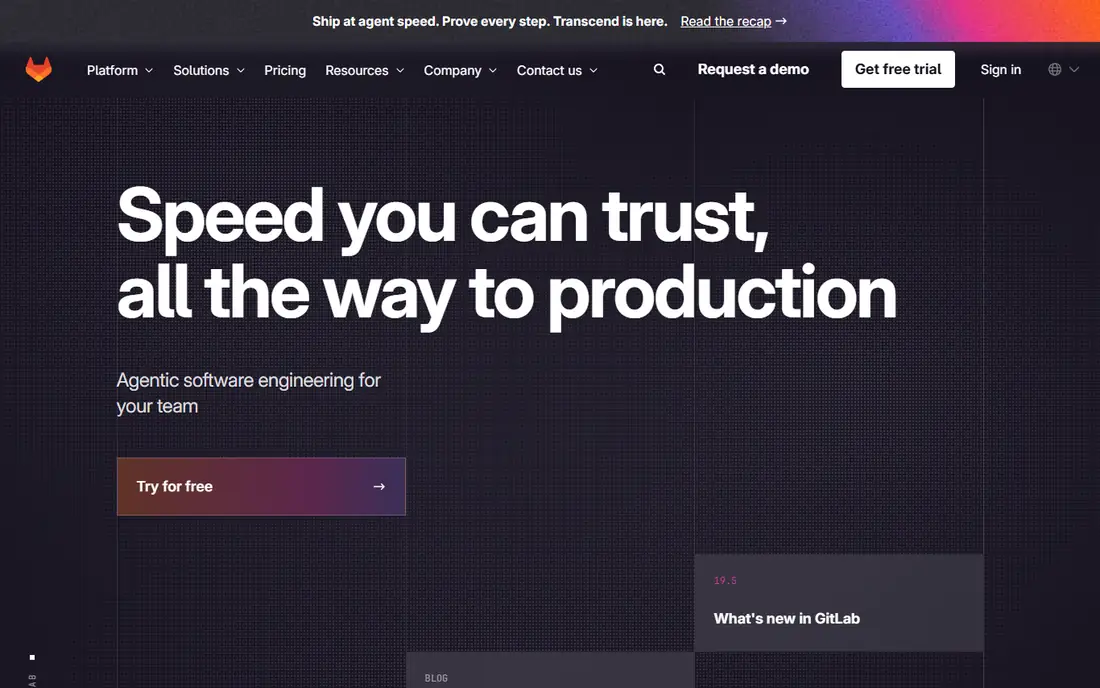
GitLab CI/CD is part of a single DevOps platform covering repositories, issues, CI, security scanning, registries and deployment. Pipelines are defined in a gitlab-ci.yml file, Auto DevOps templates generate pipelines for common stacks, and runners can be cloud-hosted or self-managed. The free tier covers small teams generously.
The platform's breadth makes the interface dense, and complex pipelines need care with runner configuration. For a team that wants one vendor from code to production, GitLab is the most complete Jenkins alternative.
What we like- Code, CI, security scanning and deployment in one platform
- Auto DevOps templates
- Self-hosting option
Watch out for- Interface is dense
- Runner setup takes effort for complex pipelines

#3CircleCI
Best for: Fast cloud builds4.4/5 on
G2 (510 reviews, checked Oct 2026)
Visit circleci.com
Starting priceSee website
Free planYes
CircleCI is built for speed. Docker layer caching, dependency caching and test splitting cut build times, and orbs package reusable configuration for common stacks. Insights show which jobs are slow or flaky, and the cloud platform needs no server maintenance. The free tier covers small projects well.
Credit-based pricing can be hard to forecast for variable workloads, and self-hosted runners are newer than the cloud offering. For a team that values fast feedback on every commit, CircleCI is the performance pick.
What we like- Fast builds with strong Docker layer caching
- Orbs for reusable config
- Good insights and test splitting
Watch out for- Pricing by credits can be hard to predict
- Self-hosted runners are a newer option

#4Buildkite
Best for: Hybrid cloud and own agents4.7/5 on
G2 (31 reviews, checked Oct 2026)
Visit buildkite.com
Starting priceSee website
Free planFree trial

Buildkite splits CI into cloud orchestration and agents that run on your own machines or cloud accounts. That hybrid model suits teams with security rules, special hardware or existing infrastructure, since code never needs to leave your network for builds. Pipelines are defined in YAML, builds parallelise well, and the dashboard is clean.
The trade-off is agent management. You own the machines, scaling and maintenance, which is work Jenkins users know well. For a team that wants cloud convenience without giving up build infrastructure control, Buildkite is the best hybrid choice.
What we like- Cloud orchestration with agents on your own infrastructure
- Fast parallel builds
- Good security story
Watch out for- You manage the agents
- Pricing is per user plus agent costs

#5TeamCity
Best for: Self-hosted with polish4.2/5 on
G2 (90 reviews, checked Oct 2026)
Visit jetbrains.com
Starting priceSee website
Free planYes
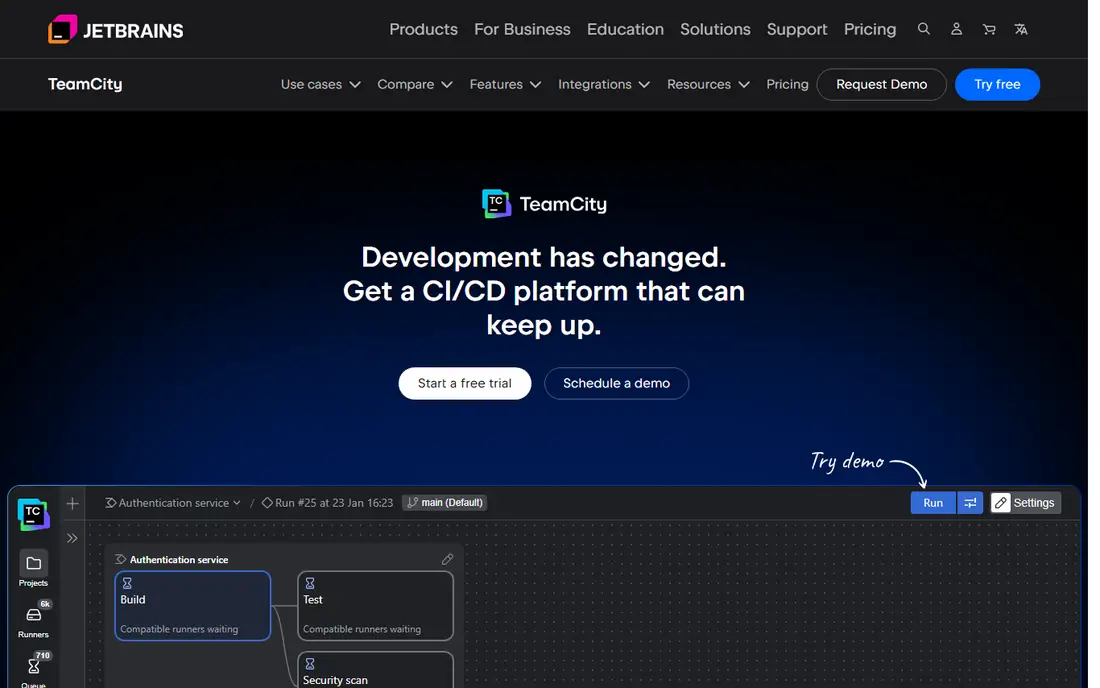
TeamCity, from JetBrains, is the polished self-hosted alternative to Jenkins. Build chains, templates and test history tools make pipeline management smoother, and support for .NET and Java stacks is strong. The interface is more refined than Jenkins, and the free tier covers small teams.
Self-hosting still means maintenance, backups and upgrades, and agent-based pricing grows with scale. For a team that wants to keep CI in-house but prefers a smoother product than Jenkins, TeamCity is the natural step.
What we like- Polished self-hosted CI with smart test history
- Strong .NET and Java support
- Build chains and templates
Watch out for- Self-hosting needs maintenance
- Pricing grows with agents
Starting priceSee website
Free planYes
Azure DevOps bundles pipelines, boards, repositories, test plans and artifact feeds into one Microsoft suite. YAML pipelines support multi-stage builds and deployments, and integration with Azure, .NET and Visual Studio is deep. The free tier covers small teams with build minutes and private repos.
The suite's breadth can overwhelm, since boards, repos and pipelines each have their own concepts. For a Microsoft shop that wants CI inside its existing platform, Azure DevOps is the most integrated choice.
What we like- Pipelines, boards, repos and artifacts in one suite
- Strong Microsoft and .NET integration
- Generous free tier
Watch out for- Interface spans many services
- YAML learning curve for new users
Starting priceSee website
Free planYes
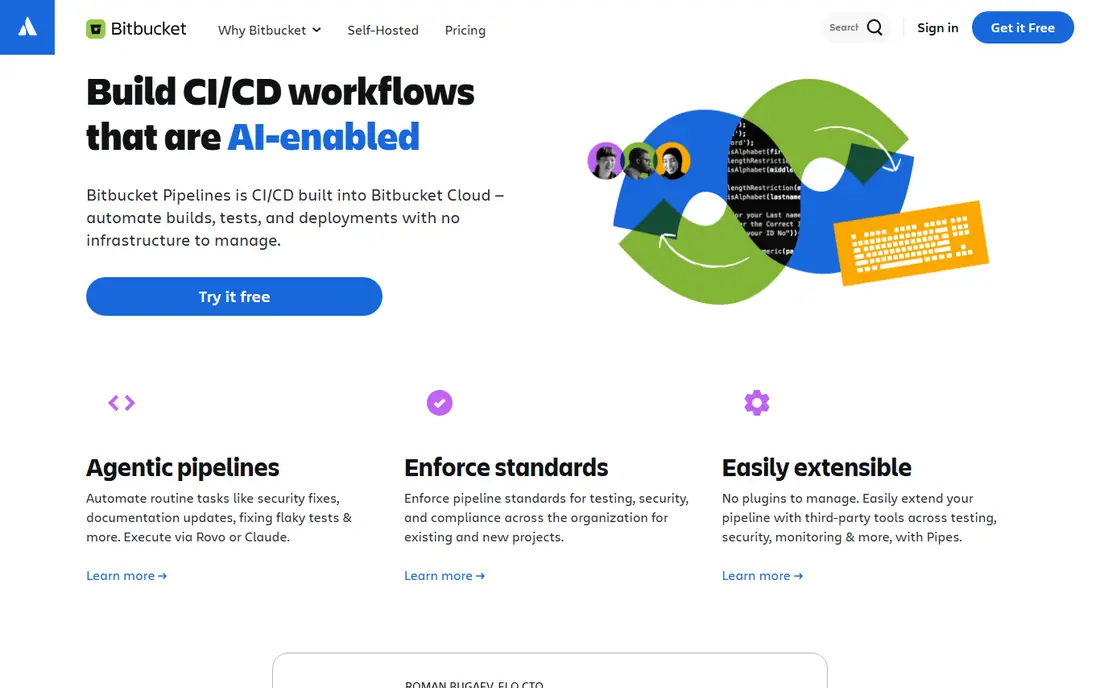
Bitbucket Pipelines brings CI to Bitbucket Cloud without a separate server. Pipelines are defined in a bitbucket-pipelines.yml file, builds run in Docker containers, and integration with Jira and Confluence ties code to issues. The free tier covers small teams with monthly build minutes.
There is no self-hosted option, and larger teams pay for minutes. For a team already on Bitbucket and Jira, Pipelines is the simplest CI path with nothing new to maintain.
What we like- CI built into Bitbucket with no extra server
- Simple YAML configuration
- Atlassian integration
Watch out for- Cloud-only, so no self-hosted option
- Minutes-based pricing for larger teams

#8Harness
Best for: Enterprise delivery platform4.6/5 on
G2 (336 reviews, checked Oct 2026)
Visit harness.io
Starting priceSee website
Free planFree trial
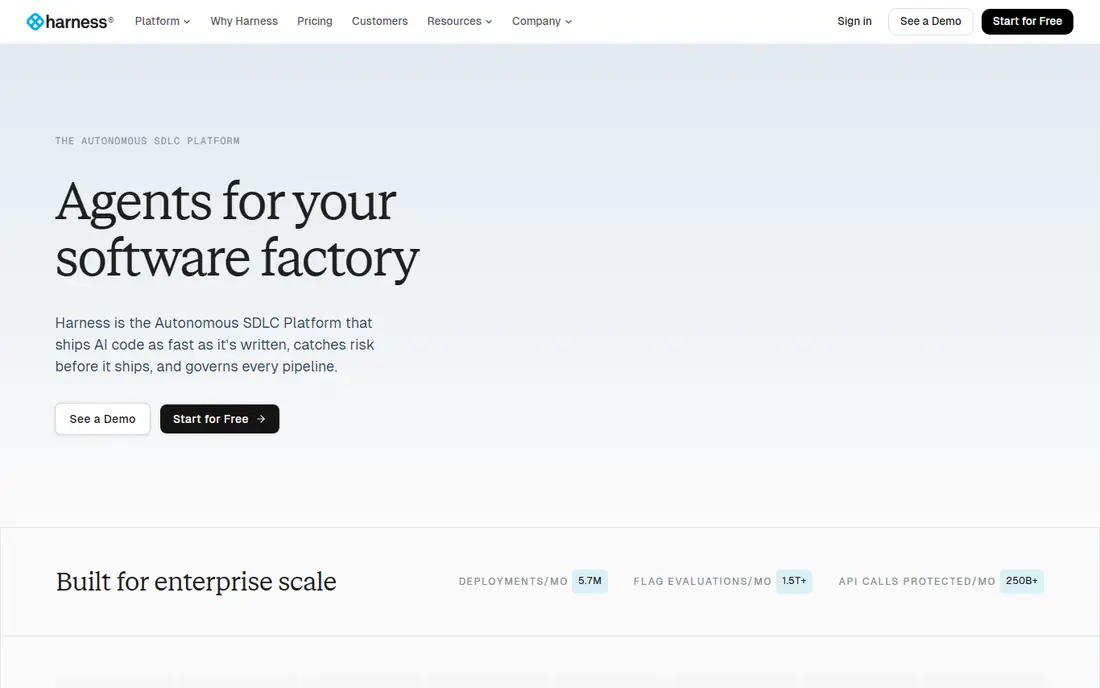
Harness is a delivery platform that goes beyond CI into continuous delivery, feature flags and cloud cost management. AI-driven verification watches deployments and can roll back on failure signals, and governance features cover approvals, policies and audit trails. The platform targets enterprises with complex deployment needs.
Pricing and complexity suit larger organisations, not small teams that need simple CI. For an enterprise that wants delivery, verification and governance in one platform, Harness is the most complete option here.
What we like- Continuous delivery with AI-driven verification
- Broad deployment targets
- Strong governance and policy
Watch out for- Enterprise pricing and complexity
- Overkill for small teams
How we chose
We compared tools on their published pipeline features, pricing pages, documentation and public reviews from engineering teams. We favoured tools with pipeline-as-code, strong caching or speed features, and a clear hosting story. Prices were marked "See website" because minute, credit and runner pricing varies. We did not claim hands-on testing.
Migrating from Jenkins without breaking builds
Start by inventorying your Jenkins setup: plugins in use, shared libraries, secrets handling and agent types. Cloud alternatives replace many plugins with marketplace actions or orbs, but some custom Groovy logic will need rewriting as scripts or actions. Secrets move to the new platform's secret store, and agent-specific builds need runner equivalents.
Migrate one repository first, running old and new pipelines in parallel until results match. Watch build times and flaky tests, since caching behaviour differs between platforms. Once the pilot passes, migrate teams in waves, keeping Jenkins running until the last pipeline moves. A parallel run catches more problems than a big-bang switch.
Migrating CI/CD pipelines works best one repository at a time. Pick a low-risk service, rebuild its pipeline in the new tool alongside the old one, and run both for a few weeks, comparing build times, failure rates and the effort needed to debug failures. This parallel run exposes gaps, such as missing plugins, secret handling differences or caching behaviour, before any critical service depends on the new system. Document the pipeline as code from the start, since click-built pipelines become unrepeatable and painful to audit. Also plan secret rotation during migration, because copying secrets between systems is the moment leaks happen, and a fresh set of credentials for the new tool removes that risk.
Pipeline observability saves more time than pipeline speed. Add clear stage names, timing logs and failure notifications that name the failing step and link directly to its logs, so a developer woken by a failed build finds the cause in minutes rather than digging through raw output. Keep build history for at least a month, since patterns such as flaky tests or slow dependency downloads only appear across many runs. Alert on failure rate changes, not just single failures, because a pipeline that fails ten percent more often this week signals a real problem. Teams that invest in observability debug faster and trust their pipelines more, which is worth more than shaving a minute off build time.
Frequently asked questions
What is the best alternative to Jenkins?
GitHub Actions is the best alternative for teams on GitHub, with pipelines beside code and a large action marketplace. GitLab CI/CD suits teams that want one platform for everything, while CircleCI suits teams that prioritise build speed. The best pick depends on where your code lives.
Is GitHub Actions free?
GitHub Actions is free for public repositories, with a monthly minute allowance for private repos. Paid plans add more minutes and larger runners. Small teams and open-source projects usually fit within the free allowance, while heavy private builds need a paid plan.
Can I self-host CI instead of using cloud runners?
Yes. Jenkins, TeamCity and GitLab support self-hosting, and Buildkite runs agents on your infrastructure with cloud orchestration. Self-hosting gives control over hardware and security but adds maintenance work that cloud runners remove.
How long does it take to migrate from Jenkins?
A single repository can migrate in days, while a large Jenkins estate with many plugins and shared libraries can take weeks or months. Migrating one pilot repo first, then teams in waves, keeps risk low. Budget time for rewriting custom pipeline logic and testing build parity.
What is the difference between CI and CD?
Continuous integration builds and tests code on every commit, catching problems early. Continuous delivery extends that by deploying passing builds to staging or production, often with approvals. Most tools here cover both, though some, like Harness, focus more on the delivery side.
Does CircleCI support Docker?
Yes, CircleCI has strong Docker support, including Docker layer caching, custom images and orbs for common Docker workflows. That caching is a major reason teams choose CircleCI for containerised builds, since it cuts repeat build times significantly.
Sources we checked (8)
- https://github.com/features/actions
- https://about.gitlab.com
- https://circleci.com
- https://www.buildkite.com
- https://www.jetbrains.com/teamcity/
- https://azure.microsoft.com/en-us/products/devops
- https://bitbucket.org/product/features/pipelines
- https://www.harness.io
Is your product missing or out of date?
We review this list regularly. Vendors can request a listing, send updated pricing or ask about featured placement.

Shihab Mia · Founder, Rankite
Shihab has 5+ years in B2B and SaaS SEO. He writes Rankite's software buying guides from pricing pages, documentation and public user reviews. More about Shihab.
 GitHub Actions
 GitLab CI/CD
 Azure DevOps
 Bitbucket Pipelines