How we make this list: we compare pricing pages, product documentation and public user reviews. Ratings come from G2, Capterra or Trustpilot, with the date we checked them.
Key takeaways
- BrowserStack and Sauce Labs are the full platform swaps: real devices plus desktop browsers, priced per parallel session from 175 and 199 dollars a month for real device automation.
- TestMu AI, the rebranded LambdaTest, undercuts on entry with a free tier and 15 dollar web plans, reaching the same 199 dollars at real device automation parity.
- HeadSpin is the pick when deployment is the issue: cloud now, on premises and private devices later, from 49 dollars a month at its Lite tier.
- Kobiton meters by minutes, from 83 dollars a month for 500. Most rivals meter by parallel sessions with unlimited minutes, so your CI shape, not the sticker, decides which is cheaper.
Quick comparison
| Tool | Best for | Starting price | Free plan |
|---|
 BrowserStack | Devices plus browsers in one platform | $29 per month | No |
 Sauce Labs | Enterprise testing with governance | $39 per month | No |
 TestMu AI | Value device and browser cloud | $15 per month | Yes |
 HeadSpin | Private and on premises device labs | $49 per month | No |
 pCloudy | Real device breadth, quote priced | See website | No |
 Perfecto by Perforce | Regulated enterprise mobile testing | See website | No |
 AWS Device Farm | Pay per use device testing in AWS | See website | Yes |
 Firebase Test Lab | Android and iOS testing in Google's cloud | See website | Yes |
Is your product missing or out of date?
We review this list regularly. Vendors can request a listing, send updated pricing or ask about featured placement.
The best Kobiton alternatives
#1BrowserStack
Best for: Devices plus browsers in one platform4.4/5 on
G2 (3,361 reviews, checked Oct 2026)
Visit browserstack.com
Starting price$29 per month
Free planNo
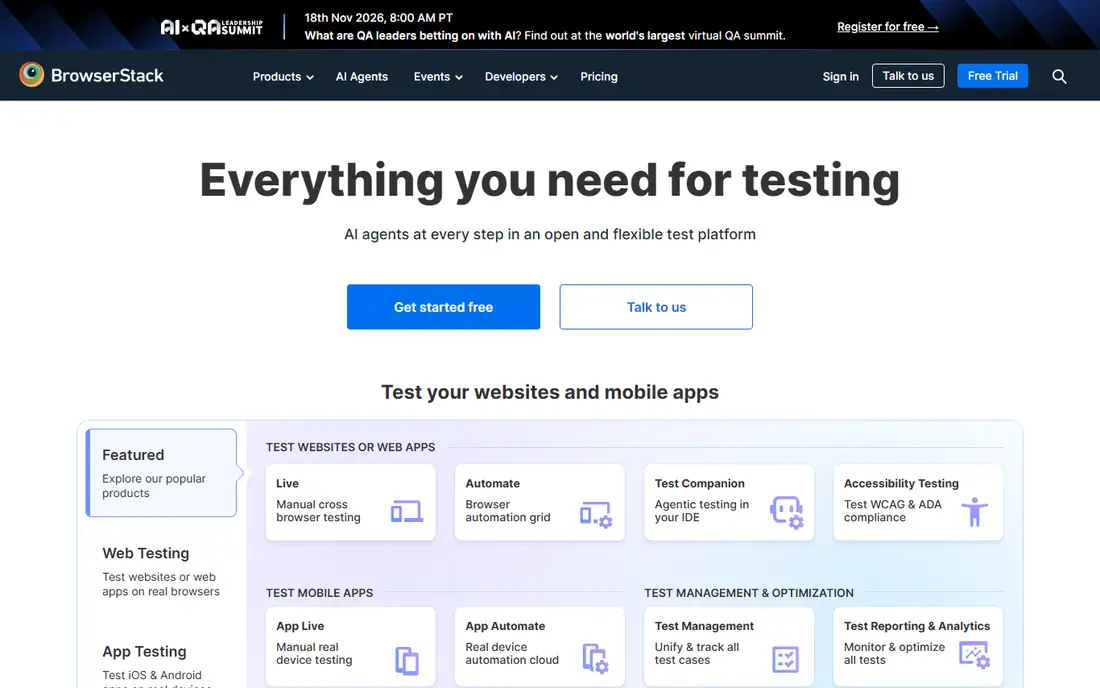
What we like- BrowserStack is the largest general testing cloud: thousands of real devices, 3,500 plus by its count and far more in some published tallies, plus the full desktop browser matrix, live manual testing from 29 dollars a month and real device automation at 175 dollars per parallel per month on annual billing. Unlimited minutes and unlimited team members per parallel simplify the maths at CI scale. If Kobiton's mobile only scope is the complaint, BrowserStack is the complete platform answer.
Watch out for- Real device automation at 175 dollars per parallel means a five parallel pipeline is a serious line item before anyone writes a test. Its device count claims vary between its own pages and third party checks. Residency controls sit on enterprise tiers, and the product sprawl, visual testing, accessibility, test management sold alongside, makes the pricing page a study exercise.
#2Sauce Labs
Best for: Enterprise testing with governance4.3/5 on
G2 (185 reviews, checked Oct 2026)
Visit saucelabs.com
Starting price$39 per month
Free planNo
What we like- Sauce Labs runs the other enterprise device cloud: virtual devices at 149 dollars per parallel per month, Real Device Cloud at 199, live testing from 39 dollars, and the governance, analytics and compliance posture regulated enterprises require. Its error reporting and test analytics are a genuine differentiator for large suites, and its framework support spans the Appium and web ecosystem completely. One region per account by default, with multi region on enterprise, suits data policy conversations.
Watch out for- Mirrors BrowserStack's per parallel economics almost exactly, so the saving from switching is rarely the reason
- Features and contracts decide. Real devices are the expensive tier, and simulator only work overpays here if your app tolerates virtual devices. Enterprise sales gravity means small teams feel like small accounts.
Starting price$15 per month
Free planYes
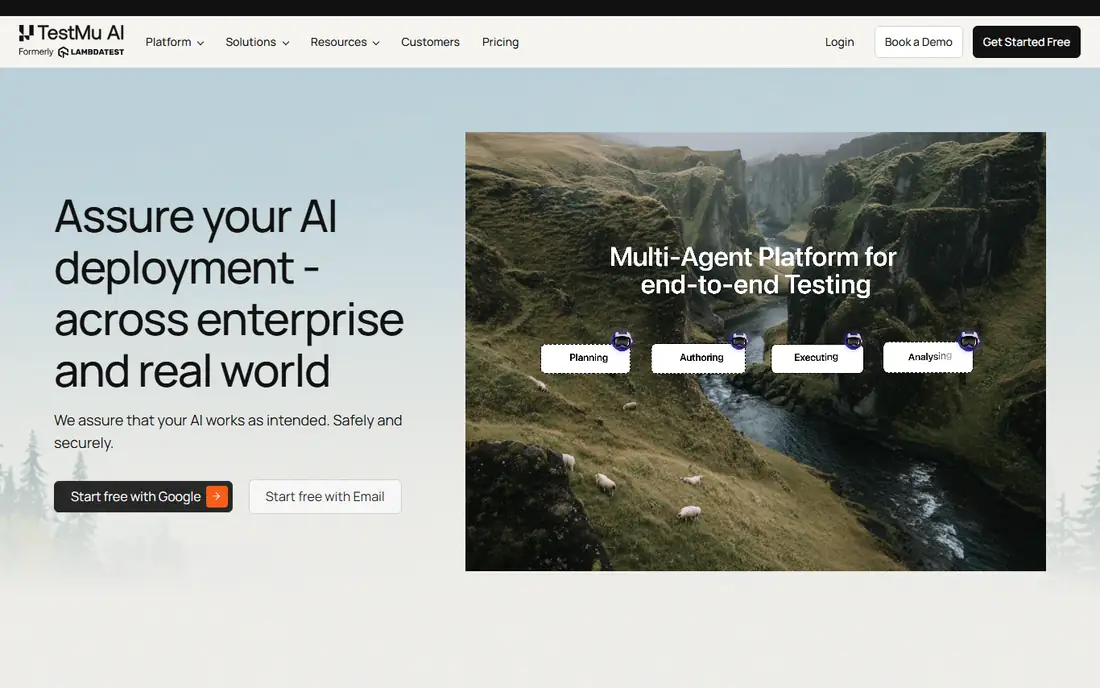
What we like- TestMu AI, the 2026 rebrand of LambdaTest, is the value route into the same category: a permanent free tier, web testing from 15 dollars a month, real device manual testing at 39, and real device automation at 199 dollars per parallel, parity with Sauce at the top and cheaper everywhere below it. Its KaneAI authoring layer writes tests from plain English and exports standard framework code. Teams leaving Kobiton for budget reasons with broad needs land here first.
Watch out for- The rebrand means older LambdaTest reviews, pricing and documentation sit beside current TestMu pages, so verify figures on the live pricing page. At real device automation it is not cheaper than Sauce Labs, just cheaper to start. Device fleet size claims, 10,000 plus combinations, count combinations rather than physical units, as do all rivals' numbers.
Starting price$49 per month
Free planNo
What we like- HeadSpin's distinction is deployment: start on its cloud from a reported 49 dollars a month at Lite, and move to dedicated, on premises or even air gapped device deployments on its Pro tiers, which is the path regulated and privacy bound teams actually need. It also measures real user experience signals, performance and quality metrics from devices around the world, beyond pass and fail. Kobiton users drawn by its private cloud story will find HeadSpin the most complete version of it.
Watch out for- The deployment flexibility that matters lives on custom priced plans, so the published Lite price is a beginning. Its performance measurement depth is more than a functional testing team needs, and priced accordingly. Smaller community and knowledge base than BrowserStack or Sauce for self help at midnight.
Starting priceSee website
Free planNo
What we like- PCloudy claims 5,000 plus real devices and 3,500 plus browser combinations, with continuous testing, device tunnelling for local builds and AI assisted features, positioned like for like against Kobiton's mobile cloud with web testing included. Enterprise and BFSI customers feature heavily in its base, and private and dedicated device options follow the regulated pattern.
Watch out for- No public pricing at all in current comparisons, so evaluation starts with a sales call and a proof of concept. Its brand gravity outside its core markets is lower, which thins peer reviews for the specific device and OS combinations you may need. Claims on fleet size, like every vendor's, deserve verification against your device matrix during the trial.
#6
Perfecto by Perforce
Best for: Regulated enterprise mobile testing
Visit perfecto.io
Starting priceSee website
Free planNo
What we like- Perfecto is the enterprise mobile testing veteran inside Perforce: real and virtual devices, scriptless and coded automation, strong reporting, and on premises or hybrid deployment for organisations whose devices and data cannot sit in a public cloud. Banks and healthcare organisations form its core references. Its test failure analysis and stability tooling serve very large suites where flake management is a programme, not an annoyance.
Watch out for- Quote only, enterprise priced, with an implementation weight to match. The platform's breadth and age mean a learning curve the lighter clouds avoid. For a team whose need is fifty devices and a CI pipeline, Perfecto is more machinery than the job asks for.
Starting priceSee website
Free planYes
What we like- AWS Device Farm sells device time the AWS way: real Android and iOS devices at 0.17 dollars per device minute in current comparisons, with a limited free trial pool, no subscription and no parallels to buy. Bursty testing, a release candidate hammered for a week then nothing for a month, fits this meter better than any subscription. It runs standard Appium, Espresso and XCUITest suites, and private device options exist for committed fleets.
Watch out for- Per minute billing punishes slow suites and idle device time with the same meter, and costs at sustained CI volume overtake the subscriptions quickly. The console and reporting are utilitarian next to the dedicated platforms. Desktop browsers are not its business
- It pairs with something else for web coverage.
Starting priceSee website
Free planYes
What we like- Firebase Test Lab runs tests on Google's physical and virtual devices, integrated with the Firebase and Android Studio workflows mobile teams already use, with a free daily quota on the no cost plan and paid usage reported around 5 dollars per device hour for physical devices. Robo tests crawl your app without scripts, catching crashes for teams with no automation at all. Android first teams inside Google's ecosystem get device testing almost as a by product.
Watch out for- It is a test execution service, not a device cloud for manual exploration: interactive device access and the broader tooling of BrowserStack or Sauce are not the offer. iOS support exists but the platform's heart is Android. Reporting and cross platform suite management are thinner than the commercial clouds, and heavy use needs the paid Blaze plan's budgeting care.
How we chose
Kobiton itself is excluded because this article covers its alternatives. We selected real device testing platforms in active operation in October 2026 spanning the public clouds, private deployment specialists, pay per use and ecosystem options. Prices come from vendor pricing pages as checked by current comparisons in August and October 2026; where vendors publish nothing we wrote see website. Metering models, per minute, per parallel, per device hour, are stated in each entry because they decide real cost. Device fleet numbers are vendor claims and are labelled as such. Nothing was hands on tested.
How to choose your Kobiton alternative
Price your pipeline's shape before any vendor call. Count your peak parallel need, set by how fast CI must finish, and your monthly device minutes. Flat parallels with unlimited minutes, BrowserStack, Sauce, TestMu, win when pipelines run constantly. Kobiton style minute plans and AWS's per minute meter win when testing is bursty. Choosing the wrong meter costs more than choosing the wrong vendor on the right one.
Then verify the fleet against your matrix: your top twenty device and OS combinations from your own analytics, your framework versions, and any private deployment or residency requirement, which narrows the field to HeadSpin, Perfecto or dedicated options fast. Run your flakiest suite in the trial on each finalist: device clouds differ in stability more than in catalogues, and the trial that reveals it is the one with your worst tests, not their demo app.
Frequently asked questions
Why do device clouds charge per parallel session?
Because the scarce resource is physical hardware: a device can run one team's test at a time. Parallels measure how many devices you can occupy simultaneously, and vendors include unlimited minutes within them. The exception models, Kobiton's minutes and AWS's per minute billing, rent the same hardware by time instead, which suits bursty workloads and punishes slow ones.
Are real devices necessary, or are emulators enough?
For most functional testing, modern emulators and simulators cover the majority of cases at a fraction of the cost, and Sauce and TestMu sell virtual tiers for exactly that. Real devices earn their price for hardware specific behaviour: cameras, sensors, biometrics, carrier and battery behaviour, and the long tail of manufacturer Android builds. Mature teams run virtual for breadth in CI and real devices for release gates on their top combinations.
How does Kobiton's pricing compare with these alternatives?
Current comparisons put Kobiton from 83 dollars a month for 500 minutes, minute metered and mobile only. BrowserStack and Sauce real device automation run 175 to 199 dollars per parallel per month with unlimited minutes. A team running thousands of CI minutes monthly usually pays less on parallels; a team testing a few hundred minutes pays less on Kobiton or AWS. Your usage decides, which is why headline comparisons mislead.
Can these platforms test on devices inside our own network?
Yes, at the specialist end: HeadSpin and Perfecto offer on premises, dedicated and hybrid device labs, Kobiton itself has private options, and AWS sells private devices. Public cloud only vendors cannot meet that requirement at any tier, so state it in the first conversation rather than discovering it in the security review.
What should we check in a device cloud trial?
Your exact device matrix availability at your peak hour, not just in the catalogue, your framework and CI integration working end to end, video and log quality on a deliberately failed test, and flake rate on your least stable suite. Then model the production bill at your real parallels and minutes. Device clouds demo beautifully and invoice arithmetically; the trial should test both.
Sources we checked (0)
Is your product missing or out of date?
We review this list regularly. Vendors can request a listing, send updated pricing or ask about featured placement.

Shihab Mia · Founder, Rankite
Shihab has 5+ years in B2B and SaaS SEO. He writes Rankite's software buying guides from pricing pages, documentation and public user reviews. More about Shihab.