How we make this list: we compare pricing pages, product documentation and public user reviews. Ratings come from G2, Capterra or Trustpilot, with the date we checked them.
Key takeaways
- Fivetran and Stitch suit teams that want managed connectors and less pipeline upkeep, with pricing tied to usage or rows synced.
- Airbyte suits teams that want open-source control, self-hosting, and a large connector catalog without a high entry cost.
- Hevo Data suits small and mid-size teams that need a simple setup, real-time sync, and clear pipeline monitoring.
- Matillion, Talend, Informatica, and SnapLogic suit larger data teams that need transformation, governance, and enterprise controls.
Quick comparison
| Tool | Best for | Starting price | Free plan |
|---|
 Fivetran | Managed ELT connectors | See website | Free trial |
 Stitch | Simple managed ELT | See website | Free trial |
 Airbyte | Open-source data pipelines | See website | Yes |
 Hevo Data | Simple real-time pipelines | See website | Yes |
 Matillion | Cloud data transformation | See website | Free trial |
 Talend | Enterprise data integration | See website | Free trial |
 Informatica | Enterprise data governance | See website | Free trial |
 SnapLogic | Low-code enterprise integration | See website | Free trial |
Is your product missing or out of date?
We review this list regularly. Vendors can request a listing, send updated pricing or ask about featured placement.
The best Integrate.io alternatives for data teams
Integrate.io, formerly Xplenty, combined ETL, ELT, and reverse ETL in a low-code platform. Teams that used it often need three things from a replacement: connectors that pull data from apps and databases, transformation that cleans and models that data, and a destination such as a warehouse or a lake. The tools below split on how much they manage for you. Managed ELT tools handle connectors and sync, so your team focuses on models. Open-source and low-code platforms give more control, but they also ask for more setup and upkeep. Start with data volume, connector needs, and team skills.
#1Fivetran
Best for: Managed ELT connectors4.3/5 on
G2 (841 reviews, checked Oct 2026)
Visit fivetran.com
Starting priceSee website
Free planFree trial
Fivetran moves data from apps, databases, and files into a warehouse or lake, with connectors that handle schema changes, incremental sync, and retries. A data team connects a source, picks a destination, and lets Fivetran manage the sync schedule and failure handling. That managed model saves engineering time, especially for common sources such as Salesforce, Shopify, Google Ads, and Postgres. Transformations happen in the warehouse, often with dbt, rather than inside Fivetran itself.
Pricing is usage-based, tied to monthly active rows and other consumption measures, so costs grow with data volume and source count. Teams with large, fast-changing tables should model costs from real row counts, not from a demo. Fivetran fits teams that value reliability and low upkeep over the lowest possible price. Teams that need heavy in-pipeline transformation or many custom sources may pair it with a transformation tool, or choose a more flexible platform.
What we like- Large managed connector catalog
- Automated schema changes and sync handling
- Strong warehouse and lake destinations
Watch out for- Usage-based pricing can rise with row volume
- Custom sources need extra work compared with code-first tools
Starting priceSee website
Free planFree trial
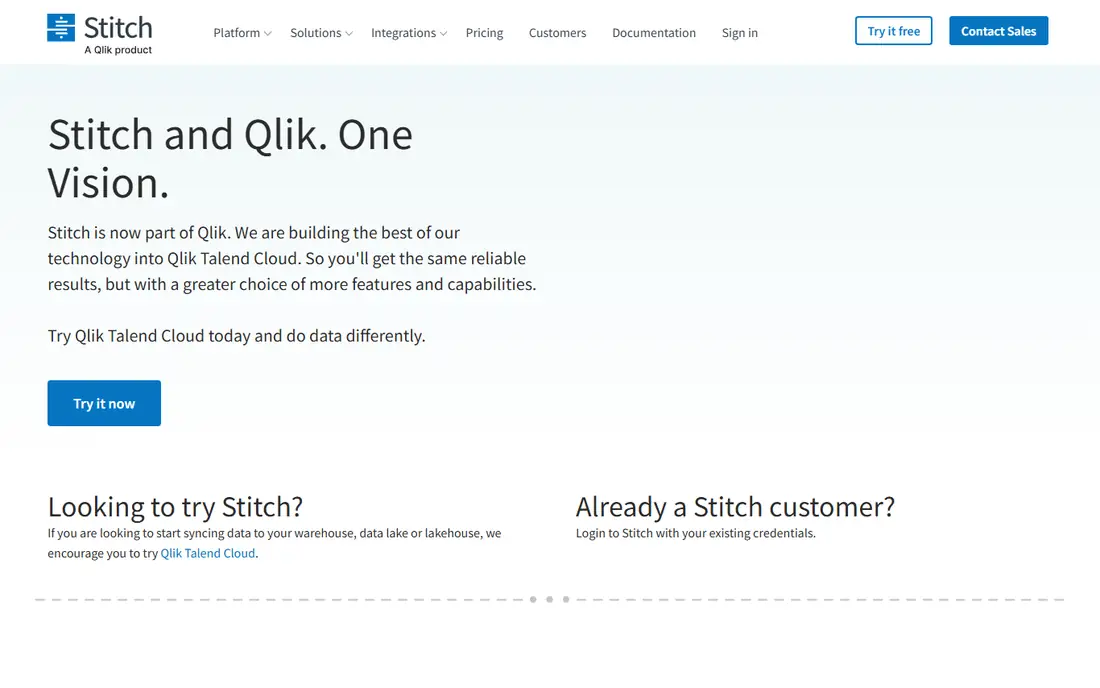
Stitch, owned by Talend, offers managed ELT with a focus on simplicity. A user connects a source, selects tables, picks a destination warehouse, and sets a replication schedule. Stitch handles incremental replication, schema changes, and error alerts, which keeps pipeline work low for small data teams. The interface is straightforward, and the setup for a standard source often takes less than an hour once credentials are ready.
The catalog is smaller than Fivetran, and teams with many niche sources may hit gaps. Transformation is also limited inside Stitch, so most teams model data in the warehouse with SQL or dbt. Stitch fits startups and small analytics teams that need reliable sync for common sources without a dedicated data engineering team. Larger teams with complex sources or heavy transformation needs will likely need a broader platform.
What we like- Simple setup for standard sources
- Managed sync and schema handling
- Clear pipeline monitoring for small teams
Watch out for- Smaller connector range than Fivetran
- Advanced transformation happens outside Stitch
#3Airbyte
Best for: Open-source data pipelines4.4/5 on
G2 (78 reviews, checked Oct 2026)
Visit airbyte.com
Starting priceSee website
Free planYes
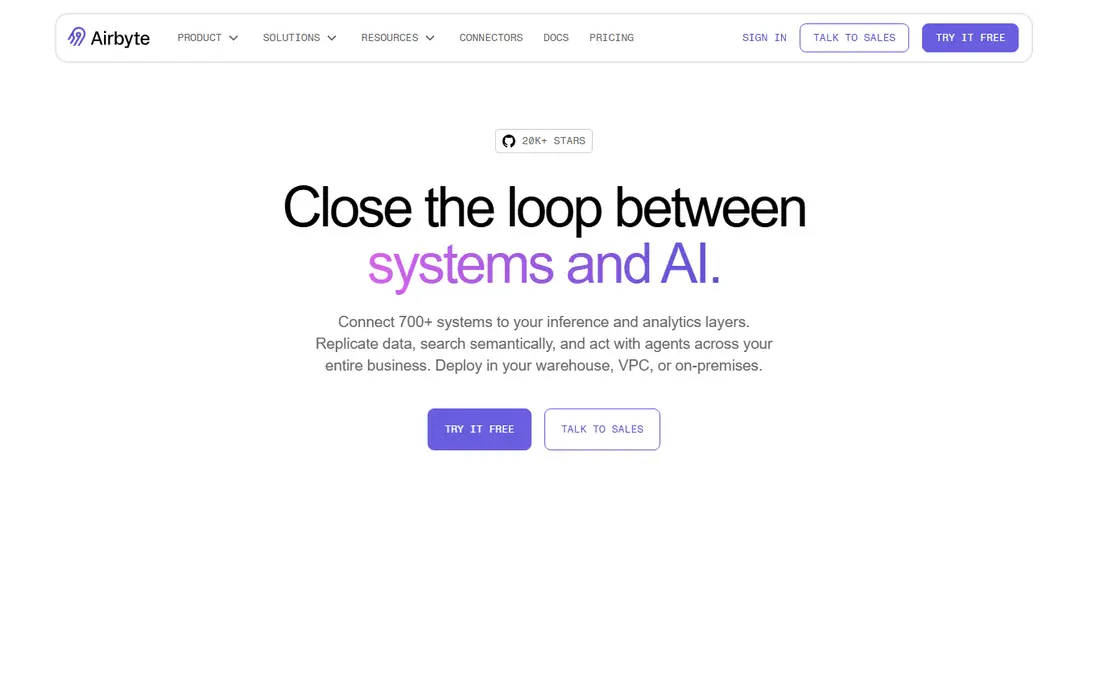
Airbyte is an open-source data integration platform that teams can self-host or run on Airbyte Cloud. It offers a large catalog of connectors, including community-built connectors, and it supports ELT into warehouses, lakes, and databases. Teams can build a custom connector with the low-code connector builder or the Python CDK when a source is missing. That openness makes Airbyte a strong pick for teams with unusual sources or strict data control needs.
Self-hosting gives control over cost and data location, but it also means the team handles upgrades, monitoring, scaling, and security. Airbyte Cloud removes that burden for a usage-based price. Airbyte fits engineering-led teams that want open-source flexibility and are willing to maintain a platform. Non-technical teams that want a fully managed setup may find Fivetran or Stitch simpler.
What we like- Open-source core with self-hosting
- Large connector catalog including community connectors
- Flexible deployment options
Watch out for- Self-hosting needs engineering upkeep
- Managed cloud pricing depends on volume and features
#4Hevo Data
Best for: Simple real-time pipelines4.4/5 on
G2 (295 reviews, checked Oct 2026)
Visit hevodata.com
Starting priceSee website
Free planYes
Hevo Data is a no-code pipeline platform for moving data from apps, databases, and SaaS tools into a warehouse. Setup uses a visual interface, with source and destination configuration, field mapping, and transformation steps that do not require code. Pipelines can run in near real time for sources that support it, which suits dashboards and operational reports that need fresh data. Monitoring shows pipeline health, lag, and errors in one view.
Hevo includes a free plan with limited events, which lets a small team test a real pipeline before paying. Paid plans scale by events and features. Connector depth varies, so check your exact sources, especially for less common apps or on-premise databases. Hevo fits small and mid-size teams that want a simple, visual pipeline tool with real-time options. Enterprise teams with strict governance needs may need a larger platform.
What we like- Simple no-code setup
- Real-time and near real-time sync options
- Built-in transformation and monitoring
Watch out for- Connector depth varies by source
- Larger enterprise governance features are thinner than Informatica or Talend
#5Matillion
Best for: Cloud data transformation4.4/5 on
G2 (83 reviews, checked Oct 2026)
Visit matillion.com
Starting priceSee website
Free planFree trial
Matillion builds ETL and ELT jobs visually for cloud data platforms, with strong support for Snowflake, BigQuery, Databricks, and Redshift. Data engineers design jobs with components for extraction, transformation, and loading, then schedule and orchestrate them inside Matillion. The platform suits teams whose warehouse is the center of analytics, because transformation logic runs close to the data and can use warehouse compute efficiently.
Matillion is less central for teams that still run on-premise databases or need broad SaaS-to-SaaS integration outside the warehouse. Pricing uses credits or usage measures that depend on job size and frequency, so model costs from real job runs. Matillion fits cloud-first data teams that need visual transformation and orchestration. Teams that only need simple source-to-warehouse sync may find Stitch or Hevo simpler and cheaper.
What we like- Visual transformation jobs for cloud warehouses
- Strong Snowflake, BigQuery, and Databricks support
- Orchestration and scheduling built in
Watch out for- Focused on cloud warehouses, not on-premise stacks
- Pricing and credits need careful modeling
#6Talend
Best for: Enterprise data integration4.0/5 on
G2 (65 reviews, checked Oct 2026)
Visit talend.com
Starting priceSee website
Free planFree trial
Talend covers data integration, data quality, and data governance in one platform, with tools for batch, real-time, and API integration. Teams can build jobs visually, apply data quality rules, profile data, and manage metadata across sources. That breadth suits enterprises that need to clean, govern, and move data across many systems, including on-premise databases and cloud apps. Talend also owns Stitch, so teams can mix managed ELT for simple sources with Talend jobs for complex work.
The breadth is also a drawback for small teams. Setup, licensing, and learning time exceed simple ELT tools, and a small analytics team may not use most features. Talend fits larger organizations with data governance needs, mixed on-premise and cloud systems, and dedicated data engineers. Smaller teams should start with a managed ELT tool and move to Talend only when governance or complex transformation becomes a real need.
What we like- Broad integration, data quality, and governance features
- Large connector set
- Strong on-premise and cloud support
Watch out for- Platform can feel heavy for small teams
- Setup and learning time are higher than simple ELT tools
Starting priceSee website
Free planFree trial
Informatica Intelligent Data Management Cloud covers integration, data quality, master data management, governance, and cataloging. For large enterprises, the value is not only moving data, but knowing where data came from, who can use it, and how it changed. Lineage, catalog, and governance features help regulated industries meet audit and compliance needs. Integration tools handle batch and real-time pipelines across cloud and on-premise systems.
Cost and complexity are the main barriers. Pricing is often quote-based, and implementation usually needs experienced data engineers or a partner. Small and mid-size teams will find Informatica heavy for simple warehouse sync. Informatica fits enterprises with governance, compliance, and large-scale integration needs, where the cost of poor data quality or failed audits exceeds the platform price.
What we like- Enterprise-grade integration, quality, and governance
- Strong metadata and lineage
- Broad cloud and on-premise support
Watch out for- Pricing is enterprise-level and often quote-based
- Implementation needs skilled staff or partners
#8SnapLogic
Best for: Low-code enterprise integration4.4/5 on
G2 (404 reviews, checked Oct 2026)
Visit snaplogic.com
Starting priceSee website
Free planFree trial

SnapLogic is a low-code integration platform for connecting apps, data, and APIs. Users build pipelines, called Snaps, in a visual designer, with AI assistance for building and documenting integrations. The platform covers application integration, data integration, and API management, which suits enterprises that need both SaaS-to-SaaS workflows and warehouse pipelines. Prebuilt connectors cover major enterprise apps, databases, and cloud platforms.
Buying is sales-led and pricing is enterprise-level, so small teams should expect a quote process rather than a simple self-serve checkout. The platform also carries more features than a simple ELT team needs. SnapLogic fits mid-size and large organizations that want low-code integration across apps and data, with AI help for building pipelines. Teams that only need warehouse sync will likely find a simpler ELT tool faster and cheaper.
What we like- Visual low-code integration with AI assistance
- Application and data integration in one platform
- Strong enterprise connectors
Watch out for- Enterprise pricing and sales-led buying
- Smaller teams may find it more than they need
How we chose
We compared vendor documentation, pricing pages, and public reviews on G2, Capterra, and Reddit, focusing on connector coverage, sync reliability, transformation options, deployment choices, and fit for different team sizes. Each tool here exists today and serves data integration or ELT work a US reader can buy or trial. Where a price could not be confirmed at the time of writing, the entry reads See website, because data pricing often depends on volume, sources, and deployment. We did not run hands-on pipeline tests, and the order reflects managed ease, openness, and enterprise depth rather than a lab score.
Sizing a replacement before you migrate
A data pipeline migration fails most often on volume, connector gaps, or transformation logic that was hidden in the old tool. Before you switch, list every source, destination, and transformation step in current use. Include scheduled jobs, reverse ETL flows that send warehouse data back to apps, and any custom scripts that clean data before loading. That list becomes the test plan for the new tool.
Test connectors with real data, not demos
Connect each critical source with real credentials in a trial, and sync a full table, not only a sample. Check how schema changes, deleted records, and large tables are handled. A connector that works on a demo table can still struggle with a large production table, a custom field, or an API rate limit.
Model cost from real row and event counts
Managed tools price by rows, events, credits, or compute, and those measures differ across vendors. Pull row counts, sync frequency, and table change rates from your current system for a full month. Run the same workload in a trial where possible, and compare the modeled bill, not the headline starter price.
Plan transformation ownership
Decide where transformation will live: inside the pipeline tool, in the warehouse with SQL or dbt, or in a separate transformation layer. Managed ELT tools push transformation to the warehouse, while Matillion, Talend, and Informatica handle more inside the platform. A clear choice prevents duplicate logic and makes future changes easier to trace.
Frequently asked questions
What is the best Integrate.io alternative for small teams?
Stitch and Hevo Data are strong small-team picks, because both offer managed sync with simple setup and clear monitoring. Airbyte is also strong for engineering-led small teams that want open-source control and self-hosting. Pick Stitch or Hevo for managed ease, and Airbyte for control and custom connectors.
Can I self-host an Integrate.io alternative?
Yes. Airbyte offers a self-hosted open-source edition, and Talend and Matillion offer deployment options that include private cloud or on-premise setups in some plans. Self-hosting gives control over data and cost, but it also means your team handles upgrades, monitoring, and security. Managed cloud plans remove that work for a usage-based price.
Do these tools handle reverse ETL?
Some do, and some focus only on loading data into a warehouse. If you need to send warehouse data back to a CRM, ad platform, or support tool, check that feature directly for each candidate. A tool that only loads data will leave reverse ETL to a separate product, which adds cost and upkeep.
How do I handle data transformation after migration?
Most managed ELT tools expect transformation in the warehouse, using SQL or dbt, after data is loaded. Matillion, Talend, Informatica, and SnapLogic offer more transformation inside the platform. Choose one home for transformation logic, document it, and avoid splitting the same logic across two tools.
Which alternative is best for real-time data?
Hevo Data offers near real-time sync for supported sources, and Fivetran, Airbyte, and other tools offer frequent sync schedules that suit many dashboards. True real-time needs depend on source APIs, which often limit how often data can be pulled. Check sync frequency for your exact sources, not only the marketing claim for the platform.
Is open-source cheaper than managed ELT?
Open-source software can be free, but hosting, engineering time, monitoring, and upgrades still cost money. For a small team without data engineering capacity, a managed tool often costs less in total time, even with a subscription. For a team with engineering capacity and high volume, self-hosting can save a large amount over time.
Sources we checked (8)
- https://fivetran.com/pricing
- https://www.stitchdata.com/pricing/
- https://airbyte.com/pricing
- https://hevodata.com/pricing/
- https://www.matillion.com/pricing
- https://www.talend.com/pricing/
- https://www.informatica.com/pricing/
- https://www.snaplogic.com/pricing
Is your product missing or out of date?
We review this list regularly. Vendors can request a listing, send updated pricing or ask about featured placement.

Shihab Mia · Founder, Rankite
Shihab has 5+ years in B2B and SaaS SEO. He writes Rankite's software buying guides from pricing pages, documentation and public user reviews. More about Shihab.