How we make this list: we compare pricing pages, product documentation and public user reviews. Ratings come from G2, Capterra or Trustpilot, with the date we checked them.
Key takeaways
- PostGraphile is the closest Hasura replacement for Postgres teams, generating a GraphQL API from your database schema in seconds.
- Supabase is the best full backend pick, with Postgres, auth, instant REST APIs, realtime, storage, and vector search in one open-source platform.
- Prisma is the best TypeScript pick, with a free ORM, a free Postgres tier, and operation-based pricing with spend limits.
- AWS AppSync suits AWS shops, with serverless GraphQL and pub/sub APIs, instant DynamoDB and Aurora APIs, and pay-per-use pricing.
- Apollo GraphOS and WunderGraph Cosmo lead for federation, unifying many services into one governed supergraph.
Quick comparison
Is your product missing or out of date?
We review this list regularly. Vendors can request a listing, send updated pricing or ask about featured placement.
The best Hasura alternatives
Starting priceFree
Free planYes
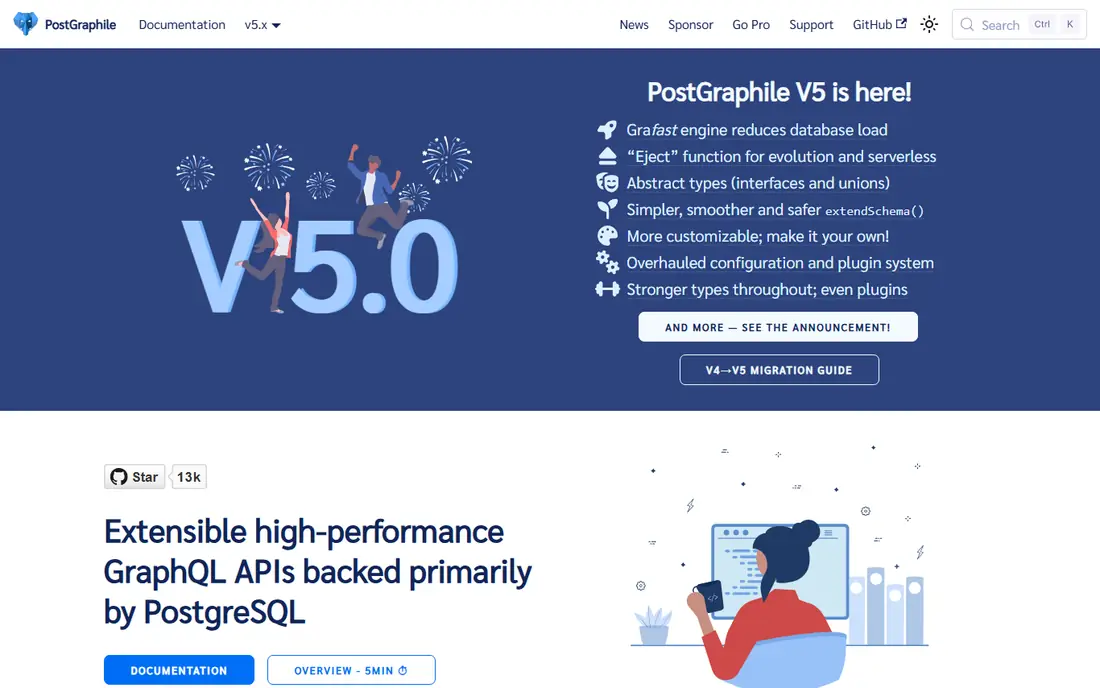
PostGraphile describes itself as a way to craft your perfect API, and its homepage shows the speed: run one command with your Postgres connection string and you are running, trying it out without investing large amounts of time. Its version 5 engine, Gra*fast, brings a new holistic approach with simpler abstractions, better performance, and code that is easier to read and maintain, while Graphile Starter provides a full-stack foundation with user registration, session management, and a job queue.
For Postgres teams wanting Hasura's instant GraphQL without a hosted service, PostGraphile is the best pick, since it generates the API from your schema and lets you shape it precisely. Teams on other databases should look at Supabase or Prisma instead.
What we like- Get started in seconds with a single command against your Postgres database
- Version 5 built on the Gra*fast planning and execution engine for better performance
- Craft your API shape rather than accepting defaults
- Graphile Worker and Graphile Migrate included in the ecosystem
Watch out for- Postgres-only, so multi-database teams need another tool
- Open-source project with paid priority support rather than a hosted platform
Starting priceFree
Free planYes
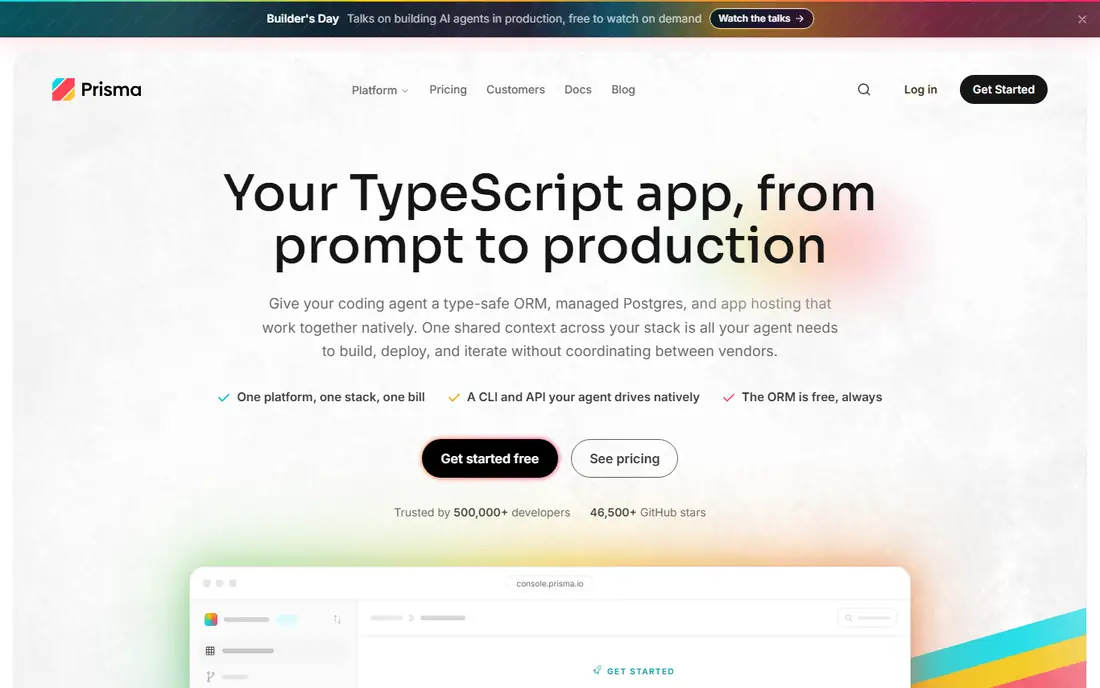
Prisma calls itself agent infrastructure for TypeScript, and its homepage explains the unified stack: ship a production TypeScript app in three steps, with your agent handling the full loop of build, deploy, debug, and redeploy, and no vendor coordination between database, ORM, and hosting. Its pricing scales with you, starting free with the ORM and a capped free Postgres tier, then moving to operation-based pricing with spend limits and unlimited database data transfer included.
For TypeScript teams building a backend around Postgres, Prisma is the best Hasura alternative, since it replaces the database, ORM, and hosting glue with one platform. It is not a GraphQL generator like Hasura, so teams needing GraphQL specifically should pair it with a GraphQL layer or choose PostGraphile.
What we like- ORM is free, always, with a free Postgres tier that has a hard cap and needs no credit card
- App and Postgres on one platform in the same region
- Spend limits on every paid tier so bills never surprise you
- SOC2, HIPAA, ISO 27001, and GDPR at the Business tier
Watch out for- Now positioned as agent infrastructure for TypeScript, so the GraphQL story is indirect
- Prisma 8 is a separate opinionated product, not a forced upgrade from Prisma 7
Starting priceFree
Free planYes
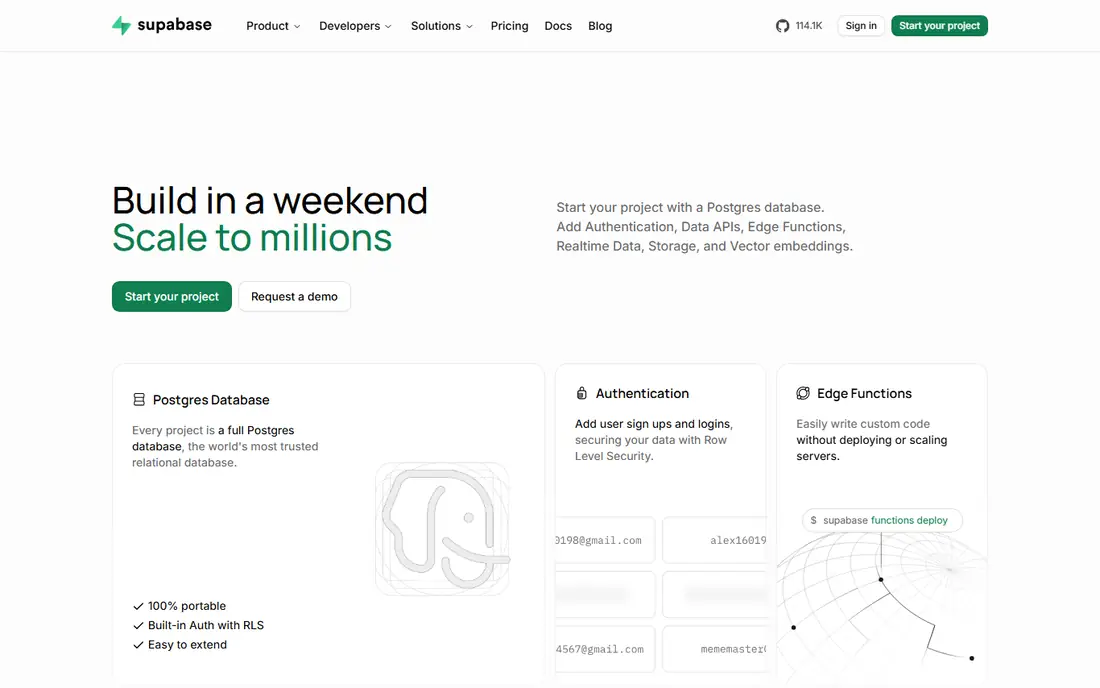
Supabase calls itself the Postgres development platform, and its homepage lists the stack plainly: Postgres database, authentication, edge functions, storage, realtime, vector embeddings, and data APIs, all usable together or separately as best-of-breed products integrated as a platform. Its open-source stance is explicit: built in the open because great developer tools should be transparent, inspectable, and owned by the community, with no lock-in and full control through self-hosting.
For teams wanting more than just an API layer, Supabase is the best Hasura alternative, since it covers auth, storage, and realtime alongside the database. GraphQL purists may miss Hasura's GraphQL-first approach, but for most new backends, Supabase's breadth wins.
What we like- Every project is a full Postgres database with instant ready-to-use REST APIs
- Auth with Row Level Security, edge functions, storage, realtime, and vector embeddings in one platform
- Open source from day one with self-hosting
- Powers millions of AI-generated apps for Lovable
Watch out for- GraphQL is not the primary API style, since instant APIs are REST
- Managed pricing scales with usage, so heavy projects need cost monitoring
Starting priceFree tier
Free planFree tier
AWS AppSync describes itself as serverless GraphQL and pub/sub APIs, and its homepage explains the model: give developers access to data from multiple databases, microservices, and AI models with a single GraphQL API request, starting quickly by instantly creating APIs from DynamoDB and Aurora. Its Events feature handles real-time use cases like score updates, chat messages, and inventory changes, managing millions of connections and billions of messages, with auth modes including API key, OIDC, Cognito, IAM, and Lambda.
For AWS-centric teams, AppSync is the best Hasura alternative, since it integrates natively with AWS data sources, Bedrock AI backends, and CloudWatch observability. Teams outside AWS should choose a cloud-neutral option like PostGraphile or Supabase instead.
What we like- Serverless GraphQL and pub/sub APIs connecting apps to events, data, and AI models
- Instantly create GraphQL APIs from DynamoDB and Aurora databases
- Federated super-graph combining multiple APIs
- Pay only for operations, connection minutes, and data transfer with a free tier
Watch out for- AWS-only, so multi-cloud teams face lock-in
- Pricing follows AWS usage, which needs monitoring at scale
Starting priceSee website
Free planSee website
Apollo GraphQL describes GraphOS as the platform to build and manage the domain model for your business, giving AI access to the systems that run your business. Its homepage explains the foundation: a shared domain model with semantics, policy, and discovery, so agents and applications can find, understand, and use services safely, with GraphOS Agent Services adding governed MCP access, identity tracking, field-level access policy, and auditing.
For large organizations unifying many APIs into one graph, Apollo GraphOS is the best Hasura alternative, since federation is its core strength. Small teams with a single database will find PostGraphile or Supabase simpler, but for enterprise API platforms, Apollo leads.
What we like- GraphOS builds and runs the domain model for your business, unifying REST, GraphQL, and SaaS APIs
- Federation, performance, security, and observability in one platform
- 2 trillion-plus monthly operations and 1 billion-plus open-source downloads
- 98 percent willing to recommend in Gartner Peer Insights
Watch out for- Enterprise platform with quote-led pricing
- Federation depth exceeds teams that only need a single-database API
Starting priceFree
Free planYes
StepZen describes itself as GraphQL-as-a-service, and its homepage is now a transition notice: StepZen is now part of IBM, and StepZen is now available as IBM API Connect Essentials, optimizing and scaling GraphQL automatically. Its promise remains building, optimizing, and scaling APIs quickly and easily, with the same developer experience for building GraphQL APIs, now running on AWS or on-premise via IBM.
For teams already in the IBM ecosystem, StepZen through IBM API Connect Essentials is a reasonable Hasura alternative, since it keeps the GraphQL-as-a-service model under IBM support. Independent teams should weigh the acquisition carefully, since the standalone StepZen brand no longer exists as a separate product.
What we like- Build GraphQL easily for free with a developer experience focused on speed
- Now available as IBM API Connect Essentials, running on AWS or on-premise via IBM
- Same developer experience carried into the IBM product
Watch out for- StepZen is now part of IBM, so buyers should evaluate IBM API Connect Essentials rather than a standalone StepZen product
- Homepage is now a transition notice
Starting priceSee website
Free planSee website
WunderGraph calls Cosmo an enterprise-ready platform for teams scaling from their first subgraph to thousands of daily operations, and its homepage explains the governance angle: build and run your supergraph with governance and no lock-in, with composition checks catching problems before they ship and every field owned and explorable. Its customers report real savings, including Acoustic saving an estimated $178,000 on feature building and SoundCloud cutting infrastructure costs from $14,000 to $9,750.
For teams wanting Apollo-style federation without vendor lock-in, WunderGraph is the best Hasura alternative, since its open-source router and self-host option keep control with your team. Single-database teams may prefer PostGraphile, but for federated graphs, Cosmo is a strong open choice.
What we like- Open-source GraphQL federation with governance and no lock-in
- Cosmo runs supergraphs at scale past 20 subgraphs
- Open-source router with self-host or managed options and no usage penalties
- Trusted by eBay, GoDaddy, Royal Caribbean, and monday.com
- Deploy in minutes with no credit card
Watch out for- Federation focus suits multi-service architectures more than single-database APIs
- Managed pricing requires a sales conversation

#8Strapi
Best for: Headless CMS APIs4.5/5 on
G2 (204 reviews, checked Oct 2026)
Visit strapi.io
Starting priceFree
Free planYes
Strapi calls itself the open-source TypeScript headless CMS, and its homepage explains the model: create and manage content models through a user-friendly interface, build reusable content blocks with components and dynamic zones, and customize everything with custom backend logic. Its cloud option deploys from a GitHub repo with Postgres, CDN, and email included, while self-hosting gives full control over data residency and compliance.
For content-driven projects that need APIs alongside editorial workflows, Strapi is the best Hasura alternative, since it pairs API generation with a full admin panel for editors. Database-first teams should choose PostGraphile or Supabase, but for content APIs, Strapi leads.
What we like- Open-source TypeScript headless CMS with content type builder, components, dynamic zones, and custom fields
- Self-host anywhere for full data control or use Strapi Cloud with Postgres, CDN, and email included
- Trusted by 3,000-plus customers including Airbus and Tesco Technology
Watch out for- CMS-first, so API generation follows content modeling rather than database schema introspection
- GraphQL requires plugin setup rather than being the default
How we chose
We compared GraphQL and instant API tools on vendor homepages, weighing database support, API generation speed, auth and realtime features, federation depth, open-source availability, and pricing transparency. We favored tools with live homepages and current offerings, and we included both database-first and federation-first options because Hasura buyers range from single-database teams to enterprise API platforms.
What to check before you commit
Start with your data source. Postgres teams should shortlist PostGraphile and Supabase, AWS teams should shortlist AppSync, and multi-service teams should shortlist Apollo GraphOS and WunderGraph Cosmo. Content teams should shortlist Strapi.
Next, test with your real schema. Generate an API from your actual database, measure query performance, and test auth rules, since Row Level Security in Supabase and field-level policy in Apollo behave differently in practice. Check whether you need GraphQL specifically or whether REST suffices, since Supabase's instant APIs are REST-first.
Finally, price the full stack, including hosting and data transfer. Prisma includes unlimited database data transfer, AppSync charges per operation and connection minute, and StepZen now sits inside IBM pricing, so model your traffic and hosting before signing.
Frequently asked questions
What is the best Hasura alternative overall?
PostGraphile for Postgres GraphQL, Supabase for a full backend, and Prisma for TypeScript apps. Apollo GraphOS leads for federation, while AWS AppSync leads for AWS shops.
Is there a free Hasura alternative?
Yes. PostGraphile, Prisma ORM, Supabase, and Strapi are all free and open source, with paid tiers or support available. AWS AppSync offers a free tier, and StepZen offers a free start through IBM API Connect Essentials.
Which alternative works with Postgres?
PostGraphile, Supabase, and Prisma all center on Postgres. PostGraphile generates GraphQL from your schema, Supabase provides a full Postgres platform with instant REST APIs, and Prisma pairs its ORM with Prisma Postgres.
Which alternative is best for federation?
Apollo GraphOS for enterprise federation with AI agent governance, and WunderGraph Cosmo for open-source federation with no lock-in. Both unify many services into one supergraph with schema governance.
Which alternative is best for AWS?
AWS AppSync, with serverless GraphQL and pub/sub APIs, instant DynamoDB and Aurora APIs, and native integration with Bedrock, CloudWatch, and AWS auth modes.
Which alternative is best for content APIs?
Strapi, with a content type builder, components, dynamic zones, and an editor-friendly admin panel, plus self-hosting or Strapi Cloud. It suits content-driven projects better than database-first tools.
Sources we checked (8)
- https://www.postgraphile.org
- https://www.prisma.io
- https://supabase.com
- https://aws.amazon.com/appsync/
- https://www.apollographql.com
- https://stepzen.com
- https://wundergraph.com
- https://strapi.io
Is your product missing or out of date?
We review this list regularly. Vendors can request a listing, send updated pricing or ask about featured placement.

Shihab Mia · Founder, Rankite
Shihab has 5+ years in B2B and SaaS SEO. He writes Rankite's software buying guides from pricing pages, documentation and public user reviews. More about Shihab.
 PostGraphile
 Prisma
 Supabase
 AWS AppSync
 Apollo GraphOS
 StepZen
 WunderGraph