How we make this list: we compare pricing pages, product documentation and public user reviews. Ratings come from G2, Capterra or Trustpilot, with the date we checked them.
Google Drive vs Dropbox at a Glance
Google Drive is the top pick for teams that want simple file sharing with strong search and Google Workspace apps, while Dropbox is the top pick for people and teams that want the most reliable sync and sharing controls. Drive gives you 15 GB free and search that finds text inside documents, PDFs and images. Dropbox gives you the best sync engine in this list, with clear sharing controls and file requests. Dropbox costs more per user, so the choice comes down to free storage and search against sync quality.
Key takeaways:
- Google Drive is free with 15 GB, while Dropbox is free with only 2 GB.
- Dropbox Plus costs 9.99 dollars a month billed annually for 2 TB, against 1.99 dollars for Google One Basic at 100 GB.
- Google Drive wins on free storage, search and Google Workspace apps.
- Dropbox wins on sync reliability, sharing controls and version history.
- Box is the best alternative for governed content, and pCloud is the best pick for lifetime storage.
Which is better for cloud storage, Google Drive or Dropbox?
Google Drive and Dropbox both store files in the cloud, but they start from different jobs. Drive is a file store first. Files live in folders and shared drives, sharing is a link or an email address, and search finds text inside documents, PDFs and images. It fits teams that share files fast, work in Docs and Sheets, and want a search box that rarely misses. Dropbox is a sync engine first. Files sync fast and reliably across desktop, web and mobile, sharing controls are clear, and file requests let anyone send you a file without an account. It fits people and teams that move files between devices all day and need sync that never loses a change. Choose Drive if you want the largest free tier, if search matters most, or if your team already uses Google Workspace. Choose Dropbox if sync reliability matters most, if you share files with clients who need clear controls, or if you want version history and file requests built in.
How much do Google Drive and Dropbox cost?
Google Drive costs less than Dropbox at every tier. Drive is free with 15 GB of storage shared across Gmail, Drive and Photos. Google One Basic costs 1.99 dollars a month for 100 GB for one person. Google Workspace Business Starter costs 7 dollars per user per month, Standard costs 14 dollars, and Plus costs 22 dollars, adding more pooled storage and admin controls. Dropbox is free with only 2 GB. Plus costs 9.99 dollars a month billed annually, or 11.99 dollars monthly, for 2 TB and one user. Professional costs 16.58 dollars a month billed annually for 3 TB. Standard costs 15 dollars per user per month billed annually for a team of three or more, with pooled storage, and Advanced costs 24 dollars, adding unlimited storage and single sign-on. Over three years, a ten-person team pays 2,520 dollars for Workspace Starter and 5,400 dollars for Dropbox Standard. A single user pays 71.64 dollars for three years of Google One Basic at 100 GB, and 359.64 dollars for three years of Dropbox Plus at 2 TB, though the storage sizes differ.
For teams, Google Drive is the stronger default when the team already uses Google Workspace. Files, Docs, Sheets and Gmail share one account, sharing is a link, and the free 15 GB tier covers light use before anyone pays. A team that hires fast and shares files with clients will move quicker on Drive. Dropbox is the stronger pick when sync and sharing controls matter more than price. Standard gives pooled storage, admin controls and version history, and file requests make client work simple. Box suits teams that need governed content with compliance controls, while OneDrive suits Microsoft 365 teams. iCloud Drive fits Apple households, Egnyte fits regulated teams with on-premises files, pCloud fits people who want a lifetime plan, and Sync.com fits people who want zero-knowledge encryption on every file.
Google Drive vs Dropbox Compared Side by Side
The table below puts the eight tools side by side on starting price, free plan and best use, so you can shortlist in a minute.
| Tool | Starting price | Free plan | Best for |
| Google Drive | Free, Workspace from $7 per user per month | Yes, 15 GB free | Simple file sharing and search |
| Dropbox | $9.99 per month billed annually (Plus) | Yes, 2 GB free | Reliable sync and sharing |
| Box | $5 per user per month billed annually (Business Starter) | Yes, free personal account | Governed content and compliance |
| OneDrive | $1.99 per month (Microsoft 365 Basic) | Yes, 5 GB free | Microsoft 365 storage |
| iCloud Drive | $0.99 per month (iCloud+ 50 GB) | Yes, 5 GB free | Apple device storage |
| Egnyte | $10 per user per month billed annually (Team) | No free plan, free trial | Regulated teams and hybrid files |
| pCloud | $4.99 per month (Premium 500 GB) | Yes, 10 GB free | Lifetime storage plans |
| Sync.com | $12 per month billed annually (Personal 1 TB) | Yes, 5 GB free | Zero-knowledge encryption |
Quick comparison
| Tool | Best for | Starting price | Free plan |
|---|
 Google Drive | Simple file sharing, search and Google Workspace collaboration | Free, Google Workspace from $7 per user per month (Starter plan) | Yes, 15 GB free, shared across Gmail, Drive and Photos |
 Dropbox | Reliable sync, sharing and file transfer | $9.99 per month billed annually (Plus plan, 2 TB) | Yes, 2 GB free |
 Box | Governed content, compliance and secure collaboration | $5 per user per month billed annually (Business Starter plan) | Yes, free personal account with 10 GB |
 OneDrive | Microsoft 365 storage and personal file backup | $1.99 per month or $19.99 per year (Microsoft 365 Basic, 100 GB) | Yes, 5 GB free with a Microsoft account |
 iCloud Drive | Apple device storage, photos and family sharing | $0.99 per month (iCloud+ 50 GB) | Yes, 5 GB free with an Apple Account |
 Egnyte | Regulated teams, hybrid files and governed content | $10 per user per month billed annually (Team plan) | No free plan, free trial available |
 pCloud | Lifetime storage plans and media playback | $4.99 per month (Premium 500 GB) | Yes, 10 GB free |
 Sync.com | Zero-knowledge encryption and private file storage | $12 per month billed annually (Personal 1 TB) | Yes, 5 GB free |
Is your product missing or out of date?
We review this list regularly. Vendors can request a listing, send updated pricing or ask about featured placement.
The eight tools below cover Google sharing, sync, governed content, Apple storage and lifetime plans. Prices were checked 18 November 2026.
#1Google Drive
Best for: Simple file sharing, search and Google Workspace collaboration4.8/5 on
Capterra (28,634 reviews, checked Oct 2026)
Visit drive.google.com
Starting priceFree, Google Workspace from $7 per user per month (Starter plan)
Free planYes, 15 GB free, shared across Gmail, Drive and Photos
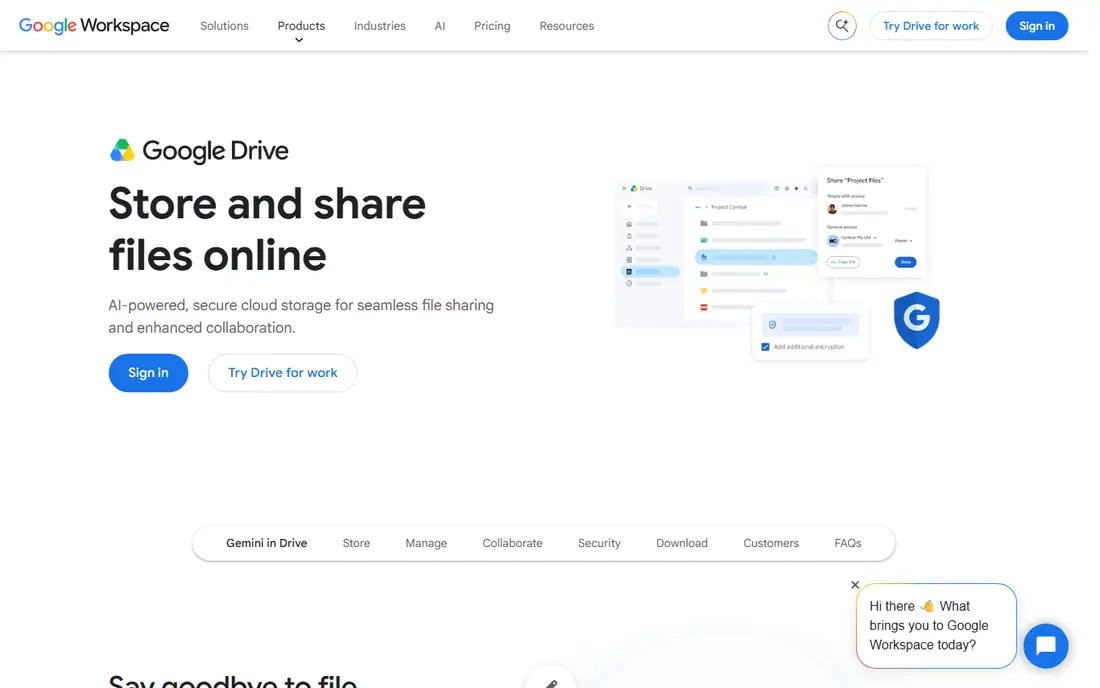
Google Drive is the simplest file store in this list, and that is its strength. Files live in folders and shared drives, sharing is a link or an email address, and search finds text inside documents, PDFs and images. The free tier gives 15 GB shared across Gmail, Drive and Photos, which covers light use. Google One Basic costs 1.99 dollars a month for 100 GB for one person. Google Workspace Business Starter costs 7 dollars per user per month, Standard costs 14 dollars, and Plus costs 22 dollars, adding more pooled storage and admin controls. The trade-offs are shared storage and admin depth. The free 15 GB is shared across Google services, so a heavy Gmail user fills it fast, and the entry Workspace plan has weaker admin controls than Dropbox Standard.
What we like- Free 15 GB tier, best search in this list, easy link sharing, strong Docs and Sheets integration
Watch out for- Storage is shared across Google services, and admin controls are weaker than Dropbox on the entry plan
#2Dropbox
Best for: Reliable sync, sharing and file transfer4.4/5 on
G2 (31,453 reviews, checked Oct 2026)
Visit dropbox.com
Starting price$9.99 per month billed annually (Plus plan, 2 TB)
Free planYes, 2 GB free
Dropbox is the sync benchmark that other tools are measured against. Files sync fast and reliably across desktop, web and mobile, sharing controls are clear, and file requests let anyone send you a file without an account. Plus costs 9.99 dollars a month billed annually, or 11.99 dollars monthly, for 2 TB and one user. Professional costs 16.58 dollars a month billed annually for 3 TB. Standard costs 15 dollars per user per month billed annually for a team of three or more, with pooled storage, and Advanced costs 24 dollars, adding unlimited storage and single sign-on. The trade-offs are the free plan and the price. Free is only 2 GB, so almost anyone who uses it daily must pay, and the business plans cost more per user than Google Workspace Starter.
What we like- The most reliable sync in this list, strong sharing controls, file requests, version history, wide app support
Watch out for- The free plan is only 2 GB, and business plans cost more per user than Workspace Starter
#3Box
Best for: Governed content, compliance and secure collaboration4.2/5 on
G2 (5,259 reviews, checked Oct 2026)
Visit box.com
Starting price$5 per user per month billed annually (Business Starter plan)
Free planYes, free personal account with 10 GB

Box is a content platform built for governed collaboration. Business plans give unlimited storage, admin controls, Box Sign for e-signatures, and integrations with Microsoft 365, Google Workspace and Slack. Business Starter costs 5 dollars per user per month billed annually, Business costs 15 dollars, Business Plus costs 25 dollars, and Enterprise costs 35 dollars, adding advanced compliance, watermarking and device trust. Every business plan has a three-user minimum, so the smallest Business account is 45 dollars a month billed annually. The trade-offs are the minimum and the feel. A two-person team still pays for three seats, and the interface feels more enterprise than personal, with more admin screens than a simple file store needs.
What we like- Unlimited storage on business plans, strong admin controls, Box Sign, wide integrations, compliance features
Watch out for- Every business plan has a three-user minimum, and the interface feels more enterprise than personal
#4OneDrive
Best for: Microsoft 365 storage and personal file backup4.5/5 on
Capterra (12,889 reviews, checked Oct 2026)
Visit microsoft.com
Starting price$1.99 per month or $19.99 per year (Microsoft 365 Basic, 100 GB)
Free planYes, 5 GB free with a Microsoft account
OneDrive is the storage that comes with Microsoft 365, so paying for Word and Excel gets you storage too. The free plan gives 5 GB with a Microsoft account. Microsoft 365 Basic costs 1.99 dollars a month or 19.99 dollars a year for 100 GB, plus a 100 GB mailbox and ad-free Outlook. Personal costs 9.99 dollars a month or 99.99 dollars a year for 1 TB with the desktop Office apps, and Family costs 12.99 dollars a month for up to six people. Business Basic costs 7 dollars per user per month paid yearly, with 1 TB per user. The trade-offs are the free tier and the bundle. Free is only 5 GB, and the best value sits inside a Microsoft 365 plan, so a team that does not use Office pays for apps it may not need.
What we like- Cheap entry price, deep Windows and Office integration, Personal Vault, 1 TB on Personal plan
Watch out for- The free plan is only 5 GB, and the best value needs a Microsoft 365 subscription
#5
iCloud Drive
Best for: Apple device storage, photos and family sharing
Visit icloud.com
Starting price$0.99 per month (iCloud+ 50 GB)
Free planYes, 5 GB free with an Apple Account
iCloud Drive is the storage built into every iPhone, iPad and Mac. Files, photos and app data sync without setup, and the same account backs up the device. The free plan gives 5 GB, which fills fast with photos and backups. iCloud+ costs 0.99 dollars a month for 50 GB, 2.99 dollars for 200 GB, and 9.99 dollars for 2 TB, with 6 TB at 29.99 dollars and 12 TB at 59.99 dollars. Paid plans add Private Relay, Hide My Email and HomeKit Secure Video, and the 200 GB and 2 TB plans share with family. The trade-offs are the audience and the platforms. There is no business plan, so a team cannot buy iCloud Drive for staff, and Windows and Android support is weak next to the Apple apps.
What we like- Built into every Apple device, cheap entry price, Family Sharing, Private Relay and Hide My Email
Watch out for- No business plan, weak Windows and Android support, and the free plan is only 5 GB
#6Egnyte
Best for: Regulated teams, hybrid files and governed content4.4/5 on
G2 (1,167 reviews, checked Oct 2026)
Visit egnyte.com
Starting price$10 per user per month billed annually (Team plan)
Free planNo free plan, free trial available
Egnyte is a content platform for teams that must govern files strictly, including regulated industries and firms with on-premises file servers. It combines cloud storage with local file servers, so a team can keep some files on site and some in the cloud, with the same permissions and search. Ransomware detection, lifecycle policies and detailed audit logs sit on the higher plans. Team costs 10 dollars per user per month billed annually for one to ten users, with 1 TB of storage. Business costs 22 dollars, Enterprise Lite costs 39 dollars, and Elite costs 48 dollars, adding AI features and advanced compliance. The trade-offs are price and the user cap. Business costs more than twice Workspace Starter per user, and the Team plan is limited to ten users, so a growing team must move up.
What we like- Hybrid cloud and on-premises storage, ransomware detection, strong permissions, lifecycle policies
Watch out for- Costs more per user than Drive or Dropbox, and the entry plan is limited to ten users
#7pCloud
Best for: Lifetime storage plans and media playback4.3/5 on
G2 (166 reviews, checked Oct 2026)
Visit pcloud.com
Starting price$4.99 per month (Premium 500 GB)
Free planYes, 10 GB free
pCloud is the only tool in this list that sells lifetime storage. Premium gives 500 GB for 4.99 dollars a month, 49.99 dollars a year, or 199 dollars once for a lifetime. Premium Plus gives 2 TB for 9.99 dollars a month, 99.99 dollars a year, or 399 dollars once. Ultra gives 10 TB for 29.99 dollars a month. Business costs 9.99 dollars per user per month with a three-user minimum, adding client-side encryption and 180-day file history. The free plan gives 10 GB, the largest free tier in this list. The trade-offs are the encryption add-on and the lifetime bet. Zero-knowledge encryption costs 49.99 dollars a year extra on personal plans, and a lifetime plan only pays off if the company lasts for years.
What we like- Lifetime plans with a one-time payment, built-in media player, file versioning, client-side encryption option
Watch out for- Zero-knowledge encryption costs extra on personal plans, and lifetime plans bet on the company lasting
#8Sync.com
Best for: Zero-knowledge encryption and private file storage4.0/5 on
G2 (44 reviews, checked Oct 2026)
Visit sync.com
Starting price$12 per month billed annually (Personal 1 TB)
Free planYes, 5 GB free
Sync.com is the privacy pick in this list. Every file is encrypted end to end before it leaves your device, so Sync.com says it cannot read your files, and the encryption is included on every plan at no extra cost. The free plan gives 5 GB. Personal 1 TB costs 12 dollars a month billed annually, or 16 dollars monthly, and Solo 5 TB costs 28 dollars a month billed annually, or 32 dollars monthly, with a 25 percent discount in the first year. Version history runs for a year on paid plans, and team plans add admin controls and shared folders. The trade-offs are integrations and speed. Sync.com has fewer third-party integrations than Dropbox, and the app can feel slower than Dropbox when it syncs a large folder for the first time.
What we like- Zero-knowledge encryption on every file, simple pricing, strong version history, Canadian jurisdiction
Watch out for- No lifetime plan, fewer integrations than Dropbox, and the app is slower than Dropbox on large folders
Frequently asked questions
Is Google Drive really free?
Yes, Google Drive is free with 15 GB of storage, shared across Gmail, Drive and Photos. You can store files, share links and collaborate in Docs and Sheets without paying anything. The only costs are optional, such as Google One at 1.99 dollars a month for 100 GB. The free tier is the largest in this list.
Can I move files from Dropbox to Google Drive?
Yes, both tools support standard file formats, so a move is possible but not instant. Download a folder from Dropbox and upload it to Drive, or use a migration tool that moves files, folders and sharing settings. A small library moves in an afternoon, while a large team drive with thousands of files needs a week of planning, since sharing links break and permissions map differently.
Does Dropbox work offline?
Yes, Dropbox works offline through the desktop app, which syncs chosen folders to your computer, so files open without a connection, and changes sync when you reconnect. The mobile app also saves files for offline use. Google Drive works the same way through its desktop app and the Chrome offline extension, so both tools cover offline use, and the difference is which suite your team already uses for documents and email.
Which is better for photos, Drive or Dropbox?
Google Drive is the better pick for photos, since it ties into Google Photos, offers strong search that finds images by content, and gives 15 GB free before you pay. Dropbox is the better pick for sharing photos with clients, since sharing controls, file requests and version history make delivery simple, and the Plus plan gives 2 TB for 9.99 dollars a month billed annually.
Should I pay for pCloud lifetime?
Pay for lifetime if you will use the same storage for at least four years and trust the company to last. Premium Plus at 2 TB costs 399 dollars once, against 99.99 dollars a year on the annual plan, so it pays for itself in about four years. Stay on the annual plan if you may switch tools soon, or if you need zero-knowledge encryption, which costs extra on personal plans.
Sources we checked (8)
- https://drive.google.com
- https://www.dropbox.com
- https://www.box.com
- https://www.microsoft.com/en-us/microsoft-365/onedrive/online-cloud-storage
- https://www.icloud.com
- https://www.egnyte.com
- https://www.pcloud.com
- https://www.sync.com
Is your product missing or out of date?
We review this list regularly. Vendors can request a listing, send updated pricing or ask about featured placement.

Shihab Mia · Founder, Rankite
Shihab has 5+ years in B2B and SaaS SEO. He writes Rankite's software buying guides from pricing pages, documentation and public user reviews. More about Shihab.