How we make this list: we compare pricing pages, product documentation and public user reviews. Ratings come from G2, Capterra or Trustpilot, with the date we checked them.
Direct answer
Mercurial is the top pick for teams that want a distributed system instead of Git, since every clone holds the full history and the software is free under GPLv2+. Game teams with large binary assets should look at Perforce P4 instead, since Cloud lists $39 per user per month billed monthly.
Key takeaways
- Small teams that want simple distributed workflows should start with Mercurial, which is free under GPLv2+.
- Game teams with large assets should compare Perforce P4 Cloud at $39 per user per month billed monthly.
- Unity teams should check Unity Version Control, with 25 GB storage and 100 GB egress free per month.
- Teams that want built-in project tools should look at Fossil, which adds wiki, forum, and bug tracking in 1 executable at no license cost.
- Cloud game teams should compare Diversion Pro - A at $25 per user per month.
Quick comparison
| Tool | Best for | Starting price | Free plan |
|---|
 Mercurial | Teams wanting simple distributed workflows | Free under GPLv2+ | Free software under GPLv2+ |
 Apache Subversion | Simple centralized workflows | Free, open source | Open source, release 1.15.0 |
 Perforce P4 | Large binary files and game assets | Cloud $39 per user/month billed monthly | Free for up to 5 users and 20 workspaces |
 Unity Version Control | Game teams with large assets | Free tier, then storage overage $0.14/GB/month | 25 GB storage and 100 GB egress free per month |
 Fossil | Small teams wanting built-in project tools | Free under 2-clause BSD license | Free and open source |
 Sapling | Large monorepos and stacked commits | See website | None found on vendor page |
 Pijul | Patch-based collaboration and clean merges | Free under GPL2 or later | Free software under GPL2 or later |
 Breezy | Python teams wanting multi-format support | Free under GNU GPL version 2 or later | Free software under GNU GPL version 2 or later |
 Darcs | Interactive patch selection on smaller projects | Free, open source | Free, open source |
 Diversion | Cloud game asset version control | Pro - A $25 per user/month | Indie free for first 5 users with eligibility |
Is your product missing or out of date?
We review this list regularly. Vendors can request a listing, send updated pricing or ask about featured placement.
The best git alternatives
Git alternatives matter when Git fits poorly, for example with large binary assets, strict file locking needs, or a team that prefers centralized control. This list covers version control systems a team could adopt instead of Git, not Git hosting services or Git GUI clients, since those still use Git underneath. The ranking puts the workflow model first, then large-file handling, then price clarity. Prices and license terms come from official vendor and project pages checked on 2026-11-28. Where official pages did not state price terms, the entry says See website.
Starting priceFree under GPLv2+
Free planFree software under GPLv2+
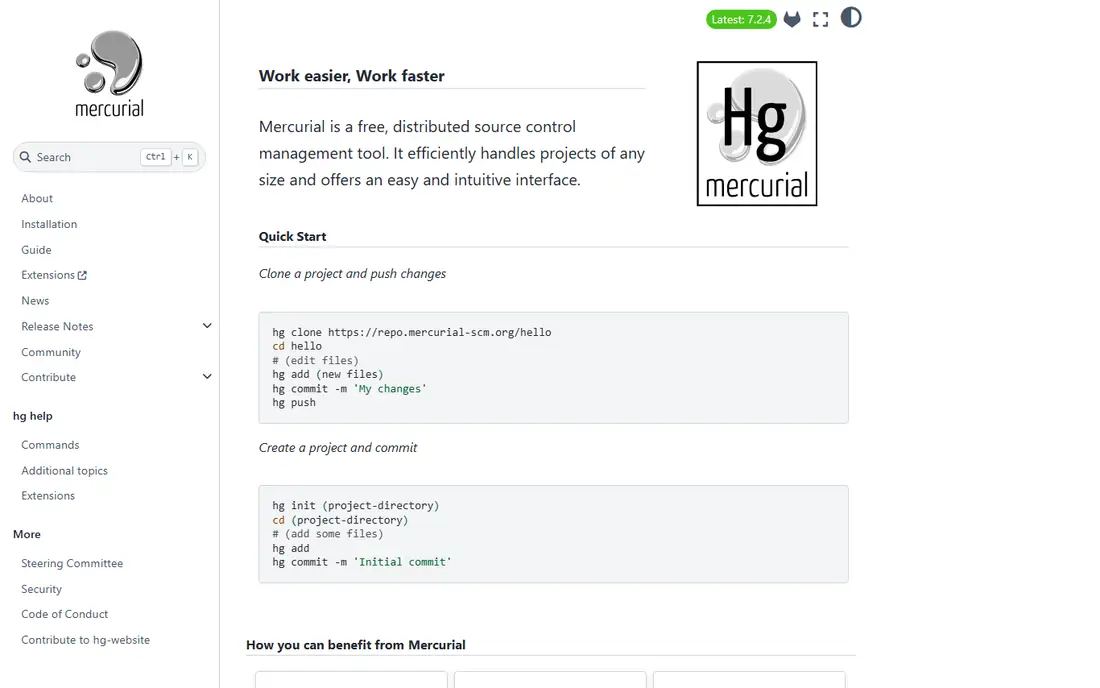
Mercurial is a free distributed version control system licensed under GPL version 2 or any later version. The official site states every clone contains the whole project history, so most actions are local, and that Mercurial handles projects of any size. Extensions add functionality beyond the core commands. Teams that find Git commands hard to teach often pick Mercurial for a smaller command surface with the same distributed model. It suits small and mid-size teams that want local history, branches, and merges without a central server requirement. Hosting choices stay separate, since Mercurial is the version control system itself, not a hosted forge.
The catch is API stability and tooling split. Mercurial does not promise API stability, so an update might break extensions or tools that use Mercurial internals, and GUI use runs through separate tools such as TortoiseHg. Pick Mercurial if simple distributed workflows matter most. Look elsewhere if you need file locking for large binaries or a hosted platform in the same purchase.
What we like- Every clone contains the whole project history, so most actions are local
- Handles projects of any size per official site
- Functionality can be extended with extensions
Watch out for- Mercurial does not promise API stability, so updates might break extensions
- Homepage workflow is command-line driven, with GUI use through separate tools
Starting priceFree, open source
Free planOpen source, release 1.15.0
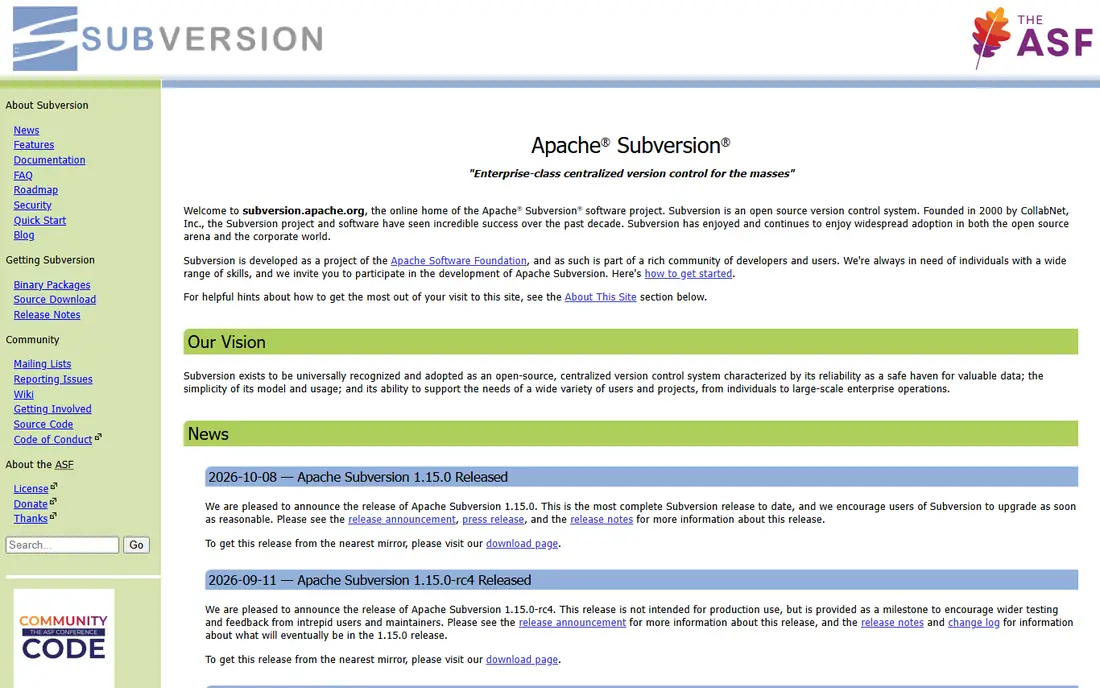
Apache Subversion is a free open-source centralized version control system from the Apache project. The official site states a simple centralized model, atomic commits, and file locking for files that multiple people might edit. The download page lists source releases, with release 1.15.0 as the latest recommended source release in this check. Centralized control suits teams that want one repository of record, path-based permissions, and locking for design files that cannot merge. Subversion fits regulated teams and document-heavy projects where a central history is a feature, not a limit. Binary packages come from third parties, since the project distributes source code.
The catch is central dependence and packaging. Work depends on the central repository rather than full local history in every clone, and binary packages come from third parties. Pick Subversion if centralized control and file locking fit your team. Look elsewhere if offline work with full local history is required. Central access planning matters for every distributed team working today.
What we like- Centralized model with simple usage stated
- Atomic commits, so no part of a commit takes effect until the whole commit succeeds
- File locking supported for files multiple people might edit
Watch out for- Project distributes source code only, with binary packages from third parties
- Centralized model depends on a central repository
Starting priceCloud $39 per user/month billed monthly
Free planFree for up to 5 users and 20 workspaces
Perforce P4 is a centralized version control system built for large files and game assets. The official pricing page lists Cloud at $39 per user per month billed monthly, and a Free version at $0 for up to 5 users and 20 workspaces, self-hosted. Product pages state exclusive checkout and file locking, file-level permissions with an audit trail, and visual branching and merging through P4V. Game studios and media teams use locking to stop two artists editing one unmergeable asset at once. P4 suits teams whose repositories hold large binaries that Git handles poorly. Check free tier file limits on the pricing page before a pilot, since caps apply when limits are exceeded.
The catch is tier pricing and free caps. Scale and Platform are priced without a public figure on the pricing page, and the free version is self-hosted with caps at 5 users and 20 workspaces. Pick P4 if large binaries and locking drive the choice. Look elsewhere if your team needs distributed local history or a free hosted service. Quote time matters too.
What we like- Exclusive checkout and file locking stated
- File-level permissions and audit trail stated
- Visual branching and merging through P4V stated
Watch out for- Scale and Platform tiers list no public price
- Free version is self-hosted and capped at 5 users and 20 workspaces
#4
Unity Version Control
Best for: Game teams with large assets
Visit unity.com
Starting priceFree tier, then storage overage $0.14/GB/month
Free plan25 GB storage and 100 GB egress free per month
Unity Version Control is Unity version control for game projects with large assets, successor to Plastic SCM. Unity support pricing from 1 Mar 2026 states cloud-hosted use has unlimited seats, with the first 25 GB of storage and first 100 GB of egress per month free, storage overage at $0.14 per GB per month, and egress overage at $0.10 per GB. Product pages state Smart Locks, engine-agnostic use, and cloud or on-premises deployment. Game teams use locking and large-file handling for art, audio, and scene files. It suits Unity and mixed-engine teams that outgrow Git large-file workflows. Note that an older product FAQ still shows different free terms, so use the dated 2026 support pricing.
The catch is usage billing and term drift. Storage and egress overages bill once usage passes the free tier, and legacy Plastic SCM or on-premise terms may differ from public cloud pricing. Pick Unity Version Control if game assets and Smart Locks fit your pipeline. Look elsewhere if flat per-seat pricing is easier for your budget. Storage growth needs monthly tracking.
What we like- Smart Locks enforces a single line of development across branches until merge back
- Engine-agnostic version control stated
- Deployable in the cloud or on-premises
Watch out for- Storage and egress overages are billed past 25 GB storage or 100 GB egress
- Legacy Plastic SCM and on-premise terms may differ from public cloud pricing
Starting priceFree under 2-clause BSD license
Free planFree and open source
Fossil is a free distributed version control system under the 2-clause BSD license. The official homepage states integrated bug tracking, wiki, forum, and technotes beside distributed version control, in a single self-contained stand-alone executable. Content is stored in an SQLite database, so transactions stay atomic even if interrupted by power loss or system crash. Small teams use Fossil when they want code history and project notes in one tool with simple deployment. It suits solo developers and small teams that value a single binary and built-in project pages. The current download release could not be verified in this check after a rate-limit response, so confirm the release on the official site.
The catch is binary asset handling and hosting duty. The homepage does not state file locking for unmergeable binary assets, and shared use still means running the Fossil server. Pick Fossil if built-in wiki, forum, and bug tracking in one executable fits your team. Look elsewhere if large binary locking is required. Server duty stays with your small internal team.
What we like- Integrated bug tracking, wiki, forum and technotes stated
- Single self-contained stand-alone executable stated
- SQLite storage makes transactions atomic even after power loss
Watch out for- Homepage does not state file locking for unmergeable binary assets
- Teams still run the Fossil server for shared hosting
Starting priceSee website
Free planNone found on vendor page
Sapling is a source control system from Meta built for large monorepos and stacked commit workflows. Official docs state a special emphasis on usability and scalability. Smartlog shows local commits, bookmarks, and stack state in one view, and amend automatically restacks child commits in the documented workflow. Teams with stacked diffs use this model to keep change stacks current without manual rebasing. Sapling suits monorepo teams that feel Git limits at scale. Price and license terms were not stated on the official pages opened in this check, so this guide lists See website. Confirm current terms on the official site before adoption.
The catch is maturity of the full stack. The Sapling server and virtual filesystem are described as not yet available publicly, and Git support may have remaining issues. Pick Sapling if monorepo scale and stacked commits drive the choice. Look elsewhere if you need a fully public server stack today. Adoption timing matters for large monorepo teams working together today.
What we like- Special emphasis on usability and scalability stated in docs
- Smartlog shows local commits, bookmarks and stack state in one view
- Amend automatically restacks child commits in the documented workflow
Watch out for- Sapling server and virtual filesystem are described as not yet available publicly
- Git support may have remaining issues to be worked out
#7
Pijul
Best for: Patch-based collaboration and clean merges
Visit pijul.org
Starting priceFree under GPL2 or later
Free planFree software under GPL2 or later
Pijul is a free distributed version control system built on patches, licensed under GPL2 or any later version. The official FAQ states the software can be used freely for any kind of projects, including commercial ones. Independent changes can be applied in any order without changing the result, and first-class conflicts are resolved by a change and do not come back for the same two changes. Partial clones can work on a subset of a repository and merge cleanly into the full repo. Pijul suits teams that hit painful merge conflicts in branch-based workflows and want patch order independence. It is a smaller ecosystem than Git or Mercurial, so hosting and tooling choices are narrower.
The catch is ecosystem size and install route. Quick install on the homepage uses cargo install with a beta version string, and Pijul does not yet have an equivalent of darcs replace. Pick Pijul if patch-based merges solve a named pain. Look elsewhere if you need wide hosting and GUI choice today. Ecosystem size matters during early adoption planning work.
What we like- Independent changes can be applied in any order without changing the result
- First-class conflicts do not come back for the same two changes
- Partial clones can merge cleanly into the full repo
Watch out for- Quick install uses cargo install with a beta version string
- Pijul does not yet have an equivalent of darcs replace
Starting priceFree under GNU GPL version 2 or later
Free planFree software under GNU GPL version 2 or later
Breezy is a free version control system and successor to Bazaar, released under GNU GPL version 2 or later. The official homepage states it is implemented in Python with multi-format support, including Git and Bazaar file formats and network protocols. It supports both central and distributed workflows, so one tool can work across repository types. Python teams use Breezy when format flexibility matters during a migration. As a Git alternative, the Bazaar format is the non-Git repository choice, while Git format support helps mixed estates. Breezy suits teams that need one client across formats. Check platform support on the homepage before rollout, since Windows support statements differ between pages.
The catch is platform and format clarity. The official homepage says Windows is not yet supported, while package listings include Windows wheels, so do not assume Windows support without a spot check. Teams must also choose the Bazaar format deliberately for a non-Git repository. Pick Breezy if multi-format support in Python fits your estate. Look elsewhere if Windows support must be certain today.
What we like- Implemented in Python with multi-format support stated
- Built-in support for Git and Bazaar formats and protocols stated
- Supports central and distributed workflows
Watch out for- Official homepage says Windows is not yet supported
- Teams must choose the Bazaar format deliberately for a non-Git repository
#9
Darcs
Best for: Interactive patch selection on smaller projects
Visit darcs.net
Starting priceFree, open source
Free planFree, open source
Darcs is a free open-source distributed version control system based on an algebra of patches. Official docs state every user has access to the full command set, and interactive prompts let users record one change in a file while ignoring another. That patch selection suits smaller projects where changes are reviewed piece by piece. Darcs fits teams that value patch-level control over branch-heavy workflows. The ecosystem is small beside Git and Mercurial, and install routes found in this check rely on Haskell tooling such as Cabal or source builds. Hosting, file locking, and GUI clients are not stated on the homepage copy opened. Confirm current install options on the official site before adoption.
The catch is install and ecosystem scope. Installation relies on Haskell tooling, and built-in hosting, file locking, and a GUI client are not stated on the homepage. Pick Darcs if interactive patch selection on a smaller project is the goal. Look elsewhere if you need hosted collaboration or large binary locking. Install planning matters for new project team users today.
What we like- Every user has access to the full command set stated
- Interactive prompts let users record one change while ignoring another
- Based on an algebra of patches
Watch out for- Installation routes rely on Haskell tooling such as Cabal or source builds
- Homepage does not state built-in hosting, file locking or a GUI client
Starting pricePro - A $25 per user/month
Free planIndie free for first 5 users with eligibility
Diversion is a cloud-native version control service for source code, large binary assets, and engine files. The pricing page lists Pro - A at $25 per user per month and Studio - AA at $35 per user per month. Indie is free for the first 5 users with eligibility required, up to 20 users, with 100GB free storage and up to 5 repositories. Paid tiers include a 21-day free trial. Native Unreal Engine and Unity integrations are stated, with no server management in the cloud edition. Game teams use Diversion when Git large-file workflows slow artists down. Storage beyond 100GB on Indie costs $10 per month per additional 100GB.
The catch is tier gating. Hard locks and granular permissions sit on Studio - AA at $35 per user per month, not on Pro - A, and Indie is eligibility-gated with a 5 repository cap. Pick Diversion if cloud game asset version control with engine integrations fits your studio. Look elsewhere if you need self-hosting or free use without eligibility rules.
What we like- Cloud-native version control for code, large binary assets and engine files stated
- Native Unreal Engine and Unity integrations stated
- No server management with cloud edition stated
Watch out for- Hard locks and granular permissions sit on Studio - AA at $35 per user per month
- Indie is eligibility-gated and capped at 5 repositories
Should your team choose distributed or centralized version control?
Choose distributed version control when developers need full local history and offline work, and choose centralized control when locking and one repository of record matter more. Mercurial and Fossil are free distributed options, so license cost is $0. Perforce P4 Cloud costs $39 per user per month billed monthly, so 10 users cost $390 per month, with a free self-hosted version up to 5 users. Diversion Pro - A costs $25 per user per month, so 10 users cost $250 per month. Unity Version Control bills storage past 25 GB at $0.14 per GB per month. Game asset teams usually need locking, while code-only teams usually need local history.
Which Git alternative is best for game assets?
Perforce P4 is the best starting point for game assets that need exclusive checkout and file locking, with Cloud at $39 per user per month. Unity Version Control fits Unity teams that want 25 GB storage free and Smart Locks. Diversion fits cloud studios that want engine integrations at $25 per user per month on Pro - A.
Is Mercurial better than Git for small teams?
Mercurial is better for small teams that want distributed history with a smaller command surface, and it is free under GPLv2+. Git has wider hosting and tooling choice. Choose Mercurial when teachability matters most, and stay with Git when ecosystem breadth matters most.
What is the best free alternative to Git?
Mercurial is the best free alternative for most teams, since it is free under GPLv2+ with full local history in every clone. Fossil fits small teams that want wiki, forum, and bug tracking built in. Apache Subversion fits teams that want centralized control with file locking at no license cost.
Frequently asked questions
Can I use Mercurial instead of Git for a small team?
Yes. Mercurial gives every clone the full project history, so most actions stay local, and the software is free under GPLv2+. Teams get distributed branches and merges without Git. Hosting and GUI tools sit outside the core system, so plan those choices during adoption.
Which version control system is best for large binary files?
Perforce P4 is built for large binary files, with exclusive checkout and file locking stated and Cloud at $39 per user per month. Unity Version Control adds Smart Locks with 25 GB storage free. Diversion offers cloud game asset control at $25 per user per month on Pro - A.
Is Subversion still a good choice in 2026?
Subversion fits teams that want centralized control, atomic commits, and file locking at no license cost. Release 1.15.0 is the latest recommended source release in this check. It fits document-heavy and regulated projects. Distributed teams that need full local history should pick Mercurial or Fossil instead.
What does Perforce P4 cost for a team of 10?
Perforce P4 Cloud lists $39 per user per month billed monthly, so 10 users cost $390 per month. The free version covers up to 5 users and 20 workspaces, self-hosted. Scale and Platform tiers list no public price, so larger needs require a vendor quote.
Can Sapling replace Git for a monorepo?
Sapling targets large monorepos and stacked commits, with smartlog and automatic restacking stated in docs. The server and virtual filesystem are described as not yet available publicly. Price terms were not stated on official pages in this check. Pilot Sapling only after confirming current public availability and terms.
What to look for before you buy
First, decide between distributed local history and centralized locking, since that choice narrows the list fast. Second, test your largest files, because binary asset handling separates Perforce P4, Unity Version Control, and Diversion from code-only systems. Third, read the license meter, whether it is per user, storage and egress, or a free license with support sold separately. Fourth, check hosting and GUI options, since several systems in this list are engines without a hosted forge. Fifth, confirm platform support on official pages, including Windows statements, before rollout.
How we chose
We built a candidate list of 20 version control systems, then kept 10 that are real live systems a team could adopt instead of Git. Prices and license terms come from official vendor and project pages checked on 2026-11-28. Git hosting services and Git GUI clients were excluded, since they still use Git. No hands-on testing is claimed. Renamed and successor products are noted, including Unity Version Control and Breezy.
Sources we checked (10)
- https://mercurial-scm.org/
- https://subversion.apache.org/download.cgi
- https://www.perforce.com/products/p4/pricing
- https://support.unity.com/hc/en-us/articles/34748492914964-Understanding-of-New-Unity-DevOps-Pricing-starting-from-Mar-1-2026
- https://fossil-scm.org/
- https://sapling-scm.com/docs/introduction/
- https://pijul.org/faq
- https://www.breezy-vcs.org/
- https://darcs.net/
- https://www.diversion.dev/pricing
Is your product missing or out of date?
We review this list regularly. Vendors can request a listing, send updated pricing or ask about featured placement.

Shihab Mia · Founder, Rankite
Shihab has 5+ years in B2B and SaaS SEO. He writes Rankite's software buying guides from pricing pages, documentation and public user reviews. More about Shihab.