How we make this list: we compare pricing pages, product documentation and public user reviews. Ratings come from G2, Capterra or Trustpilot, with the date we checked them.
Key takeaways
- BugBug is the closest codeless swap, with a free plan, a Chrome recorder, and cloud runs without seat-based pricing.
- Rainforest QA suits growing SaaS teams that want AI-drafted visual tests anyone can maintain without code.
- Mabl and Testim lead on AI self-healing, keeping tests green as the interface changes.
- Selenium and Cypress are the code-first options for teams that want full control and open-source foundations.
- Katalon Studio and Leapwork cover the widest surface, from web and API to mobile, desktop, and enterprise apps.
Quick comparison
| Tool | Best for | Starting price | Free plan |
|---|
 BugBug | Codeless SaaS regression tests | See website | Yes |
 Mabl | AI self-healing test automation | See website | Free trial |
 Selenium | Open-source browser automation | See website | Yes |
 Rainforest QA | No-code visual QA for SaaS | See website | Free trial |
 Testim | AI-stable web and Salesforce tests | See website | Free trial |
 Leapwork | Enterprise continuous validation | See website | Free trial |
 Katalon Studio | All-in-one web, API, mobile | See website | Yes |
 Cypress | Developer-friendly web testing | See website | Yes |
Is your product missing or out of date?
We review this list regularly. Vendors can request a listing, send updated pricing or ask about featured placement.
#1BugBug
Best for: Codeless SaaS regression tests4.7/5 on
G2 (30 reviews, checked Oct 2026)
Visit bugbug.io
Starting priceSee website
Free planYes
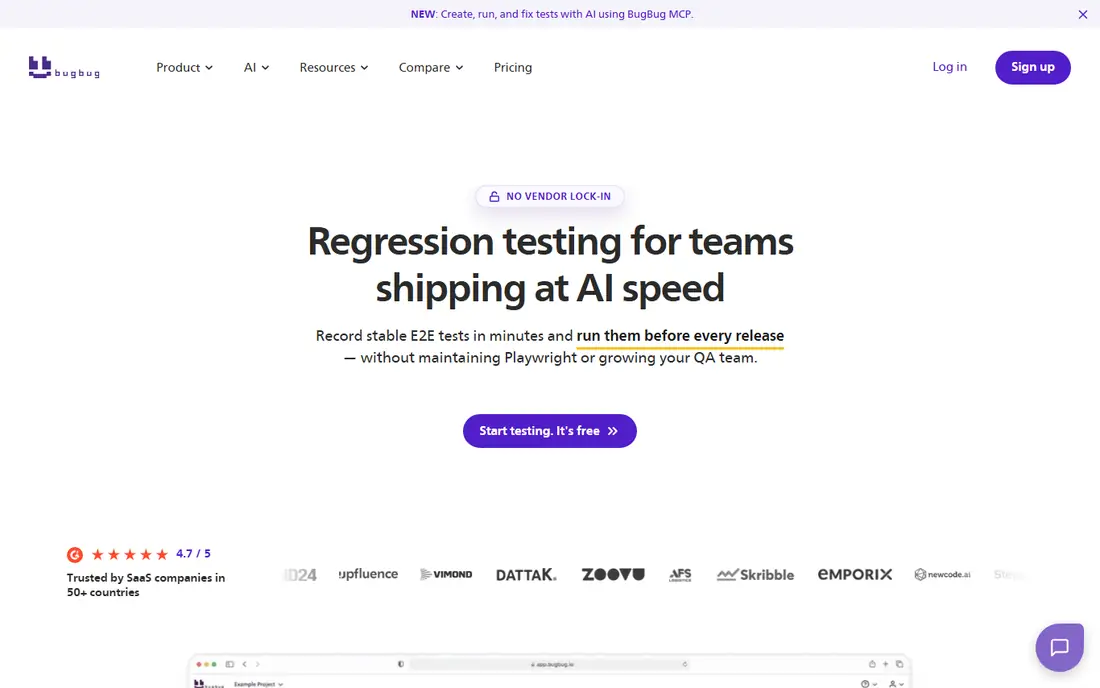
BugBug is a no-code end-to-end test tool built for SaaS teams that ship fast. Install the Chrome extension, record a flow directly in the browser, and turn it into an automated test without setting up a framework. Tests run locally or on a schedule in BugBug's cloud, with email and Slack alerts when a critical flow fails.
The pricing model stands out. BugBug offers a free plan with unlimited local testing and no seat-based pricing, plus reusable components, built-in email testing, and YAML import and export so tests can be reviewed and backed up. The honest catch is browser scope: BugBug runs on Chromium only, so teams needing Firefox or Safari coverage must pair it with another tool or pick a cross-browser platform.
What we like- Free plan with unlimited local testing
- Chrome extension recorder
- YAML export avoids lock-in
Watch out for- Runs on Chromium only
- Smaller ecosystem than Selenium-based tools
#2Mabl
Best for: AI self-healing test automation4.4/5 on
G2 (40 reviews, checked Oct 2026)
Visit mabl.com
Starting priceSee website
Free planFree trial
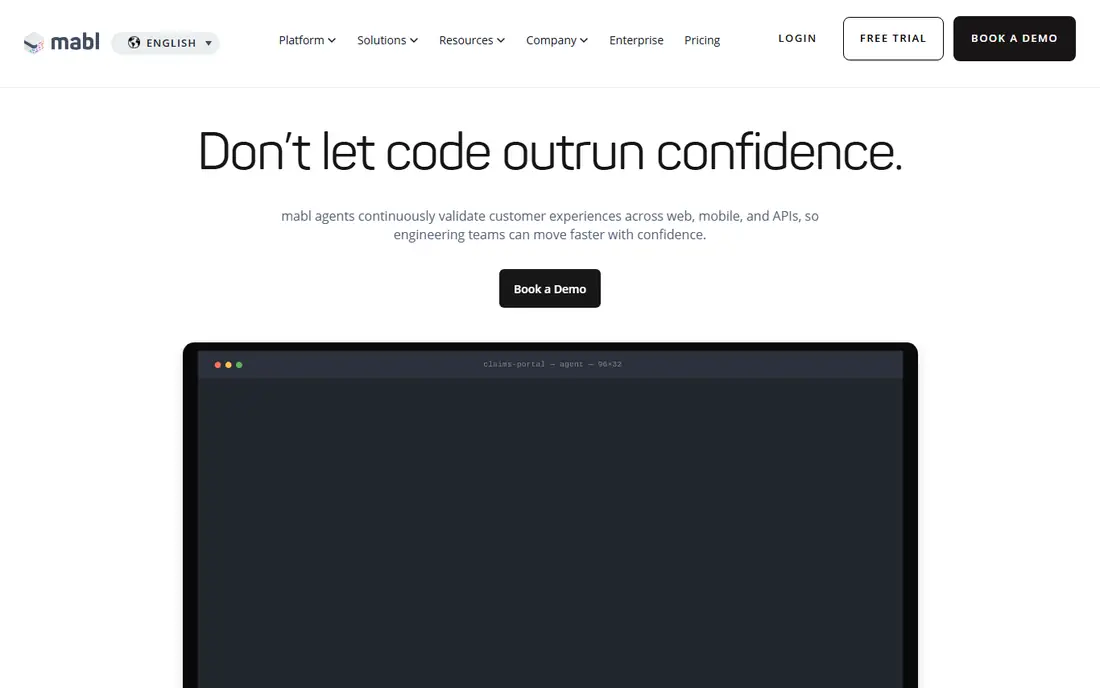
Mabl is an agentic testing platform that validates customer experiences across web, mobile, and APIs. Specialized agents create, run, analyze, and maintain tests, adapting them as software changes so teams spend less time fixing brittle selectors. It covers low-code authoring, API testing, performance testing, and cross-browser runs in one system.
The platform now presents itself as a testing harness for AI-powered development, catching what general coding agents miss. That makes it a strong fit for teams whose release pace has outgrown manual QA. The downside is pricing transparency: mabl sells by quote, and its enterprise feature set can be more than a small team needs for simple regression coverage.
What we like- Agentic testing across web, mobile, and APIs
- Auto-healing keeps tests current
- Cross-browser testing
Watch out for- Quote-based pricing
- Enterprise positioning may exceed small-team budgets
#3Selenium
Best for: Open-source browser automation4.5/5 on
G2 (27 reviews, checked Oct 2026)
Visit selenium.dev
Starting priceSee website
Free planYes
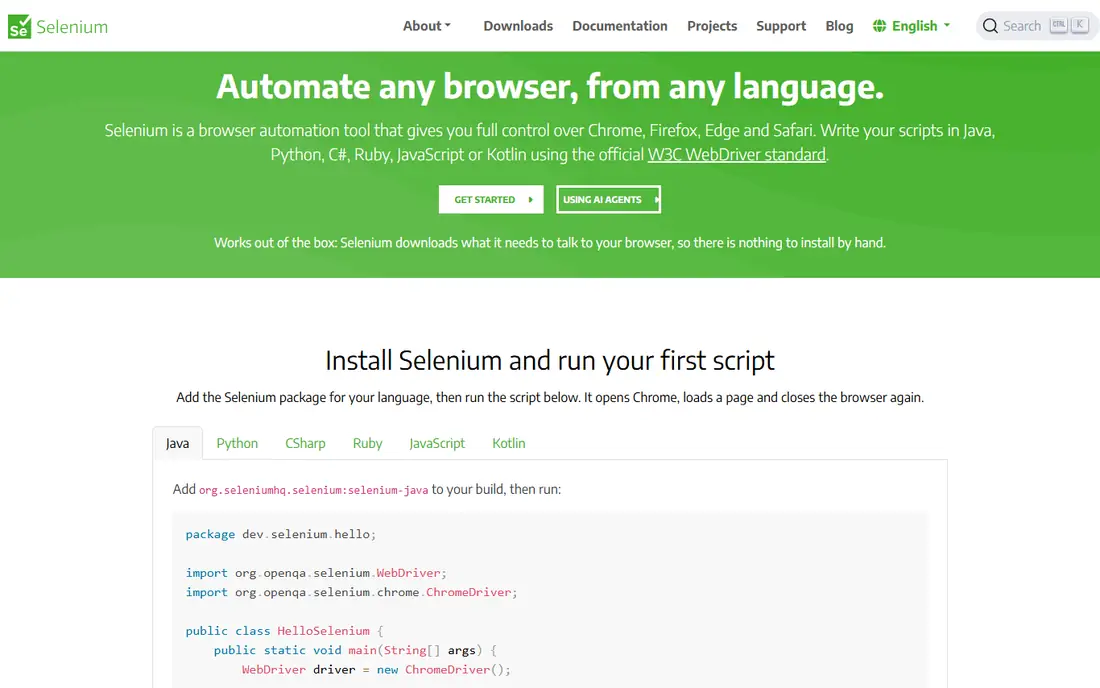
Selenium automates browsers, and that is the whole pitch. WebDriver drives reliable regression suites across languages and browsers, Selenium IDE records quick bug reproduction scripts with simple record-and-playback, and Selenium Grid distributes runs across machines and environments. The latest release, Selenium 4.51 from October 2026, shows the project is actively maintained.
For a Ghost Inspector user who wants to drop subscription costs entirely, Selenium IDE is the free starting point, and WebDriver is the path to a serious suite. The trade-off is ownership. Selenium gives no hosted runs, no built-in dashboard, and no vendor support, so teams must supply their own infrastructure and maintenance, usually through a cloud grid provider.
What we like- Free and open-source
- WebDriver, IDE, and Grid cover every scale
- Huge community and language support
Watch out for- Requires coding for serious suites
- No hosted dashboard or support without third parties
Starting priceSee website
Free planFree trial
Rainforest QA is a no-code platform that uses AI to create, maintain, and manage tests without sacrificing predictability. Its tests are visual-first, written from the user's point of view, which means small code changes break fewer tests. AI drafts suggested tests from an analysis of the site, self-heals tests when the interface changes, and shows exactly what changed.
Debugging is fast: video replays plus browser and network logs show why a test failed, and parallel runs through CLI, GitHub Actions, or CircleCI finish large suites quickly. Rainforest reports serving more than 17,000 startups and growth-stage companies. The catch is pricing, which is quote-based, and the visual model fits web apps better than native mobile testing.
What we like- Visual-first no-code tests
- AI drafts and self-heals tests
- Parallel CI runs with video replays
Watch out for- Quote-based pricing
- Visual approach suits web apps more than native mobile
#5Testim
Best for: AI-stable web and Salesforce tests4.5/5 on
G2 (54 reviews, checked Oct 2026)
Visit testim.io
Starting priceSee website
Free planFree trial
Testim, now Tricentis Testim, is an AI-powered testing platform for custom web, mobile, and Salesforce apps. Tests are created by clicking through the application, with the option to add code when needed. Its smart locators understand the app, identify elements, and self-heal automatically to keep tests working as applications change.
Salesforce coverage is the standout. Testim's agentic test automation can build Salesforce tests without code using natural language, which matters for teams whose CRM customizations break constantly. Root cause analysis aggregates errors with screenshots and logs to speed fixes. The flag is corporate: as part of Tricentis, Testim's packaging and pricing may shift, so buyers should confirm current terms during evaluation.
What we like- Smart locators self-heal automatically
- Strong Salesforce coverage
- Code flexibility when needed
Watch out for- Now part of Tricentis, so packaging may change
- Quote-based pricing
#6Leapwork
Best for: Enterprise continuous validation4.5/5 on
G2 (107 reviews, checked Oct 2026)
Visit leapwork.com
Starting priceSee website
Free planFree trial
Leapwork is a continuous validation platform for enterprises. Tests are built as visual flowcharts in plain language, covering web apps, Salesforce, Dynamics 365, Oracle, SAP, ServiceNow, desktop applications, APIs, and AI workflows. It combines Playwright, visual automation, AI validation, and performance testing under one platform with shared governance.
The enterprise argument is determinism. Leapwork pairs AI where it speeds quality with deterministic execution where results must be provable, giving regulated teams governance, evidence, and traceability. A free Playwright-focused tier exists for developers. The downside is weight: Leapwork is built for complex estates, so a small SaaS team may find it heavier and pricier than BugBug or Rainforest QA.
What we like- Visual flowcharts in plain language
- Covers Salesforce, SAP, Dynamics, Oracle, desktop, and APIs
- Playwright support
Watch out for- Enterprise pricing
- Heavier than a simple recorder for small teams
Starting priceSee website
Free planYes
Katalon Studio is the automation environment inside the Katalon True Platform, which also includes TestOps for test management, TestCloud for execution on real browsers and devices, and TrueTest for production insights. One platform covers web, mobile, API, and desktop testing with no-code, low-code, full-code, and AI-assisted authoring in the same project.
Katalon AI generates test cases from requirements or tickets, heals locators when interfaces change, and explains failures in plain language, and the platform now supports Playwright scripts alongside Studio tests. It is free to start with no credit card. The catch is that full platform pricing spans products and execution allotments, so the total needs a careful quote, and advanced customization still calls for Groovy scripting.
What we like- Web, mobile, API, and desktop in one platform
- AI test generation and self-healing
- Free to start
Watch out for- Full platform pricing is tiered and complex
- Groovy needed for advanced cases
#8Cypress
Best for: Developer-friendly web testing4.7/5 on
G2 (107 reviews, checked Oct 2026)
Visit cypress.io
Starting priceSee website
Free planYes
Cypress runs end-to-end and component tests directly in a real browser, watching them execute in real time as they are built. Its Time Travel debugger lets a developer hover any command to see the app at that exact step, and Test Replay rewinds CI failures down to the DOM, network events, and console logs. Newer AI features describe tests in plain language and adjust steps when a button moves or is renamed.
With more than 6 million weekly downloads, Cypress has the largest developer community on this list, which means abundant examples and integrations. The trade-off is audience. Cypress is code-first, so manual testers moving from Ghost Inspector will need developer support, and its cross-browser story, while improved, still trails Selenium's breadth.
What we like- Real-browser runs with Time Travel debugging
- Fast developer experience
- Huge open-source adoption
Watch out for- Code-first, so non-technical testers need developer help
- Cross-browser scope trails Selenium
How we chose
We compared tools on the job Ghost Inspector does: recording browser flows without code, scheduling runs, and reporting failures with evidence. Vendor homepages were opened for every tool listed, and pricing is reported as quote-based wherever the vendor does not publish it. Tools were kept only when their homepage loaded and belonged to the listed product.
Start with who writes the tests. If manual testers own QA, a codeless recorder such as BugBug or Rainforest QA will deliver value in days. If developers own testing, Cypress or Selenium give more control and lower long-run cost, at the price of setup time.
Next, test maintenance on a real interface change. Rename a button, move a form field, and watch what breaks. Self-healing tools such as mabl, Testim, and Katalon recover automatically, while code-first tools need a developer edit. The maintenance cost, not the license fee, usually decides the total cost of ownership.
Finally, confirm browser and device coverage. BugBug covers Chromium only, while Selenium, mabl, Testim, and Katalon cover multiple browsers. If Safari or Firefox users matter to your business, that single question can eliminate half this list before pricing even enters the conversation.
Frequently asked questions
What is the closest Ghost Inspector alternative?
BugBug is the closest codeless match, with a Chrome recorder, cloud runs, and a free plan. Rainforest QA is the closest alternative for teams that want AI-drafted visual tests maintained without code.
Can I migrate my Ghost Inspector tests to these tools?
No tool offers a one-click Ghost Inspector import. Expect to re-record flows in the new tool, which is why recorder speed matters. BugBug and Rainforest QA re-record fastest, while Selenium and Cypress migrations take developer time.
Which alternative is free?
Selenium is free and open-source, BugBug has a free plan with unlimited local testing, and Katalon Studio and Cypress are free to start. Mabl, Rainforest QA, Testim, and Leapwork sell by quote with trials.
Do these tools test mobile apps too?
Mabl, Testim, Katalon Studio, and Leapwork cover mobile testing, while BugBug, Rainforest QA, and Cypress focus on web. Selenium covers mobile web through Appium-based setups rather than natively.
How do self-healing tests work?
Self-healing tools store multiple locators for each element and re-resolve them when the interface changes, instead of failing on a single changed selector. Mabl, Testim, Katalon, and Rainforest QA all offer this, which cuts the maintenance burden after UI redesigns.
Should a small team pick codeless or code-first testing?
Pick codeless if testers are non-technical and speed matters most. Pick code-first if developers own quality and the suite must scale past a few hundred tests, since code gives version control, reuse, and precise control that recorders cannot match.
Sources we checked (10)
- https://bugbug.io
- https://www.mabl.com
- https://www.selenium.dev
- https://www.rainforestqa.com
- https://www.testim.io
- https://www.leapwork.com
- https://www.katalon.com
- https://www.cypress.io
- https://bugbug.io/blog/test-automation-tools/ghost-inspector-alternatives/
- http://testsigma.com/blog/ghost-inspector-alternatives/
Is your product missing or out of date?
We review this list regularly. Vendors can request a listing, send updated pricing or ask about featured placement.

Shihab Mia · Founder, Rankite
Shihab has 5+ years in B2B and SaaS SEO. He writes Rankite's software buying guides from pricing pages, documentation and public user reviews. More about Shihab.