How we make this list: we compare pricing pages, product documentation and public user reviews. Ratings come from G2, Capterra or Trustpilot, with the date we checked them.
Key takeaways
- Google Translate leads on language breadth at 240-plus languages and free everyday use, with a Cloud API at $20 per million characters.
- Microsoft Translator is the cheapest per-character API at $10 per million characters, with 2 million free characters per month.
- ChatGPT and Claude-style models win for context, tone control, and Asian languages, where pure machine translation engines trail.
- Lara is the one to watch: free to use and built to replace ModernMT, which shuts down at the end of 2026.
- DeepL itself is not listed here, since this article covers alternatives to it, not the product itself.
Quick comparison
Is your product missing or out of date?
We review this list regularly. Vendors can request a listing, send updated pricing or ask about featured placement.
The best DeepL alternatives
Starting priceFree
Free planYes
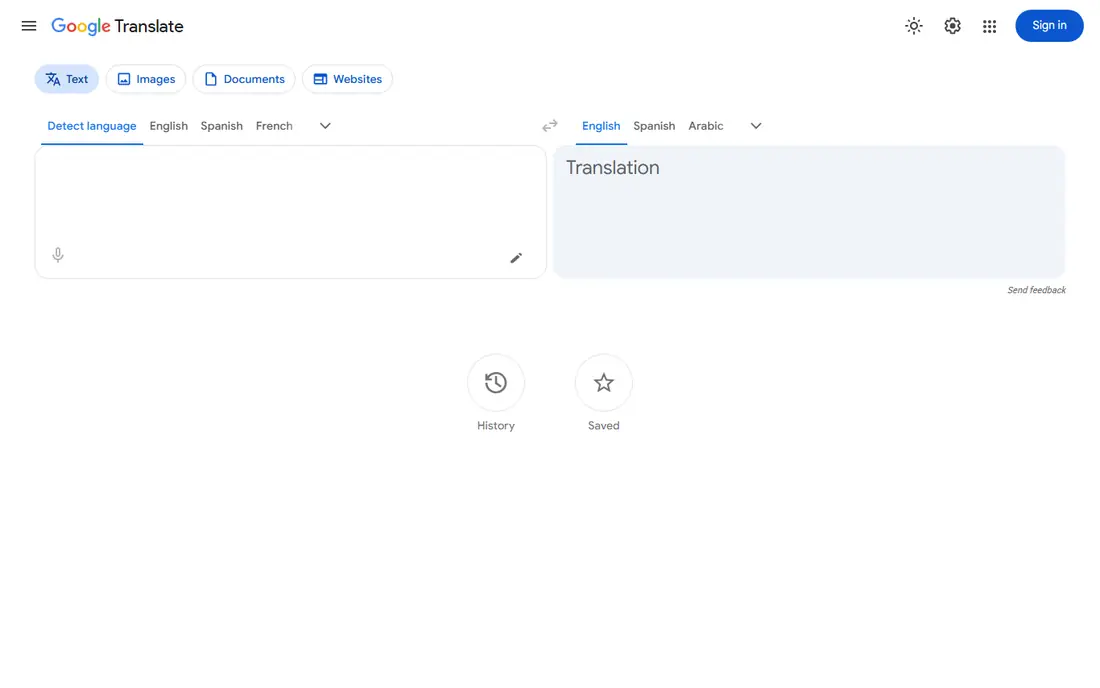
Google Translate is the breadth leader, covering over 240 languages and dialects, including rare languages where DeepL or ChatGPT fall short, and it is free for everyday use across web, iOS, and Android. Camera, voice, and offline translation plus Chrome integration make it the everyday default for most people.
For professional texts, it still falls short of DeepL on nuanced European copy, and the Cloud Translation API costs $20 per million characters, with the first 500,000 characters free in guides. For broad coverage and quick, everyday translation, Google Translate is unmatched.
What we like- Over 240 languages and dialects
- Free for everyday use
- Camera, voice, and offline translation
- Cloud API for developers
Watch out for- Trails DeepL on nuanced European copy
- Cloud API costs $20 per million characters
- Quality varies by language pair

#2Microsoft Translator
Best for: Cheapest API at scale4.3/5 on
G2 (95 reviews, checked Oct 2026)
Visit microsoft.com
Starting priceFree
Free planYes
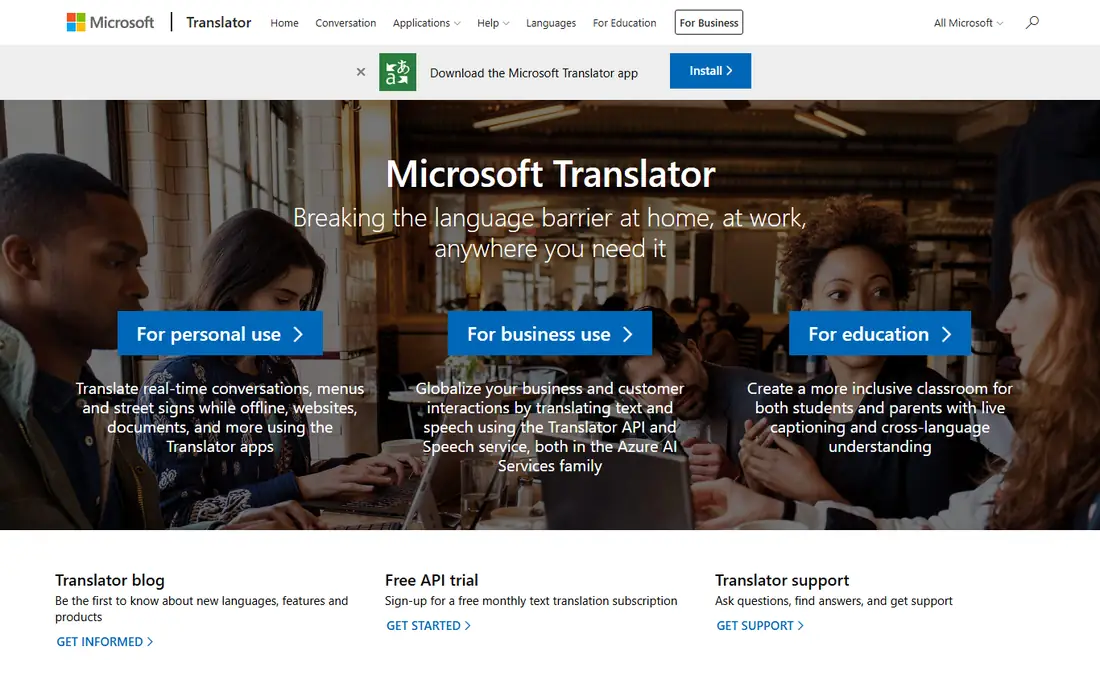
Microsoft Translator is the cheapest API at scale, at $10 per million characters in guides, with 2 million free characters per month and no expiry, which makes it the lowest-cost production API in this list. Azure integration suits teams already building on Microsoft cloud products.
Quality trails DeepL on nuanced European copy, and enterprise features sit behind Translator Pro. For developers and Azure teams that need high-volume translation at the lowest per-character price, Microsoft Translator is the best API value.
What we like- Lowest per-character API price at $10 per million characters
- 2 million free characters per month with no expiry in guides
- Azure integration
Watch out for- Quality trails DeepL on nuanced European copy
- Enterprise features need Translator Pro
- Smaller language marketing than Google
Starting priceFree
Free planYes
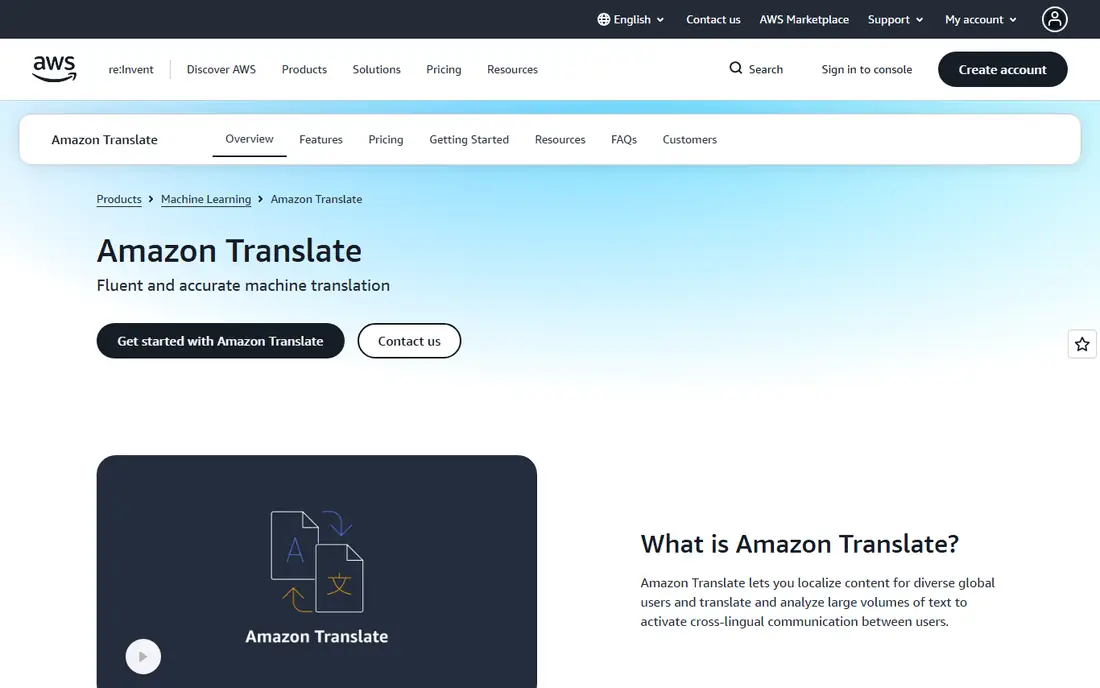
Amazon Translate fits AWS workflows, offering 75-plus languages with 2 million free characters per month for 12 months in guides and paid pricing at $15 per million characters. It integrates cleanly with other AWS services for document and content pipelines.
Language coverage trails Google, and quality is solid rather than best-in-class for nuanced copy. For teams already running on AWS, Amazon Translate is the natural, well-priced alternative.
What we like- AWS-native translation with 75-plus languages
- 2 million free characters per month for 12 months in guides
- $15 per million characters paid
Watch out for- Language coverage trails Google
- Quality is solid but not best-in-class for nuance
- Best value only inside AWS

#4ChatGPT
Best for: Context and tone control4.6/5 on
G2 (3,089 reviews, checked Oct 2026)
Visit chatgpt.com
Starting priceFree
Free planYes
ChatGPT wins where pure machine translation engines struggle: context understanding, tone control, glossary enforcement, and Asian languages. Many teams use both approaches, with a dedicated engine for bulk drafts and ChatGPT for nuanced marketing, documentation, and ambiguous interface strings that need judgment.
API pricing varies by model, with guides placing recent models near $2 to $4 per million input tokens, and the free tier carries message limits, while Plus costs $20 per month. For creative, context-sensitive translation, ChatGPT is the best DeepL alternative.
What we like- Best for context, tone, glossary enforcement, and Asian languages
- Strong on creative and marketing copy
- Plus at $20 per month
Watch out for- API pricing varies by model and token use
- Not a dedicated translation engine, so consistency needs review workflows
- Free tier has message limits
Starting priceFree
Free planYes
Lara is the one to watch in this category. It is free to use, built as an adaptive, context-aware machine translation engine, and designed to replace ModernMT, which shuts down at the end of 2026. For teams migrating off ModernMT, Lara is the direct successor path.
As a newer engine, it carries less benchmark history than DeepL or Google, and language coverage is still growing. For a free, adaptive engine with a clear migration story, Lara deserves a test in your next translation project.
What we like- Free to use
- Adaptive, context-aware machine translation
- Built to replace ModernMT, which shuts down at the end of 2026
Watch out for- Newer engine with less benchmark history than DeepL or Google
- Language coverage still growing
- Enterprise features limited
#6Unbabel
Best for: AI plus human editing4.6/5 on
G2 (198 reviews, checked Oct 2026)
Visit unbabel.com
Starting priceSee website
Free planNo
Unbabel suits teams that need human-quality output without managing translators themselves. It blends AI translation with professional editors, so customer-facing content gets a human pass, with pay-as-you-go pricing from about $0.00020 per word in guides.
There is no free tier in guides, human editing adds turnaround time versus pure machine translation, and pricing varies by language and content type. For customer-facing content where quality matters more than speed, Unbabel is the best blended option.
What we like- Blends AI translation with professional human editors
- Pay-as-you-go from about $0.00020 per word in guides
- Strong for customer-facing content
Watch out for- No free tier in guides
- Human editing adds turnaround time
- Pricing varies by language and content type

#7Lilt
Best for: Enterprise interactive translation4.4/5 on
G2 (112 reviews, checked Oct 2026)
Visit lilt.com
Starting priceSee website
Free planNo
Lilt is the enterprise interactive option, pairing machine translation with human translators in a workflow where the engine learns from every correction. That adaptive learning suits large localization programs that translate continuously and want quality to improve over time.
Pricing is quote-only, and the enterprise focus means individuals and small teams get less value. For large programs that need interactive, learning translation at scale, Lilt is the strongest enterprise alternative.
What we like- Interactive enterprise machine translation with human-in-the-loop workflows
- Strong for large localization programs
- Adaptive learning
Watch out for- Quote-only pricing
- Enterprise focus means less for individuals
- Implementation needs planning
Starting priceSee website
Free planTrial
SYSTRAN suits regulated industries and teams that need private deployment. It offers on-prem and private cloud options, which matter for legal, defense, and government content that cannot leave a private network, plus a 14-day free trial in guides.
Pricing is quote-only, and its interface feels older than newer rivals, with narrower language coverage than Google. For private, regulated translation where data control matters most, SYSTRAN is the best fit.
What we like- Strong for regulated industries and private deployment
- On-prem and private cloud options
- 14-day free trial in guides
Watch out for- Quote-only pricing
- Interface and brand feel older than rivals
- Language coverage narrower than Google
How we chose
We started from what DeepL alternatives must do well: translate accurately, cover the languages you need, and fit your workflow, whether that is a free app, an API, or a human-edited program. We compared vendor pages and current 2026 guides, and we favored tools with clear pricing, honest language coverage, and real use cases. We left out dead tools, single-language engines, and tools whose pricing could not be traced. Prices here come from 2026 guides and vendor pages, and API prices vary by region, volume, and plan tier, so confirm them before committing. DeepL itself is excluded, since this article covers alternatives to it. Note that DeepL lacks some languages entirely, such as Uzbek in earlier checks, so verify coverage for every language pair you need, and watch Cyrillic versus Latin script support where relevant.
How to pick a DeepL alternative
Start with your language pairs, not the brand. The best engine for European languages is rarely the best for Asian languages or rare languages, and coverage gaps decide more purchases than small quality differences.
Match the engine to the language pair
For European languages and nuanced business content, DeepL set the bar, and ChatGPT now rivals it on context and tone. For Asian languages, large language models score higher in guides. For rare and regional languages, Google Translate breadth wins. Test your actual top five language pairs on real content before committing.
Compare API prices on your real volume
Per-million-character prices look small until volume grows. Google costs $20, Microsoft $10, Amazon $15, and DeepL API Pro $25 per million characters in guides, with free tiers that change the math at low volumes. Project your monthly character count, subtract the free tier, and compare totals, since the cheapest headline rate is not always the cheapest bill.
Test on your real content
Run the same test set through each finalist before you commit: a marketing paragraph, a technical help article, a legal clause, and a short interface string, in each of your top language pairs. Score the outputs for accuracy, tone, and terminology consistency, and keep the scores in a simple sheet so the decision rests on evidence rather than brand reputation. Include at least one edge case your business actually faces, such as a product name that must not be translated, a formal address form for business customers, or a script variant such as Cyrillic versus Latin. Engines that handle your edge cases cleanly will save far more review time than engines that only shine on generic sample text.
Add human review where it matters
Machine translation plus human review is the sweet spot in guides, saving 30 to 50 percent of time versus pure human translation. Use pure machine translation for internal drafts and bulk content, and route customer-facing, legal, and brand content through human review or a blended service such as Unbabel.
Frequently asked questions
What is the best DeepL alternative overall?
Google Translate for breadth and free use, Microsoft Translator for the cheapest API at scale, and ChatGPT for context and tone. No single engine wins every language pair, so most teams test their top pairs first.
Is Google Translate better than DeepL?
Neither is universally better. DeepL consistently outperforms Google for European languages and nuanced business content, while Google leads on breadth, supporting over 240 languages compared with DeepL more limited coverage.
How much do translation APIs cost in 2026?
Per million characters in guides: Microsoft $10, Amazon $15, Google $20, and DeepL API Pro $25, with free tiers from 500,000 to 2 million characters per month depending on provider. LLM APIs cost more per character but add context and instruction-following.
Can AI translation replace human translators?
For internal drafts and bulk content, often yes with review. For legal documents, customer-facing content, and brand messaging, human review remains the standard, and blended services such as Unbabel exist for exactly that job.
Which DeepL alternative is best for developers?
Microsoft Translator for the lowest per-character price, Google Cloud Translation for breadth and ecosystem fit, and Amazon Translate for AWS-native workflows. Compare free tiers and per-character rates on your real volume before choosing.
Sources we checked (8)
- https://translate.google.com
- https://www.microsoft.com/en-us/translator
- https://aws.amazon.com/translate
- https://chatgpt.com
- https://www.translated.com/lara
- https://unbabel.com
- https://lilt.com
- https://www.systran.net
Is your product missing or out of date?
We review this list regularly. Vendors can request a listing, send updated pricing or ask about featured placement.

Shihab Mia · Founder, Rankite
Shihab has 5+ years in B2B and SaaS SEO. He writes Rankite's software buying guides from pricing pages, documentation and public user reviews. More about Shihab.
 Google Translate
 Amazon Translate
 Lara
 SYSTRAN