How we make this list: we compare pricing pages, product documentation and public user reviews. Ratings come from G2, Capterra or Trustpilot, with the date we checked them.
Key takeaways
- DuckDB is the best ClickHouse alternative for embedded and local analytics, with no server to run.
- Apache Druid and Apache Pinot suit real-time, user-facing analytics on high-volume event streams.
- StarRocks suits teams that want ClickHouse speed with stronger joins, materialized views, and lakehouse queries.
- Snowflake and BigQuery suit governed enterprise warehouses where managed elasticity matters more than raw query cost.
- Most open-source alternatives are free to run, but the real cost is operations: clusters, ingestion, and tuning.
Quick comparison
| Tool | Best for | Starting price | Free plan |
|---|
 DuckDB | Embedded and local analytics | Free | Yes |
 Apache Druid | Time-series event analytics | Free | Yes |
 Apache Pinot | User-facing real-time analytics | Free | Yes |
 StarRocks | BI with joins and lakehouse queries | Free | Yes |
 Apache Doris | Mixed batch and streaming analytics | Free | Yes |
 MotherDuck | Collaborative DuckDB in the cloud | Free | Yes |
 Snowflake | Governed enterprise warehousing | See website | Free trial |
 Google BigQuery | Serverless cloud analytics | Pay per use | Yes |
Is your product missing or out of date?
We review this list regularly. Vendors can request a listing, send updated pricing or ask about featured placement.
The best ClickHouse alternatives
Starting priceFree
Free planYes
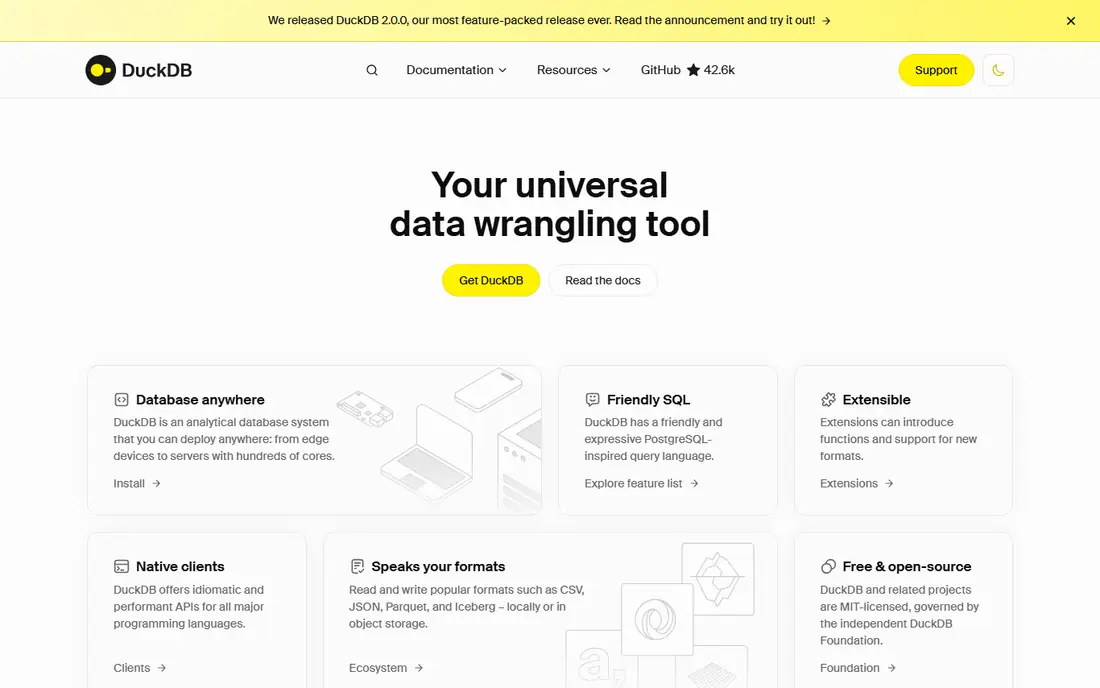
DuckDB is an in-process analytical database that runs inside your application, and for local or embedded analytics it is hard to beat. It reads Parquet, CSV, and JSON files directly, runs full analytical SQL with window functions and joins, and delivers columnar speed without a server, a cluster, or a managed bill. A data analyst exploring a few gigabytes of event data, or a developer embedding analytics into an app, can start in minutes.
The limits are scale and sharing. DuckDB's native in-process design has a single writer process, so shared services need a separate plan, and a distributed cluster for thousands of concurrent dashboard users is not what it is built for. DuckDB fits best for local exploration, embedded analytics, and bounded batch jobs where simplicity beats distributed scale.
What we like- In-process engine, no server to run
- Reads Parquet and CSV directly
- Fast analytical SQL on one machine
Watch out for- Single writer process limits shared services
- Not a distributed cluster
- Large concurrent dashboards need a different tier
Starting priceFree
Free planYes
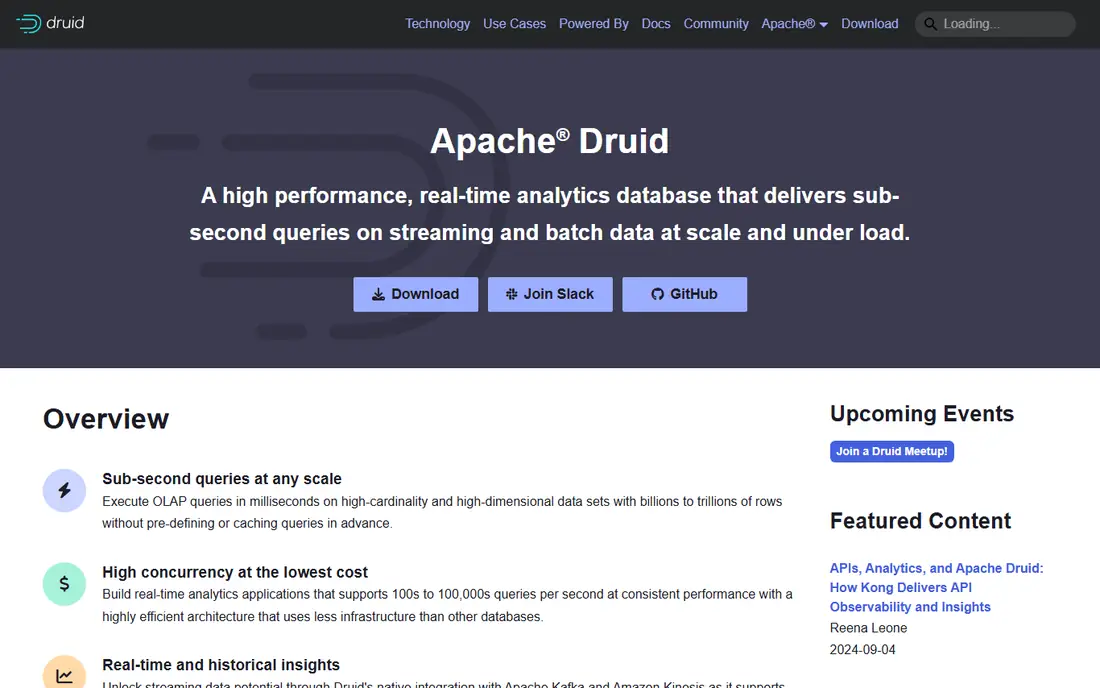
Apache Druid is built for time-oriented event analytics with continuous ingestion, and it remains a top ClickHouse alternative for that workload. Events stream in from Kafka or other sources, get partitioned into segments by time, and serve sub-second aggregations for dashboards, alerts, and product analytics. Its design suits clickstreams, telemetry, and observability data where time is the primary dimension.
The trade is operations. Druid's segments, deep storage, and metadata store add distinct recovery responsibilities, and its join support is narrower than a general warehouse. Managed services such as Imply reduce that burden for a fee. Druid fits best for data platform teams that run real-time event analytics and can operate a distributed cluster.
What we like- Built for real-time ingestion and time-series queries
- Sub-second dashboards on event data
- Strong Kafka integration
Watch out for- Complex to operate
- Segments, deep storage, and metadata add recovery duties
- Joins are limited
Starting priceFree
Free planYes
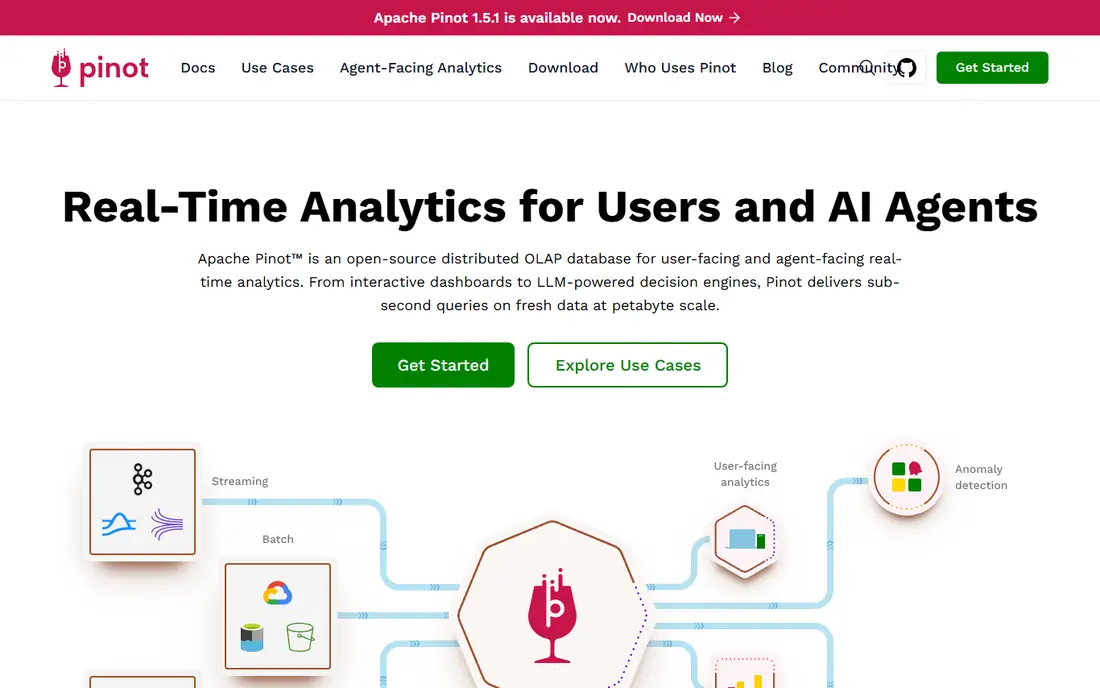
Apache Pinot is built for analytics exposed inside an application, where end users query data directly and latency must stay low at high concurrency. It supports real-time tables fed by streams alongside offline tables for historical data, and its indexing options suit point lookups and aggregations that power user-facing features such as personalization and reporting. LinkedIn originally built Pinot for exactly this workload.
The trade is complexity. Pinot's operational complexity is very high, index selection and table design shape results, and it needs a dedicated data platform team to run well. StarTree's managed service reduces that burden. Pinot fits best for product teams building user-facing analytics at scale, where latency and concurrency justify the operational cost.
What we like- Built for analytics inside applications
- Low-latency queries at high concurrency
- Real-time and offline tables
Watch out for- Very high operational complexity
- Index and table design shape results
- Needs a dedicated platform team
Starting priceFree
Free planYes
StarRocks is the closest open-source alternative for teams that like ClickHouse speed but want stronger joins, materialized views, and lakehouse analytics. It handles BI workloads, complex joins, and queries over lakehouse tables such as Iceberg, with a vectorized engine that keeps dashboard latency low. For a team moving from ClickHouse to a broader analytical platform, StarRocks covers more query shapes without leaving open source.
The limits are design effort. Storage and compute topology plus materialized view refresh behavior are part of the design, and its ecosystem is newer than Snowflake's or BigQuery's. StarRocks fits best for BI and product analytics teams that want ClickHouse-like speed with richer SQL and lakehouse support.
What we like- Fast BI queries with strong joins
- Materialized views
- Lakehouse and Iceberg support
Watch out for- Storage and compute topology is part of the design
- Newer ecosystem than Snowflake
- Cluster tuning still needed
Starting priceFree
Free planYes
Apache Doris suits teams that want one engine for mixed batch and streaming analytics. It ingests streaming data alongside batch loads, serves reporting and ad-hoc queries with MySQL-compatible SQL, and queries lakehouse tables without moving data first. That breadth makes it a practical replacement for teams running separate batch and real-time systems.
The trade is deployment. Doris has distinct frontend and backend components, and the deployment mode changes how those components behave, so planning matters. Its community is smaller than Druid's or Pinot's. Doris fits best for shared SQL analytics, reporting, and lake queries where one engine should cover both batch and streaming.
What we like- Handles batch and streaming in one engine
- MySQL-compatible SQL
- Lakehouse queries
Watch out for- Frontend and backend components add deployment complexity
- Smaller community than Druid or Pinot
- Tuning needed at scale
Starting priceFree
Free planYes
MotherDuck takes DuckDB to the cloud, adding sharing, collaboration, and serverless execution to the same in-process engine. A team can query shared datasets, collaborate on notebooks, and scale from local exploration to cloud analytics without standing up a cluster. Its operational complexity is low, and its migration path from Postgres via the pg_duckdb extension is straightforward.
The limits mirror DuckDB's. MotherDuck is not a distributed OLAP cluster, streaming ingestion is limited, and very large concurrent workloads need another tier. MotherDuck fits best for SaaS and AI engineering teams that want lightweight, collaborative analytics without heavy infrastructure.
What we like- DuckDB in the cloud with sharing
- Minimal operational complexity
- Good for SaaS and AI teams
Watch out for- Not a distributed OLAP cluster
- Streaming ingestion is limited
- Large-scale concurrency needs another tier
#7Snowflake
Best for: Governed enterprise warehousing4.6/5 on
G2 (762 reviews, checked Oct 2026)
Visit snowflake.com
Starting priceSee website
Free planFree trial
Snowflake suits enterprise teams that prioritize governed, managed warehousing over raw query cost. Its separation of storage and compute gives elasticity for spiky workloads, its governance and catalog features suit regulated data, and its ecosystem of integrations and marketplace data is the broadest in this list. For a team that needs compliance, sharing, and a large partner network, Snowflake covers more than an OLAP engine alone.
The trade is cost and lock-in. Usage-based pricing can grow quickly, and proprietary formats make migration expensive. Snowflake fits best for enterprise data teams that want a managed warehouse with governance, not for a team optimizing purely for cost per query.
What we like- Fully managed elasticity
- Strong governance and catalog
- Broad ecosystem and integrations
Watch out for- Costs can grow with usage
- Proprietary formats make migration costly
- Raw speed per dollar trails ClickHouse on some workloads
#8Google BigQuery
Best for: Serverless cloud analytics4.5/5 on
G2 (1,223 reviews, checked Oct 2026)
Visit cloud.google.com
Starting pricePay per use
Free planYes
BigQuery suits teams already on Google Cloud that want serverless analytics at petabyte scale. There is no cluster to manage, queries scale automatically, and integration with Vertex AI and other Google services suits AI and machine learning workloads. Its free tier covers a monthly allowance of queries and storage, which suits evaluation and small workloads.
The limits are latency and cost discipline. BigQuery offers near real-time latency rather than sub-second dashboard speed, and query costs need partition discipline to stay predictable. Its ecosystem is centered on Google Cloud. BigQuery fits best for enterprise teams on GCP that want governed, serverless analytics with AI integration.
What we like- Serverless, no cluster to manage
- Scales to petabytes
- Deep Google Cloud and AI integration
Watch out for- Near real-time, not sub-second latency
- Query costs need partition discipline
- GCP-centered ecosystem
How we chose
We compared these tools on query latency, ingestion model, concurrency, operational complexity, and cost, since ClickHouse buyers weigh raw speed against the effort of running a cluster. Pricing figures come from vendor pages and current comparison guides checked in October 2026, and any figure we could not confirm is marked as See website. We did not claim hands-on testing. Instead we weighed public documentation, release notes, and user reviews, plus the practical difference between an embedded engine, a distributed cluster, and a managed warehouse.
What to check before you pick
Start with latency. Sub-second dashboards on event streams point to Druid, Pinot, or StarRocks, while near real-time reporting suits BigQuery or Snowflake. Next, check ingestion: Kafka-native streams suit Druid and Pinot, change-data-capture pipelines suit ClickHouse-style engines, and micro-batch loads suit warehouses. Finally, weigh operations honestly: a free open-source engine is not free if it needs a dedicated platform team.
Managed versus self-hosted
Managed services such as ClickHouse Cloud, BigQuery, and Snowflake trade higher bills for lower operational burden, while self-hosted Druid, Pinot, and StarRocks trade lower license cost for cluster duties. A small team should default to managed or embedded options such as MotherDuck, DuckDB, or BigQuery, and only self-host when latency, cost, or control clearly demands it.
Cost predictability at scale
Open-source engines bill infrastructure and operations, while warehouses bill usage. Model both at your expected data volume and query count, not at trial scale. A warehouse that looks cheap on a gigabyte of data can grow sharply at a terabyte, while a cluster that looks cheap to license can grow in engineering time.
Frequently asked questions
Is ClickHouse free?
ClickHouse open source is free to run, with infrastructure and operations as the cost. ClickHouse Cloud is a paid managed service. Most alternatives in this list have open-source cores with paid managed options, while Snowflake and BigQuery are proprietary managed services.
Can ClickHouse replace Snowflake or BigQuery?
Sometimes. ClickHouse wins on raw speed, real-time ingestion, and cost efficiency for analytical workloads that fit its model. Snowflake and BigQuery win on managed elasticity, governance, and broader platform features, plus more mature handling of complex joins.
Which ClickHouse alternative is best for real-time analytics?
Apache Druid and Apache Pinot lead for ultra-low-latency, user-facing analytics on event streams, with StarRocks close behind for BI and lakehouse queries. BigQuery and Snowflake suit near real-time reporting rather than sub-second dashboards.
What is the difference between OLAP and OLTP?
OLTP handles frequent, small operational transactions with strong consistency and single-record speed, using row stores such as MySQL or Postgres. OLAP handles complex analytical queries over historical data, prioritizing read speed for scans and aggregations, using columnar stores such as ClickHouse or Snowflake.
Is DuckDB a real ClickHouse replacement?
For embedded and local analytics, yes. DuckDB covers exploration, bounded batch jobs, and app-embedded analytics with far less setup. For distributed, high-concurrency dashboards, a cluster engine such as Druid, Pinot, StarRocks, or a managed warehouse is a better fit.
Do I need a data platform team to run these tools?
For Druid, Pinot, and StarRocks, a dedicated platform team is strongly advised. For DuckDB, MotherDuck, BigQuery, and Snowflake, a small team or even a single analyst can start, since operations are managed or minimal.
Sources we checked (8)
- https://duckdb.org
- https://druid.apache.org
- https://pinot.apache.org
- https://www.starrocks.io
- https://doris.apache.org
- https://motherduck.com
- https://www.snowflake.com
- https://cloud.google.com/bigquery
Is your product missing or out of date?
We review this list regularly. Vendors can request a listing, send updated pricing or ask about featured placement.

Shihab Mia · Founder, Rankite
Shihab has 5+ years in B2B and SaaS SEO. He writes Rankite's software buying guides from pricing pages, documentation and public user reviews. More about Shihab.