How we make this list: we compare pricing pages, product documentation and public user reviews. Rankite is independent; if a vendor ever pays for a featured spot, that listing is clearly labeled Partner.
Key takeaways
- NICE, Verint and Genesys lead the enterprise WFO suite market, combining forecasting, scheduling, quality and analytics.
- Calabrio is the mid-market favorite: full WFO capabilities without enterprise complexity.
- Playvox targets the modern digital-first contact center with coaching-centric workforce engagement.
- Aspect, Alvaria and Five9 serve specific niches from large outbound operations to integrated CCaaS platforms.
Quick comparison
| Tool | Best for | Starting price | Free plan |
|---|
 NICE NICE | large enterprises wanting the complete WFO suite | See website (custom quote) | No |
 Verint Verint | AI-driven forecasting and quality automation | See website (custom quote) | No |
 Calabrio Calabrio | mid-market centers wanting full WFO without enterprise weight | See website | No |
 Aspect Aspect | large operations with complex scheduling needs | See website (custom quote) | No |
 Playvox Playvox | digital-first centers focused on agent coaching | See website | Free trial |
 Alvaria Alvaria | outbound-heavy and compliance-driven operations | See website (custom quote) | No |
 Genesys Genesys | Genesys Cloud users adding workforce optimization | See website (custom quote) | No |
 Five9 Five9 | Five9 customers unifying WFO and CCaaS | See website (custom quote) | No |
Is your product missing or out of date?
We review this list regularly. Vendors can request a listing, send updated pricing or ask about featured placement.
The best workforce optimization software
#1
NICE
Best for: large enterprises wanting the complete WFO suite
Visit nice.com
Starting priceSee website (custom quote)
Free planNo
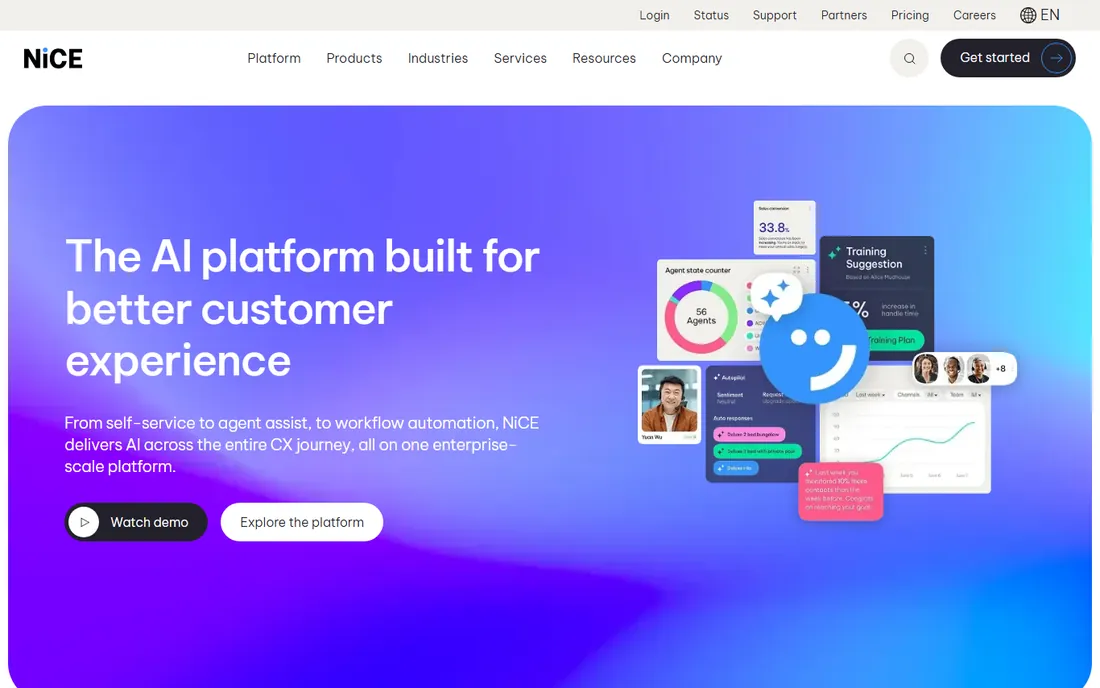
NICE's workforce optimization suite covers the full lifecycle: forecasting, scheduling, quality management, performance analytics and employee engagement, increasingly unified by AI. Large contact centers with thousands of agents rely on its depth and the analytics that tie workforce decisions to business outcomes.
Everything about NICE is enterprise: pricing, sales process, implementation timelines. Mid-size centers find it heavy. For organizations where workforce optimization is strategic and the agent count justifies the investment, it is the safe market leader.
What we like- Market-leading breadth
- Strong AI and analytics
- Proven at massive scale
Watch out for- Enterprise pricing and complexity
- Implementation is a project
#2
Verint
Best for: AI-driven forecasting and quality automation
Visit verint.com
Starting priceSee website (custom quote)
Free planNo
Verint has pushed AI through workforce optimization: automated quality scoring, intelligent forecasting and agent assist features that reduce manual WFM work. The platform handles the full WFO stack with particular strength in analytics and compliance recording.
Pricing is custom and the product range is wide enough to confuse buyers. Implementation needs planning. Contact centers that want AI doing the heavy lifting in QA and forecasting should put Verint on the shortlist.
What we like- Strong AI across the suite
- Good analytics
- Flexible deployment
Watch out for- Quote-based pricing
- Product breadth can overwhelm
#3
Calabrio
Best for: mid-market centers wanting full WFO without enterprise weight
Visit calabrio.com
Starting priceSee website
Free planNo
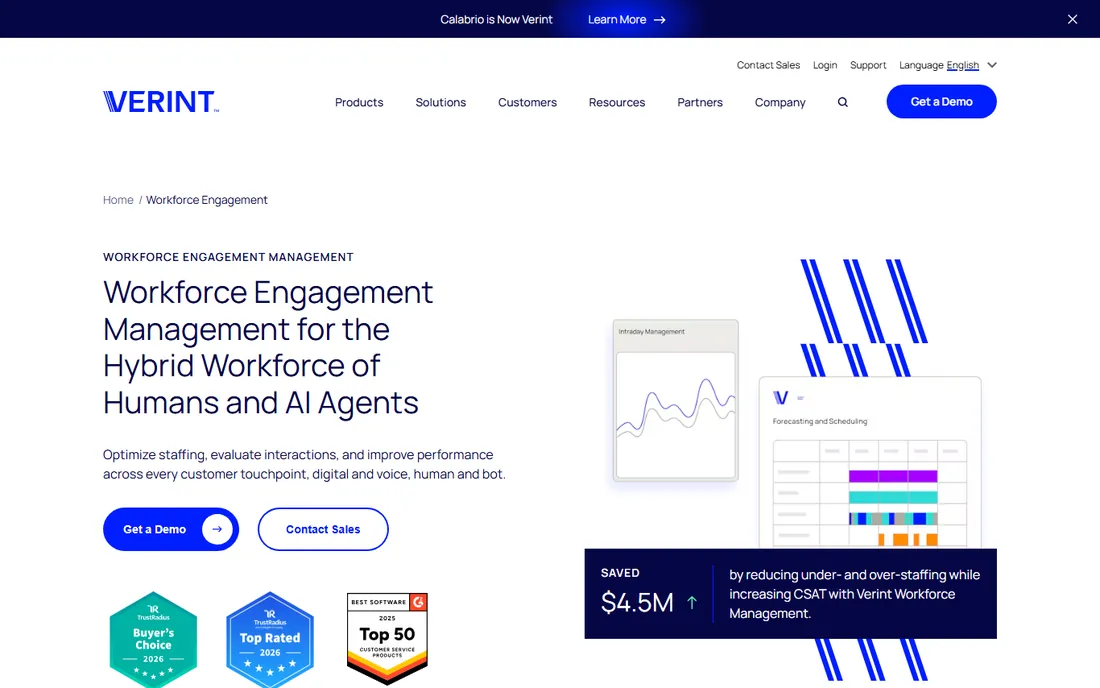
Calabrio packages workforce management, quality management and analytics in a suite mid-market centers can actually deploy and use. The usability exceeds the enterprise giants, and the implementation timelines are shorter. It is the "just right" choice for centers with 50 to 1,000 agents.
At multi-thousand-agent scale, NICE and Verint offer more depth. Pricing is not published. For the broad middle of the contact center market, Calabrio hits the sweet spot of capability versus complexity.
What we like- Complete WFO suite
- More approachable than NICE/Verint
- Good usability
Watch out for- Less depth at extreme scale
- Pricing not published
#4
Aspect
Best for: large operations with complex scheduling needs
Visit aspect.com
Starting priceSee website (custom quote)
Free planNo
Aspect's workforce management heritage runs deep: the scheduling optimization handles intricate constraints, union rules and multi-skill routing that simpler tools cannot. Large, complex operations with demanding scheduling requirements benefit most.
The enterprise sales motion and less modern interface deter smaller buyers. It is a specialist's tool. When scheduling complexity is the core problem, Aspect's algorithms justify the enterprise engagement.
What we like- Deep WFM heritage
- Powerful scheduling algorithms
- Handles complexity
Watch out for- Enterprise sales motion
- Interface less modern
#5
Playvox
Best for: digital-first centers focused on agent coaching
Visit playvox.com
Starting priceSee website
Free planFree trial
Playvox rethinks WFO around coaching and engagement rather than surveillance: quality scores feed coaching sessions, recognition and agent development. The modern interface suits digital-first and remote teams that find legacy WFO oppressive.
The suite breadth trails NICE and Verint: forecasting depth and advanced analytics are lighter. As a smaller vendor, enterprise buyers do diligence. Centers that believe engaged agents perform better find the philosophy refreshing and the results real.
What we like- Modern coaching-centric design
- Good for remote teams
- Approachable pricing
Watch out for- Less breadth than enterprise suites
- Smaller vendor
#6
Alvaria
Best for: outbound-heavy and compliance-driven operations
Visit alvaria.com
Starting priceSee website (custom quote)
Free planNo
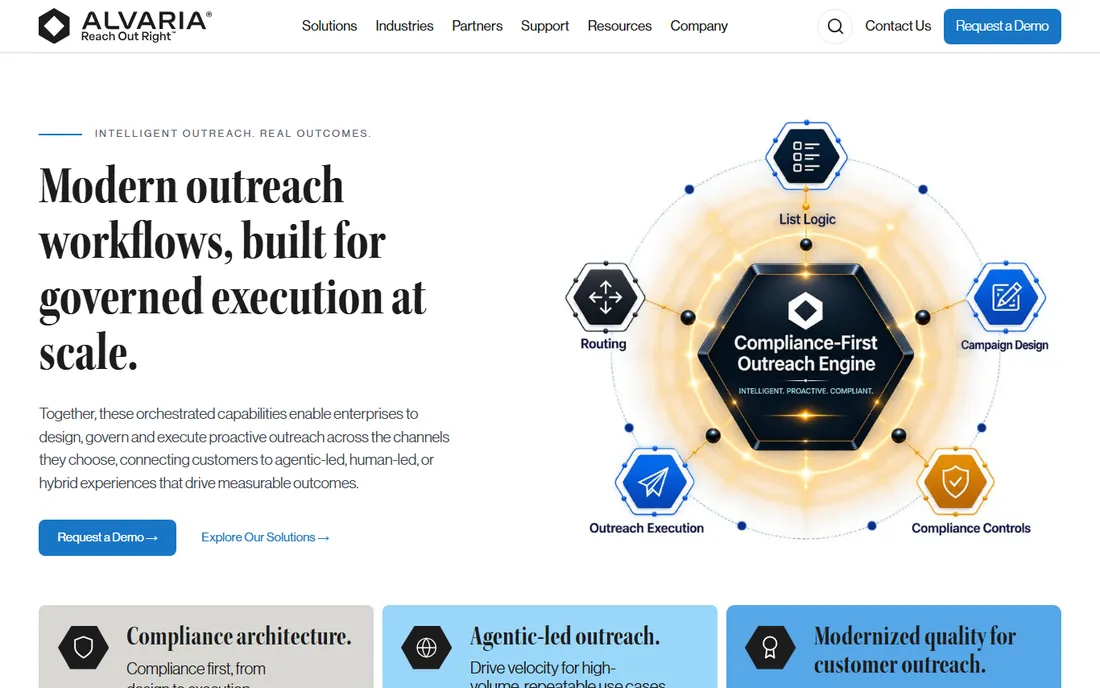
Alvaria (formed from Aspect and Noble Systems) serves outbound-heavy operations with workforce tools integrated to dialing and campaign management. Compliance features for regulated outbound (TCPA and similar) matter in its core markets. The scale credentials are serious.
General inbound centers find the positioning narrow. Enterprise complexity applies. For outbound operations where compliance and dialer integration are non-negotiable, it is purpose-built.
What we like- Strong outbound and dialer integration
- Compliance features
- Scale proven
Watch out for- Niche positioning
- Enterprise complexity
#7
Genesys
Best for: Genesys Cloud users adding workforce optimization
Visit genesys.com
Starting priceSee website (custom quote)
Free planNo
Genesys Cloud's workforce engagement management benefits from native platform integration: scheduling, quality and analytics share data with routing and interaction handling natively. AI forecasting improves with the platform's data depth. Existing Genesys customers get WFO without integration projects.
Standalone value outside Genesys is limited; this is a platform play. Pricing is enterprise. If your contact center runs on Genesys Cloud, evaluating its WFO first is obvious.
What we like- Native CCaaS integration
- AI-powered forecasting
- Unified agent desktop
Watch out for- Best inside Genesys
- Pricing enterprise
Starting priceSee website (custom quote)
Free planNo
Five9's workforce optimization rides on its leading CCaaS platform: forecasting informed by real interaction data, quality management tied to actual calls, scheduling that understands the routing. The practical AI features (agent assist, workflow automation) help daily operations.
Pure-play WFO vendors offer more depth in specific functions. This is the integrated choice. Five9 customers wanting one vendor and one data model for contact center operations find it compelling.
What we like- Tight CCaaS integration
- Practical AI features
- Strong mid-market to enterprise
Watch out for- WFO depth less than pure plays
- Enterprise pricing
How we chose
We evaluated current WFO suites on capability breadth, AI features, usability and market position, cross-checked against analyst reports and practitioner feedback. Every tool listed is actively maintained with a live homepage as of October 2026. We weighted the full optimization lifecycle (forecast, schedule, quality, coach, analyze) over point solutions. Pricing is quote-based across the category and marked accordingly.
The AI shift in workforce optimization
AI is changing WFO faster than any previous technology wave. Automated quality scoring now evaluates 100% of interactions instead of the traditional 2-3% sample, which transforms coaching from anecdote to data. Forecasting models incorporate more signals and adapt faster. Agent-assist tools provide real-time guidance that shortens ramp time.
The implication for buyers: evaluate the AI features as the core, not the add-on. Ask vendors what percentage of quality scoring is automated, how forecasting accuracy is measured, and what the AI actually does versus what the marketing claims. The gap between AI leaders and laggards in this category is now the primary differentiator. Buying a non-AI WFO suite in 2026 is buying obsolescence.
What to check before you sign
Start with your interaction channels. Voice-centric, digital-first and blended operations need different WFO strengths. Verify the forecasting and scheduling handle your actual channel mix, including the asynchronous channels (messaging, email) that legacy WFM handles poorly.
Then check the integration with your contact center platform. Native integration (Genesys, Five9, NICE CXone) beats third-party connectors for data depth and reliability. If you are not on the vendor's CCaaS, verify the integration quality with your platform specifically, including real-time data feeds.
Finally, evaluate the agent experience. WFO fails when agents hate it: clunky schedule bidding, opaque quality scoring and surveillance-feeling monitoring drive attrition. Ask for the agent-facing demo, check mobile schedule access, and prefer vendors whose philosophy centers coaching over monitoring. Your agents' opinion predicts the ROI.
Do not skip the change management planning. New WFO systems change how agents bid for shifts, receive feedback and understand their performance. Communicate early, involve agent representatives in the selection, and train thoroughly. The best software fails when agents experience it as something done to them rather than for them. Budget as much for adoption as for licenses: the technology is the easy part.
Frequently asked questions
What is workforce optimization software?
Software that manages the full agent lifecycle in contact centers: forecasting demand, scheduling staff, monitoring quality, coaching agents and analyzing performance. The goal is the right agents, with the right skills, at the right times, performing well.
How much does WFO software cost?
Enterprise suites are quote-based, typically priced per agent per month. Expect $50-200+ per agent per month depending on modules and scale. Mid-market options cost less. Get quotes from three vendors: the range surprises buyers.
Do I need a full suite or just WFM?
Start with workforce management (forecasting and scheduling) if staffing is the pain. Add quality management when consistency matters, and analytics when you need insight. Suites bundle these, but point solutions exist. Match the purchase to the actual problem.
How does AI improve quality management?
Traditional QA scores 2-3% of interactions manually. AI scores 100% automatically, finding patterns humans miss and freeing QA staff for coaching. The shift from sampling to full coverage is the biggest quality advance in the industry's history.
Can WFO software handle remote agents?
Modern platforms can, with mobile schedule access, remote quality monitoring and digital coaching tools. Verify remote-specific features during evaluation: the pandemic proved that WFO designed for the office floor adapts poorly.
How long does implementation take?
Mid-market deployments (Calabrio, Playvox) typically take 4-12 weeks. Enterprise suites (NICE, Verint) run 3-9 months including integration and change management. Data quality in your existing systems is usually the bottleneck, not the software.
Should WFO and CCaaS come from the same vendor?
It simplifies integration and data flow: workforce decisions informed by real interaction data perform better. But best-of-breed WFO sometimes outperforms the CCaaS vendor's built-in modules. If your CCaaS is entrenched, evaluate its WFO first but compare honestly against specialists. The integration advantage is real but not decisive.
How do I measure WFO ROI?
Track schedule adherence, forecast accuracy, quality scores, agent attrition and cost per contact before and after. The biggest returns usually come from reduced overstaffing (better forecasting) and reduced attrition (better coaching and scheduling fairness). Quantify both: finance understands dollars, not adherence percentages.
What is the difference between WFM and WFO?
Workforce management (WFM) covers forecasting and scheduling: the right people at the right times. Workforce optimization (WFO) adds quality management, coaching, performance analytics and engagement: the right people performing well. WFM is the foundation; WFO is the full building. Buy WFM first if staffing is the crisis, expand to WFO as you mature.
How do I get agents to trust AI quality scoring?
Transparency is everything. Show agents exactly what the AI evaluates and why scores change. Let them dispute scores with human review. Start with AI assisting human QA rather than replacing it, and share the data showing the AI is fair across teams. Agents accept scoring they understand; they resist black boxes. The vendors with explainable AI features deserve preference. Run a pilot with one team first, gather their feedback, and refine the approach before rolling out to the whole center. The pilot's lessons about communication and training will determine whether the full rollout succeeds or struggles. Document what worked and apply it systematically as you expand to additional teams.
Sources we checked (8)
- https://www.nice.com
- https://www.verint.com
- https://www.calabrio.com
- https://www.aspect.com
- https://www.playvox.com
- https://www.alvaria.com
- https://www.genesys.com
- https://www.five9.com
Is your product missing or out of date?
We review this list regularly. Vendors can request a listing, send updated pricing or ask about featured placement.

Shihab Mia · Founder, Rankite
Shihab has spent more than a decade helping SaaS and e-commerce brands grow through search. He writes Rankite's software buying guides from pricing pages, documentation and public user reviews. More about Shihab.