How we make this list: we compare pricing pages, product documentation and public user reviews. Ratings come from G2, Capterra or Trustpilot, with the date we checked them.
Key takeaways
- This is a strategies list, not a software list: each entry is a promotion method, with the main channel or tool used to run it and what it honestly costs.
- App store optimisation is the foundation, because most discovery still happens inside the stores, and it costs effort rather than media money.
- Paid channels, Apple Search Ads, Google App Campaigns, and Meta, buy learning speed, and their cost per install decides whether they scale or stop.
- Referrals and community compound: a product people recommend and a place where users gather beat any single campaign over a year.
Quick comparison
Is your product missing or out of date?
We review this list regularly. Vendors can request a listing, send updated pricing or ask about featured placement.

#1
App store optimisation with AppTweak
Best for: Organic discovery inside the stores
Visit apptweak.com
Starting priceSee website
Free planNo
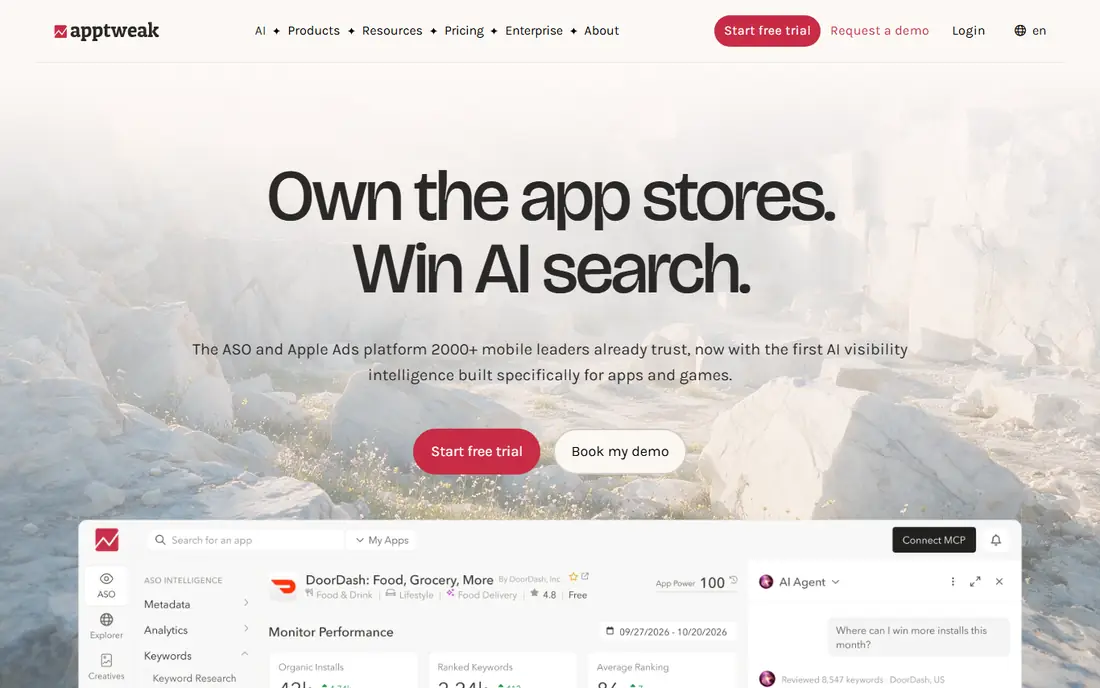
What we like- ASO is the work every other channel depends on: keyword research for the title and subtitle, a screenshot set that sells the outcome in the first two frames, ratings prompts timed after a success moment, and localisation for your top countries. AppTweak is the standard research tool for it, tracking keyword rankings, competitor moves, and store experiments. Store listing experiments on Google Play and product page optimisation on Apple let you test rather than guess, and the gains compound because they apply to every visitor the other channels send.
Watch out for- ASO is slow: ranking changes take weeks, and in crowded categories the head keywords belong to apps with ten times your install velocity. Tools such as AppTweak cost money before they save any, and small apps can start with manual research. ASO alone rarely creates demand
- It captures the demand that exists.
Starting priceSee website
Free planYes
What we like- Apple Search Ads puts your app at the top of the exact search a motivated user just typed in the App Store, which makes it the highest intent paid channel in mobile. You pay per tap, set budgets and bids by keyword, and can defend your own brand term while prospecting category terms. Discovery campaigns also mine new keywords from Apple's matching. For subscription and paid apps with a known value per user, it is usually the first paid channel to test on iOS.
Watch out for- Auctions in finance, dating, and utility categories push cost per tap to levels only high lifetime value apps survive. It reaches iOS only, and only inside the store. Brand defence is a quiet tax: once competitors bid on your name, you pay for traffic that was free, and opting out costs more.
Starting priceSee website
Free planYes
What we like- Google App Campaigns automate Android and iOS promotion across Search, Play, YouTube, Discover, and the display network from one campaign: you supply text, images, and video assets plus a target cost per install or per action, and Google's systems find the users. It is the fastest route to volume for a new app and the standard testbed for creative, since asset level reporting shows which video or message earns installs. Budgets scale from tens of dollars a day.
Watch out for- Automation means limited control: placement and audience choices are mostly the algorithm's, and learning periods burn budget before costs settle. Optimising for installs alone buys low quality users, so the campaign only behaves once it is fed in app events and aimed at actions that signal retention. Creative quality decides results more than settings do.
Starting priceSee website
Free planYes
What we like- Meta's app campaigns across Facebook and Instagram remain the interest targeting channel: creative built for the feed, audiences built from interests, lookalikes, and your own user data where privacy rules allow, and optimisation toward installs or in app events. For visual, lifestyle, and social apps it often finds users the stores never would. Short video creative made for the app itself doubles as organic content, so production effort earns twice.
Watch out for- IOS privacy changes since App Tracking Transparency permanently reduced targeting and measurement precision, so reported and real results differ more than they did. Costs swing with auction competition and creative fatigue is fast, demanding a steady supply of new ads. As with Google, the platform optimises for the event you choose, and choosing installs buys installs, not customers.

#5
TikTok organic and creators
Best for: Discovery through short video
Visit tiktok.com
Starting priceFree
Free planYes
What we like- TikTok is where app discovery now happens for younger audiences: a founder or creator showing the app solving a problem in fifteen seconds can out perform a quarter of ad spend, and the organic route costs time rather than media. Paid creator partnerships through TikTok's marketplace formalise the same motion at every budget, and Spark Ads let you put spend behind a creator's post that already works. Apps with a visual payoff, photo, fitness, language, AI tools, are built for this channel.
Watch out for- Organic results are a lottery: most posts do little, and the one that works cannot be scheduled. Creator quality varies wildly and briefs that read as ads die on contact with the audience. TikTok's regulatory future in the US has been contested for years, so building your whole acquisition on it carries platform risk no marketer controls.
Starting priceFree
Free planYes
What we like- Product Hunt concentrates early adopters, makers, and tech press into one launch day: a well prepared launch, clear tagline, first comment from the maker, gallery and a launch offer, can deliver a spike of installs, feedback, and backlinks that a new app cannot buy elsewhere at any sane price. It is free to launch. For developer tools, productivity, and AI apps aimed at early adopters, it remains the standard opening move.
Watch out for- The audience is a niche: a consumer app for parents or tradespeople will find few of its users there. Results hinge on the day's competition and your existing network's support, and a quiet launch produces a quiet day. The spike also fades in days, so Product Hunt opens a launch
- It does not sustain one.

#7
Referral programme with Branch
Best for: Turning users into a channel
Visit branch.io
Starting priceSee website
Free planYes
What we like- A referral programme is the only channel whose cost per install falls as it works: give users a personal link, reward both sides where the economics allow, and every satisfied user becomes distribution. Branch is the infrastructure most teams use, because its deep links carry the referral through the store install and into the right in app destination, which is where home built schemes usually break. Referral users typically retain better than ad bought users, since they arrive with a friend's endorsement and often a friend inside the app.
Watch out for- Referral amplifies what exists: an app people do not love generates no invitations, and no incentive design fixes that. Rewards invite fraud and gaming, which need monitoring from day one. Attribution disputes, who invited whom and whether the reward is owed, are a support cost nobody budgets for.

#8
Reddit and community marketing
Best for: Niche audiences and honest feedback
Visit reddit.com
Starting priceFree
Free planYes
What we like- Reddit hosts the exact niche communities most apps serve, by hobby, profession, condition, and interest, and a maker who participates honestly, answering questions, sharing progress, and posting in the sanctioned self promotion threads, can earn a first thousand users and the sharpest product feedback available anywhere. It costs nothing but time and conduct. The same applies to Discord servers and specialist forums in your category.
Watch out for- Communities detect marketing instantly and punish it
- Accounts that arrive selling get removed and sometimes banned, and one clumsy post can follow a brand for years. The channel does not scale on command and cannot be delegated to someone who does not know the community. Results are slow and lumpy compared with paid media.
How we chose
We listed the methods an app team would actually sequence in 2026, foundation first, then paid capture, then compounding channels, and named the main platform or tool for each so the entries stay actionable. We judged each way on evidence of current practice in app marketing, cost shape, and who it suits, rather than on novelty. We excluded store featuring as a strategy, since it cannot be bought or scheduled and follows success more often than it creates it, and we excluded incentivised install networks, which buy low quality installs that stores penalise and advertisers regret.
Sequence by stage. Before launch: build the store page properly, seed a community presence, and prepare a Product Hunt or category launch moment. At launch: turn on Apple Search Ads for your brand and a small set of category terms, and a Google App Campaign aimed at an in app action, with budgets sized to learn, not to boast. Always running: ASO experiments, a referral programme once retention proves out, and a short video habit on TikTok or Reels, because creative made for one channel feeds all the others.
Measure every channel on cost per retained, paying user where your model allows, and kill channels on that number rather than on install price. Keep the arithmetic honest: a 3 dollar install with 5 percent day 30 retention costs 60 dollars per kept user, which a 6 dollar install at 25 percent retention beats at 24 dollars. Promotion multiplies the product you have; if the kept user maths never works, the next dollar belongs in the app, not the ads. No method here guarantees downloads or revenue, and any agency or tool promising either is telling you what you want to hear. Channel prices and store policies are October 2026 positions and shift constantly.
Frequently asked questions
How much does it cost to promote an app?
From nothing but time, ASO, community work, organic video, and a Product Hunt launch, to whatever an auction charges: cost per install runs from under a dollar for casual games in cheap geographies to tens of dollars for finance or dating apps in the US. A realistic learning budget is a few thousand dollars across the paid channels, spent to find one channel whose cost per retained user fits your revenue per user. Without that fit, spend stays a cost, not an investment.
What is the single most effective way?
For most apps, the unglamorous answer is the store page itself: ranking for the searches your users already make and converting the visitors every other channel sends. Teams consistently underrate ASO because it has no launch moment, then discover their paid campaigns were quietly taxed by a weak page converting at half the category rate. Fix the foundation, then buy traffic.
Do I need paid ads to launch an app?
No, and many apps launch better without them: a focused community, a launch platform moment, and creator outreach can deliver the first thousand users and the feedback that matters more. Paid ads earn their place when you know your retention numbers and need volume or faster learning than organic channels provide. Launching paid spend before the product retains is the most common way new apps waste their first budget.
How do referrals fit with the other channels?
Referrals multiply them. Every user the stores, ads, and videos bring in becomes a potential inviter, so the programme should be live before you scale spend, not after. The mechanics matter more than the reward size: a link that lands the friend in the right place in the app, a reminder at the moment of user success, and a reward both sides value. Branch or a similar deep linking layer is what makes the accounting work through a store install.
Can promotion get my app featured by Apple or Google?
Featuring cannot be bought or applied for with any promise of success. Editors pick apps that are new or meaningfully updated, well designed, localised, and often tied to a moment or a story, and a launch that performs well elsewhere raises your visibility with them. Treat featuring as a possible bonus on top of the channels in this guide, never as the plan: apps that plan around it usually launch to silence.
Sources we checked (0)
Is your product missing or out of date?
We review this list regularly. Vendors can request a listing, send updated pricing or ask about featured placement.

Shihab Mia · Founder, Rankite
Shihab has 5+ years in B2B and SaaS SEO. He writes Rankite's software buying guides from pricing pages, documentation and public user reviews. More about Shihab.
 Apple Search Ads
 Google App Campaigns
 Meta app ads
 Product Hunt