How we make this list: we compare pricing pages, product documentation and public user reviews. Ratings come from G2, Capterra or Trustpilot, with the date we checked them.
Key takeaways
- Vanido is the cheapest vocal trainer, with 3 free exercises a day and a subscription at $2.99 a month or $17.99 a year by guides, though another guide lists about $39.99 a year on iOS.
- Erol Singer's Studio is the most structured trainer, with range finding from your natural speaking voice, posture tutorials with anatomy visuals, and instant pitch feedback on every exercise.
- SingTrue suits pitch accuracy training, while SwiftScales suits singers who want piano-style warm-ups they control in real time, as high or low and as fast or slow as needed.
- Warm Me Up suits serious singers and choirs, with 50 to 60 professional warm-up exercises by voice type, guided by a professional singer and a baby grand piano.
- Apps build technique, but they do not replace a teacher for diagnosing strain: stop and rest if singing hurts, and seek help if hoarseness lasts more than two weeks.
Quick comparison
Is your product missing or out of date?
We review this list regularly. Vendors can request a listing, send updated pricing or ask about featured placement.
The best vocal training app
Starting priceFree
Free planYes
Vanido is a pop-singing trainer rather than a pure rating tool, with daily sessions that adapt to your vocal range and past performance. The real-time pitch line is the standout: you watch your voice drift off the note as it happens, which teaches faster than any after-the-fact score. Each exercise gets scored on a 3-star scale with notes on what to improve.
At $2.99 a month or $17.99 a year by one guide, with another listing about $39.99 a year on iOS, pricing needs confirming in the App Store before buying. The free tier still gives 3 exercises a day. For pop singers who want cheap daily practice with visual pitch feedback, Vanido is the best value pick.
What we like- Cheapest subscription here at $2.99 a month by guides
- 3 free exercises daily
- Real-time pitch line
Watch out for- Pop-genre focus, weak for other styles
- IOS only by vendor terms
- 3-star scale vaguer than numeric scores
Starting priceFree
Free planYes
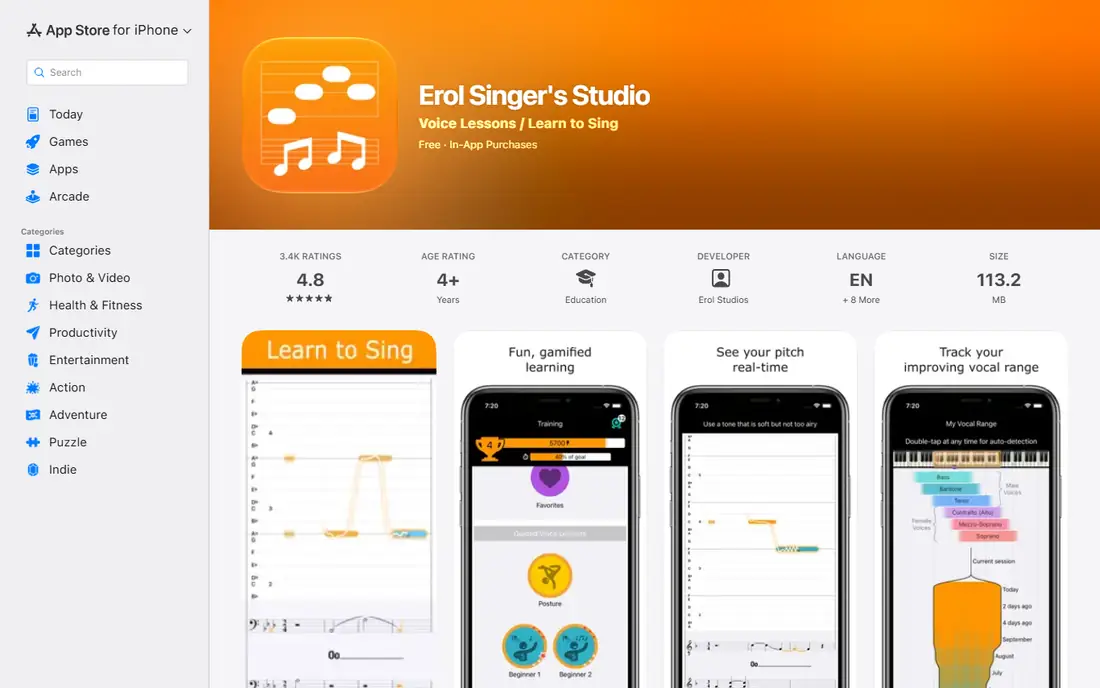
Erol Singer's Studio is the most structured trainer here, and it is the only singing app in one voice-teacher review that helps you find your vocal range, showing keyboard positions and voice types with a recording-based detector. Exercises start from your comfortable note, determined by your natural speaking voice, which is ideal for beginners.
Posture tutorials include animated demonstrations showing lung and rib anatomy, and every exercise gives instant feedback on how you did. Upgrade pricing runs about 1.99 euros a week, 7.49 euros a month, or 54.99 euros a year by guides. For a singer who wants structure over entertainment, Erol is the strongest pick.
What we like- Range finder from your natural speaking voice
- Posture tutorials with anatomy visuals
- Instant pitch feedback
Watch out for- IOS only
- Some exercises lack audio, text only
- Older add-on pricing confused some users
Starting priceFree
Free planYes
SingTrue suits singers whose main problem is pitch accuracy, using a proprietary algorithm to analyze your singing and give personalized feedback. Exercises and games target pitch accuracy and vocal technique directly, rather than wrapping training in karaoke or social features.
The pitch focus means less full curriculum than Erol or Yousician, and the app history is iOS-first. For a singer who knows they sing out of tune and wants to fix that one problem, SingTrue is a focused, effective pick.
What we like- Proprietary pitch analysis
- Exercises and games for pitch accuracy
- Free app to start
Watch out for- Pitch focus, less full curriculum
- Smaller feature set than Vanido
- IOS-first history
Starting priceFree
Free planYes
SwiftScales was created by singers, for singers, and it is the first app to simulate sitting at the piano with a vocal coach. Unlike other apps and audio lessons, it moves with you, as high or low, fast or slow as needed, with complete control of sessions in real time and no musical knowledge required.
Built-in sessions run from beginner to expert, and custom sessions allow any difficulty, with professionally recorded audio samples. Most features are free with ads, and a one-time purchase removes ads and adds extended features. For a singer who wants coach-style warm-ups they control, SwiftScales is a distinctive pick.
What we like- Simulates sitting at the piano with a vocal coach
- Full real-time control
- Built-in sessions beginner to expert
Watch out for- Store listing used as website field, needs link-pass check
- Most features free with ads
- Interface takes learning
Starting pricePaid app
Free planNo
Warm Me Up suits serious singers, choirs, and teachers who want professional warm-ups without a piano. The app holds 50 to 60 vocal exercises in five categories, from gentle start to tuned up, tailored to high or low male and female voice types, and it generates a warm-up based on your available time.
A baby grand and a professional singer perform the first two repeats of each exercise, and on-screen instructions guide each one. The team behind it warmed up casts of Jersey Boys, Wicked, Mamma Mia, and Les Miserables. For a singer who wants a professional warm-up routine, Warm Me Up is the most proven pick.
What we like- 50 to 60 exercises by voice type
- Professional singer guides first repeats
- Trusted by musical casts
Watch out for- Paid app, no free tier
- Store listing used as website field, needs link-pass check
- No pitch scoring
Starting priceFree
Free planYes
Smule suits singers who stay motivated by singing with others, with a huge song library, duets, and group singing in a social community. For a learner who practices more when others listen, Smule turns daily singing into a habit.
It is karaoke-first, not structured training: there is no curriculum, no range finder, and no technique progression like Erol or Vanido. Premium gives access to the full library. For motivation and repertoire, Smule earns its place, paired with a trainer app for technique.
What we like- Huge song library
- Duets and group singing
- Social community for motivation
Watch out for- Karaoke-first, not structured training
- Premium needed for full library
- Social features distract from technique
Starting priceFree
Free planYes
Yousician suits learners who want a guided lesson path with feedback, covering singing beside guitar, piano, and ukulele in one app. The step-by-step path gives structure that karaoke apps lack, and the free tier lets a beginner test the format.
Singing is one instrument among many, so vocal-specific depth trails Erol and Vanido. For a musician learning several instruments who wants singing included, Yousician is a convenient all-in-one pick.
What we like- Guided lesson path with feedback
- Covers singing beside guitar, piano, and ukulele
- Free tier to start
Watch out for- Singing is one instrument among many
- Premium needed for full lessons
- Less vocal-specific depth than Erol
How we chose
We compared vocal training apps on pitch feedback quality, curriculum structure, warm-up depth, price, platform support, and current status, using vendor pages and October 2026 singing app guides, and we favored real training over karaoke alone. We favored apps with real training over karaoke-only apps, except where social motivation justified inclusion, and we left out apps with no training component at all.
How to pick a vocal training app
Start with your goal. For pitch problems, pick SingTrue or Vanido. For structured technique, pick Erol. For warm-ups, pick SwiftScales or Warm Me Up. For motivation, add Smule. For a guided path across instruments, pick Yousician. Most singers benefit from two apps: one trainer for technique, one social app for repertoire.
Practice daily, but protect your voice
Short daily practice beats occasional long sessions, and apps make daily practice easy. Warm up before singing hard, stay hydrated, and stop if singing hurts: pain is a signal, not a challenge. Apps cannot diagnose vocal strain or injury, so see a voice teacher or clinician if hoarseness lasts more than two weeks.
Track progress with recordings
Record yourself monthly on the same song and compare takes, since daily practice hides gradual improvement. Pitch scores and range charts help, but your ear on a recording tells you more about tone and control than any number. Keep the first recording as a baseline, and celebrate range and steadiness gains, not just high notes.
Build a warm-up routine that sticks
A routine you actually do beats a perfect routine you skip. Start with five minutes of breathing and gentle humming, add five minutes of scales in your comfortable range, then sing one song slowly before any hard repertoire. Keep the routine in the same app every day so it becomes a habit, and set a daily reminder at a time when your voice is warmed up naturally, such as late morning rather than first thing. If a day gets busy, do three minutes of humming rather than skipping entirely, since consistency protects the voice better than intensity.
Frequently asked questions
Which vocal training app is best for beginners?
Vanido, for cheap daily practice with real-time pitch feedback and 3 free exercises a day, or Erol Singer's Studio for structured technique with a range finder. Both suit beginners, with Vanido cheaper and Erol more structured, so pick Vanido for budget and Erol for a full curriculum.
Is there a free vocal training app?
Yes. Vanido gives 3 free exercises a day, Erol and SingTrue offer free tiers, SwiftScales is mostly free with ads, and Smule and Yousician offer free tiers. Warm Me Up is the only paid-only app here, so a beginner can start free and pay only after a routine sticks.
Can an app really teach me to sing?
Apps teach pitch, range, breath, and warm-up habits well, and they give feedback a teacher cannot give daily. They cannot diagnose strain, correct posture in person, or replace a teacher for advanced technique, so combine app practice with lessons when possible, even one lesson every few months to check form.
How long should I practice each day?
Start with 10 to 20 minutes of warm-ups and exercises daily, building to 30 minutes as stamina grows. Short daily practice beats occasional long sessions, and rest days matter as much as practice days for vocal health, especially after heavy singing or a performance.
Should I worry about vocal strain from app practice?
Yes, if singing hurts. Stop, rest, and hydrate, and do not push through pain to finish an exercise. See a voice teacher or clinician if hoarseness lasts more than two weeks, since apps cannot diagnose injury.
Do I need a teacher if I use a vocal training app?
Not at first, but a teacher helps once basics are solid. Apps build pitch, range, and warm-up habits well, yet a teacher hears tension, posture, and breath problems that an app cannot see. Book even one lesson every few months to check technique, and use apps daily between lessons to keep the habit alive and to practice what the teacher assigned.
Sources we checked (7)
- https://vanido.io
- https://apps.apple.com/us/app/erol-singers-studio/id502780186
- http://singtrue.co
- https://play.google.com/store/apps/details?id=com.swiftscales.music.vvt&hl=en_US
- https://play.google.com/store/apps/details?id=com.wmu&hl=en_AU
- https://www.smule.com
- https://yousician.com
Is your product missing or out of date?
We review this list regularly. Vendors can request a listing, send updated pricing or ask about featured placement.

Shihab Mia · Founder, Rankite
Shihab has 5+ years in B2B and SaaS SEO. He writes Rankite's software buying guides from pricing pages, documentation and public user reviews. More about Shihab.
 Vanido
 Erol Singer's Studio
 SingTrue
 SwiftScales
 Warm Me Up
 Smule
 Yousician