How we make this list: we compare pricing pages, product documentation and public user reviews. Ratings come from G2, Capterra or Trustpilot, with the date we checked them.
Key takeaways
- Google Voice is the cheapest legitimate start: free for personal use in the US, and $10 per user per month as a business line inside Google Workspace.
- Quo, formerly OpenPhone, at $15 per user per month is the modern team pick, with shared numbers and a shared texting inbox.
- Grasshopper charges one flat $14 per month rather than per user, which suits solopreneurs who only need a professional front door.
- TextNow is the free personal second number, ad supported, for calls and texts over Wi-Fi and data.
- One limit applies to every service here: many banks and platforms refuse virtual numbers for verification codes, because the number is not tied to a mobile carrier. Keep a real mobile line for banking and critical two factor codes.
Quick comparison
| Tool | Best for | Starting price | Free plan |
|---|
 Google Voice | A free personal or cheap Workspace business line | Free | Yes |
 Quo | Shared business numbers for small teams | $15 per user per month | No |
 Grasshopper | Flat rate business line for solopreneurs | $14 per month | No |
 TextNow | A free second number for personal use | Free | Yes |
 Dialpad | Business phone with AI notes on every call | $15 per user per month | No |
 RingCentral | Full phone, video, and messaging for larger teams | $20 per user per month | No |
 Nextiva | Reliability and human support | $15 per user per month | No |
 CloudTalk | Sales and support teams calling internationally | $25 per user per month | No |
Is your product missing or out of date?
We review this list regularly. Vendors can request a listing, send updated pricing or ask about featured placement.
The best virtual phone number services
#1Google Voice
Best for: A free personal or cheap Workspace business line4.1/5 on
G2 (167 reviews, checked Oct 2026)
Visit voice.google.com
Starting priceFree
Free planYes
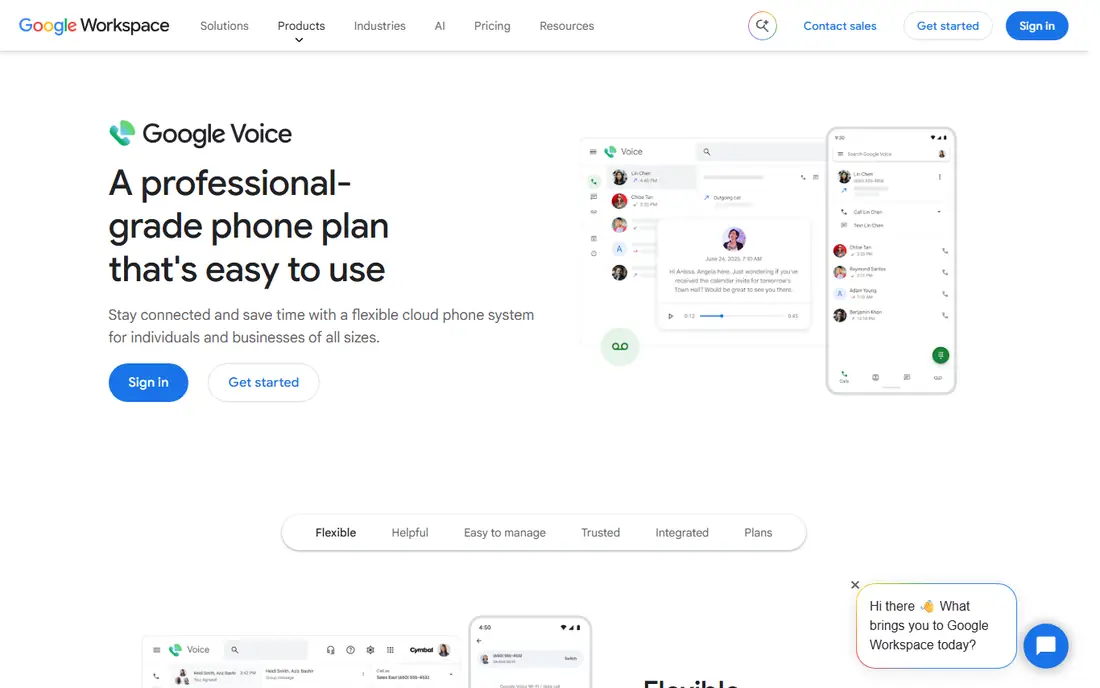
Google Voice is where most people should start. The personal version gives US users a free second number for calls and texts, which covers privacy for listings, dating apps, and side projects. The Workspace version at $10 per user per month turns it into a simple business line with admin controls.
The trade off is depth and acceptance. Teams outgrow its shared number handling quickly, and the verification code problem is real: several banks will not send codes to Voice numbers. Google Voice fits individuals and Workspace based small teams that want a legitimate second line for almost nothing.
What we like- Personal tier is free in the US with calls, texts, and voicemail
- Business plans start at $10 per user per month inside Google Workspace
- Voicemail transcription and spam filtering built in
- Number works across phone, tablet, and browser
Watch out for- Personal numbers can be reclaimed if left unused
- Business tier lacks the shared inbox depth of team tools
- Some banks and services reject Voice numbers for verification codes
- International features are limited next to business systems
#2
Quo
Best for: Shared business numbers for small teams
Visit quo.com
Starting price$15 per user per month
Free planNo
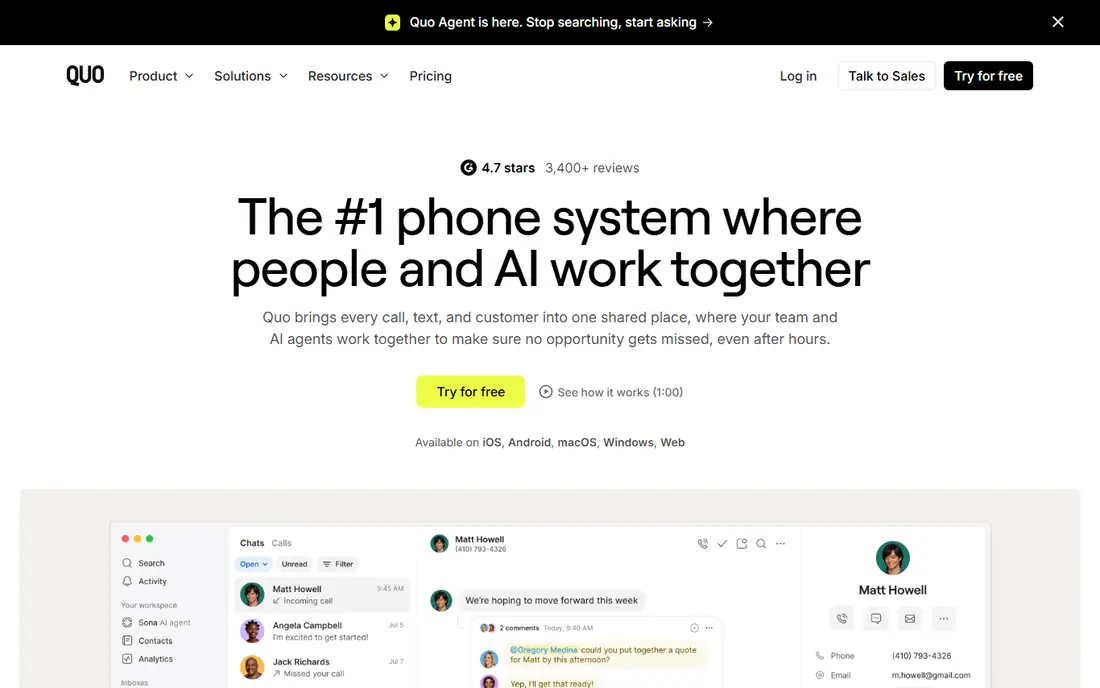
Quo, the renamed OpenPhone, is what a business number looks like when designed by a messaging company. A sales or support number can be shared by the whole team, conversations are visible to everyone, and nothing depends on one person's phone. For text heavy small businesses it is the current benchmark.
The trade off is cost shape. Per user pricing and texting registration steps make it a real system rather than a casual add on. Quo fits startups and small teams whose customers text as much as they call.
What we like- Shared numbers with a shared inbox, so a team texts from one business number
- Modern apps that feel like a messaging product, not a phone system
- AI call summaries and an AI agent for missed calls
- Local and toll free numbers at $15 per user per month
Watch out for- Per user pricing adds up across a team
- Shared numbers cap the number of users on the entry plan
- Business texting needs A2P 10DLC registration, with small registry fees on top
#3Grasshopper
Best for: Flat rate business line for solopreneurs3.9/5 on
G2 (162 reviews, checked Oct 2026)
Visit grasshopper.com
Starting price$14 per month
Free planNo
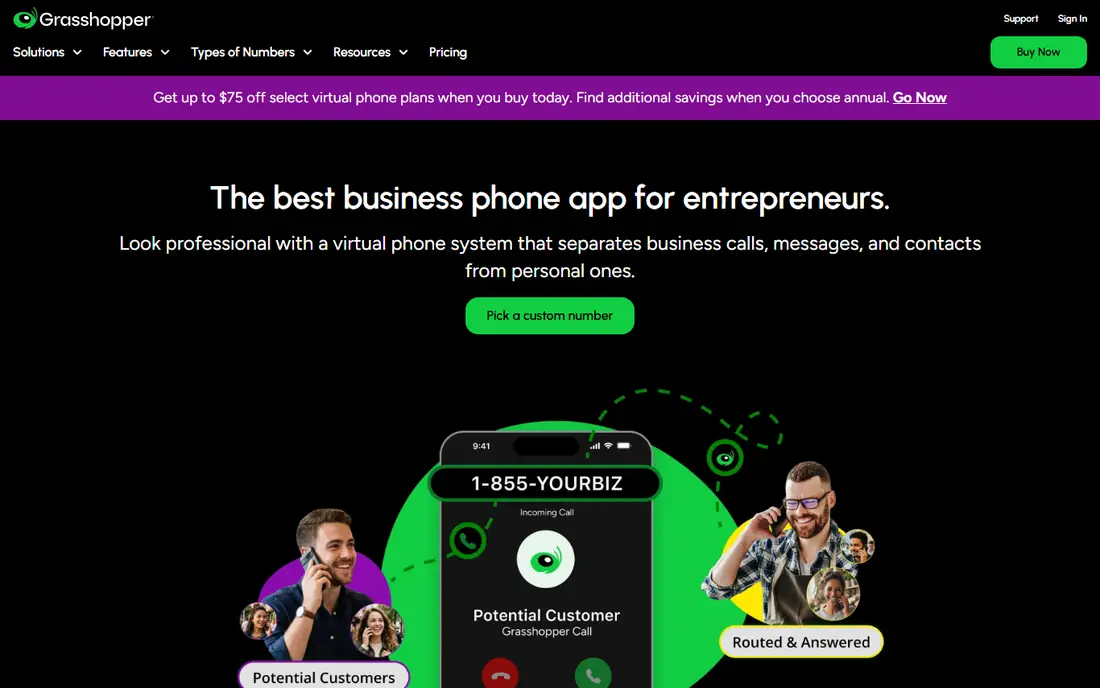
Grasshopper is the original virtual number for solo operators. It puts a business face, a greeting, extensions, a toll free option, over the mobile phone you already carry, for one flat fee. For a tradesperson, consultant, or freelancer, that is often the whole requirement.
The trade off is that the face is mostly what you get. There is no real team collaboration or deep texting product underneath. Grasshopper fits solopreneurs and very small firms that want to sound established without adopting a phone system.
What we like- One flat monthly price from $14, not per user
- Forwards a professional business number to your existing phone
- Extensions, custom greetings, and voicemail to email included
- Toll free and local numbers available
Watch out for- It is a forwarding layer, not a full phone system
- Team texting and shared inboxes are thin
- Per minute and feature limits hide in the plan details
Starting priceFree
Free planYes
TextNow is the free personal second number. People use it for marketplace sales, travel, and keeping a main number private, and it works fine for ordinary calls and texts. Its optional SIM makes it one of the cheapest ways to keep a working number active in the US.
The trade off is standing. A free, ad supported number sits at the bottom of the trust ladder for banks and platforms, so verification codes often fail. TextNow fits personal privacy on a budget, with a real carrier line kept for anything financial.
What we like- A free US or Canada number for calls and texts over Wi-Fi and data
- Ad supported, with paid options to remove adverts
- A SIM option turns it into a low cost mobile line on a national network
- Simple apps aimed at personal, not business, use
Watch out for- Free numbers can be reclaimed after inactivity
- Many verification systems reject TextNow numbers
- Adverts in the free experience
- Not built for business features or teams
#5Dialpad
Best for: Business phone with AI notes on every call4.4/5 on
G2 (4,201 reviews, checked Oct 2026)
Visit dialpad.com
Starting price$15 per user per month
Free planNo
Dialpad sells the phone call that documents itself. Every call is transcribed and summarised, action items surface automatically, and managers can coach from live call cards. For teams whose calls carry commitments, that record is the product.
The trade off is focus. A two person business that just needs a number is buying machinery it will not use. Dialpad fits mid size sales and support teams that live on calls and want the notes handled.
What we like- AI transcription and summaries included on every plan, not sold as an add on
- Phone, video, and messaging in one app
- Live coaching features for sales and support calls
- $15 per user per month starting price
Watch out for- AI extras can feel like more than a small team needs
- Business texting registration and approval takes time
- Contact centre features sit on separate, pricier products
#6RingCentral
Best for: Full phone, video, and messaging for larger teams4.1/5 on
G2 (1,076 reviews, checked Oct 2026)
Visit ringcentral.com
Starting price$20 per user per month
Free planNo
RingCentral is the safe enterprise answer. It does everything a business phone category contains, works with desk phones and headsets as happily as apps, and integrates with the CRM and productivity stack a larger company already runs. Current comparisons place Core at $20 per user per month billed annually.
The trade off is weight and texting limits. Small teams pay for depth they will never touch, and the included text allowance is small. RingCentral fits established companies standardising communications across offices and roles.
What we like- The complete unified communications stack: phone, video, team chat, and fax
- Hundreds of integrations and desk phone support
- Scales from small teams to enterprise deployments
- Core plan from $20 per user per month
Watch out for- The entry plan includes only a small monthly text allowance per user
- The platform's breadth makes setup and admin heavier
- Pricing tiers push growing teams upward quickly
#7Nextiva
Best for: Reliability and human support4.5/5 on
G2 (3,659 reviews, checked Oct 2026)
Visit nextiva.com
Starting price$15 per user per month
Free planNo
Nextiva competes on being looked after. Its plans start at $15 per user per month, its support answers around the clock, and its uptime reputation is the reason many small and mid size firms pick it over flashier rivals. The product covers phone, SMS, video, and chat without drama.
The trade off is excitement and extras. AI and automation features trail Dialpad, and the top capabilities sit on higher tiers. Nextiva fits businesses that value a phone system that works and a human who answers when it does not.
What we like- Phone, video, and team chat from $15 per user per month
- 24/7 human support on every plan, a rarity in this category
- Strong published reliability record
- A bundle of texts per user included on plans
Watch out for- Interface and feature naming change as plans rebrand
- Advanced and contact centre features cost more
- Less developer and API focus than some rivals
#8CloudTalk
Best for: Sales and support teams calling internationally4.4/5 on
G2 (1,938 reviews, checked Oct 2026)
Visit cloudtalk.io
Starting price$25 per user per month
Free planNo
CloudTalk is the international call team option. A support or sales team can hold local numbers in the countries it serves, run outbound campaigns with a dialer, and keep every conversation synced to the CRM. For companies selling across borders, that local presence changes answer rates.
The trade off is audience. CloudTalk is a call centre grade tool sold per user, and a freelancer needing one extra number should look at the top of this list instead. CloudTalk fits growing sales and support operations with international customers.
What we like- Local numbers in more than 160 countries
- Power dialer and call centre tooling for outbound teams
- Two way CRM sync with the major sales platforms
- Texting alongside calling in one workspace
Watch out for- The priciest starting point here at $25 per user per month
- Built for call teams, so casual users overbuy
- Per user costs multiply across large teams
How we chose
We covered both jobs a virtual number does: personal second lines and business phone systems, using vendor pricing pages and dated October 2026 comparisons for every per user figure. Free plans are listed only where the number genuinely costs nothing to keep, and we noted where free numbers can be reclaimed for inactivity. We weighted texting support and its registration rules heavily, because business texting in the US now runs through A2P 10DLC registration and any honest guide has to say so. We did not claim hands on testing.
What to know before you rely on a virtual number
Understand the verification limit first. Banks, payment apps, and many platforms screen out virtual and VoIP numbers when sending login codes, because those numbers are easier to obtain anonymously. Any of the services here can be refused, without warning, by a system you need. Keep your carrier number for banking, tax, and critical account recovery, and use the virtual number for the public facing parts of life.
For business texting, budget the registration step. US carriers require A2P 10DLC registration for application based texting from local numbers, through The Campaign Registry, with a small one off fee and a monthly charge, and approval can take weeks on some providers. Calls are unaffected, but a team that launches on day one expecting to text customers will be disappointed. Finally, keep the number active: free tiers reclaim unused numbers, and a reclaimed business number printed on your cards and listings is a mess to unwind.
Frequently asked questions
Are virtual phone numbers legal to use?
Yes, for ordinary purposes: business lines, privacy for listings and dating, local presence in another city, and travel. Millions of businesses run on them. What you may not do is use any number, virtual or not, to impersonate others, evade a ban or legal obligation, or commit fraud. The number is a tool; the use decides the legality.
Why do banks reject virtual numbers for verification codes?
Because codes are a security control, and virtual numbers can be obtained without identity checks tied to a carrier account. Banks and platforms screen number types and refuse VoIP and virtual ranges to cut account takeover fraud. It is inconsistent, some accept Google Voice, most refuse free services, so the safe pattern is a real mobile number for financial accounts.
What does a virtual business number cost per month?
From nothing to $25 per user. Google Voice is free personally and $10 per user in Workspace, Grasshopper is a flat $14 per month, and team systems run $15 to $25 per user per month at Quo, Dialpad, Nextiva, RingCentral, and CloudTalk. Add small texting registration fees for US business messaging, and check extra number prices, since second and toll free numbers are rarely all included.
Can I keep my number if I switch providers?
Usually yes. US numbers can be ported between providers, and the business services here accept ports in and allow ports out, though free personal tiers have limits and some charge or restrict porting out. Start the port before cancelling the old service, and expect days, not minutes, for it to complete.
Can I text customers from a virtual number?
Yes, with registration. US business texting from local numbers requires A2P 10DLC registration of your brand and campaign, handled inside providers like Quo, Dialpad, and CloudTalk, with small registry fees and approval times from days to about three weeks. Toll free numbers follow a separate verification. Personal texting to friends needs none of this; the rules target business messaging.
Sources we checked (0)
Is your product missing or out of date?
We review this list regularly. Vendors can request a listing, send updated pricing or ask about featured placement.

Shihab Mia · Founder, Rankite
Shihab has 5+ years in B2B and SaaS SEO. He writes Rankite's software buying guides from pricing pages, documentation and public user reviews. More about Shihab.