How we make this list: we compare pricing pages, product documentation and public user reviews. Ratings come from G2, Capterra or Trustpilot, with the date we checked them.
Key takeaways
- Experity is the only tool on this list built exclusively for urgent care, which makes it the strongest fit for walk-in clinics and multi-location chains.
- Most vendors do not publish a list price, so ask for a written quote that covers implementation, training, migration, and add-ons before you sign.
- PrognoCIS publishes the clearest starting price at 280 dollars per provider per month, checked on its own pricing page on 12 November 2026.
- If your clinic also runs primary care, a general EHR such as eClinicalWorks or athenahealth may fit better.
- Fast charting matters more than feature count, so test templates, e-prescribing, and discharge workflows in a live demo with your own visit types.
What makes urgent care EHR software different from general EHR software?
Urgent care EHR software is built for patients who walk in without an appointment, while general ambulatory EHR software is built around scheduled visits and long-term patient panels. That difference shapes almost every workflow. An urgent care visit starts with rapid registration and moves through triage, a short exam, labs or imaging, discharge papers, and payment in under an hour. A general EHR assumes the patient booked ahead, has a known history with the practice, and will return for follow-up visits over years.
The charting model differs too. Urgent care providers see a high volume of short, episodic visits, so they need complaint-driven templates for sore throats, sprains, and lacerations that can be finished in a few clicks. General EHRs favor long problem lists and care plans that span months, and a template that forces a provider through a full primary care workup slows every visit.
Billing is the third difference. Urgent care clinics bill a mix of commercial insurance, workers compensation, occupational medicine, and self-pay, sometimes for the same patient on the same day. Experity, for example, separates urgent care visits from occupational medicine and workers compensation claims inside one encounter. A general EHR can handle those payers, but it usually needs extra configuration. For a closer look at general systems, see our guide to the best EMR EHR software.
How much does urgent care EHR software cost in 2026?
Most vendors charge per provider per month, and published starting prices on this list run from 280 dollars to 449 dollars, with several vendors keeping prices behind a sales quote. Percentage-of-collections pricing is the main alternative: athenahealth charges roughly 4 to 8 percent of monthly collections on top of a per-provider floor, and CareCloud offers a managed billing tier at 3 to 7 percent of collections.
Expect extra costs beyond the subscription. Implementation commonly runs from 1,000 to 15,000 dollars, data migration can add 500 to 25,000 dollars, and add-ons such as AI scribes and extended lab integrations are often billed separately. Get each of these in writing before you sign.
A note on verification: we opened every vendor homepage on 12 November 2026. PrognoCIS lists its 280 dollar starting price on its own pricing page. The eClinicalWorks pricing page we opened showed no prices, and the AdvancedMD pricing page returned a not-found error, so their prices are third-party reported. Experity, athenahealth, DrChrono, CareCloud, and NextGen Healthcare also do not publish a list price. Treat every price below as a starting point and confirm it in a written quote.
Quick comparison
| Tool | Best for | Starting price | Free plan |
|---|
 Experity | Multi-location urgent care chains and high-volume walk-in clinics | quote (third-party reported 300 to 500 dollars per provider per month) | No |
 eClinicalWorks | Clinics that mix urgent care with primary care and scheduled visits | 449 dollars per provider per month for EHR only (third-party reported) | No |
 athenahealth | Clinics that want EHR, billing, and patient engagement handled in one contract | quote (third-party reported about 140 dollars per provider per month plus 4 to 8 percent of collections) | No |
 DrChrono | Mobile-first providers and small clinics that chart on iPad or iPhone | quote (third-party reported from 199 dollars per provider per month) | No |
 PrognoCIS | Budget-conscious clinics that want a published starting price | 280 dollars per provider per month | No |
 AdvancedMD | Growing multi-provider groups that need deep reporting and modular billing | 429 dollars per provider per month (third-party reported) | No |
 CareCloud | Clinics that want EHR, practice management, billing, and patient experience in one platform | 349 dollars per provider per month (third-party reported) | No |
 NextGen Healthcare | Small clinics using NextGen Office and larger groups using NextGen Enterprise | 300 dollars per provider per month (third-party reported estimate) | No |
Is your product missing or out of date?
We review this list regularly. Vendors can request a listing, send updated pricing or ask about featured placement.
Which urgent care EHR is best for a single-location clinic?
A single-location urgent care clinic should pick the system with the shortest path from door to discharge, not the one with the longest feature list. Experity is the natural first demo because its templates, registration flow, and billing were designed for walk-in volume. PrognoCIS is the best low-cost alternative for a single site because its 280 dollar starting price is published and easy to budget.
DrChrono suits a clinic where providers work from iPads, while NextGen Office is aimed at practices with fewer than 10 providers. The deciding test is a timed demo: register a walk-in, chart a common complaint, order a lab, e-prescribe, and print discharge papers. Compare each finalist against our guide to the top 10 medical billing software before you decide.
What should you check before you sign an urgent care EHR contract?
Check whether the price you were quoted covers the whole visit or only part of it. Ask if e-prescribing, lab interfaces, patient messaging, and the clearinghouse are included, and what each one costs if it is not. Several vendors on this list charge separately for extended lab integrations, controlled-substance prescribing verification, and text reminders.
Check the contract terms as well. Ask how long the initial term runs, what the renewal price will be, and what it costs to export your data if you leave. Reviewers report multi-year terms on some platforms, so read the exit clause before you sign. Confirm that the system is ONC certified and supports the occupational medicine forms your clinic files, since a missing workers compensation workflow creates manual work on every shift.
Finally, check support hours against your clinic hours. Urgent care clinics run evenings and weekends, so a vendor whose support team works weekdays only will leave your busiest shifts uncovered. Ask for the average response time in writing. HIPAA compliance is part of the same check, and our guide to the best HIPAA compliance software covers the tools that sit alongside your EHR.
We started from vendors with a documented urgent care presence and kept only vendors with a working official website we could open on 12 November 2026. We checked each vendor pricing page the same day and recorded whether the price came from the vendor or a third-party source. We ranked tools on urgent care fit first, then charting speed, e-prescribing, lab integration, billing depth, and price transparency. We did not run hands-on trials.
Last verified: 12 November 2026
The best urgent care EHR software
Starting pricequote (third-party reported 300 to 500 dollars per provider per month)
Free planNo
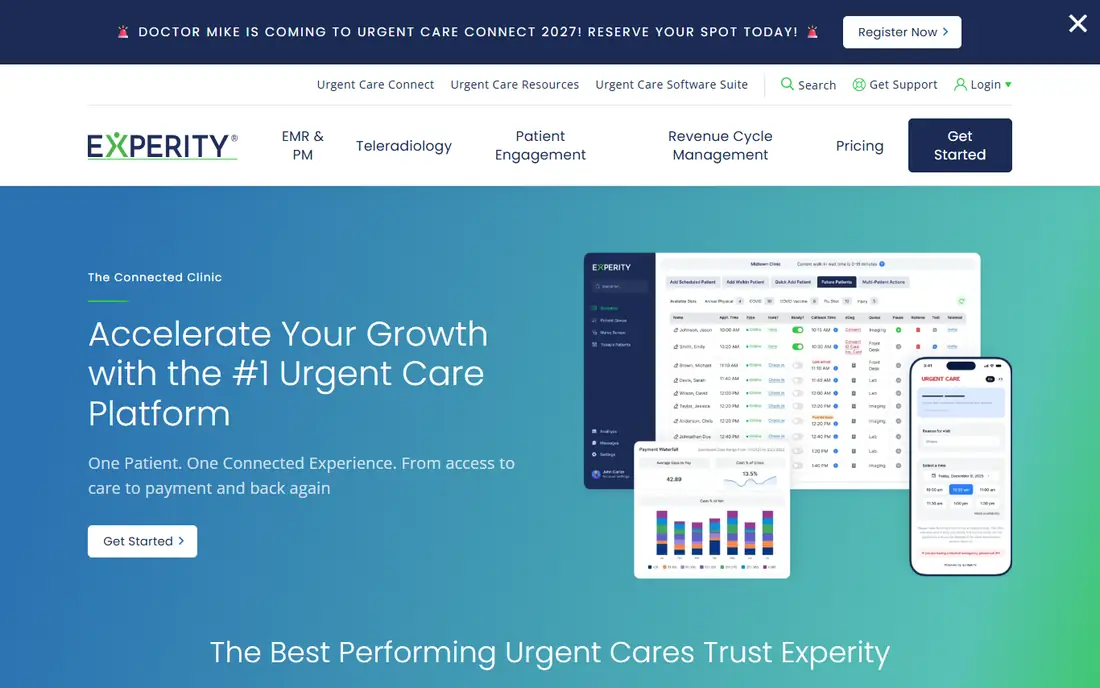
Experity is the only platform on this list built exclusively for urgent care. It was formed in 2019 from the merger of DocuTAP and Practice Velocity, so those two names are now part of one Experity platform. Its codeless templates let providers chart common complaints quickly, and its split-billing logic separates urgent care visits from occupational medicine and workers compensation claims in one encounter.
What we like- Purpose-built for urgent care, codeless charting templates, occupational medicine and workers compensation billing, real-time insurance eligibility checks
Watch out for- Reviewers report occasional system glitches and data lags during busy shifts, and reporting depth is thinner than generalist EHR platforms
#2eClinicalWorks
Best for: Clinics that mix urgent care with primary care and scheduled visits3.7/5 on
G2 (158 reviews, checked Oct 2026)
Visit eclinicalworks.com
Starting price449 dollars per provider per month for EHR only (third-party reported)
Free planNo

eClinicalWorks is a general ambulatory EHR that suits urgent care clinics which also run primary care. Its tiers start at 449 dollars per provider per month for EHR only and 599 dollars for EHR with practice management, with revenue cycle management as a service at 2.9 percent of collections. The platform includes e-prescribing, lab orders, the healow patient portal, messaging, and telehealth, plus an AI scribe through Sunoh.ai.
What we like- Published tier pricing, large provider network, integrated telehealth and patient portal, native Sunoh.ai scribe
Watch out for- The interface feels dated and crowded, and new staff face a steep learning curve before they work quickly
#3
athenahealth
Best for: Clinics that want EHR, billing, and patient engagement handled in one contract
Visit athenahealth.com
Starting pricequote (third-party reported about 140 dollars per provider per month plus 4 to 8 percent of collections)
Free planNo
athenahealth sells athenaOne, a cloud platform that combines the athenaClinicals EHR, the athenaCollector billing engine, and patient engagement tools in one system. For an urgent care clinic, the main draw is billing: athenahealth reports that its network-driven claims scrubbing reaches first-pass acceptance above 95 percent. The vendor says more than 180,000 clinicians use the athenaOne network. athenahealth does not publish a list price, so the 140 dollar floor and the 4 to 8 percent collections range are third-party reported.
What we like- Strong billing network with high first-pass claim rates, athenaAmbient AI scribe, cloud implementation in weeks, specialty-specific workflows
Watch out for- Percentage-of-collections pricing means the bill rises as revenue rises, and template customization is more limited than in some rival systems
#4DrChrono
Best for: Mobile-first providers and small clinics that chart on iPad or iPhone3.4/5 on
G2 (43 reviews, checked Oct 2026)
Visit drchrono.com
Starting pricequote (third-party reported from 199 dollars per provider per month)
Free planNo
DrChrono, by EverHealth, is a cloud EHR built for independent practices, and it stands out for providers who want to chart from an iPad or iPhone rather than a desktop. Its current tiers are Foundation, Growth, and Premium, covering core EHR, patient engagement, practice management, billing, and revenue cycle workflows. The pricing page we opened on 12 November 2026 lists usage fees but no base subscription price, and third-party directories report entry pricing from about 199 dollars per provider per month.
What we like- Native iOS apps with full EHR function, integrated telehealth and patient check-in kiosk, flexible month-to-month terms with no long-term contract
Watch out for- The vendor does not publish a base price, so budgeting requires a sales call, and some users report slow support responses
#5
PrognoCIS
Best for: Budget-conscious clinics that want a published starting price
Visit prognocis.com
Starting price280 dollars per provider per month
Free planNo
PrognoCIS, developed by Bizmatics, is a cloud EHR with practice management and billing that lists urgent care among the specialties it supports. Its pricing page, which we opened on 12 November 2026, states a starting price of 280 dollars per provider per month, making it the only vendor on this list with a vendor-verified published price. The monthly fee covers cloud hosting and support, while setup, training, data migration, controlled-substance prescribing verification, and clearinghouse fees are billed separately.
What we like- Starting price published on the vendor pricing page, customizable templates by specialty, ONC certified and HIPAA compliant, cloud hosting included
Watch out for- Setup and training fees are extra and are only quoted at purchase, and the interface looks dated next to newer EHR designs
#6AdvancedMD
Best for: Growing multi-provider groups that need deep reporting and modular billing3.6/5 on
G2 (63 reviews, checked Oct 2026)
Visit advancedmd.com
Starting price429 dollars per provider per month (third-party reported)
Free planNo
AdvancedMD is a cloud platform for independent practices that combines EHR, practice management, and patient engagement. Its modular pricing lets a clinic buy only the modules it needs, and third-party sources report medical specialty pricing from 429 to 1,070 dollars per provider per month, with the RCM service at 4 to 8 percent of collections. The platform includes AI-enabled charting, automated claim scrubbing, and real-time financial analytics across locations. The AdvancedMD pricing page returned a not-found error when we tried to open it, so the price is third-party reported.
What we like- Unified EHR, practice management, and patient engagement, more than 700 standard reports, real-time eligibility checks, ambient AI documentation
Watch out for- Entry pricing is high for small clinics, and implementation commonly takes 6 to 12 weeks
#7CareCloud
Best for: Clinics that want EHR, practice management, billing, and patient experience in one platform3.6/5 on
Capterra (112 reviews, checked Oct 2026)
Visit carecloud.com
Starting price349 dollars per provider per month (third-party reported)
Free planNo
CareCloud is a cloud healthcare platform built for ambulatory practices, with CareCloud Charts as its EHR, CareCloud Central for practice management, the Breeze patient experience app, telehealth, and optional managed billing. Its homepage lists urgent care among the specialties it serves. Third-party sources report three tiers: Central at 349 dollars per provider per month, Complete at 629 dollars, and Concierge managed billing at 3 to 7 percent of collections. CareCloud does not publish prices on its own site, so these figures are third-party reported.
What we like- All-in-one platform with EHR, practice management, telehealth, and RCM, Breeze patient experience app, AI charting on mobile, urgent care specialty workflows
Watch out for- No public price list, so comparison shopping requires a written quote, and reviewers report multi-year contract terms
#8NextGen Healthcare
Best for: Small clinics using NextGen Office and larger groups using NextGen Enterprise3.7/5 on
G2 (175 reviews, checked Oct 2026)
Visit nextgen.com
Starting price300 dollars per provider per month (third-party reported estimate)
Free planNo
NextGen Healthcare sells its EHR in two editions: NextGen Enterprise for practices with 10 or more providers and NextGen Office for practices with fewer than 10. That split is useful for urgent care, since a single clinic can start on Office and move to Enterprise as it adds locations. The platform includes scheduling, charting, e-prescribing, billing, a patient portal, telehealth, and Ambient Assist for AI documentation. NextGen does not publish pricing, and third-party guides estimate 300 to 550 dollars per provider per month, checked in November 2026.
What we like- Two editions sized for small and large practices, Ambient Assist AI documentation, mobile EHR, population health tools, secure AWS hosting
Watch out for- The two editions are different products, which can confuse buyers, and the vendor publishes no price list
Frequently asked questions
What is the best urgent care EHR software for a new clinic?
Experity is the best pick for a new urgent care clinic because it was built only for urgent care and covers walk-in registration, fast charting, and occupational medicine billing in one system. PrognoCIS is the best budget option at 280 dollars per provider per month. A new clinic with low early volume should also price athenahealth, since percentage-of-collections billing can cost less than a flat subscription at first.
How much does urgent care EHR software cost per provider?
Urgent care EHR software typically costs 280 to 449 dollars per provider per month for a published starting price, based on the vendors on this list. Experity, athenahealth, DrChrono, CareCloud, and NextGen Healthcare do not publish prices and require a quote. Implementation, data migration, and add-ons are usually billed separately, so ask for a written quote that lists every cost.
Does urgent care EHR software include billing?
Most urgent care EHR platforms include billing tools, and several offer a full revenue cycle service as well. Experity, athenahealth, eClinicalWorks, AdvancedMD, and CareCloud combine charting with claims management, denial work, and payment posting. DrChrono, PrognoCIS, and NextGen Healthcare include billing modules too. Confirm whether claims scrubbing, clearinghouse fees, and patient statements are included, since some vendors charge for them separately.
Can an urgent care clinic use a general EHR instead of an urgent care EHR?
Yes, a general EHR can work, and it is often the better choice for a clinic that also runs primary care or scheduled specialty visits. eClinicalWorks and athenahealth handle both walk-ins and scheduled visits in one system, which avoids running two charts. The trade-off is speed: general EHRs usually need extra template work to match the fast charting of a purpose-built urgent care system, so test your most common visit types in a demo.
What features matter most in urgent care EHR software?
Fast complaint-driven charting matters most, since providers see a high volume of short visits and cannot spend ten minutes on each note. Walk-in registration, online check-in, and a patient kiosk keep the front desk moving. E-prescribing, lab and imaging orders, and discharge papers should work from the same screen. Real-time eligibility checks and workers compensation workflows matter too, because urgent care clinics bill more payer types than most practices.
Sources we checked (15)
- https://www.experityhealth.com/
- https://www.findemr.com/experity-ehr-software
- https://www.anygen.io/showcase/ecw-ehr/index.html
- https://www.eclinicalworks.com/
- https://softwarefinder.com/emr-software/athenahealth
- https://www.athenahealth.com/
- https://www.drchrono.com/pricing
- https://softwarefinder.com/emr-software/drchrono
- https://prognocis.com/pricing-ehr/
- https://www.medprecisionbilling.com/resources/list-of-emr-systems-in-healthcare/
- https://www.advancedmd.com/
- https://softwarefinder.com/emr-software/carecloud
- https://carecloud.com/
- https://www.itqlick.com/nextgen-healthcare/pricing
- https://www.nextgen.com/
Is your product missing or out of date?
We review this list regularly. Vendors can request a listing, send updated pricing or ask about featured placement.

Shihab Mia · Founder, Rankite
Shihab has 5+ years in B2B and SaaS SEO. He writes Rankite's software buying guides from pricing pages, documentation and public user reviews. More about Shihab.