How we make this list: we compare pricing pages, product documentation and public user reviews. Rankite is independent; if a vendor ever pays for a featured spot, that listing is clearly labeled Partner.
Key takeaways
- Utilization management software splits into payer-side platforms (running prior auth and medical necessity review) and provider-side tools (getting authorizations approved faster). Know which side you are buying for.
- eviCore by Evernorth is the largest prior authorization company in the US, while Cohere Health represents the newer AI-driven approach to automating the same decisions.
- CMS rule CMS-0057-F is pushing the industry toward FHIR-based prior authorization APIs; Cohere Health and Elligint Health both market compliance-ready API support.
- Every platform here is enterprise software sold by quote and demo. There are no free plans or published prices in this category.
- Consolidation is active: Medecision absorbed MHK, and VirtualHealth merged with HealthEC to form Elligint Health. Evaluate vendors under their current names.
Quick comparison
| Tool | Best for | Starting price | Free plan |
|---|
 eviCore by Evernorth eviCore by Evernorth | specialty benefits management at national scale | See website | No |
 Medecision Medecision | payer care management and UM on one data platform | See website | No |
 Cohere Health Cohere Health | AI-driven prior authorization automation | See website | No |
 ZeOmega ZeOmega | integrated UM inside population health management | See website | No |
 AssureCare AssureCare | payers, providers, and pharmacies on one platform | See website | No |
 Elligint Health Elligint Health | Helios UM with CMS compliance tooling | See website | No |
 HealthEdge HealthEdge | payer enterprise pairing UM with claims | See website | No |
 Infinx Infinx | provider-side prior authorization automation | See website | No |
 Optum Optum | UM backed by InterQual evidence-based criteria | See website | No |
Is your product missing or out of date?
We review this list regularly. Vendors can request a listing, send updated pricing or ask about featured placement.
The best utilization management software
#1
eviCore by Evernorth
Best for: specialty benefits management at national scale
Visit evicore.com
Starting priceSee website
Free planNo
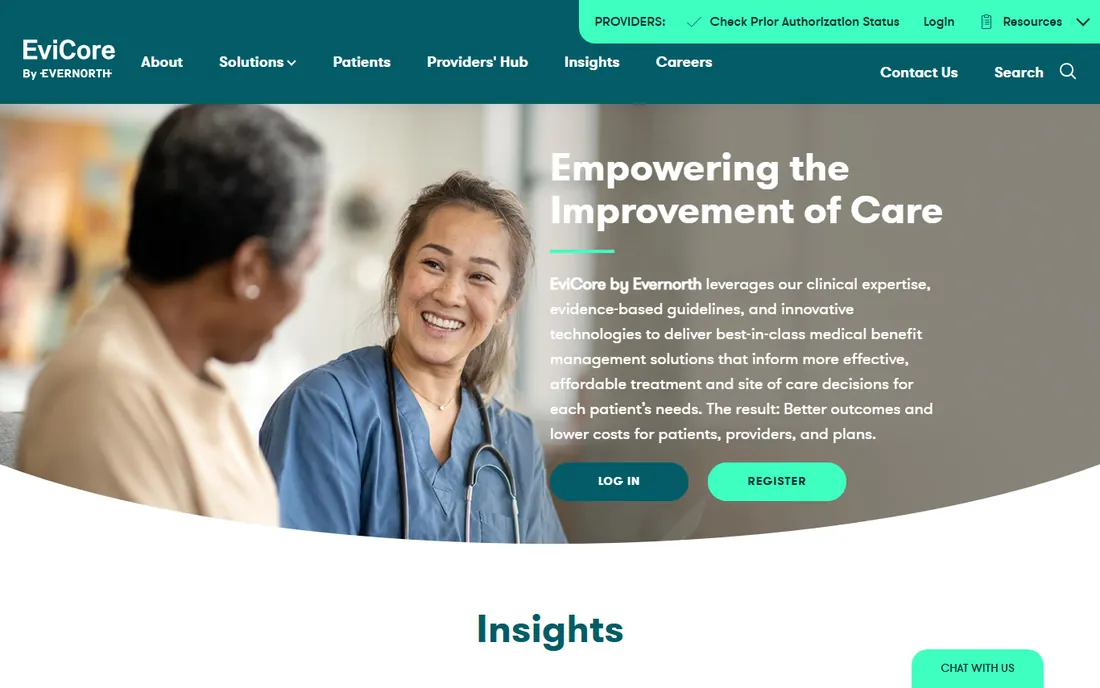
eviCore is the incumbent everything else is measured against. Owned by Cigna through Evernorth and formed from the 2014 merger of MedSolutions and CareCore, it reviews prior authorizations for specialty procedures on behalf of more than a hundred insurers and Medicaid programs. If your health plan needs to delegate an entire specialty UM program (musculoskeletal, radiation oncology, cardiology, sleep, post-acute care), eviCore is the turnkey option with the deepest program catalog.
The Black Book 2026 payer survey named eviCore the top client-rated vendor for prior authorization and utilization management, which speaks to payer satisfaction. The provider side is a different story: physician groups routinely complain about delays and denials, and the company's use of predictive algorithms in reviews has drawn public criticism. Buyers should weigh both sides. As a delegated UM partner for payers, eviCore's scale is unmatched. As a provider experience, it is the baseline your own portal will be compared against, usually unfavorably.
What we like- Largest prior authorization company in the US
- Deep specialty programs (musculoskeletal, radiology, cardiology, post-acute)
- Evidence-based clinical guidelines
Watch out for- Enterprise contracts only, no self-serve entry
- Provider experience draws frequent criticism
- Innovation pace lags newer AI-native competitors
Starting priceSee website
Free planNo
Medecision sells a unified data platform rather than a point UM product, and that is the pitch: utilization management, care management, quality (HEDIS), risk adjustment, and pharmacy run on one set of member data instead of five disconnected systems. The UM module covers prior authorization and care review with AI-assisted policy management, automated decision rules, smart workflow routing, and integrated appeals and peer-to-peer scheduling.
The company absorbed MHK in 2023, consolidating two payer-platform competitors, so anyone evaluating older MHK references should look at Medecision's current platform. Black Book's 2026 survey rated Medecision the top client-rated payer IT vendor for care management and complex-care coordination. For a health plan that wants UM connected to the rest of medical management rather than bolted on, Medecision is the most complete suite in this list. Expect an enterprise sales cycle and an implementation measured in months, not weeks.
What we like- Unified platform spanning UM, care, quality, and risk
- AI-powered policy management and automated decision rules
- Strong payer install base
Watch out for- Broad platform means complex implementation
- Pricing is entirely quote-based
- MHK customers went through a merger transition
Starting priceSee website
Free planNo
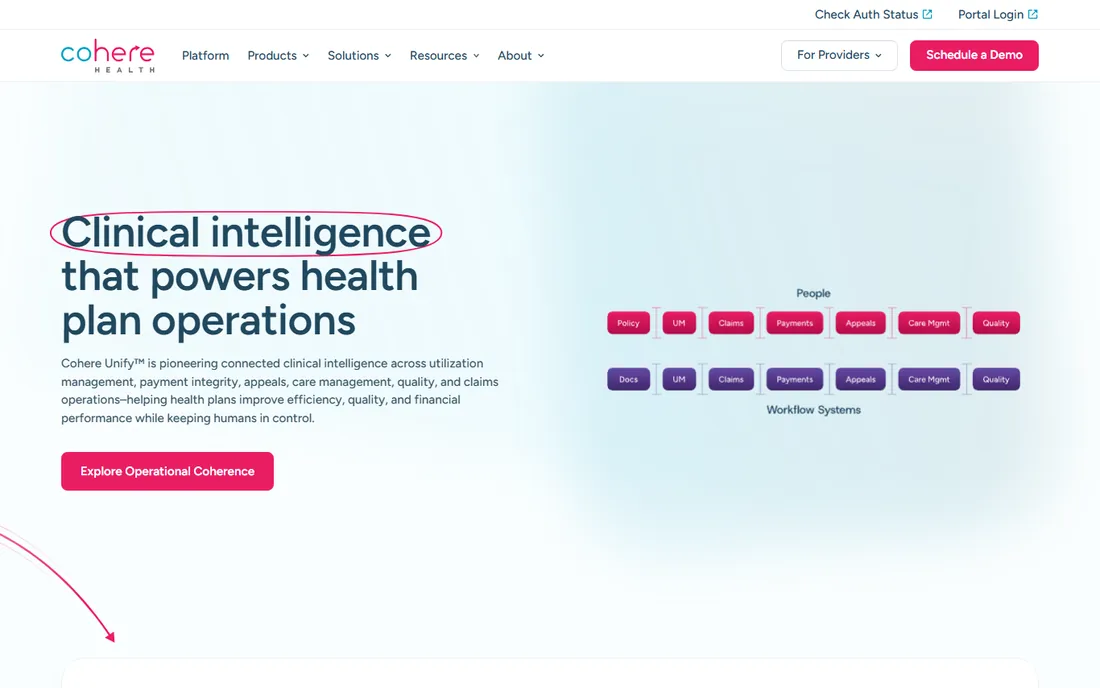
Cohere Health is the challenger brand in this list and the one most directly attacking the fax-machine era of prior authorization. Its platform digitizes the full authorization workflow, and the company publishes unusually specific numbers: 85% real-time approvals on its homepage, up to 90% auto-approval of requests, 12 million prior authorization requests processed annually across nearly 600,000 providers, and a provider NPS of 64.
The regulatory angle matters here. CMS-0057-F requires payers to support FHIR-based prior authorization APIs, and Cohere built its Cohere Connect product around the Da Vinci implementation guides (CRD, DTR, PAS) specifically for that compliance need. For a health plan that wants to modernize prior auth without replacing its core UM platform, Cohere works as the automation layer. The trade-off is scope: this is prior authorization depth, not a full care management suite, so pair it accordingly.
What we like- High auto-approval rates with published metrics
- FHIR APIs built for CMS-0057-F compliance
- Strong provider satisfaction scores
Watch out for- Younger company with a shorter track record
- Focused on prior auth rather than full medical management
- Enterprise deals only
#4
ZeOmega
Best for: integrated UM inside population health management
Visit zeomega.com
Starting priceSee website
Free planNo
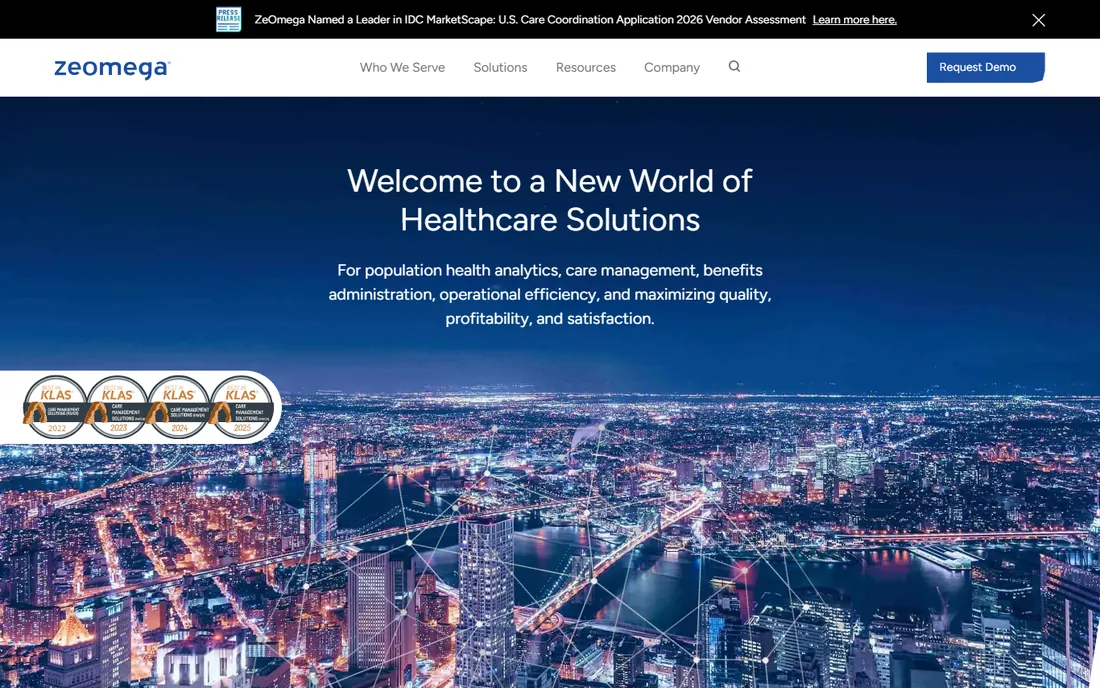
ZeOmega's Jiva platform has been in the payer care management market since 2001, and it earned Best in KLAS for payer care management in 2022 and 2023. The platform treats utilization management as one module inside an integrated whole: care management, disease management, and population health share the same data, rules engine, and workflow automation, with electronic prior authorization built in rather than added on.
The company's pitch centers on clean, connected data as the foundation: a single source of truth that drives automated next-best-action workflows across the member journey. With more than 30 million lives on the platform, it has the scale to prove the model. ZeOmega fits health plans and risk-bearing entities that want one vendor for the full care management continuum instead of stitching UM, case management, and analytics together themselves. Like everything in this category, pricing and timelines come through the sales process.
What we like- Jiva platform unifies UM, care, and disease management
- Best in KLAS for payer care management
- Strong rules engine and interoperability
Watch out for- Quote-only enterprise pricing
- Implementation is a significant project
- Brand recognition lags behind larger competitors
Starting priceSee website
Free planNo
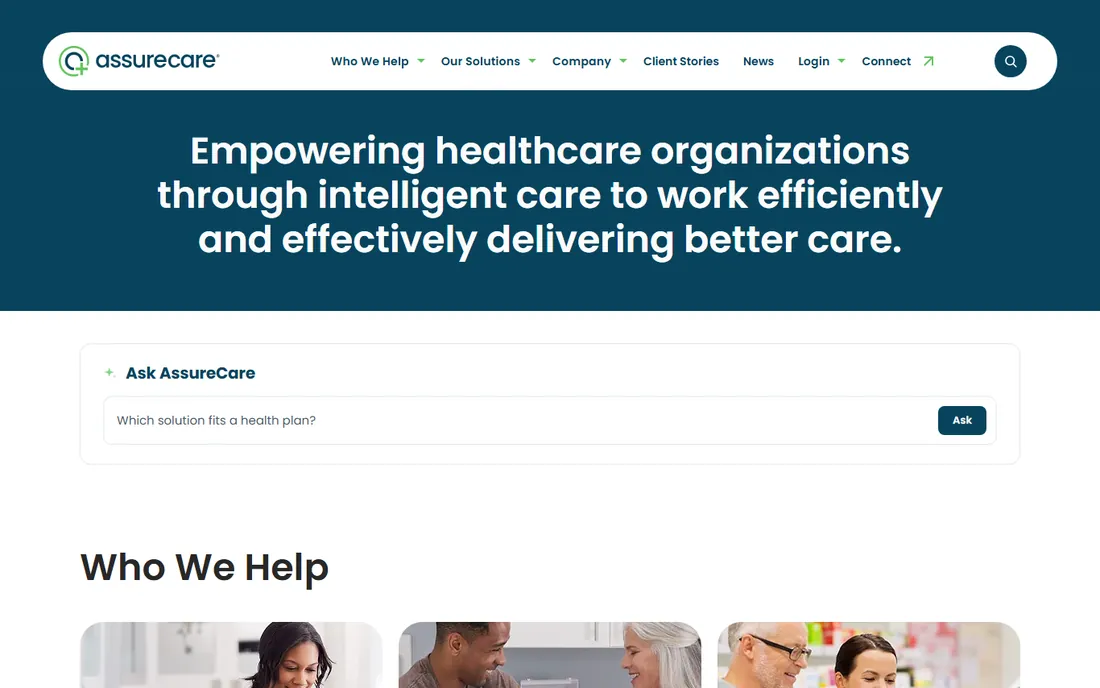
AssureCare's Intelligent Care Platform is unusual in this list for serving three markets at once: commercial and government payers, risk-bearing providers (ACOs, IPAs, TPAs), and pharmacies. The MedCompass product handles utilization management with automated authorizations alongside care coordination, risk stratification, compliance, and medication safety, while sibling products cover pharmacy services, revenue cycle, and credentialing.
That breadth is the selling point for organizations that sit in more than one seat. A provider group taking on risk, or a pharmacy organization partnering with payers, gets UM tooling in the same platform as its other workflows. For a pure-play health plan shopping for UM depth, the national specialists above offer more focused products. AssureCare's strength is the integrated footprint across the care ecosystem rather than any single module, and buyers should evaluate it on the workflows they will actually use.
What we like- Serves payer, provider, and pharmacy segments
- MedCompass covers UM plus care and medication management
- Modular product family
Watch out for- Broad positioning can blur the UM story
- Smaller vendor than the national names
- Enterprise sales only
Starting priceSee website
Free planNo
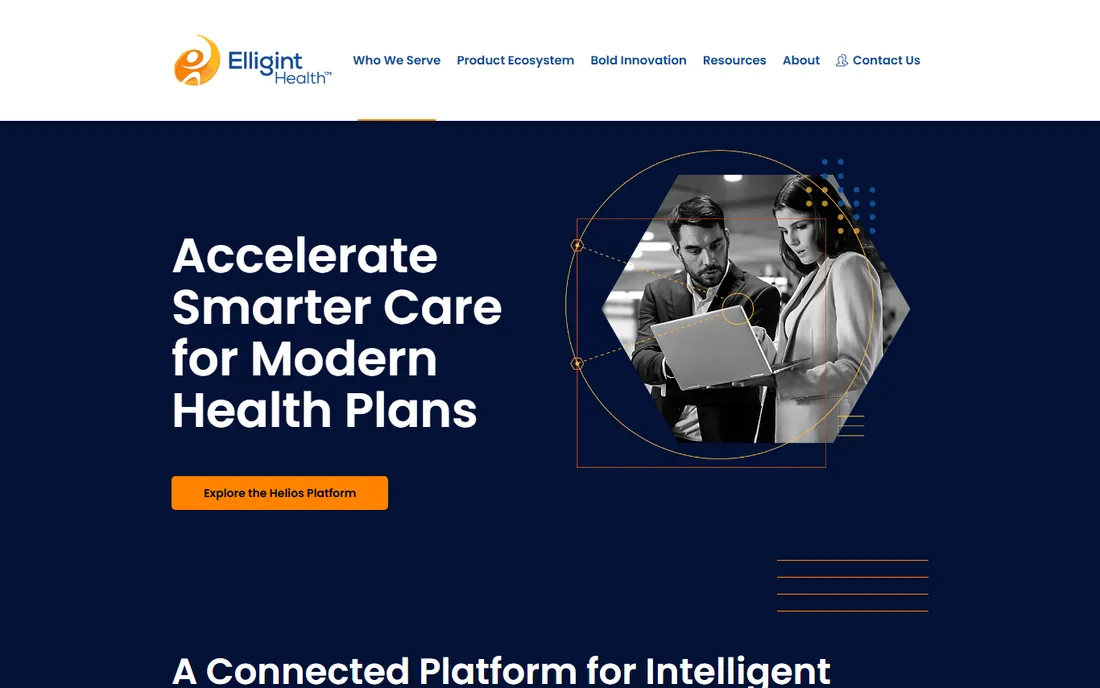
Elligint Health is the current name for the merged VirtualHealth and HealthEC businesses, and the HELIOS platform is now Helios by Elligint Health. Anyone researching VirtualHealth's HELIOS should evaluate it under the Elligint name going forward. The platform unifies care management and utilization management with configurable workflows, and the UM side specifically targets prior authorization management with configurable routing, medical necessity review, grievances and appeals, and automated decision support.
The compliance positioning is explicit: faster prior authorization decisions aligned with CMS-0057-F timelines, audit-ready CMS-aligned tracking, and built-in regulatory reporting. KLAS rated Helios a top performer in 2025, supporting more than 13 million covered lives. The merger means buyers should ask direct questions about the product roadmap and which legacy components carry forward, but the combined entity covers the full medical management footprint that mid-size and large plans need.
What we like- Helios UM purpose-built for prior authorization workflows
- CMS-0057-F timeline support
- KLAS top performer with 13M+ covered lives
Watch out for- New brand after the VirtualHealth-HealthEC merger
- Platform transition details still settling
- Enterprise pricing by quote
Starting priceSee website
Free planNo
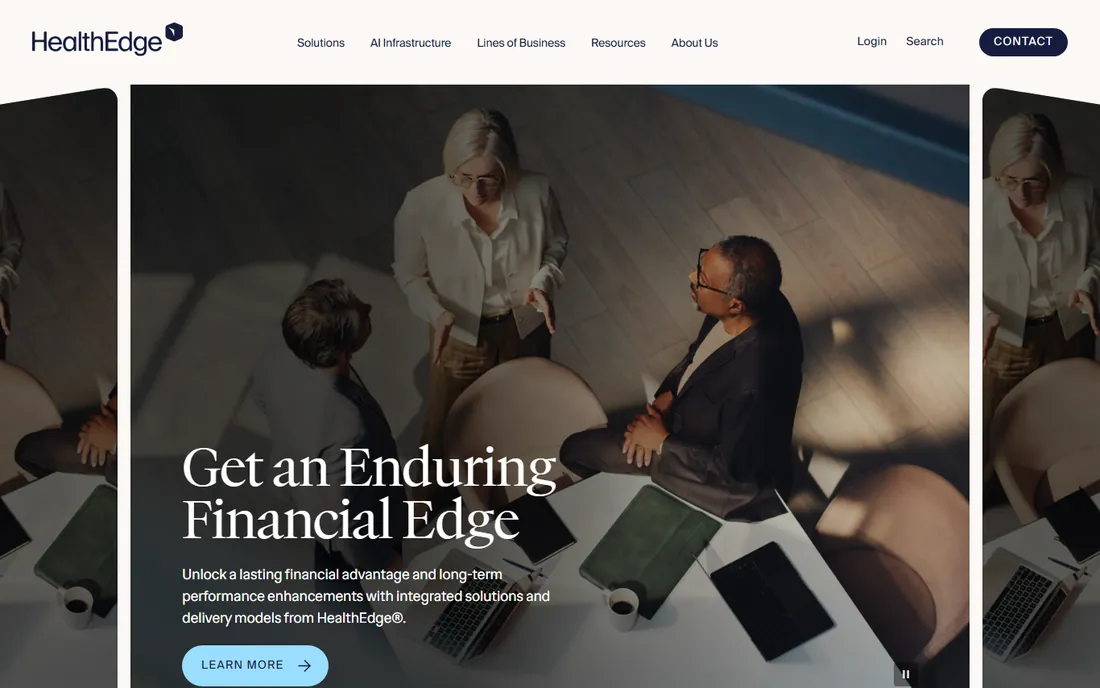
HealthEdge plays a different game from the UM specialists: its GuidingCare care management product lives inside an integrated payer platform that also runs claims administration (HealthRules), payment integrity, and more. The company reports supporting six of the nine largest national health plans. For utilization management, the advantage is architectural: UM decisions, claims data, and payment integrity operate off one system of record instead of three vendors' integrations.
That integration cuts both ways. If you are a health plan modernizing the full core stack, HealthEdge's unified platform with AI embedded across claims and care workflows is a compelling single-vendor story, now offered with performance-based delivery models. If you only need UM, you are buying into far more platform than the problem requires, and the sales and implementation process reflects that. Evaluate HealthEdge when the project is enterprise transformation, not point automation.
What we like- GuidingCare sits inside a full payer platform
- Claims and care management share one system of record
- Strong large-plan install base
Watch out for- UM is one piece of a much larger sale
- Implementation scope is enterprise-scale
- Pricing is entirely custom
#8
Infinx
Best for: provider-side prior authorization automation
Visit infinx.com
Starting priceSee website
Free planNo
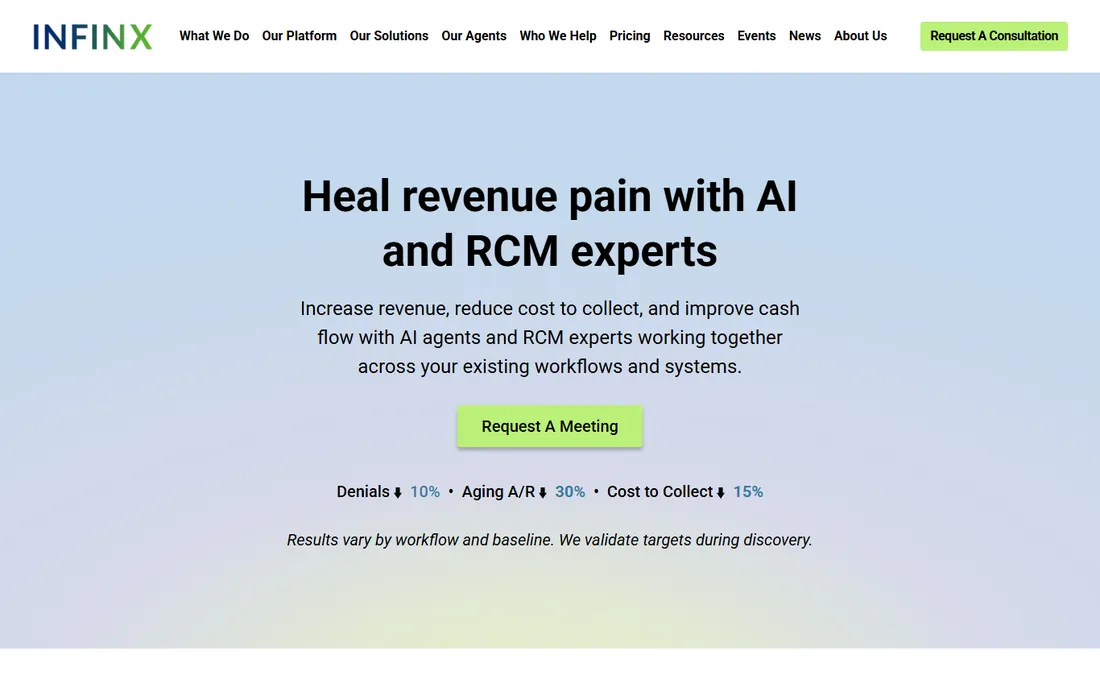
Infinx is the one tool in this list built for the provider's side of the prior authorization fight. Its Patient Access Plus suite automates eligibility verification, benefits checks, and prior authorization determination, initiation, and follow-up, combining AI agents with human revenue cycle specialists who work the exceptions. The company reports supporting 172,000 healthcare professionals across 4,000 facilities, and its 2025 acquisition of Glidian expanded its prior authorization automation footprint.
This is the right category entry for hospitals, health systems, and large physician groups whose UM problem is getting approvals through payer portals, not making coverage decisions. The model blends software with managed services, so buyers should be clear about what is technology and what is staffing. If your organization is a provider losing revenue to authorization delays and denials, Infinx belongs on the shortlist. If you are a payer, look at the other eight.
What we like- Built for providers chasing approvals, not payers issuing them
- AI agents plus human RCM specialists
- Deep payer portal and EHR connectivity
Watch out for- Provider-side focus means it is not a payer UM platform
- Services-heavy model blurs the software line
- Pricing by engagement
#9
Optum
Best for: UM backed by InterQual evidence-based criteria
Visit optum.com
Starting priceSee website
Free planNo
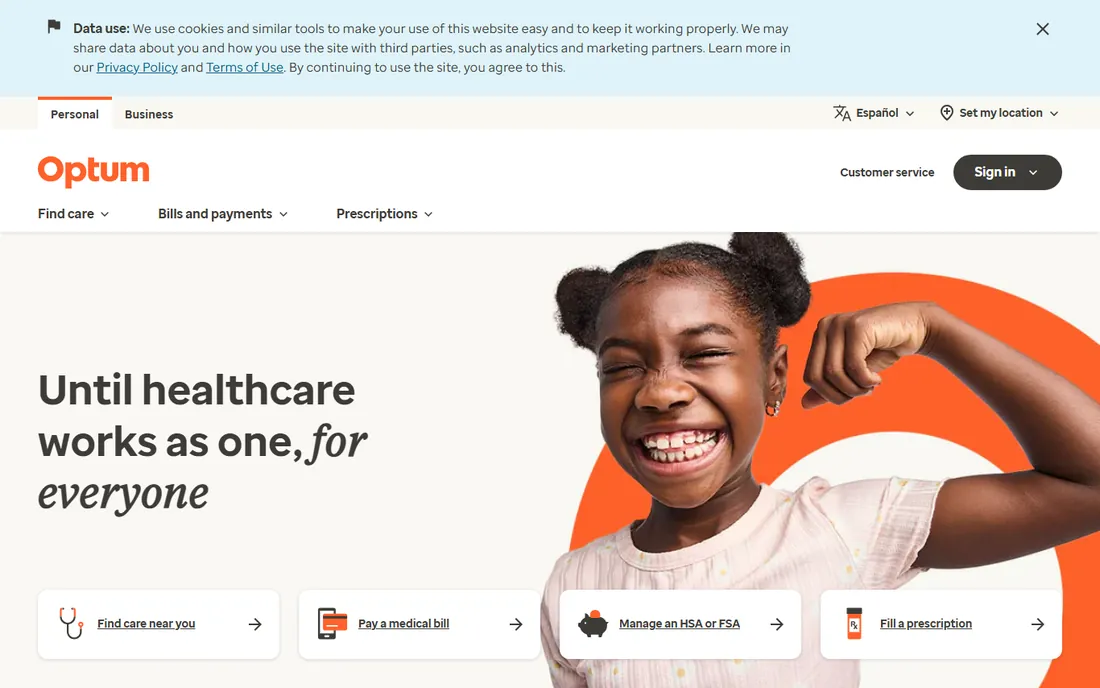
Optum's utilization management story runs through two assets: InterQual, the evidence-based clinical criteria set that much of the industry uses for medical necessity review, and its 2026 push into AI-powered digital prior authorization (Digital Auth Complete for providers, InterQual Auth Accelerator for payers). As part of UnitedHealth Group, Optum touches nearly every corner of US healthcare, which means its UM tools come with unmatched data and connectivity.
The practical challenge is navigation. Optum is a conglomerate, and the UM-relevant pieces sit across Optum Insight and Optum Health, so the buying path starts with a conversation rather than a product page. For large payers and health systems that already work with Optum, adding its UM capabilities is often the path of least resistance. For smaller organizations, the scale that makes Optum powerful can also make it slow to engage. Evaluate it when InterQual-based review and deep payer connectivity are the requirements.
What we like- InterQual criteria are the industry standard for medical necessity review
- AI-powered digital prior auth announced 2026
- Massive payer and provider footprint
Watch out for- Corporate homepage, not a product page
- Solutions span multiple Optum businesses
- Buying path is complex
How we chose
We researched vendor homepages, product documentation, and company announcements, then cross-checked positioning and scale claims against industry sources including Black Book's 2026 payer IT rankings, KLAS recognition, trade press (Fierce Healthcare, Becker's), and public review sites. Every tool here is a currently active product sold under its current brand name; where mergers or renames occurred (Medecision absorbing MHK, VirtualHealth becoming Elligint Health), we list the surviving brand and note the change once. Pricing in this category is quote-based across the board, so we say so rather than inventing numbers. We did not test any of these tools hands-on.
What to check before you sign
Payer-side or provider-side: know which problem you are buying for
Utilization management software serves two opposite jobs. Payer platforms (eviCore, Medecision, Cohere, ZeOmega, HealthEdge, Optum) make coverage decisions and run prior authorization programs. Provider tools (Infinx) get authorizations approved and protect revenue. Buying the wrong side's software is an expensive mistake that no feature list will fix, so name your job before you shortlist.
Ask how medical necessity decisions are actually made
The core of UM is the medical necessity review, and vendors differ sharply in how automated it is. Ask to see the clinical criteria in action, who reviews exceptions, what the auto-approval rate is, and how peer-to-peer reviews work. eviCore's scale and Cohere's published auto-approval metrics give you reference points; make every other vendor answer with the same specificity.
CMS-0057-F compliance is a real deadline, not a buzzword
The federal prior authorization rule pushes payers toward FHIR-based APIs and faster decision timelines. Ask vendors exactly which Da Vinci implementation guides they support (CRD, DTR, PAS), whether the APIs are live with real trading partners, and how they handle the required response timeframes. Marketing slides about "API-ready" are not the same as production integrations.
Implementation will take months; plan for it
None of these are signup-and-go products. Data integration with claims systems, EHRs, and provider portals, plus configuration of medical policy and workflow rules, makes every deployment a project. Ask for reference customers at your membership scale, a realistic timeline, and what the vendor needs from your team during implementation. The cheapest quote often hides the longest timeline.
Prior authorization is the battleground
Strip away the platform language and nearly every UM buying decision comes down to prior authorization: how fast requests move, how often they are approved, and how much friction providers and members feel. That is why the most interesting movement in this category is automation. Cohere's published auto-approval rates, Infinx's AI agents working payer portals, and Optum's 2026 digital prior auth push all point the same direction: the fax queue is dying, and the vendors winning new deals are the ones that can prove turnaround times in numbers rather than adjectives.
It also explains why provider experience has become a buying criterion for payer software. Health plans feel the backlash when authorizations stall: provider abrasion, member complaints, and regulatory scrutiny. When you demo, ask for the provider-facing workflow, not just the reviewer dashboard. The platforms that treat the provider portal as a first-class product will cost you less in friction over the life of the contract.
Frequently asked questions
What is utilization management software?
It is software that helps health plans and providers manage the clinical and financial review of care: prior authorizations, medical necessity reviews, concurrent review of ongoing care, and retrospective review. Payer-side platforms run the decision workflows; provider-side tools automate getting approvals through payer requirements.
How much does utilization management software cost?
Pricing is quote-based across this entire category. Expect enterprise contracts priced by membership volume, covered lives, or modules, with implementation services on top. No vendor here publishes prices or offers a free plan, so budget for a formal procurement process with demos and reference checks.
What is the difference between prior authorization and utilization management?
Prior authorization is one process inside utilization management. UM is the broader discipline of reviewing care for medical necessity and appropriateness, which also includes concurrent review (during ongoing care like hospital stays) and retrospective review (after care is delivered). Most of the tools in this list handle all three, with prior auth getting the most attention.
What is CMS-0057-F and why does it matter for UM software?
It is the federal rule requiring impacted payers to support FHIR-based prior authorization APIs and meet faster decision timeframes. It matters because it turns API support from a nice-to-have into a compliance requirement, and vendors like Cohere Health and Elligint Health now sell specifically against it. Ask any vendor for their live API status, not just their roadmap.
Should a provider organization buy the same UM software as a health plan?
No. Providers need tools that submit, track, and expedite authorizations through payer portals (like Infinx), while payers need platforms that receive requests, apply clinical criteria, and issue determinations (like eviCore or Medecision). The workflows, integrations, and success metrics are completely different.
How long does implementation take?
Typically several months. Integrating with claims systems, EHRs, and provider portals, configuring medical policy rules, and training UM staff is a genuine project. Ask vendors for reference customers at your scale and a realistic timeline during the demo phase, and staff the project on your side accordingly.
Sources we checked (13)
- https://www.evicore.com
- https://medecision.com/
- https://coherehealth.com/
- https://zeomega.com/
- https://assurecare.com/
- https://www.virtualhealth.com
- https://healthedge.com/
- https://www.infinx.com
- https://www.optum.com
- https://en.wikipedia.org/wiki/EviCore
- https://www.globenewswire.com/news-release/2026/10/01/3373063/0/en/healthedge-launches-unified-ai-powered-platform-to-guarantee-financial-outcomes-for-health-plans.html
- https://www.fiercehealthcare.com/it/blue-cross-and-blue-shield-alabama-selects-zeomega-to-provide-integrated-care-management
- http://themedicalpractice.com/tools/best-utilization-management-software/
Is your product missing or out of date?
We review this list regularly. Vendors can request a listing, send updated pricing or ask about featured placement.

Shihab Mia · Founder, Rankite
Shihab has spent more than a decade helping SaaS and e-commerce brands grow through search. He writes Rankite's software buying guides from pricing pages, documentation and public user reviews. More about Shihab.