How we make this list: we compare pricing pages, product documentation and public user reviews. Rankite is independent; if a vendor ever pays for a featured spot, that listing is clearly labeled Partner.
Key takeaways
- Ansys and Siemens Simcenter are the enterprise standards for comprehensive multiphysics, with the deepest solver libraries and validation history.
- COMSOL Multiphysics is the most approachable true multiphysics platform, coupling physics domains in one interface without solver juggling.
- SimScale brings capable CFD and FEA to the browser with a free Community plan, the lowest barrier to entry here.
- OpenFOAM is completely free and industry-proven for CFD, if your team can handle its script-based workflow.
Quick comparison
| Tool | Best for | Starting price | Free plan |
|---|
 Ansys Ansys | comprehensive multiphysics at enterprise scale | See website | Free trial |
 COMSOL Multiphysics COMSOL Multiphysics | coupled multiphysics in one interface | See website | Free trial |
 SimScale SimScale | browser-based CFD and FEA with a free tier | See website | Yes |
 Siemens Simcenter Siemens Simcenter | simulation inside the Siemens engineering stack | See website | Free trial |
 Altair Altair | optimization-driven simulation and lightweighting | See website | Free trial |
 Abaqus Abaqus | nonlinear FEA for the toughest structural problems | See website | Free trial |
 Autodesk CFD Autodesk CFD | flow simulation for Autodesk CAD users | See website | Free trial |
 OpenFOAM OpenFOAM | free open-source CFD for technical teams | Free | Yes |
 FEATool Multiphysics FEATool Multiphysics | easy multiphysics with open-solver integration | See website | Free trial |
 LS-DYNA LS-DYNA | explicit dynamics: crashes, impacts, and blasts | See website | Free trial |
Is your product missing or out of date?
We review this list regularly. Vendors can request a listing, send updated pricing or ask about featured placement.
Engineering simulation software compared
#1
Ansys
Best for: comprehensive multiphysics at enterprise scale
Visit ansys.com
Starting priceSee website
Free planFree trial
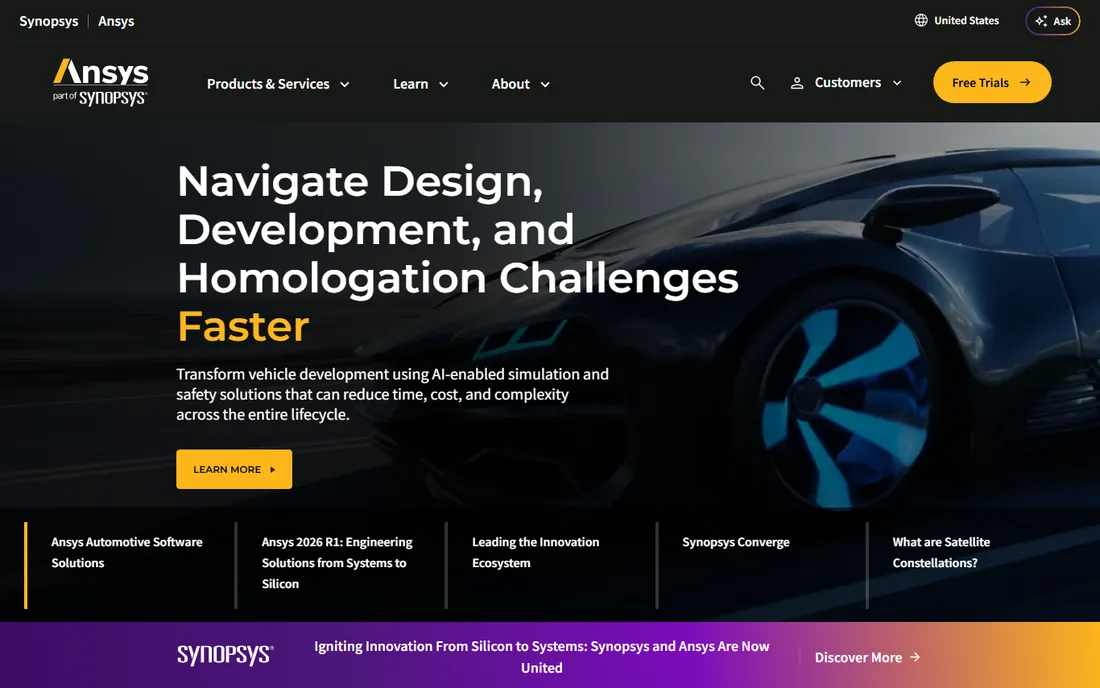
Ansys is the reference standard most of this industry is measured against. The portfolio covers structures, fluids, electromagnetics, and systems in unusual depth, with decades of validation behind the solvers, which matters enormously in aerospace, automotive, and medical devices where results must survive regulatory scrutiny. HPC scaling lets serious models run on serious hardware.
The cost is enterprise in every sense: quote-based pricing, licensing models that take study to understand, and a learning curve measured in months per product area. Small teams can feel lost in the breadth. But when the question is "which solver do the regulators and the OEMs trust," Ansys is usually the answer.
What we like- Broadest solver portfolio across physics domains
- Deep validation history in regulated industries
- Strong HPC scaling
Watch out for- Enterprise pricing with complex licensing
- Learning curve is long across the suite
#2
COMSOL Multiphysics
Best for: coupled multiphysics in one interface
Visit comsol.com
Starting priceSee website
Free planFree trial
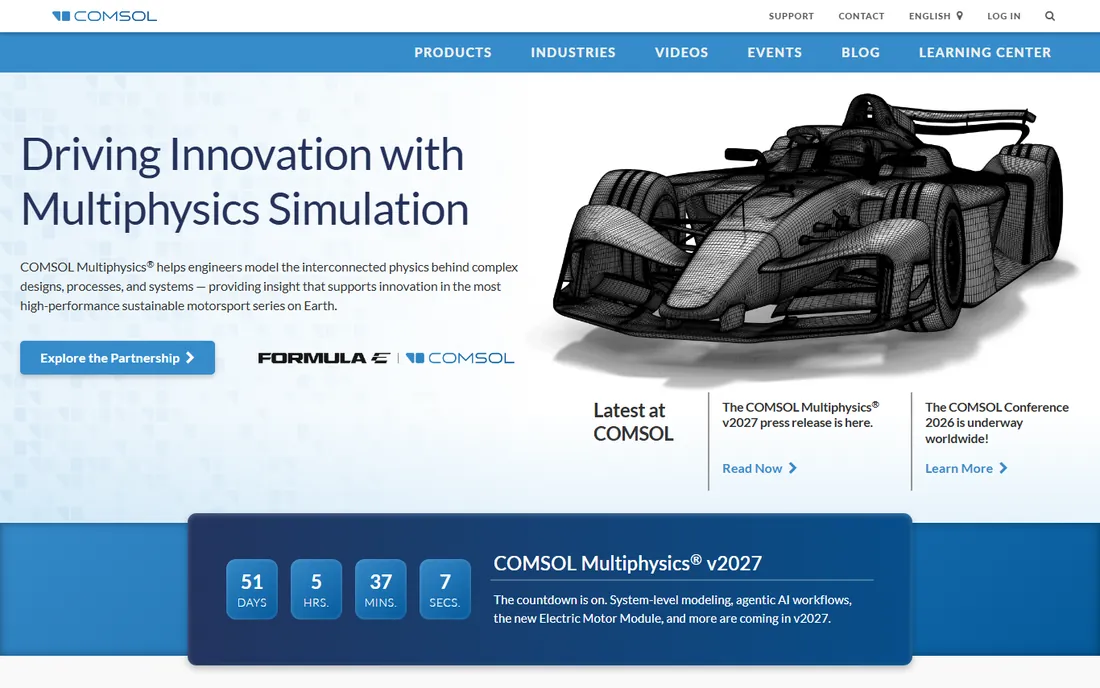
COMSOL's defining idea is that real problems do not respect domain boundaries, so the software should not either. Heat, fluids, structures, and electromagnetics couple inside one interface, and researchers love the ability to enter custom partial differential equations directly. The Application Builder lets specialists wrap models in simple apps for colleagues.
Pricing is enterprise and quote-based, and for the very largest single-physics models, dedicated solvers can outperform the unified approach. But for R and D teams, universities, and anyone whose problem is inherently multiphysics, COMSOL is the most fluid environment here.
What we like- True multiphysics coupling in a single environment
- Excellent for research and custom PDEs
- Application Builder for sharing models
Watch out for- Pricing is quote-based and significant
- Very large models can strain the unified approach
Starting priceSee website
Free planYes
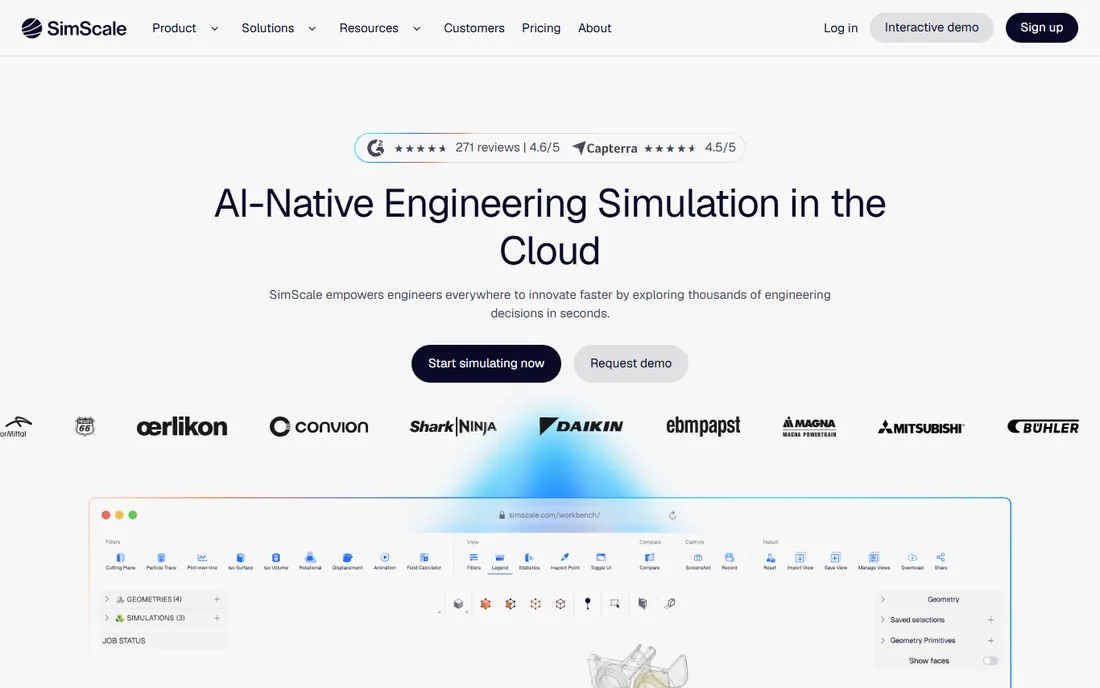
SimScale removed the two biggest barriers to simulation: expensive workstations and expensive licenses to start. The platform runs CFD, FEA, and thermal analysis in a standard web browser, with a free Community plan that lets students, startups, and the curious run real simulations. Collaboration is native, not an afterthought.
The trade is depth. Engineers doing advanced single-physics work may find dedicated solvers go further, and heavy compute usage on paid plans needs budget attention. But as the on-ramp to serious simulation, and as a collaboration platform for distributed teams, SimScale changed what is possible.
What we like- Runs fully in the browser, no workstation needed
- Free Community plan
- Easy collaboration and sharing
Watch out for- Advanced users may miss dedicated-solver depth
- Compute costs scale with usage on paid plans
Starting priceSee website
Free planFree trial
Simcenter is Siemens' answer to simulation-driven design, and its strength is integration. Inside a Siemens shop, simulation connects to NX CAD, Teamcenter data management, and testing hardware in ways standalone tools cannot match. Simcenter 3D handles structures with multi-CAE support, meaning it can pre- and post-process for Nastran, Abaqus, and Ansys solvers too.
Outside the Siemens ecosystem, some of that advantage fades, and you are still in enterprise pricing territory. But for manufacturers standardized on Siemens, the integrated digital twin story, from 1D systems to 3D detail to physical test, is compelling.
What we like- Deep integration with NX and Teamcenter
- Strong in structures, acoustics, and systems
- Multi-CAE solver support
Watch out for- Best value inside the Siemens ecosystem
- Enterprise pricing and sales process
#5
Altair
Best for: optimization-driven simulation and lightweighting
Visit altair.com
Starting priceSee website
Free planFree trial
Altair built its reputation on optimization: topology and shape tools that carve weight out of designs while keeping strength, which is why it is beloved in automotive and aerospace lightweighting. The portfolio spans structures, fluids, electromagnetics, and data analytics, with a licensing model based on flexible units rather than per-product seats.
The breadth means buyers need guidance to pick the right products, and following Siemens' acquisition of Altair, long-term roadmap questions are fair to ask. For optimization-led design workflows, though, Altair's toolset remains distinctive.
What we like- Topology optimization leadership
- Broad solver portfolio
- Flexible licensing units
Watch out for- Portfolio breadth can confuse buyers
- Now part of Siemens, so roadmap watching matters
#6
Abaqus
Best for: nonlinear FEA for the toughest structural problems
Visit 3ds.com
Starting priceSee website
Free planFree trial

When structural problems get nasty, nonlinear materials, complex contact, fracture, engineers reach for Abaqus. Dassault Systemes' SIMULIA solver has the deepest nonlinear capabilities in the industry and a material model library that covers everything from rubber to rate-dependent plasticity. Crash, sealing, and forming analyses across automotive and aerospace run on it.
It is enterprise software with enterprise pricing, and parts of the interface feel their age next to newer platforms. The Abaqus/CAE environment handles pre- and post-processing capably. Buy it when your problems are nonlinear enough to need the best; simpler linear work has cheaper answers.
What we like- Gold standard for nonlinear and contact analysis
- Huge material model library
- Trusted in automotive and aerospace
Watch out for- Dassault ecosystem pricing
- Interface shows its age in places
Starting priceSee website
Free planFree trial
Autodesk CFD is simulation for the CAD user rather than the CFD specialist. Geometry flows from Inventor, Revit, or Fusion with minimal cleanup, and design engineers can run flow and thermal studies without becoming CFD experts. Electronics cooling is a particular strength, with purpose-built workflows.
Dedicated CFD engineers will find the depth limited next to Fluent, STAR-CCM+, or OpenFOAM for exotic problems. But most flow questions in product design are not exotic, and for Autodesk shops, the frictionless CAD-to-simulation path saves more time than solver depth would add.
What we like- Smooth workflow from Autodesk CAD geometry
- Accessible for design engineers
- Good electronics cooling tools
Watch out for- Less depth than dedicated CFD codes
- Best inside the Autodesk ecosystem
Starting priceFree
Free planYes
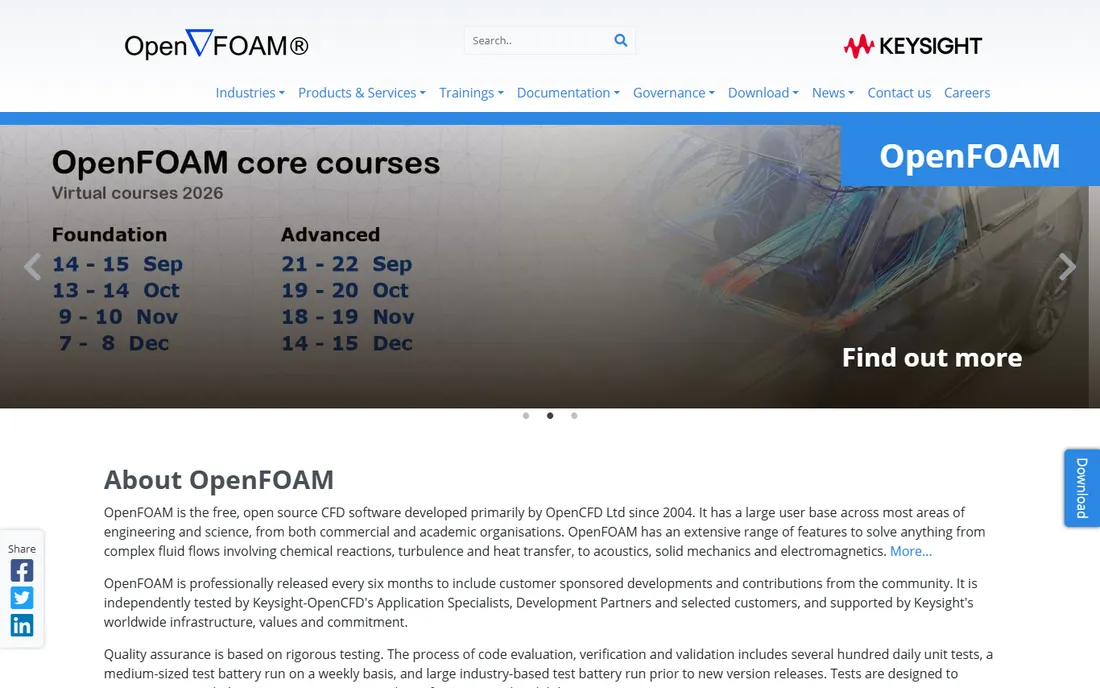
OpenFOAM is the proof that free software can compete at the highest level: Formula 1 teams use it to model aerodynamics. The open-source CFD toolbox covers incompressible and compressible flow, turbulence, heat transfer, and multiphase problems, and because there are no licenses, you can scale to as many cores as you own without asking purchasing.
The cost is expertise. Setup is script-based through text dictionaries, there is no polished GUI, and learning it is a genuine investment. Teams without CFD specialists should pair it with a GUI like FEATool or budget for training. But for capable teams, the price-to-performance ratio is unbeatable.
What we like- Completely free with no license limits
- Industry-proven solvers including F1 use
- Unlimited HPC scaling at no cost
Watch out for- Script-based setup intimidates beginners
- No vendor support without a service contract
#9
FEATool Multiphysics
Best for: easy multiphysics with open-solver integration
Visit featool.com
Starting priceSee website
Free planFree trial
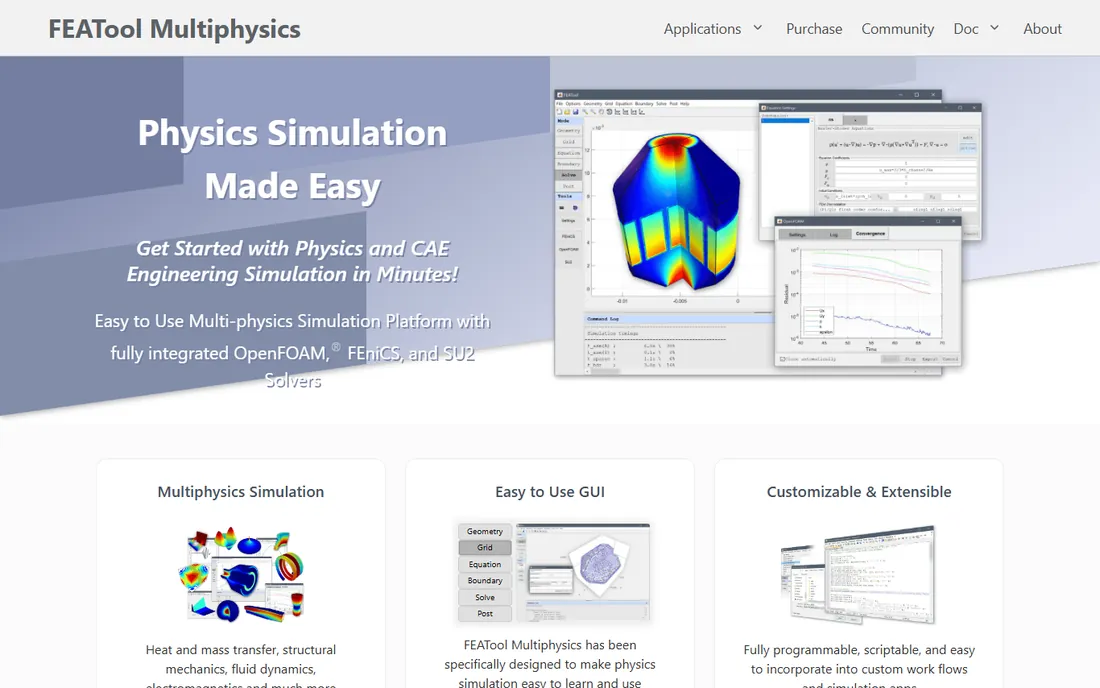
FEATool Multiphysics solves OpenFOAM's usability problem from the other direction: a genuinely easy graphical interface for setting up multiphysics simulations, with the option to run its built-in solvers or hand off to OpenFOAM, FEniCS, or SU2 for heavy lifting. MATLAB and Python integration serves researchers who script.
It is a small vendor, so support resources and community are thinner than the giants', and the very largest models belong on dedicated platforms. But as the accessible face of open-source solvers, and as a teaching and prototyping tool, it fills a real gap.
What we like- Friendly GUI over serious solvers
- Integrates OpenFOAM, FEniCS, and SU2
- MATLAB and Python scripting
Watch out for- Small vendor with a niche profile
- Largest models may need dedicated tools
#10
LS-DYNA
Best for: explicit dynamics: crashes, impacts, and blasts
Visit ansys.com
Starting priceSee website
Free planFree trial
LS-DYNA, now part of Ansys, is the solver behind vehicle crash simulation worldwide. Its explicit dynamics engine handles the violent, short-timescale physics of crashes, drops, impacts, and blasts better than anything else, with validation depth built over decades in automotive safety work.
It is a specialist. Nobody buys LS-DYNA for static bracket analysis; it earns its place on explicit problems. Licensing runs through Ansys' enterprise models. If your product must survive impacts, this is the tool the industry trusts with lives.
What we like- Industry standard for crash and impact simulation
- Superb explicit solver
- Deep automotive validation
Watch out for- Specialized tool, not a general FEA platform
- Ansys licensing complexity applies
The real cost of simulation software
The license quote is only the first line of the budget. Enterprise simulation licensing comes in flavors, node-locked, floating, and token or unit pools, and the model you choose changes the effective price per engineer dramatically. HPC costs follow: either your own cluster hardware or cloud compute bills that scale with model size and urgency.
Then there is the human cost. Training an engineer to productive independence on Ansys, Abaqus, or Simcenter takes months, and experienced analysts command premium salaries precisely because the tools are deep. Open-source tools like OpenFOAM flip the ratio: zero license cost, higher expertise cost.
Support and validation add more. Regulated industries pay for vendor support contracts and validated solver versions because the alternative, explaining an open-source result to a regulator, costs more. When comparing a free tool against a quoted suite, price the whole picture: licenses, hardware, training, support, and the cost of a wrong answer.
How we chose
We reviewed vendor pricing pages and documentation, then validated claims against public reviews on G2 and Capterra and against working engineers discussing solvers on Reddit. We weighted solver depth and validation history, multiphysics coupling, usability for different skill levels, HPC and cloud options, licensing flexibility, and fit for different organizations, from student teams to regulated enterprises. We favored tools with active development and real engineering use in 2026. We did not claim hands-on testing of any product.
How to choose simulation software for your team
Four questions cut through the marketing.
FEA, CFD, or multiphysics first
Name your dominant physics. Structural and vibration work points to Abaqus, Ansys Mechanical, or Simcenter. Fluid flow and thermal points to CFD tools like Autodesk CFD, SimScale, or OpenFOAM. Coupled problems point to COMSOL, Ansys, or Simcenter. Buying a multiphysics suite for a pure CFD problem wastes money; buying a CFD code for crash analysis wastes more.
Solver accuracy and validation
Ask what validates the solver: published benchmarks, industry adoption in your sector, and regulatory acceptance. Ansys, Abaqus, and LS-DYNA carry decades of validation in safety-critical industries. Newer or niche tools can be excellent but need harder scrutiny before you bet a product on them.
Hardware and HPC strategy
Large models need large compute. Decide whether you will run on workstations, an in-house cluster, or cloud, then check how each vendor licenses HPC: some charge per core, some include generous HPC rights, and OpenFOAM charges nothing. SimScale sidesteps the question entirely by running in the browser.
Licensing models that fit headcount
Per-seat licenses suit stable teams; token or unit pools suit organizations with bursty usage across many occasional users. Model your real concurrency, not your total headcount, and get the license terms in writing before the pilot ends.
Frequently asked questions
Should I choose Ansys or COMSOL?
Choose Ansys for the deepest single-physics solvers, the strongest validation record in regulated industries, and large-team HPC workflows. Choose COMSOL when your problems are inherently multiphysics and you want coupled simulation in one fluid interface, especially for R and D and research. Many organizations use both for different problem classes.
Is OpenFOAM good enough for professional work?
Yes, with the right team. Its solvers are proven in demanding industries including motorsport, and the price allows unlimited scaling. What it needs is expertise: script-based setup and no vendor support by default. Teams with CFD specialists get professional results; teams without them should budget for training or a GUI layer like FEATool.
Do I need HPC or cloud computing for simulation?
It depends on model size. Small to medium models run fine on a good workstation, and SimScale removes the hardware question entirely. Large, detailed, or transient models need cluster or cloud compute to finish in useful time. Check each vendor's HPC licensing before assuming your workstation plan scales.
How long does it take to learn simulation software?
Expect weeks to run guided tutorials productively and months to work independently on real problems. COMSOL and SimScale have the gentlest ramps; Ansys, Abaqus, and Simcenter reward longer investment. The physics knowledge matters as much as the software skill: a bad model in any tool gives a confident wrong answer.
Cloud or on-premise simulation?
Cloud and browser options like SimScale offer instant access, easy collaboration, and no hardware investment, which suits distributed teams and variable workloads. On-premise suits organizations with data restrictions, existing clusters, or steady heavy usage where owned hardware wins on cost. Most enterprises end up hybrid.
Sources we checked (9)
- https://www.ansys.com
- https://www.comsol.com
- https://www.simscale.com
- https://plm.automation.siemens.com
- https://www.altair.com
- https://www.3ds.com
- https://www.autodesk.com
- https://www.openfoam.com
- https://www.featool.com
Is your product missing or out of date?
We review this list regularly. Vendors can request a listing, send updated pricing or ask about featured placement.

Shihab Mia · Founder, Rankite
Shihab has spent more than a decade helping SaaS and e-commerce brands grow through search. He writes Rankite's software buying guides from pricing pages, documentation and public user reviews. More about Shihab.