How we make this list: we compare pricing pages, product documentation and public user reviews. Ratings come from G2, Capterra or Trustpilot, with the date we checked them.
Key takeaways
- Fixed asset accounting is a depreciation discipline: parallel books for financial reporting and tax, MACRS and Section 179 handling, disposals, and an audit trail.
- Sage Fixed Assets is the established specialist: depreciation, planning, tracking, and reporting modules with a Tax Audit Advisor and IRS Form 4562 support. It publishes no price.
- AssetAccountant is the transparent buy: published pricing per 100 assets, Lite at $6, with unlimited users, tax and accounting registers side by side, and ASC 842 lease accounting.
- Bloomberg BNA Fixed Assets serves enterprise tax departments that need depreciation depth and compliance across many entities and jurisdictions.
- Tax rules move: bonus depreciation was restored to 100 percent by 2025 legislation after a scheduled phase down. Software that updates its tax tables is worth more.
Quick comparison
Is your product missing or out of date?
We review this list regularly. Vendors can request a listing, send updated pricing or ask about featured placement.
The best software for fixed asset accounting

#1
Sage Fixed Assets
Best for: The established depreciation specialist
Visit sage.com
Starting priceSee website
Free planNo
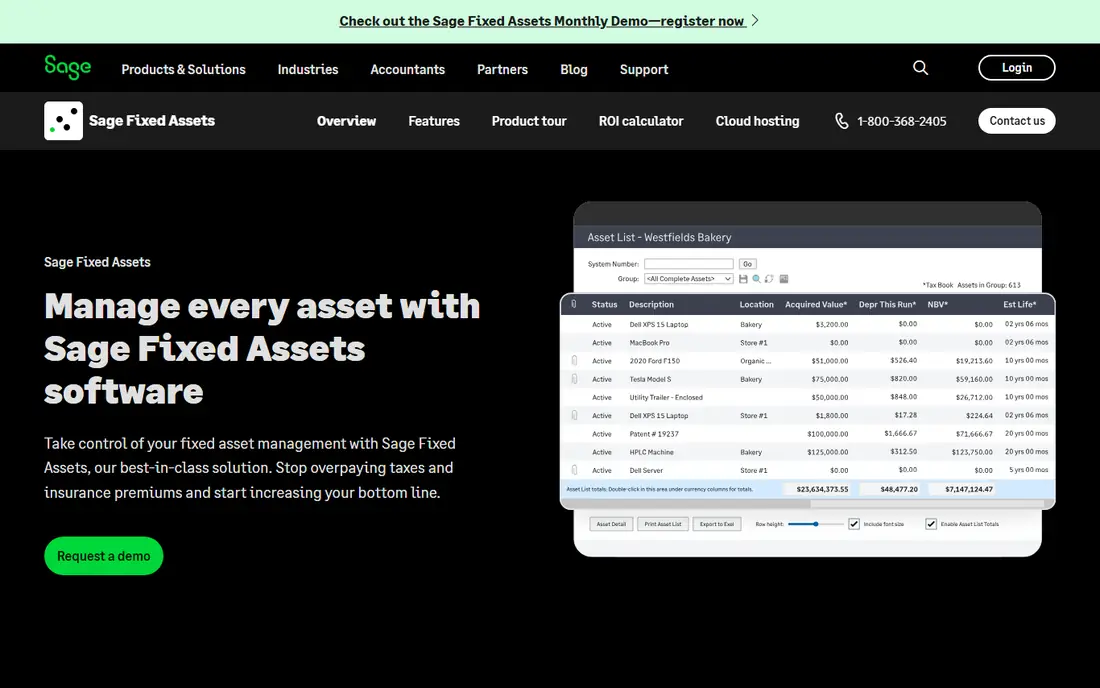
Sage Fixed Assets is the name most US accountants meet first in this category, and its structure shows why: it separates the four jobs, planning capital spend, calculating depreciation, physically tracking assets, and reporting, into modules a company licenses as needed. Its depreciation engine runs the parallel books that define this category, with US tax handling that includes MACRS, Section 179 tracking, and Form 4562 support, plus an Audit Advisor that flags assets whose treatment conflicts with current rules.
That tax currency matters more in 2026 than usual. Bonus depreciation law changed again in 2025, restoring 100 percent expensing for qualifying property after a phase down schedule, and registers built on stale tables misstate both books and returns. The purchase process is the friction: no published price, no self serve trial, a sales led evaluation.
What we like- Four modules cover the lifecycle: Planning for capital projects, Depreciation for the calculations, Tracking for inventories, Reporting for the output
- Multiple depreciation books per asset, book, tax, state, and custom, calculated together
- Tax tooling includes an Audit Advisor that checks assets against current rules, Section 179 tracking, and IRS Form 4562 support
- Integrates with Sage accounting lines and stands alone for others
Watch out for- No public pricing and no free trial currently offered, per ITQlick's October 2026 check, so evaluation runs through sales
- Implementation is a real project: importing a spreadsheet register and cleaning it is the work
- Can feel complex for a business with fifty assets and simple needs
- Per module licensing means the quote depends on which pieces you take

#2AssetAccountant
Best for: Published pricing, dual registers5.0/5 on
G2 (2 reviews, checked Oct 2026)
Visit asset.accountant
Starting price$6 per 100 assets/month
Free planNo
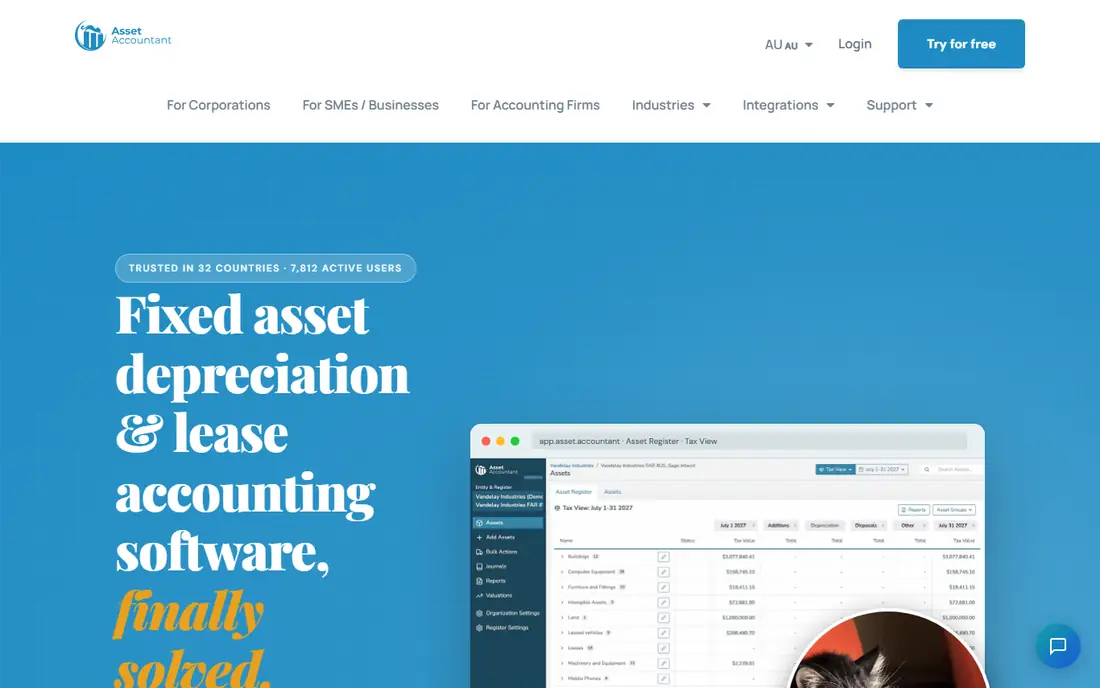
AssetAccountant is the transparency outlier: a fixed asset platform that publishes a rate card, priced by register size rather than seats, $6 per 100 assets monthly for Lite rising to $18 for Standard, with unlimited users including external advisers. Its Intacct marketplace listing documents the depth behind the price: tax and accounting depreciation calculated across all asset groups simultaneously, with journals posted to the general ledger in one click.
The feature that sells it to groups is the dual register discipline: book and tax depreciation live side by side with their own methods and lives, and events like partial disposals, revaluations, impairments, and work in progress are handled as first class transactions with an audit trail. A 30 day free period lets a finance team import a real register and test the calculations before paying.
What we like- Published, per asset pricing: Lite $6, Basic $12, Standard $18 per 100 assets per month, with unlimited users at every tier
- Separate tax and accounting registers maintained side by side, with IRS MACRS methods, Section 179, and bonus depreciation built in
- Lease accounting for ASC 842 and IFRS 16: right of use assets, payment schedules, refinancing and terminations
- Integrates with Xero, QuickBooks Online, Sage Intacct, and Microsoft Dynamics, posting depreciation journals to the ledger
Watch out for- Larger registers move to annual volume pricing, Premium is price on application above 1,000 assets
- An Australian founded product, its deepest tax content historically serves several countries, US coverage is full but newer
- The Intacct marketplace listing starts at $3,500 per annum, a different shape than the per asset page, clarify which applies
- Not a physical tracking tool: no barcode inventory workflow of its own
Starting priceSee website
Free planNo

Bloomberg BNA Fixed Assets occupies the tax department end of the market: the register as a compliance instrument, maintained by the same organisation whose tax research the department already reads. ITQlick's 2026 comparison credits it with a comprehensive feature set for complex asset management and places its buyer plainly: larger organisations with complex requirements.
The decision here is organisational, not functional. A corporate tax team managing depreciation across dozens of entities and state regimes buys BNA for the authority of its tax tables and the depth of its books. A controller at a 200 asset company buys Sage or AssetAccountant and gets the same arithmetic with less machinery.
What we like- Built for corporate tax departments: depreciation depth across federal, state, and alternative books at enterprise scale
- Bloomberg Tax's research organisation behind the tax content, so rule changes arrive with authority
- Handles complex structures: many entities, many jurisdictions, consolidated reporting
- Comprehensive reporting and compliance tooling per ITQlick's comparison
Watch out for- No public pricing, and ITQlick notes it can be cost prohibitive for smaller businesses
- Enterprise implementation and administration, not a finance team's side project
- Less suited to physical asset tracking, it is a calculation and compliance system
- Over specified for any register a spreadsheet still honestly serves

#4Asset Panda
Best for: Tracking that feeds the register4.2/5 on
G2 (43 reviews, checked Oct 2026)
Visit assetpanda.com
Starting priceSee website
Free planNo
Asset Panda approaches the register from the loading dock rather than the ledger: if nobody knows where the assets physically are, the depreciation schedule is fiction, so it builds the register around scanning, assigning, and locating things with a phone. Comparisons credit its mobile accessibility and custom reporting, and for operations heavy businesses that physical truth is the accounting control that matters most at audit time.
Know the boundary before buying it as accounting software. Asset Panda calculates depreciation and reports book values, which covers many companies' needs, but its tax book depth is not the product's centre; businesses whose returns turn on bonus depreciation elections should run the register in a specialist and, if needed, track physically in Panda alongside.
What we like- Cloud register built around mobile tracking: barcode scanning from phones, check in and check out, and location history
- Configurable records: custom fields and workflows adapt the register to equipment, vehicles, or IT
- Depreciation calculation and reporting included alongside the tracking
- User friendly reputation in comparisons, the register non accountants will actually update
Watch out for- Depreciation and tax depth trail the specialists: no MACRS machinery at Sage or BNA level
- Pricing is quote led, nothing public to budget from
- Heavy tax scenarios, multiple books, complex disposals, belong in a specialist
- Audit and compliance features serve operations more than a tax return
Starting priceSee website
Free planNo
Wasp's AssetCloud sells the physical system whole: the software, the barcode scanners, the asset tags, and the audit workflow that walks a building and reconciles what exists against what the register claims. For asset accounting that audit is not a side feature; ghost assets, items disposed of but still depreciating, are the most common register error, and a scan based count is how they get found.
What we like- From a barcode hardware company: scanners, tags, and printers integrate with the software as one system
- Asset audits become a walk with a scanner: found, missing, and moved reported automatically
- Depreciation and reporting included for the accounting side of the register
- Strong fit for schools, government, and facilities with thousands of tagged items
Watch out for- Hardware led sale: the full value needs Wasp scanners and labels in the bundle
- Tax depreciation depth is not its claim, verify methods against your return's needs
- Pricing bundles software and hardware, published figures need a quote to interpret
- Cloud and on premise variants complicate the comparison

#6EZO AssetSonar
Best for: IT and equipment asset registers4.5/5 on
G2 (88 reviews, checked Oct 2026)
Visit ezo.io
Starting priceSee website
Free planNo
AssetSonar, from EZO, is the IT department's register: laptops, licences, and equipment with who has them, what they cost, and what they are worth now, depreciation tracked inside the same record that handles assignment and maintenance. For technology heavy companies, where the fixed asset register is mostly devices cycling through employees, that union of custody and cost is the practical control.
Its accounting should be scoped honestly. Depreciation schedules and reports serve management and audit support well; the parallel tax book machinery of Sage or AssetAccountant is not the brief. Many companies run AssetSonar as the operational register and let a specialist compute tax depreciation at year end.
What we like- IT asset management heritage: hardware and software assets, licences, and assignments in one register
- Depreciation tracking alongside custody, so book value and current holder sit in one record
- Check in, check out, reservations, and maintenance for shared equipment pools
- Integrations with IT service tools pull device data into the register automatically
Watch out for- Accounting depth is a feature, not the foundation: tax books are limited beside the specialists
- Pricing is per asset and user shaped, confirm the model against your counts
- Finance teams may still export to a specialist for year end tax work
- Strongest where IT owns the register, weaker for plant and property

#7
FMIS Fixed Asset Software
Best for: Compliance grade registers, UK strength
Visit fmis.co.uk
Starting priceSee website
Free planNo
FMIS represents the international specialist tier: fixed asset software built for organisations whose reporting runs on IFRS or UK GAAP, with component accounting, where a building's roof, plant, and structure depreciate as separate assets, handled as a core discipline rather than a workaround. Public sector and education buyers, whose asset counts are audited hard, are its home market.
For a US reader its relevance is specific: groups with UK or international subsidiaries reporting under IFRS, or companies whose auditors demand component level registers, should have FMIS or its peers in the evaluation. A purely domestic US business will find its strengths unused and its tax content off centre, and should start with Sage or AssetAccountant.
What we like- A dedicated fixed asset specialist with a compliance and audit focus: component accounting, revaluations, and full transaction history
- Handles IFRS and UK GAAP requirements that US centric tools treat as edge cases
- Barcode tracking module available inside the same register
- Long standing in public sector and education, where asset audit evidence is demanding
Watch out for- UK centred vendor: US tax depreciation is not its home ground
- Smaller presence and community in the US market
- Pricing is quoted, with modules shaping the bill
- US buyers should verify MACRS and Section 179 handling directly rather than assume

#8Limble
Best for: Maintenance assets with work orders4.8/5 on
G2 (696 reviews, checked Oct 2026)
Visit limblecmms.com
Starting priceSee website
Free planNo
Limble closes the list from the plant floor: a computerised maintenance management system where every asset carries its service history, and the fixed asset register is maintained by the people who touch the machines. That produces the most current operational data in this article, and its asset value reporting gives finance a reasonable view without a second system for day to day purposes.
The accounting boundary is the same as Asset Panda's, drawn brighter: Limble's depreciation serves management reporting, while tax books, elections, and Form 4562 level detail belong to the specialists and the ledger.
What we like- A CMMS: assets live with their work orders, preventive maintenance schedules, parts, and downtime history
- Depreciation and asset value reporting included for the finance view
- Maintenance data improves accounting decisions: repair versus replace becomes a documented call
- Mobile first for technicians, so asset records stay current at the source
Watch out for- It is maintenance software: the register serves uptime first and accounting second
- Tax depreciation and parallel books are outside its design
- Per user pricing for a maintenance team is a different budget than a finance tool
- Year end tax work still happens in the ledger or a specialist
How we chose
We split the category into depreciation specialists and tracking led registers and covered both, using ITQlick's October 2026 pricing checks for Sage Fixed Assets and BNA, AssetAccountant's published US pricing and Intacct marketplace listing, and vendor positioning for the tracking platforms. Every quote only product is marked See website. General accounting suites with a basic fixed asset module were excluded, and generic inventory tools with no depreciation were excluded entirely.
What to look for in software for fixed asset accounting
Test the tax books, not the demo dashboard. Bring twenty real assets from your register, including a partial disposal, a transfer, a Section 179 candidate, and an asset with different book and tax lives, and make each vendor process them live. Fixed asset software fails at events, not at lists, and the parallel book calculation, book, federal tax, state, is the entire reason the category exists apart from spreadsheets.
Ask about the law update process by name. Bonus depreciation was restored to 100 percent by 2025 legislation after years of scheduled phase down; Section 179 limits moved too. How does the vendor ship new tables, how fast after enactment, and does an advisor flag assets recorded under old rules? Then settle the physical question: if your register's problem is that nobody can find the assets, a tracking platform matters more than a third depreciation book.
Frequently asked questions
What does fixed asset accounting software do that a spreadsheet cannot?
It maintains parallel depreciation books, book, tax, and state, with each asset's method, life, and convention applied consistently across thousands of assets and many years. It processes the events spreadsheets corrupt: partial disposals, splits, transfers between locations, revaluations, impairments, and assets moving from construction in progress into service, each with an audit trail. And it updates its tax tables when law changes, as bonus depreciation did in 2025, instead of relying on whoever built the spreadsheet to notice.
How much does fixed asset software cost?
Published pricing is rare. AssetAccountant is the exception: $6 per 100 assets per month for Lite, $12 Basic, $18 Standard, with unlimited users, and volume pricing above 1,000 assets. Sage, Bloomberg BNA, FMIS, and the tracking platforms quote, with cost driven by asset count, modules, and users; ITQlick found no public price for Sage or BNA. Budget implementation time too: cleaning and importing the existing register is real work in every deployment.
Which depreciation methods should the software support?
For US tax: MACRS with its recovery periods and conventions, Section 179 expensing, bonus depreciation at the current statutory rate, and ADS where required. For book reporting: straight line at minimum, plus declining balance and units of production for assets whose wear is usage driven. The software should run different methods on different books for the same asset simultaneously, handle short tax years and mid quarter conventions, and let you model a disposal's gain or loss before you commit it. IFRS reporters add component depreciation to the list.
Should the asset register live in our accounting system instead?
For a small register of simple assets, yes: the fixed asset modules in mainstream accounting platforms handle straight line depreciation and basic disposals adequately, and one system means no reconciliation. Move to a specialist when any of these arrive: hundreds of assets, tax and book lives that routinely differ, Section 179 and bonus depreciation planning, multi entity registers, component accounting, or an auditor asking for a transaction level audit trail the module cannot produce.
Sources we checked (0)
Is your product missing or out of date?
We review this list regularly. Vendors can request a listing, send updated pricing or ask about featured placement.

Shihab Mia · Founder, Rankite
Shihab has 5+ years in B2B and SaaS SEO. He writes Rankite's software buying guides from pricing pages, documentation and public user reviews. More about Shihab.
 Bloomberg BNA Fixed Assets
 Wasp AssetCloud