How we make this list: we compare pricing pages, product documentation and public user reviews. Ratings come from G2, Capterra or Trustpilot, with the date we checked them.
Key takeaways
- This list covers books, not software tools, so the comparison covers lessons, depth, and reader fit rather than features and pricing.
- Clean Code is the best starting book for writing readable, maintainable code, and it suits developers at any level.
- The Pragmatic Programmer is the best book for practical habits, covering the mindset behind good engineering.
- Design Patterns is the essential reference for reusable object oriented solutions, though it reads more like a catalog than a story.
- Code Complete is the most comprehensive single volume on software construction, and it rewards patient reading.
- Refactoring and Working Effectively with Legacy Code are the best books for improving existing code, which is most of real world work.
Quick comparison
Is your product missing or out of date?
We review this list regularly. Vendors can request a listing, send updated pricing or ask about featured placement.
The best software engineering books
Starting priceSee website
Free planNo

Clean Code, by Robert C. Martin, is the best starting book for writing readable, maintainable code. Its central idea is simple: code is read far more often than it is written, so clarity matters as much as correctness. The book covers meaningful names, small functions, clear comments, error handling, and testing, with before and after examples that show messy code becoming clean code.
Some rules are debated, and the Java examples date the text, but the principles transfer to any language. For a developer who wants one book that changes how they write code day to day, Clean Code is the first pick.
What we like- Clear rules for readable functions and classes
- Memorable examples
- Applies to any language
Watch out for- Some rules are debated
- Java examples date the text
- Naming advice can feel rigid
Starting priceSee website
Free planNo
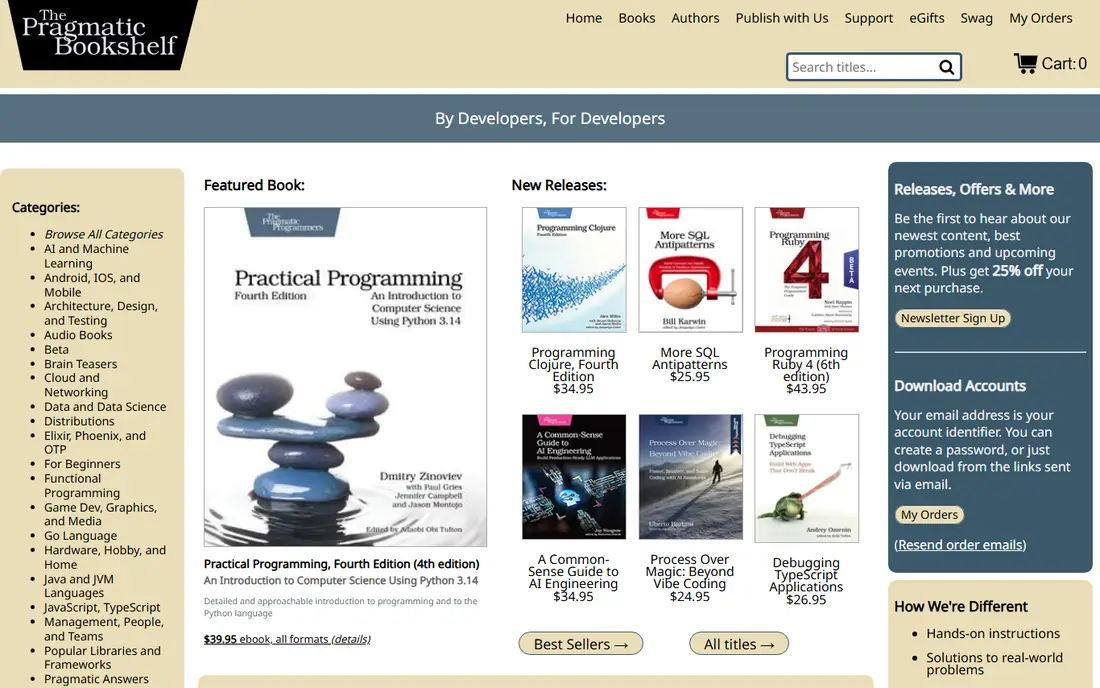
The Pragmatic Programmer, by David Thomas and Andrew Hunt, is a collection of practical habits for software engineers, covering topics like broken windows, rubber duck debugging, automation, testing, and estimating. Its advice is organized into short, readable sections with tips that stick, which makes it easy to read a little at a time and apply immediately.
The book covers mindset more than code, so readers wanting deep technical detail should pair it with Clean Code or Code Complete. Some tips feel obvious to veterans, though they are exactly the habits juniors need most. For a book that shapes how you think about engineering work, The Pragmatic Programmer is unmatched.
What we like- Practical habits and mindset
- Short readable sections
- Timeless advice
Watch out for- Less code depth than Clean Code
- Some tips feel obvious to veterans
- Newer edition needed for modern tools
Starting priceSee website
Free planNo

Design Patterns, by Erich Gamma, Richard Helm, Ralph Johnson, and John Vlissides, known as the Gang of Four, catalogs 23 reusable solutions to common object oriented design problems, from Singleton and Observer to Factory and Strategy. Its greatest gift is vocabulary: when a team shares pattern names, design discussions become faster and clearer.
The book reads like a reference rather than a narrative, and its C++ and Smalltalk examples are dated, though the patterns themselves remain relevant. Patterns can also be overused by beginners eager to apply them everywhere. For a reference every serious object oriented developer should own, Design Patterns is essential.
What we like- Essential catalog of 23 patterns
- Shared vocabulary for teams
- Timeless object oriented design
Watch out for- Reads like a reference, not a story
- C++ and Smalltalk examples are dated
- Patterns can be overused
Starting priceSee website
Free planNo
Refactoring, by Martin Fowler, catalogs safe transformations that improve code structure without changing behavior, from Extract Function to Replace Conditional with Polymorphism. Each refactoring explains the motivation, the mechanics, and an example, which makes the book a practical manual for daily code improvement. The second edition uses JavaScript examples and feels modern.
Refactoring needs a test suite to apply safely, since behavior preserving changes still need verification, and the catalog format suits reference use more than cover to cover reading. For developers who spend their days improving existing code, which is most of real world work, Refactoring is indispensable.
What we like- Catalog of safe code transformations
- Test first discipline
- JavaScript edition is modern
Watch out for- Needs a test suite to apply safely
- Catalog format suits reference more than cover to cover reading
Starting priceSee website
Free planNo
Code Complete, by Steve McConnell, is the most comprehensive single volume on software construction, covering design, naming, routines, defensive programming, testing, debugging, and integration with evidence based advice. Its second edition draws on research and industry practice, which gives its recommendations weight beyond opinion.
The book is very long, at more than 900 pages, and some sections feel academic, so it rewards patient reading in parts rather than a single sitting. For a developer who wants one deep reference on building software well, Code Complete is the most thorough choice available.
What we like- Most comprehensive construction guide
- Evidence based advice
- Covers design through debugging
Watch out for- Very long at over 900 pages
- Some sections feel academic
- Best read in parts
Starting priceSee website
Free planNo
The Mythical Man-Month, by Fred Brooks, collects essays on software project management drawn from building IBM OS/360 in the 1960s, and its lessons remain startlingly relevant. Brooks Law, that adding people to a late project makes it later, is the most famous idea, alongside essays on conceptual integrity, the second system effect, and why programming is fun and frustrating at once.
The mainframe context needs modern translation, and the book says little about code itself. It is short and readable, though, and its wisdom about teams, schedules, and complexity applies to every software project. For managers and senior engineers, it is essential reading.
What we like- Timeless project lessons
- Brooks Law
- Short and readable
Watch out for- Based on 1960s mainframe work
- Some advice needs modern translation
- Thin on code

#7
Working Effectively with Legacy Code
Best for: Taming legacy codebases
Visit pearson.com
Starting priceSee website
Free planNo
Working Effectively with Legacy Code, by Michael Feathers, tackles the hardest common problem in software: changing code with no tests and no one left who understands it. Its core techniques include finding seams where behavior can be isolated, writing characterization tests that capture current behavior, and breaking dependencies safely. The book is honest about messy real code, which makes it more useful than idealized guides.
It is dense and technical, examples are dated, and applying its techniques needs patience and practice. For developers inheriting a large old codebase, this book is the most practical guide to making progress without breaking everything.
What we like- Practical techniques for untested code
- Seam and characterization test ideas
- Honest about real code
Watch out for- Dense and technical
- Examples are dated
- Needs patience and practice
Starting priceSee website
Free planNo
Domain-Driven Design, by Eric Evans, presents a framework for modeling complex business domains in software, centered on a ubiquitous language shared by developers and domain experts, plus patterns like entities, value objects, aggregates, and bounded contexts. For systems where business complexity is the hard part, such as finance, healthcare, and logistics, its ideas prevent the model from collapsing under its own weight.
The book is dense and abstract, overkill for simple CRUD apps, and its ideas need team buy in to work, since a ubiquitous language fails when only developers speak it. For senior engineers on complex systems, Domain-Driven Design is the deepest and most rewarding book on this list.
What we like- Deep domain modeling framework
- Ubiquitous language idea
- Essential for complex systems
Watch out for- Dense and abstract
- Overkill for simple apps
- Needs team buy in to work
How we chose
We ranked books by lasting value, practical usefulness, and readability, favoring books whose lessons survive language and framework changes. We gave extra weight to books that change daily practice, such as Clean Code and Refactoring, and to books that explain teams and projects, such as The Mythical Man-Month, since engineering is a team activity. We also covered the full range of engineering work, from code and design to legacy systems and domain modeling, rather than listing eight books on one topic. Prices vary by format and retailer, so starting prices are listed as See website.
Buying guide
Start with your experience level. New developers should read Clean Code first, then The Pragmatic Programmer, since those two shape daily habits fastest. Intermediate developers should add Refactoring and Design Patterns, which deepen design and code improvement skills. Senior developers and managers should read Code Complete, The Mythical Man-Month, and Domain-Driven Design for depth on construction, projects, and modeling.
Next, decide how you read. Reference books like Design Patterns and Refactoring work best dipped into as needed, while narrative books like The Pragmatic Programmer and The Mythical Man-Month reward cover to cover reading. Buy formats you will actually use: paper for annotation, or digital for search, since a book you do not open teaches nothing.
Finally, apply one idea at a time. Reading about clean code without changing how you write functions wastes the book. Pick one practice from each book, such as smaller functions from Clean Code or characterization tests from Feathers, and use it for a month before adding another. The best software engineering book is the one whose ideas show up in your code.
Frequently asked questions
What is the best software engineering book for beginners?
Clean Code is the best first book, since it changes how you write code day to day with clear, practical rules. Follow it with The Pragmatic Programmer for habits and mindset.
Should I read Design Patterns cover to cover?
Not necessarily. Design Patterns works best as a reference: learn the most common patterns first, such as Strategy, Observer, and Factory, then consult the catalog when a design problem matches a pattern.
Are old software engineering books still relevant?
Yes, when they cover thinking, design, and people rather than specific tools. Clean Code, The Pragmatic Programmer, and The Mythical Man-Month remain relevant because their lessons apply across languages and frameworks.
What book helps most with legacy code?
Working Effectively with Legacy Code is the best book for untested, poorly understood codebases, with techniques for adding tests and breaking dependencies safely. Pair it with Refactoring for code transformations.
Is Domain-Driven Design worth reading for small apps?
Usually not as a first priority, since its framework suits complex domains. For simple apps, Clean Code and The Pragmatic Programmer give more value. Return to Domain-Driven Design when business complexity becomes the main challenge.
Sources we checked (0)
Is your product missing or out of date?
We review this list regularly. Vendors can request a listing, send updated pricing or ask about featured placement.

Shihab Mia · Founder, Rankite
Shihab has 5+ years in B2B and SaaS SEO. He writes Rankite's software buying guides from pricing pages, documentation and public user reviews. More about Shihab.
 Clean Code
 The Pragmatic Programmer
 Design Patterns
 Refactoring
 Code Complete
 The Mythical Man-Month
 Domain-Driven Design