How we make this list: we compare pricing pages, product documentation and public user reviews. Ratings come from G2, Capterra or Trustpilot, with the date we checked them.
Key takeaways
- Vercel is the default for Next.js and frontend heavy apps, and Netlify holds the same position for static sites and JAMstack projects.
- Render and Railway are the friendliest general purpose platforms, deploying web services, background workers and databases from a git push without infrastructure work.
- Fly.io runs your containers close to users worldwide on real virtual machines, and DigitalOcean App Platform suits teams already in that cloud.
- Heroku's free tier is gone and should appear in no current plan: its paid dynos still offer the simplest deployment model ever made, at prices that end most comparisons early.
Quick comparison
| Tool | Best for | Starting price | Free plan |
|---|
 Vercel | Next.js and frontend applications | $20 per user per month | Yes |
 Netlify | Static sites and JAMstack apps | See website | Yes |
 Render | Full stack apps without infrastructure work | $7 per month | Yes |
 Railway | Fast deploys with usage based pricing | $5 per month | No |
 Fly.io | Containers close to users, worldwide | See website | No |
 DigitalOcean App Platform | Apps in the DigitalOcean ecosystem | $5 per month | No |
 Heroku | The simplest git push deployment model | $5 per month | No |
Is your product missing or out of date?
We review this list regularly. Vendors can request a listing, send updated pricing or ask about featured placement.
The best services for cloud app deployment
#1Vercel
Best for: Next.js and frontend applications4.7/5 on
G2 (87 reviews, checked Oct 2026)
Visit vercel.com
Starting price$20 per user per month
Free planYes
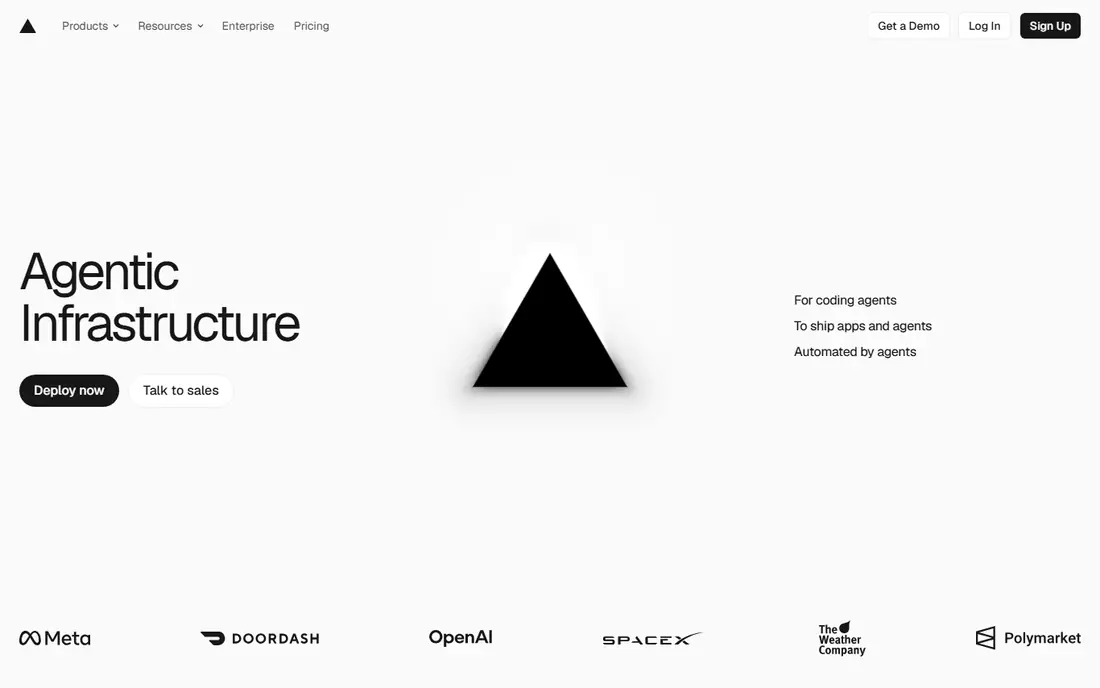
What we like- Vercel is the home of Next.js and the smoothest deployment experience in this list for frontend and full stack JavaScript apps: connect a repository and every push gets a production deploy and every pull request a shareable preview, served on a global edge network with serverless and edge functions, image optimisation and analytics built in. The free Hobby tier is generous enough for personal projects and portfolios. Pro runs 20 dollars per user per month and opens the limits real products need. For a React or Next.js team, the distance between code and a live URL is shortest here.
Watch out for- The platform's centre of gravity is its own framework and the frontend world
- Long running processes, heavy background work and non JavaScript backends fit awkwardly into serverless shapes. Costs surprise teams at scale: bandwidth, function execution and per seat pricing compound, and the bill for a popular app can pass a small cloud server's many times over. Hobby tier terms prohibit commercial use, a clause hobbyists routinely miss. Vendor comfort is real, and leaving means rebuilding the deployment habits your team formed around it.
#2Netlify
Best for: Static sites and JAMstack apps4.5/5 on
G2 (83 reviews, checked Oct 2026)
Visit netlify.com
Starting priceSee website
Free planYes
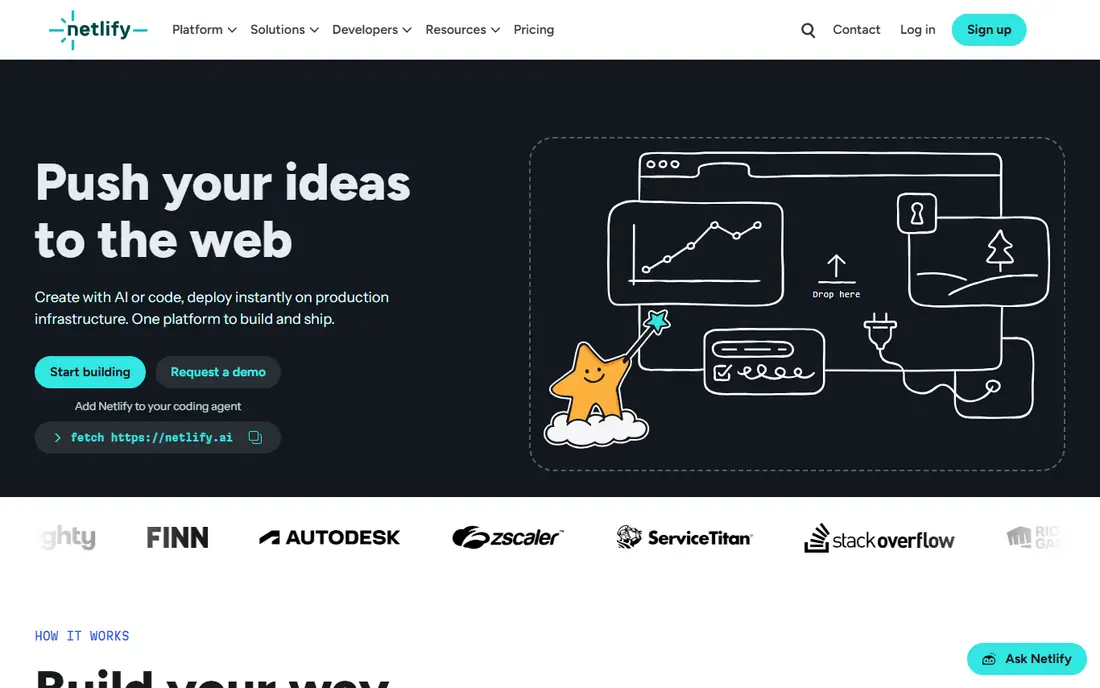
What we like- Netlify pioneered the modern static and JAMstack workflow: git based deploys, instant rollbacks, deploy previews, forms, identity and edge functions, wrapped in an interface content teams can use without engineering help. Documentation sites, marketing sites, blogs and frontend applications with API backends are its home ground, and its build ecosystem and split testing serve marketing engineering teams well. A free tier still exists for small projects, and paid plans are priced on its site in a credits influenced model that we mark see website rather than flatten.
Watch out for- Like Vercel, it is frontend first: persistent servers, long jobs and stateful backends belong on Render or Fly.io, with Netlify talking to them over APIs. Pricing model changes in recent years confused long time users about what a busy month costs, so model your bandwidth and build usage explicitly. Function limits and cold starts shape what can be built. For a documentation or marketing site it remains excellent
- For a SaaS product's core, it is half a platform by design.
#3Render
Best for: Full stack apps without infrastructure work4.7/5 on
G2 (84 reviews, checked Oct 2026)
Visit render.com
Starting price$7 per month
Free planYes
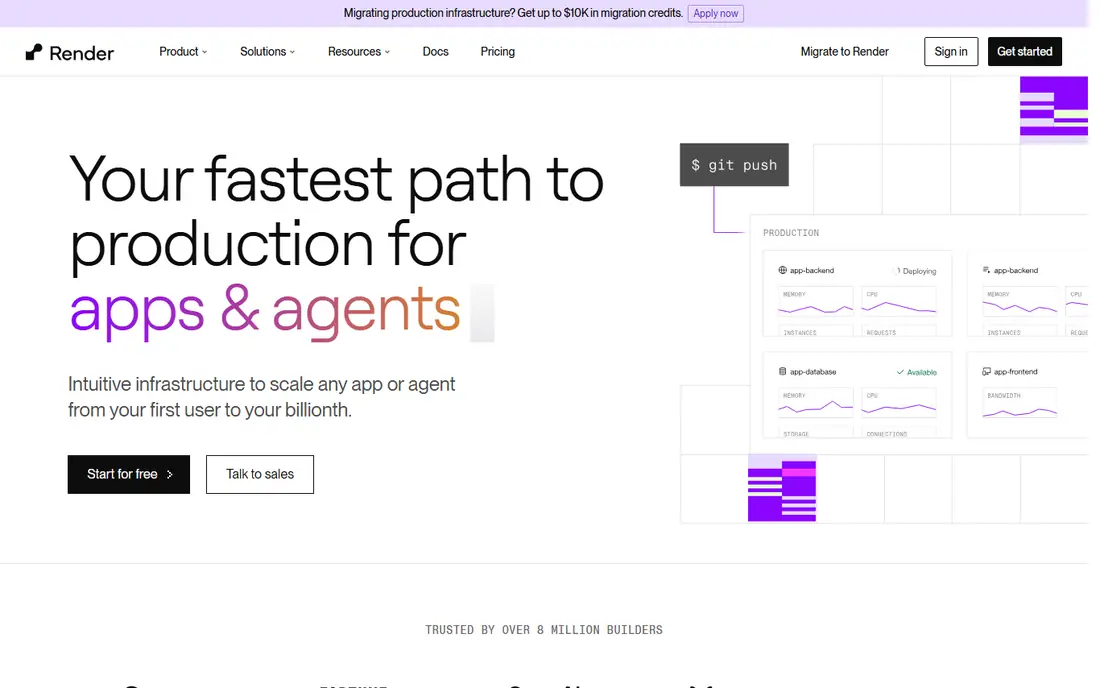
What we like- Render is the generalist most often recommended as the modern Heroku: web services in any language, background workers, cron jobs, PostgreSQL and Redis, private networking between them, and infrastructure as code in one blueprint file, deployed from git with sensible defaults throughout. Services start at 7 dollars a month for the smallest paid instance, with a free tier for web services that spins down when idle. The dashboard explains itself to developers who have never touched a cloud console, and the platform handles the certificates, scaling and deploys without an operations hire.
Watch out for- Free tier services sleep after inactivity and wake slowly, which rules them out for anything a customer touches. Cold starts and CPU limits on small instances appear under real load, and costs climb instance by instance at scale until a cloud bill comparison becomes worthwhile. Region choice is narrower than Fly.io's global spread. Databases on the free tier expire, a trap for the unwary side project. None of this dims its position: for most small products, Render is the least regret per dollar in this list.
#4Railway
Best for: Fast deploys with usage based pricing4.7/5 on
G2 (66 reviews, checked Oct 2026)
Visit railway.com
Starting price$5 per month
Free planNo
What we like- Railway made deployment feel like a sketchpad: drop in a repository, a Docker image or a database from its template gallery, watch it deploy in seconds, and wire services together on a visual canvas that developers genuinely enjoy. Pricing is usage based on top of a plan, with the Hobby tier at 5 dollars a month including a usage allowance, so idle side projects cost little and busy services pay for what they consume. It suits prototypes, internal tools, bots and small products better than almost anything here, and its templates, one click databases, queues and apps, remove whole afternoons of setup.
Watch out for- Usage based pricing cuts both ways: a runaway process or a traffic spike writes its own bill, and cost forecasting for a growing product is harder than on flat instance pricing. There is no free plan beyond an initial trial credit, a change from its earlier generosity. Enterprise features, compliance certifications and support depth trail the bigger platforms. Per project organisation quirks appear as teams grow. Railway is a joy at small scale and a pricing conversation at large scale.
#5
Fly.io
Best for: Containers close to users, worldwide
Visit fly.io
Starting priceSee website
Free planNo
What we like- Fly.io runs your application as lightweight virtual machines in data centres around the world, close to your users, from a Dockerfile or a range of framework scanners: real processes with real filesystems and persistent volumes, WebSockets and long lived connections welcome, scaled per region. That makes it the answer for latency sensitive apps, game servers, Phoenix and Rails applications with live features, and anything serverless shapes mangle. Pricing is pay for the machines and resources you run, listed by size and region on its site, so we mark see website
- A small app can cost a few dollars a month and the meter is always visible.
Watch out for- There is no free plan, and the model asks more of you than the push button platforms: regions, volumes and machine sizing are decisions, and the learning curve shows it. Billing by consumption means misconfiguration costs money quietly. Operational sharp edges, networking and storage concepts, reward experienced developers and punish a first deployment attempted on a deadline. Fly.io is the connoisseur's platform in this list: unmatched when location and real machines matter, more machine than a blog needs.
#6DigitalOcean App Platform
Best for: Apps in the DigitalOcean ecosystem4.6/5 on
G2 (757 reviews, checked Oct 2026)
Visit digitalocean.com
Starting price$5 per month
Free planNo
What we like- DigitalOcean's App Platform deploys from git to managed containers with components for web services, workers, static sites and databases, starting at 5 dollars a month for the smallest containers, inside the cloud many small teams already use for droplets and managed databases. The attraction is consolidation: one vendor, one bill, predictable component pricing, and a path to graduate parts of the stack onto DigitalOcean's other services when the platform's limits appear. Documentation is clear and the platform is stable and unfashionable in the good way.
Watch out for- Feature pace and polish trail Vercel and Render: deploy speeds, preview workflows and the developer experience details are a step behind. The region and scaling options are narrower than Fly.io's. There is no free tier beyond static site allowances in some plans. If you are not already in DigitalOcean's world, there is seldom a reason to choose it over Render
- If you are, there is seldom a reason to leave for a deployment feature alone.
Starting price$5 per month
Free planNo
What we like- Heroku invented this category and its model remains the clearest: applications run in dynos, containers with a size and a price, deployed by git push, scaled by a slider, with an add on marketplace covering databases, queues, monitoring and everything else, and two decades of tutorials answering every question a beginner can type. Eco dynos at 5 dollars a month cover hobby scale work that sleeps when idle
- Basic at 7 dollars stays awake. For teaching, prototypes and small internal tools where developer time costs more than hosting, the model still justifies itself daily.
Watch out for- The free tier ended in 2022 and the platform's momentum ended earlier: pricing per dyno makes real products expensive fast, performance per dollar trails every rival here, and Salesforce's stewardship has been quiet enough that the community treats Heroku as legacy. Region choice is limited, modern features arrive slowly, and new projects choosing it in 2026 are choosing familiarity over future. It belongs in this list because thousands of apps still run on it and its model explains the category
- It is rarely the right new home.
How we chose
We compared the deployment platforms developers actually choose between in October 2026 for web applications, and required each to deploy from a code repository with managed infrastructure, no server administration as the price of entry. Pricing is the entry paid figure or the model's shape where usage decides, and free tiers are described as they now are, not as they were in older reviews, since Heroku's ended and others tightened. We weighted the shape of the workload, frontend, full stack, global, stateful, over feature checklists, because choosing the wrong shape costs more than any missing feature, a lesson every entry's cons section repeats in its own accent.
How to choose the right deployment service
Match the platform to the app's shape first. A Next.js or frontend application goes to Vercel; a static or content site to Netlify; a conventional full stack app with a database and a worker to Render; a prototype or a pile of small services to Railway; an app that must run near users or hold connections open to Fly.io; an estate already on DigitalOcean stays there. Heroku is for the apps already on it and the teams who value its simplicity knowingly. Everything else is details, and the details to check are the bill cliffs: bandwidth on Vercel and Netlify, instance count on Render, usage spikes on Railway and Fly.io.
Then run the second year test in your head. At ten times the traffic, what does this platform cost, and what breaks first, technically and financially? Platforms are easy to join and annoying to leave once pipelines, previews and databases are woven in, so the exit question, can I take my data and my deploy process elsewhere in a weekend, deserves asking while the answer is still cheap. Finally, keep one principle from the server era: own your domain, keep your database exportable, and never let a platform's convenience features become the only copy of anything.
Frequently asked questions
Which deployment service is best for a first web app?
Render, for most first apps: it takes a repository and a database, deploys both, explains itself, and costs 7 dollars a month at the smallest serious tier, with a free tier for learning that sleeps when idle. If the app is a Next.js project specifically, Vercel's free tier and previews teach the modern workflow best. Railway suits a first prototype when speed of trying ideas matters more than predictable bills. Choose the one matching your stack's shape and spend the saved operations time on the app itself.
Are free tiers still usable for real projects?
For personal projects and portfolios, yes: Vercel and Netlify free tiers run real sites comfortably within their terms, noting Vercel's Hobby tier bars commercial use. Render's free web services sleep and its free databases expire, which limits them to experiments. Heroku and Fly.io have no free tiers, and Railway works from trial credit into a 5 dollar plan. The pattern across the industry is free for learning, paid for production, and a 5 to 7 dollar monthly tier is the honest floor for an app customers rely on.
How much does it cost to host a small SaaS on these platforms?
A realistic small SaaS, one web service, one database, a worker, on Render or Railway typically lands between about 20 and 75 dollars a month all in at the early stage, depending on instance sizes and usage. Vercel based stacks price by seats and usage and commonly land in a similar range until bandwidth grows. The figure to fear is not the start but the slope: model the cost at ten times your current usage from each vendor's pricing page before the launch that creates it, because migration mid growth is the expensive version of this decision.
When should an app leave these platforms for AWS or another cloud?
When the monthly bill passes the cost of the engineering time to run the alternative, when you need infrastructure these platforms do not offer, unusual networking, compliance postures, specific regions, GPU or very large data, or when scaling limits bite in production. Many companies never leave, paying the platform premium as an operations salary they did not have to hire. The trigger is usually a specific bill or a specific outage of capability, not a stage of funding, and moving the stateless parts first while keeping the platform for previews is a legitimate permanent answer.
What is the difference between serverless platforms and container platforms here?
Vercel and Netlify run your code as functions that start on demand and stop when idle, scaling automatically and charging per use, with limits on execution time and no persistent local state. Render, Fly.io, DigitalOcean and Heroku run containers or machines continuously: your process stays alive, holds connections and files, and you pay for its size whether or not requests arrive. Long lived work, WebSockets, background processing and predictable latency favour containers; spiky, stateless, frontend adjacent work favours serverless. Many real products end up using one of each, which the vendors' integrations quietly assume.
Sources we checked (0)
Is your product missing or out of date?
We review this list regularly. Vendors can request a listing, send updated pricing or ask about featured placement.

Shihab Mia · Founder, Rankite
Shihab has 5+ years in B2B and SaaS SEO. He writes Rankite's software buying guides from pricing pages, documentation and public user reviews. More about Shihab.