How we make this list: we compare pricing pages, product documentation and public user reviews. Rankite is independent; if a vendor ever pays for a featured spot, that listing is clearly labeled Partner.
Key takeaways
- If map-pack rankings drive your revenue, a geo-grid checker like Local Falcon tells you more than any national rank tracker.
- AccuRanker wins on refresh speed, SERPRobot wins on price, and the big suites win on convenience for teams already paying for them.
- Weekly ranking updates are fine for quarterly trend reports and useless the morning after a core update lands.
- Count your real keyword volume before comparing prices: most entry plans jump in cost fast once you pass the base tier.
Quick comparison
| Tool | Best for | Starting price | Free plan |
|---|
 Local Falcon Local Falcon | local businesses that live or die on Google Maps rankings | $24.99/month (Starter, 7,500 scan credits) | No (100 bonus scan credits on signup) |
 AccuRanker AccuRanker | agencies that need on-demand ranking refreshes | $224/month (Professional, 2,000 keywords) | Free trial (14 days) |
 Wincher Wincher | small teams that want simple daily tracking | $49/month (Basic, from 500 keywords) | Free trial |
 Nightwatch Nightwatch | teams that want postcode-level local precision | $32/month (250 daily tracked keywords) | Free trial (14 days) |
 SERPWatcher by Mangools SERPWatcher by Mangools | bloggers and small sites that also need keyword research | $49/month (Basic; $29.90/month billed annually) | Free trial (10 days) |
 ProRankTracker ProRankTracker | agencies reporting across languages, devices and search engines | $99/month (Starter; $89/month billed annually) | Paid trial ($5) |
 SERPRobot SERPRobot | solo site owners who only need positions and nothing else | $4.99 per bot per month (75 keyword checks per day) | Yes (free on-demand checker) |
 WhatsMySERP WhatsMySERP | beginners who want free daily rank tracking | $5/month (premium) | Yes |
 Ahrefs Rank Tracker Ahrefs Rank Tracker | teams already paying for Ahrefs | $129/month (Lite plan, 750 tracked keywords) | No |
 Semrush Position Tracking Semrush Position Tracking | teams that want rank data inside a full marketing suite | $139/month (SEO plan, 500 keywords tracked daily) | No |
Is your product missing or out of date?
We review this list regularly. Vendors can request a listing, send updated pricing or ask about featured placement.
Starting price$24.99/month (Starter, 7,500 scan credits)
Free planNo (100 bonus scan credits on signup)
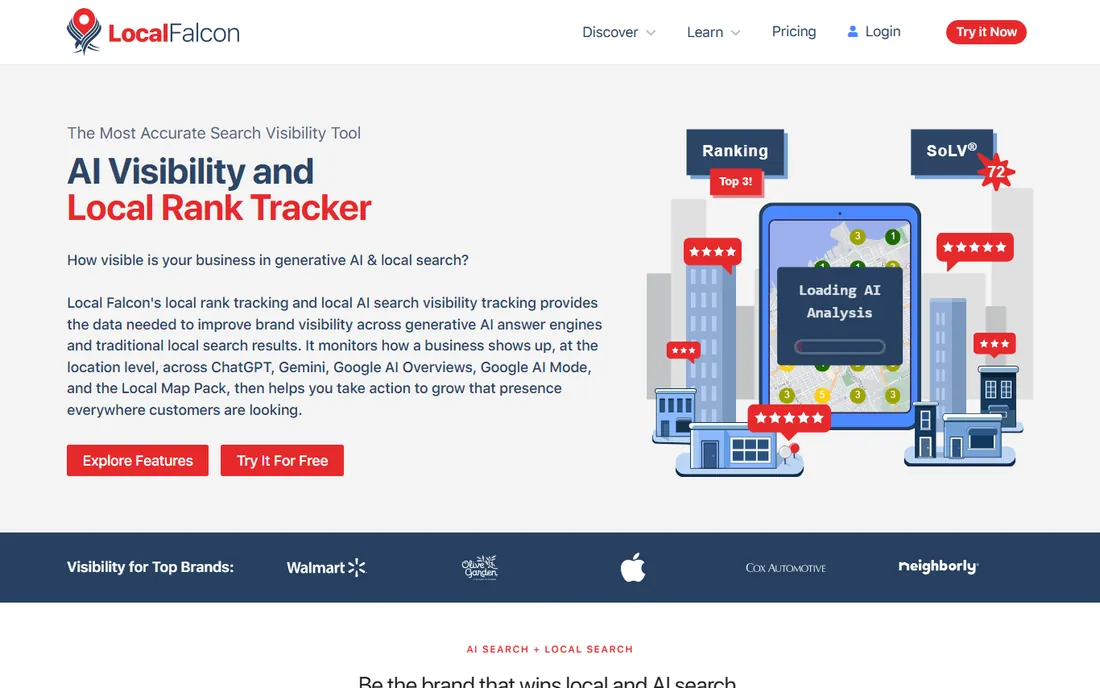
Your national tracker says the client ranks fine, but the phones stopped ringing. That is the exact gap Local Falcon fills. It drops a customizable pin grid over the service area, runs searches from real GPS coordinates, and shows a color-coded heat map of where the business actually appears in the map pack, block by block. Its SoLV metric condenses the grid into one number for the top three map positions, and the newer SAIV score tracks AI assistant recommendations across the same area.
Pricing is credit-based: one credit buys one grid point for one keyword, and the Starter plan at $24.99 a month includes 7,500 credits. Large grids across many keywords eat credits quickly, so model scan patterns before committing. New accounts get 100 bonus credits to test with.
What we like- Fastest geo-grid scans in the category
- SoLV and SAIV metrics
- Apple Maps tracking
Watch out for- Credit-based pricing punishes big grids
- No national organic rank tracking
Starting price$224/month (Professional, 2,000 keywords)
Free planFree trial (14 days)
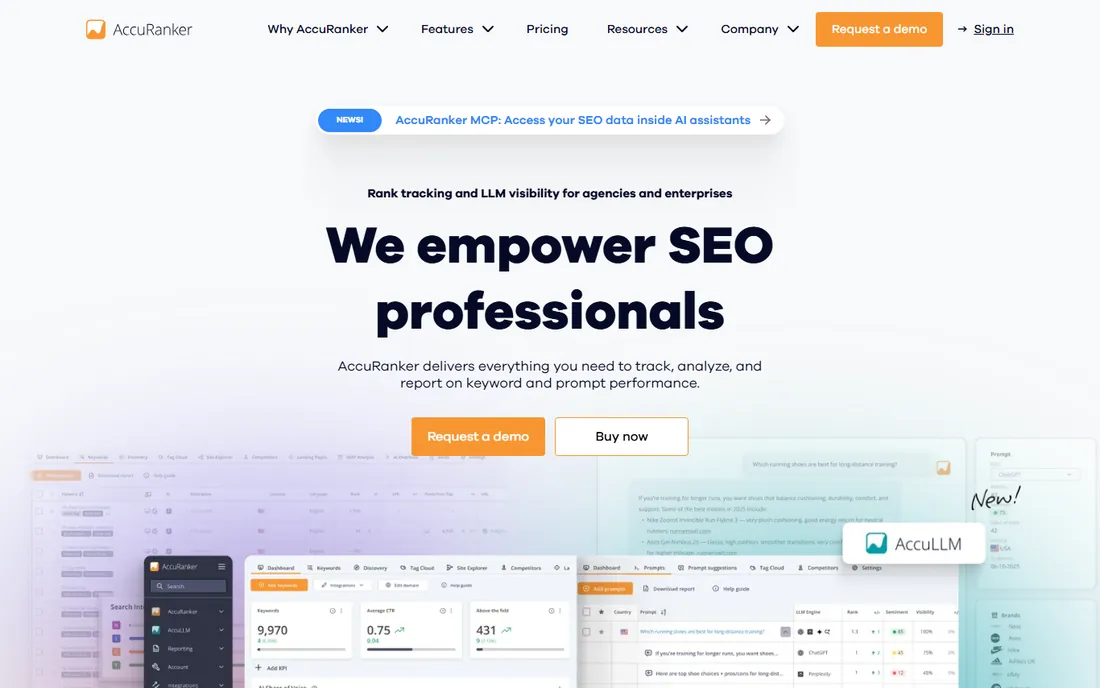
AccuRanker does one job, rank tracking, and does it faster than anyone else here. Every plan updates daily, and you can force an on-demand refresh whenever a client calls about a drop, which is the feature agencies cite most when they justify the price. All features are included on every plan; you pay by keyword volume, from $224 a month for 2,000 keywords on Professional, with 10 percent off annual billing.
The honest math is that this is a premium tool for a single function. There is no keyword research beyond a basic tool, no site audit and no backlink data, so most teams run a second subscription alongside it. Expert adds AI CTR estimates, Looker Studio integration and an unlimited read API. If refresh speed at scale is the job, nothing here beats it.
What we like- On-demand updates no other tracker matches
- Unlimited domains and users
- Full SERP feature coverage
Watch out for- Highest entry price on this list
- Rank tracking only, no research or audit tools
Starting price$49/month (Basic, from 500 keywords)
Free planFree trial
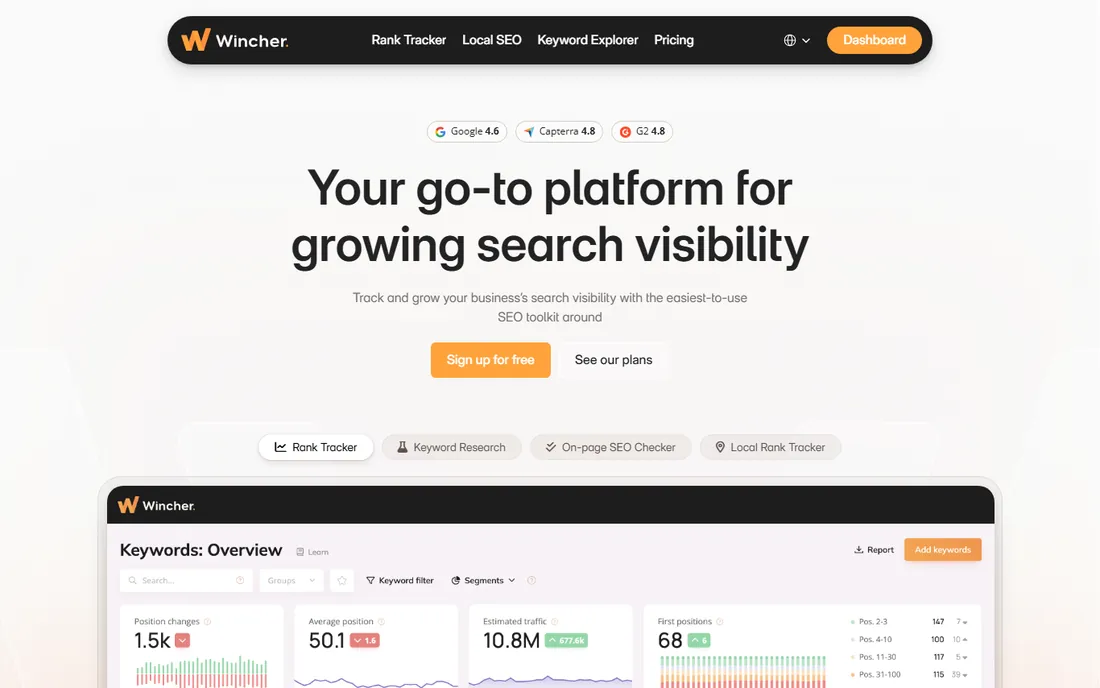
Wincher is the tracker you buy when you want rankings checked daily without learning a platform. The interface is deliberately plain: add a site, add keywords, get positions with movement arrows and scheduled reports. Basic starts at $49 a month for 500 keywords across up to 10 websites, Standard at $89 covers 1,000 keywords with unlimited websites and multiple users, and Professional at $319 covers 5,000.
Two limits deserve attention before you buy. Basic allows only one user seat, so any team with two people reporting is really shopping for Standard, and on-demand ranking updates start at Standard. Competitor tracking is capped at 5 per site on Basic and 10 on Standard.
What we like- Clean interface anyone learns in an afternoon
- Competitor tracking
- WordPress and Yoast integrations
Watch out for- Single user seat on Basic
- No on-demand updates on the entry tier
Starting price$32/month (250 daily tracked keywords)
Free planFree trial (14 days)
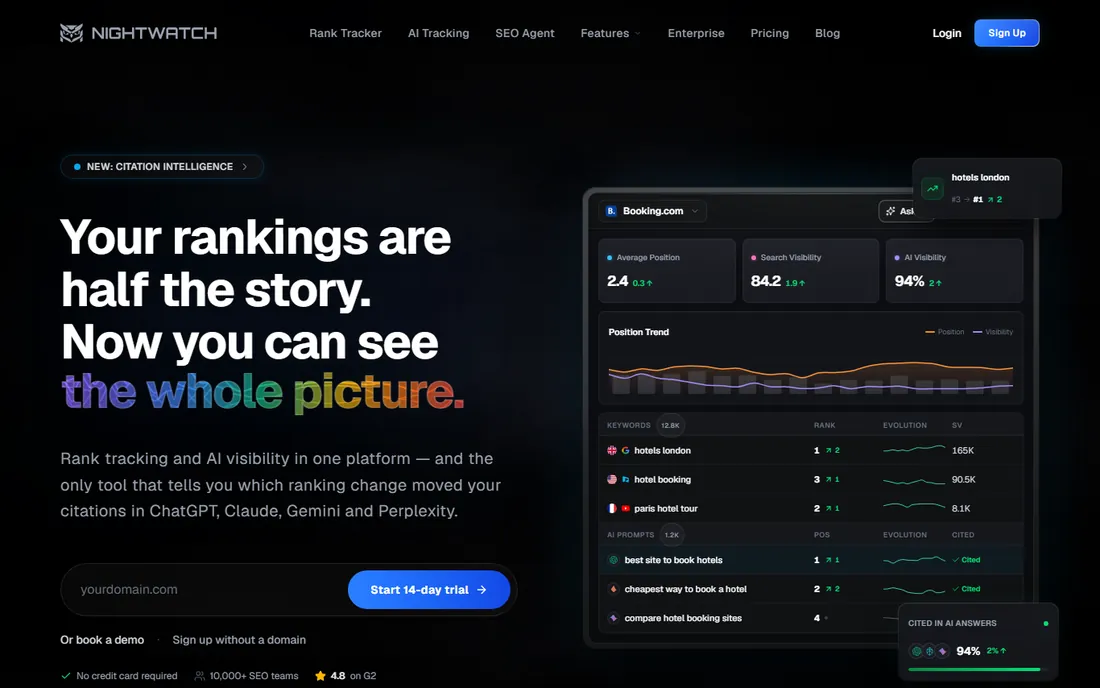
Nightwatch built its reputation on location precision. It tracks rankings across more than 100,000 locations worldwide down to ZIP-code level, which matters when a client ranks number one on desktop in one neighborhood and fourteenth on mobile two miles away. Its 2026 updates added AI search visibility monitoring across ChatGPT, Google AI Mode and AI Overviews, plus SERP feature detection. Every plan includes unlimited users.
The pricing picture has some moving parts. Paid plans start at $32 a month for 250 daily keywords, while higher tiers are quoted in euros, so US buyers should budget for conversion. A 14-day trial needs no credit card. The keyword research and site audit modules exist but are lighter than the tracker, so buy Nightwatch for ranking data, not as an all-in-one.
What we like- 100,000 plus tracking locations with ZIP-code accuracy
- AI search visibility tracking
- Unlimited seats on every plan
Watch out for- Higher tiers bill in euros
- Site audit and research tools are thin
#5
SERPWatcher by Mangools
Best for: bloggers and small sites that also need keyword research
Visit mangools.com
Starting price$49/month (Basic; $29.90/month billed annually)
Free planFree trial (10 days)
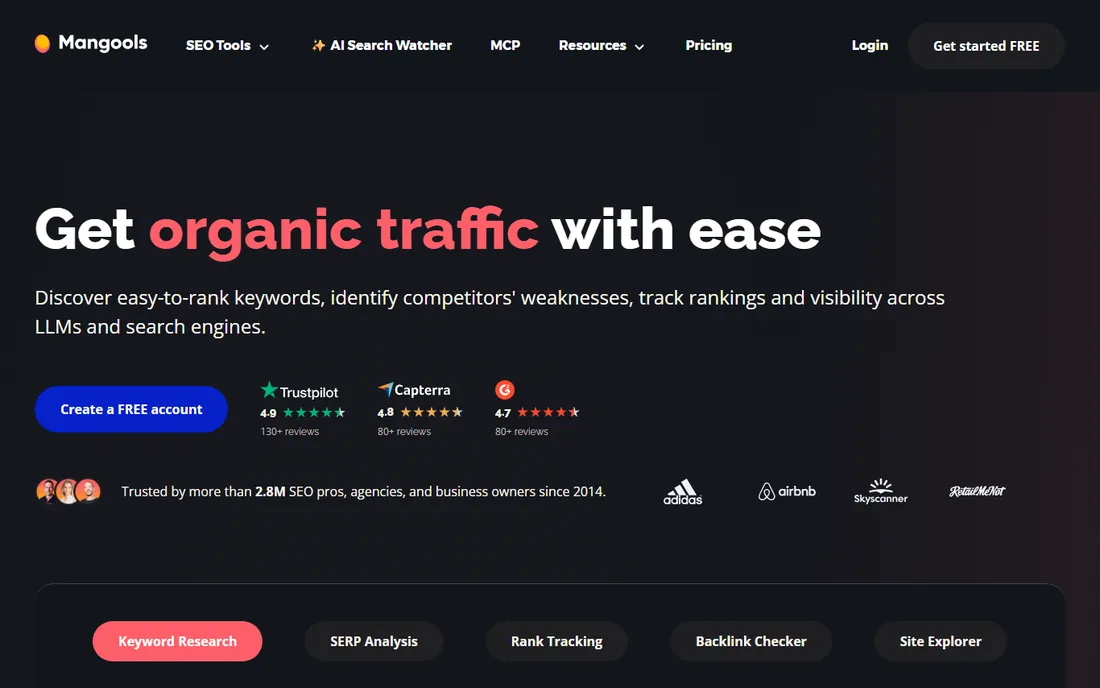
SERPWatcher is the rank tracker inside the Mangools suite, and its appeal is the bundle. Every plan includes all five Mangools tools plus the AI Search Watcher, so the same subscription that tracks your rankings also researches keywords, analyzes SERPs and checks backlinks. The standout metric is the Visibility Index, a single score for overall ranking health.
The catch is update cadence. Basic at $49 a month ($29.90 billed annually) and Premium at $69 ($44.90 annual) update rankings weekly, with daily updates reserved for the Agency plan at $129 ($89.90 annual). Tracked keyword allowances run 200, 700 and 1,500 across the tiers. For monthly reporting, weekly is fine. For reacting to movement quickly, it is a real limit.
What we like- Bundled with KWFinder, SERPChecker, LinkMiner and SiteProfiler
- Visibility Index condenses health into one score
Watch out for- Weekly updates on Basic and Premium
- Only 200 tracked keywords on Basic
Starting price$99/month (Starter; $89/month billed annually)
Free planPaid trial ($5)
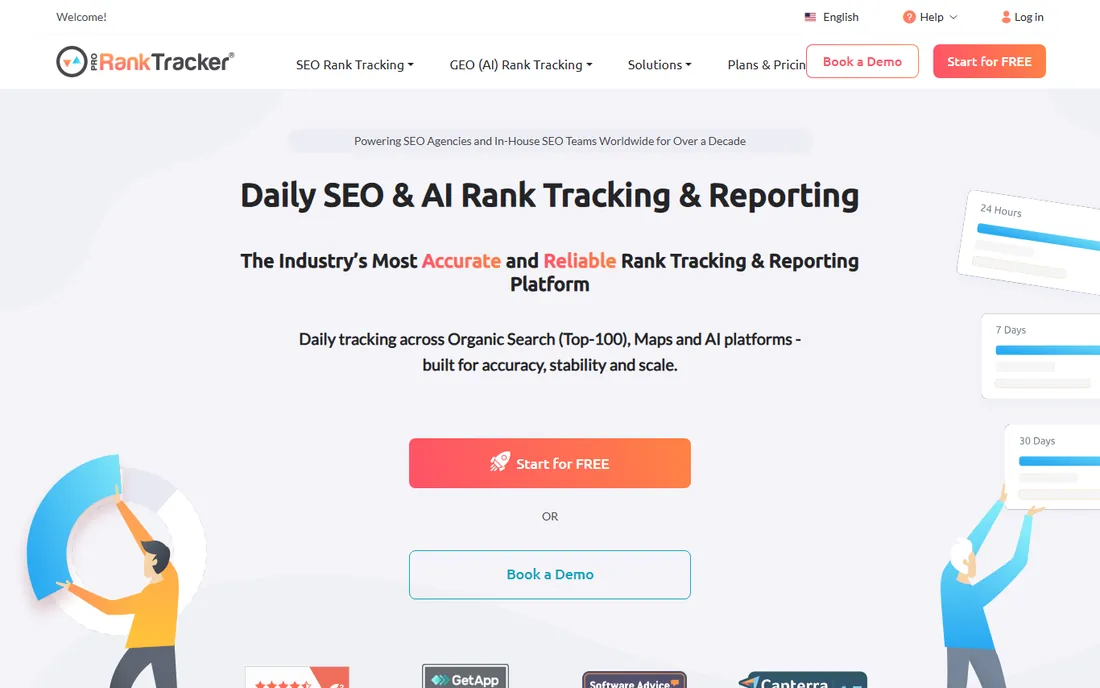
ProRankTracker is built for agencies that live in client reports. It tracks Google plus YouTube, Bing and Yahoo, splits mobile and desktop, covers the local map pack, and feeds white-label reports and a MyRanks client portal on the Pro tier and above. The Starter plan runs $99 a month ($89 billed annually) for 1,000 terms, Pro $149 ($134 annual) for 2,000, and Agency tiers scale from $199 to over $1,000 for 3,000 to 20,000 plus terms, with full API access on Agency.
The pricing unit is the "term," one organic keyword combination, and AI prompt tracking consumes two terms each, so translate your keyword list into terms before comparing with per-keyword competitors. There is no free plan; the trial costs $5 for 7 days.
What we like- YouTube, mobile and desktop splits
- MyRanks client portal
- Looker Studio integration
Watch out for- Term-based pricing needs translation
- AI tracking costs two terms per prompt
#7
SERPRobot
Best for: solo site owners who only need positions and nothing else
Visit serprobot.com
Starting price$4.99 per bot per month (75 keyword checks per day)
Free planYes (free on-demand checker)
SERPRobot has the strangest and simplest pricing in the category: you hire bots at $4.99 each per month, and each bot checks 75 keywords every 24 hours. Need 300 keywords a day? Hire four bots for $19.96. The math stays linear, which is trivially cheap for a single site and less clever past a few hundred terms. A free on-demand checker handles instant one-off lookups, and a 14-day trial needs no card.
What you get is positions, movement history, basic competitor tracking and scheduled reports, across Google, Bing, Yahoo, YouTube and Google Business Profile. What you do not get is keyword research, SERP feature alerts, cannibalization detection or annotations. If rank tracking is genuinely the only thing you need, this is the cheapest path to daily data. If you already pay for Ahrefs or Semrush, their built-in trackers make this redundant spend.
What we like- Cheapest daily rank tracking anywhere
- Unlimited projects and keywords per bot
- API access included
Watch out for- Rank tracking only, no research or audits
- Costs scale linearly with volume
Starting price$5/month (premium)
Free planYes
WhatsMySERP is the rare tracker with a free tier that covers real work. The free plan includes daily rank tracking with mobile and local support across more than 100 Google regions, plus a free SERP checker and the WMS Everywhere Chrome extension that overlays volume and CPC data on Google results. Premium at around $5 a month removes limits and is still cheaper than every paid tracker on this list.
Reporting is simpler, historical depth is thinner, and the small team ships features more slowly. For a beginner, a blogger or a small business tracking its own site, though, it answers the core question, where do I rank, accurately and for free. Start here before spending money on tracking you may not need.
What we like- Free tier is genuinely usable
- Chrome extension for on-page metrics
- 100 plus Google regions
Watch out for- Thinner reporting than paid trackers
- Small team behind the product
#9
Ahrefs Rank Tracker
Best for: teams already paying for Ahrefs
Visit ahrefs.com
Starting price$129/month (Lite plan, 750 tracked keywords)
Free planNo
If you already pay for Ahrefs, you already own a rank tracker, and for many teams that is the whole argument. Rank Tracker is included on every main plan: 750 tracked keywords on Lite at $129 a month, 2,000 on Standard at $249 and 5,000 on Advanced at $449, alongside tracked AI prompts. Positions appear next to the backlink and keyword data you bought the platform for, which makes diagnosis fast.
The limitation is cadence. Ahrefs updates tracked rankings weekly on all plans, with no daily option and no on-demand refresh. Weekly suits quarterly trend lines. It is useless the morning after a core update when a client wants to know what moved. Treat it as a bonus on a platform you bought for research and links, not as the reason to buy Ahrefs.
What we like- Rankings sit next to backlink and keyword data
- Clean interface
- Competitor tracking included
Watch out for- Weekly updates on every plan
- Fewer tracked keywords per dollar than dedicated trackers
#10
Semrush Position Tracking
Best for: teams that want rank data inside a full marketing suite
Visit semrush.com
Starting price$139/month (SEO plan, 500 keywords tracked daily)
Free planNo
Semrush includes Position Tracking in every plan, which makes it the default tracker for teams already in the ecosystem. The SEO plan at $139 a month and Starter at $199 track 500 keywords daily, Pro+ at $299 covers 1,500 with multi-location and device tracking, and Advanced at $549 covers 5,000 with share of voice. Daily updates beat Ahrefs' weekly cadence, and the data sits next to PPC research, content tools and site audits.
The honest objection is scope. If rank tracking is all you need, you are paying for keyword research, backlink analytics, social tools and more that you will never open. At 500 keywords the SEO plan costs more per tracked keyword than Wincher or SERPRobot. Buy this when the suite earns its keep across several jobs; buy a dedicated tracker when rankings are the only job.
What we like- Daily updates on every plan
- Share of voice and multi-location on higher tiers
- Deep PPC and content data alongside
Watch out for- You pay for a whole suite to get a tracker
- Keyword allowances jump in price between tiers
How we chose
We looked for tools that check real Google rankings for end users today and verified each against its pricing page and recent reviews on G2, Capterra and Reddit. The list mixes dedicated trackers, a geo-grid specialist and the suites' tracking modules, because that is how buyers choose. Prices were checked in October 2026; confirm on the vendor page before you buy.
The mistakes that waste money on rank trackers
The most expensive mistake is buying keywords you never look at. Teams routinely pay for 2,000-keyword plans while reporting on 300 terms, because the plan ladder made the bigger tier feel safer. Audit your actual tracked list first: drop dead pages, consolidate near-duplicate terms and separate the money keywords that deserve daily checks from the vanity terms that do not.
The second mistake is paying for cadence you do not use. Daily updates cost more than weekly everywhere, and they are worth it only if someone acts on movement within days. If your reporting cycle is monthly and nobody checks the dashboard between reports, a weekly tracker plus a cheaper plan leaves money on the table every month.
The third is ignoring the location question. A national tracker averaging positions across the US will tell a plumber in Austin nothing useful about the map pack their customers actually see. Local businesses should budget for a geo-grid tool or a tracker with real local precision, even if the sticker looks higher, because the national number is not just incomplete, it is misleading.
What to check before you buy a SERP checker
Start with update frequency and whether you can force a refresh. Daily is the standard for paid trackers, weekly is common on budget tiers, and on-demand refresh is a premium feature that matters exactly when a client is panicking. Ask what "daily" means in practice too: some trackers check at a fixed time, others let you schedule the window.
Next, check location and device granularity. Country-level tracking is fine for national ecommerce; local businesses need city or ZIP-code precision and a separate mobile/desktop split, because mobile and desktop positions diverge more than most reports admit. Confirm which search engines are covered if you care about Bing, YouTube or Apple Maps.
Finally, read the limits that are not the keyword count. Seats, projects, competitors per site, report branding and API access all sit on different tiers at different vendors, and the plan that fits your keyword count may not fit your team. Check the contract terms as well: most trackers bill monthly with annual discounts, historical data retention varies, and canceling mid-cycle usually means losing the remaining days.
Frequently asked questions
How often should a SERP checker update rankings?
Daily is the right default for active SEO work, since it catches drops within a day and gives clean trend lines. Weekly suits monthly reporting cycles and costs less. On-demand refresh, offered by AccuRanker and some higher tiers elsewhere, matters when you need an answer right now, such as the morning after a Google update or a site migration.
Can a free SERP checker be accurate?
Yes, for the core job. WhatsMySERP and SERPRobot's free checker pull real ranking data, and their accuracy on simple position checks is fine. What free tools lack is depth: scheduled history, alerts, competitor tracking and reporting. Accuracy is rarely the reason to upgrade; workflow features are.
Do I need a separate tracker if I already pay for Ahrefs or Semrush?
Probably not for basic needs. Both include rank tracking, Semrush updates daily and Ahrefs weekly. A dedicated tracker earns its place when you need on-demand refreshes, geo-grid maps, deeper local precision, client portals or white-label reporting that the suites do not offer or gate behind higher tiers.
What is a geo-grid rank checker and do I need one?
A geo-grid checker like Local Falcon scans rankings from many GPS points across a service area and draws a heat map, showing how map-pack positions change block by block. You need one if local customers find you through Google Maps, which covers most plumbers, dentists, restaurants and home services. National businesses can skip it.
Why do tracked keywords cost different amounts on different tools?
Because "one keyword" is not a standard unit. Some vendors count each keyword-location-device combination separately, some count terms, and SERPRobot-style tools count daily checks. Always translate the plan into your real list, locations times devices times keywords, before comparing prices, or the cheapest sticker can double at checkout.
Sources we checked (10)
- https://localfalcon.com/pricing
- https://www.spotsaas.com/blog/best-rank-tracker-tools
- https://www.technori.com/2026/09/26899-best-rank-tracker-tools-2026/kate/
- https://nightwatch.io/blog/10-best-keyword-rank-trackers/
- https://zutrix.com/guides/accuranker-alternatives
- https://ciroapp.com/software/accuranker
- https://www.digitalmarketingcommunity.com/tools/whatsmyserp/
- https://gauravtiwari.org/serprobot/
- https://www.smashingapps.com/serprobot-review/
- https://distribb.io/blog/seo-rank-tracker
Is your product missing or out of date?
We review this list regularly. Vendors can request a listing, send updated pricing or ask about featured placement.

Shihab Mia · Founder, Rankite
Shihab has spent more than a decade helping SaaS and e-commerce brands grow through search. He writes Rankite's software buying guides from pricing pages, documentation and public user reviews. More about Shihab.