How we make this list: we compare pricing pages, product documentation and public user reviews. Rankite is independent; if a vendor ever pays for a featured spot, that listing is clearly labeled Partner.
Key takeaways
- Dedicated rank trackers price by keyword volume: expect roughly $29 to $139 per month for 1,000 to 2,000 tracked keywords.
- AccuRanker (from $129 per month) remains the premium dedicated tracker, while Nightwatch (from $39) and Zutrix (from $29) undercut it substantially.
- If you already pay for Ahrefs or Semrush, their built-in rank trackers may be enough; buy a dedicated tool only when tracking is the core job.
- AI search visibility (ChatGPT, Perplexity) is the new must-check feature; Nightwatch and ProRankTracker now include it.
- Daily updates, local precision, and SERP screenshots are the three features that separate serious trackers from basic ones.
Quick comparison
| Tool | Best for | Starting price | Free plan |
|---|
 AccuRanker AccuRanker | Premium dedicated tracking | From $129 per month (1,000 keywords) | Free trial (14 days) |
 Advanced Web Ranking Advanced Web Ranking | High-volume international tracking | $139 per month | Free trial |
 Nightwatch Nightwatch | Agencies, traditional plus AI search | From $39 per month | Free trial |
 SE Ranking SE Ranking | Tracking inside a full SEO suite | From $129 per month (Core, 2,000 keywords daily) | Free trial (14 days) |
 Ahrefs Ahrefs | Tracking bundled with research | From $29 per month (Starter, 50 keywords) | No (free tools) |
 Zutrix Zutrix | Budget geo-targeted tracking | From $29 per month | Free trial |
 Wincher Wincher | Simple tracking for small sites | From $39 per month | Free plan (limited) |
 Keyword.com Keyword.com | Verified accuracy with screenshots | From $16 per month | Free plan (limited) |
 ProRankTracker ProRankTracker | Multi-platform plus AI visibility | From $99 per month | Free trial |
Is your product missing or out of date?
We review this list regularly. Vendors can request a listing, send updated pricing or ask about featured placement.
The best seo tracking software
Rankings are still the heartbeat of SEO reporting. Clients ask where they rank, teams need to know whether last month work moved the needle, and nobody trusts a strategy without numbers attached. Google Search Console shows averages and samples; it does not show daily position changes per keyword per location, which is what you actually need to manage campaigns.
The market has split into two camps. All-in-one SEO suites (Ahrefs, Semrush, SE Ranking) bundle rank tracking with research and audits, which is economical if you use the whole suite. Dedicated trackers (AccuRanker, Nightwatch, Advanced Web Ranking) do one thing with more precision: daily updates, deeper local targeting, and better reporting. This guide covers both, because the right answer depends on whether tracking is your whole job or one feature among many.
Pricing in this category is refreshingly transparent: most vendors price by tracked keyword volume, so you can compare cost per keyword directly.
Starting priceFrom $129 per month (1,000 keywords)
Free planFree trial (14 days)
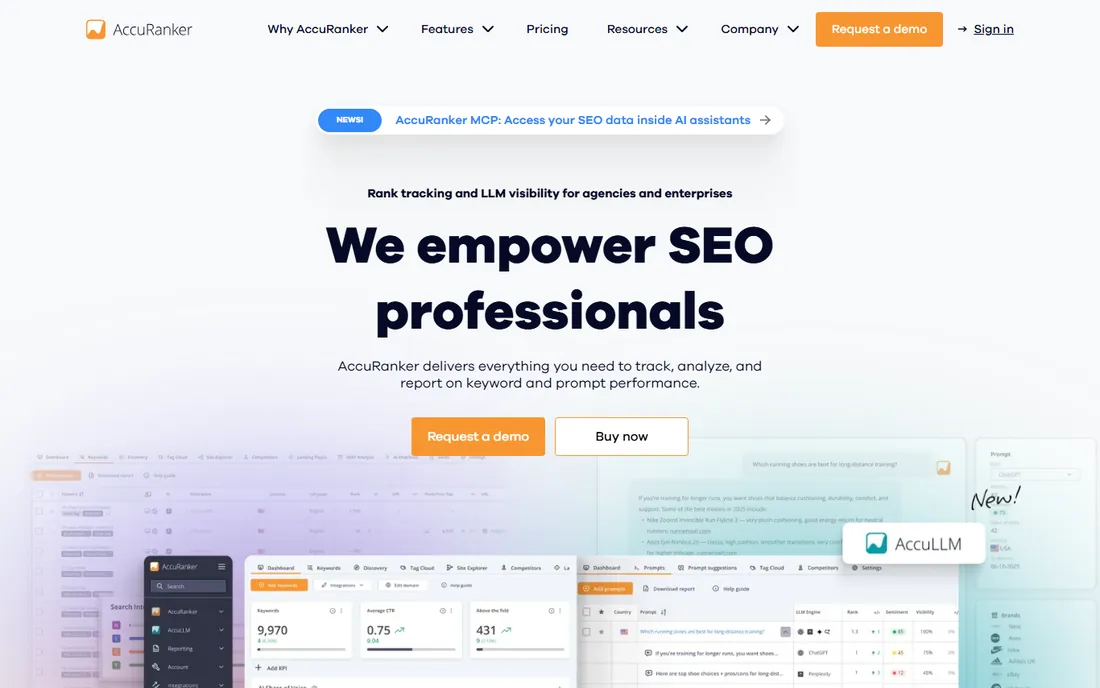
AccuRanker built its name on doing one thing extremely well: telling you exactly where you rank, every day, with data you can trust. Updates are fast, on-demand refreshes let you check positions right after a site change, and the reporting covers share of voice, SERP features, and competitor comparisons across up to ten competitors. Support for Baidu and YouTube as well as Google and Bing makes it genuinely international.
The pricing reflects the premium positioning: entry starts around $129 per month for 1,000 keywords, and costs scale with volume. Since a 2025 update, full Top 100 data refreshes biweekly while daily tracking covers the top 30, a nuance worth knowing if you track deep. For agencies and in-house teams where ranking data is the product, AccuRanker remains the benchmark dedicated tracker.
What we like- Fast daily updates with on-demand refreshes
- Tracks Google, Bing, YouTube, and Baidu
- Strong share-of-voice and SERP feature reporting
Watch out for- Entry price is high for small keyword sets
- Deeper Top 100 data refreshes less frequently than daily positions
Starting price$139 per month
Free planFree trial
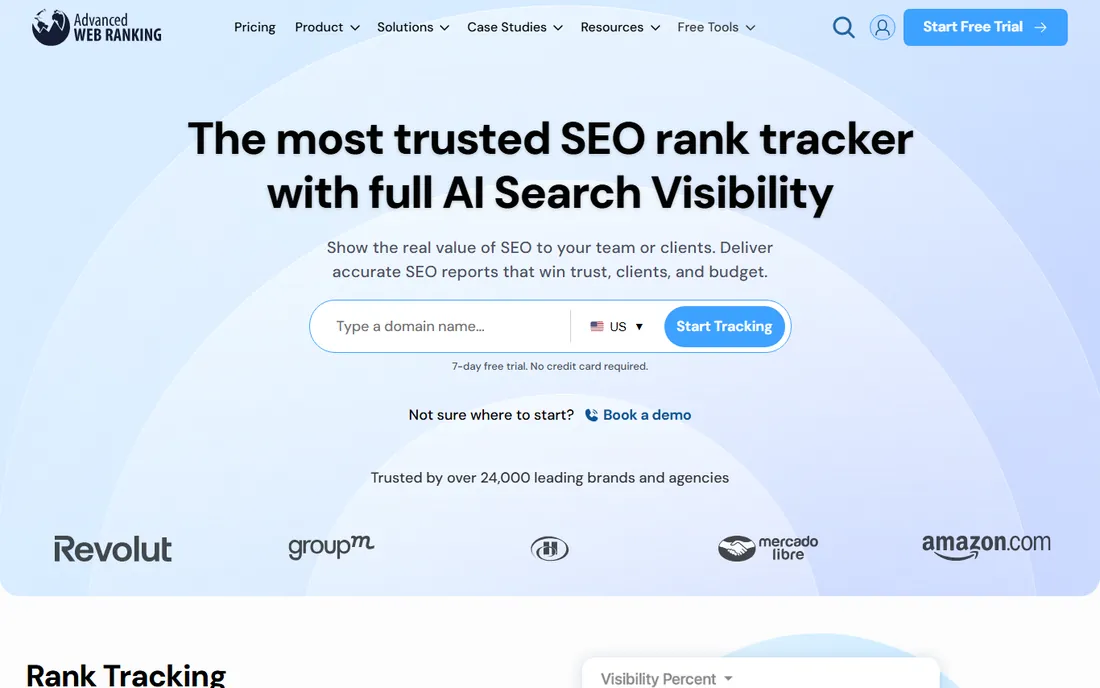
Advanced Web Ranking has been tracking rankings since 2002, and its pricing math favors volume: at higher tiers the cost per keyword drops to a couple of cents, making it one of the cheapest ways to track tens of thousands of keywords. Location coverage spans more than 4,000 locations, and both desktop software and cloud versions are available for teams with different security needs.
The trade-offs are modernity and defaults. The interface shows its age next to Nightwatch or AccuRanker, and some plans default to weekly rather than daily updates. But for enterprises and large agencies tracking massive keyword sets across many markets, the unit economics are hard to beat. If your keyword count has five digits, start your evaluation here.
What we like- Excellent cost per keyword at high volumes
- 4,000+ tracking locations
- Desktop and cloud versions available
Watch out for- Interface feels dated
- Weekly default updates on some plans
- Less hand-holding than newer tools
Starting priceFrom $39 per month
Free planFree trial
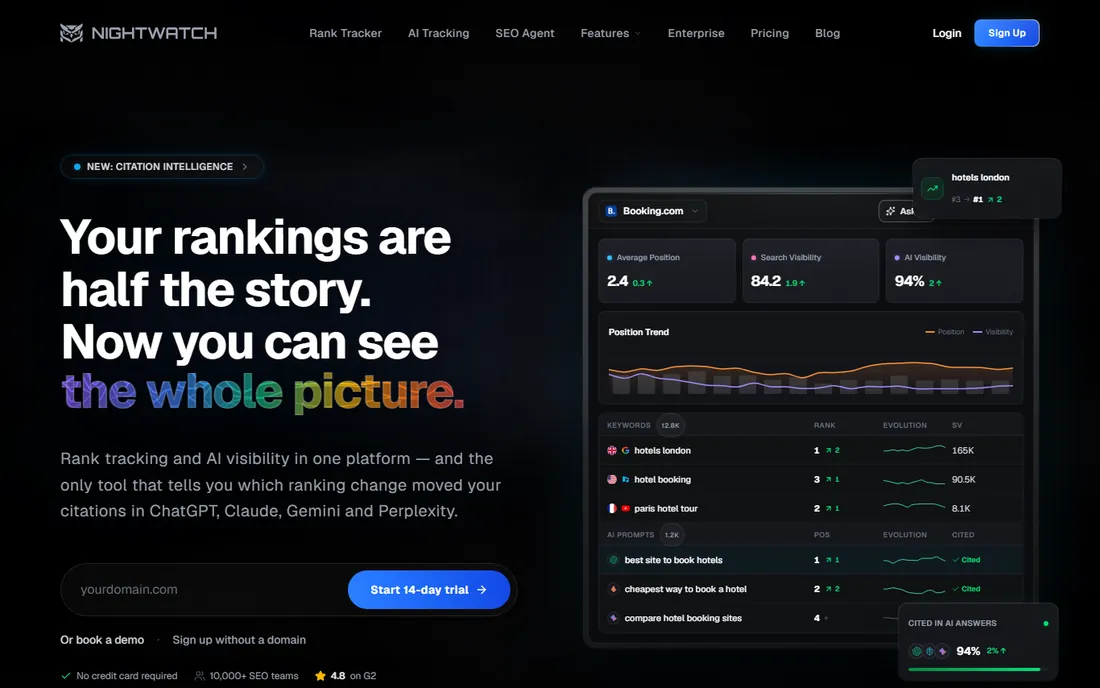
Nightwatch earned its place by combining classic rank tracking with the feature everyone started asking about in 2025: AI search visibility monitoring across ChatGPT, Perplexity, and Google AI Overviews. Local tracking reaches ZIP-code precision across more than 107,000 locations, and the interface is clean enough to share directly with clients.
At $39 per month to start, it dramatically undercuts AccuRanker while covering the modern tracking checklist. The limits appear at scale: keyword ceilings on lower tiers and restricted white-label features mean large agencies eventually graduate to bigger tools. For small to midsize agencies that need both Google rankings and AI visibility in one dashboard, Nightwatch is currently the smartest buy.
What we like- Unified traditional and AI search visibility tracking
- 107,000+ local tracking locations
- Approachable interface clients understand
Watch out for- Keyword ceilings arrive faster than on enterprise tools
- White-label and geo-precision limited on lower tiers
Starting priceFrom $129 per month (Core, 2,000 keywords daily)
Free planFree trial (14 days)
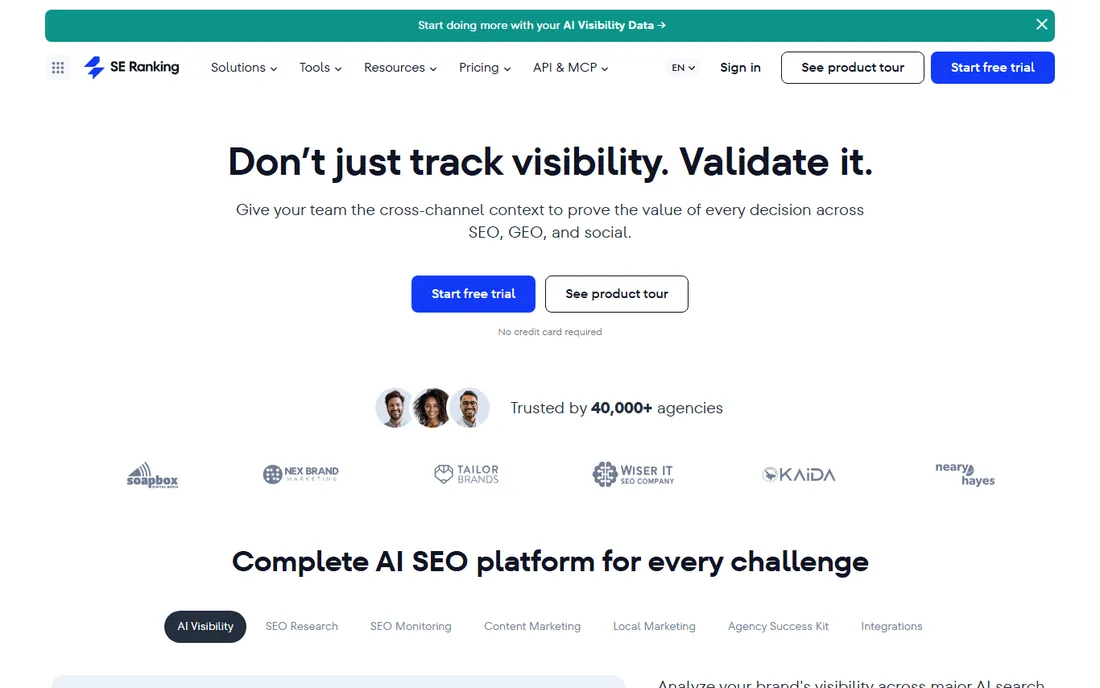
SE Ranking makes the bundle argument: for around $129 per month on Core, you get 2,000 keywords tracked daily plus keyword research, site audits, backlink checking, and white-label reporting. Bought separately, that stack would cost several times more. The per-keyword cost (about six cents at this tier) beats most dedicated trackers.
The catch is coupling: if you outgrow the tracking limits, you upgrade the whole suite, and the jump between tiers is steep. The company also restructured its plans in early 2026, so confirm current names and limits on the pricing page. For freelancers and small agencies that need the full SEO toolkit with tracking at its center, SE Ranking is the value leader.
What we like- Daily tracking bundled with research, audits, and backlink data
- Strong cost per keyword
- White-label reporting included
Watch out for- Tracking limits are tied to the suite plan
- 2026 plan restructure means verifying current tiers
Starting priceFrom $29 per month (Starter, 50 keywords)
Free planNo (free tools)
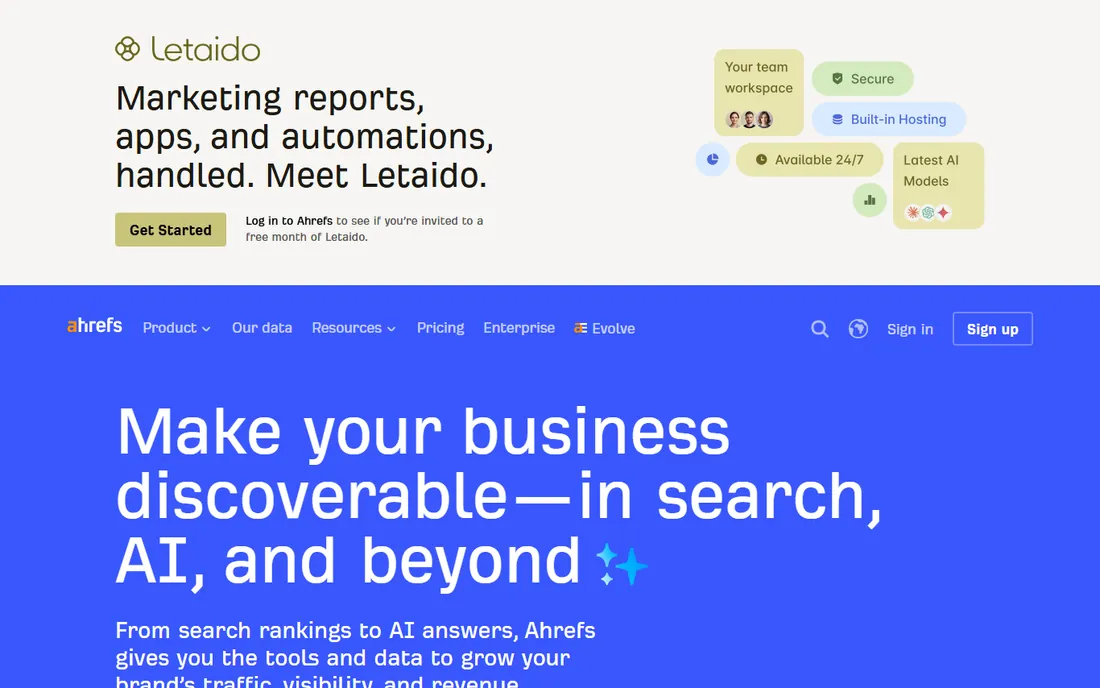
Ahrefs Rank Tracker is not the reason anyone buys Ahrefs, but it is a capable tracker riding along with the research suite. Positions update on schedules tied to your plan (weekly on lower tiers, more frequent higher up), and the integration with Keywords Explorer and Site Explorer means you can move from a ranking drop to the cause in two clicks. Starter at $29 per month includes 50 tracked keywords, which suits a single small site.
Nobody should buy Ahrefs just for rank tracking: at $249 per month for 2,000 tracked keywords on Standard, dedicated tools cost less. But if you already pay for Ahrefs for research, check whether its tracker covers your needs before adding another subscription. For many small operations, it does.
What we like- Tracking integrated with the industry deepest keyword and backlink data
- Useful competitive visibility metrics
- No separate tool to learn
Watch out for- Tracked keyword allowances are tight on lower plans
- Expensive if tracking is all you need
Starting priceFrom $29 per month
Free planFree trial
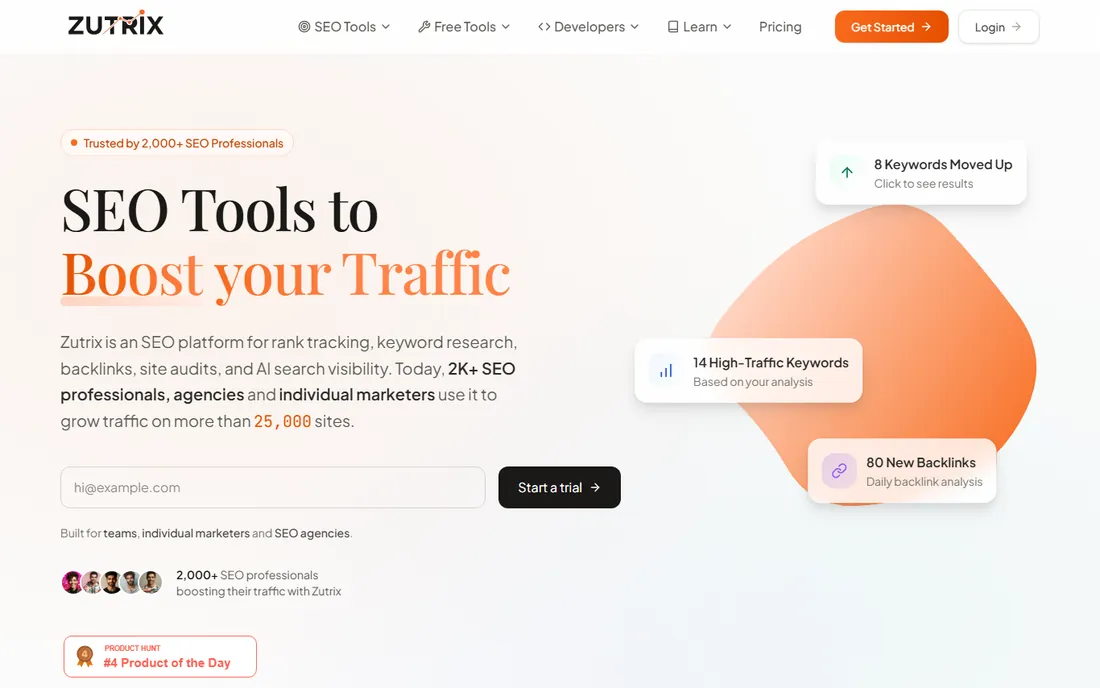
Zutrix has positioned itself as the budget alternative to AccuRanker without gutting the feature set: daily rank updates, geo-targeted tracking at city and country level, and per-keyword costs around six cents at the Agency tier ($149 for 2,500 keywords). Entry plans start near $29 per month.
The honest caveat is vendor maturity. Zutrix lacks the decade-plus track record of AccuRanker or Advanced Web Ranking, the integration ecosystem is smaller, and long-term viability matters when your reporting depends on the tool. That said, for freelancers and small agencies watching costs, the price-to-feature ratio is genuinely strong. Trial it against your current tracker on the same keyword set before switching.
What we like- Very competitive per-keyword pricing
- Daily updates
- City and country level geo-targeting
Watch out for- Smaller company with a thinner track record
- Fewer integrations than established rivals
Starting priceFrom $39 per month
Free planFree plan (limited)
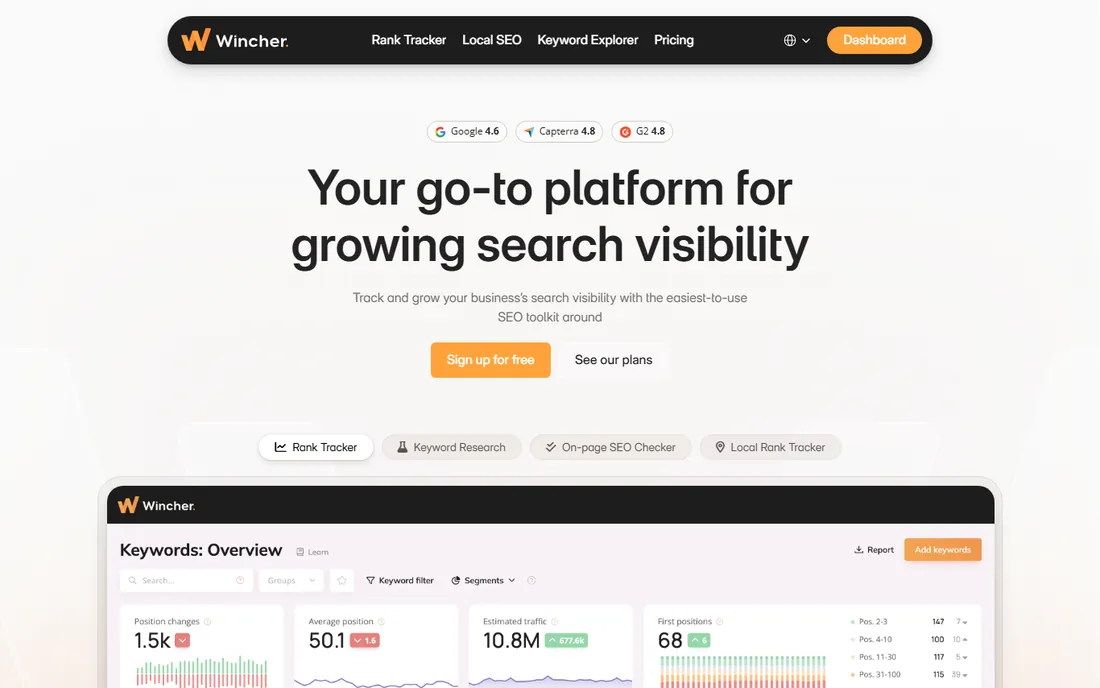
Wincher is the rank tracker for people who find rank trackers intimidating. Connect your site, add keywords, and get daily position updates in an interface with almost no learning curve. Plans start around $39 per month, and a limited free plan covers tiny keyword sets, which makes it the easiest no-risk way to start tracking.
It is deliberately not an agency tool: white-label reporting, deep local tracking, and high keyword volumes are outside its design. But for bloggers, affiliate site owners, and small businesses tracking a few hundred keywords, Wincher does exactly what is needed without the complexity or cost of bigger platforms. Sometimes the best tool is the one you will actually check.
What we like- Extremely simple setup and interface
- Free plan for very small keyword sets
- Daily updates
Watch out for- Limited advanced features
- Not built for agency scale
- Local precision is basic
Starting priceFrom $16 per month
Free planFree plan (limited)
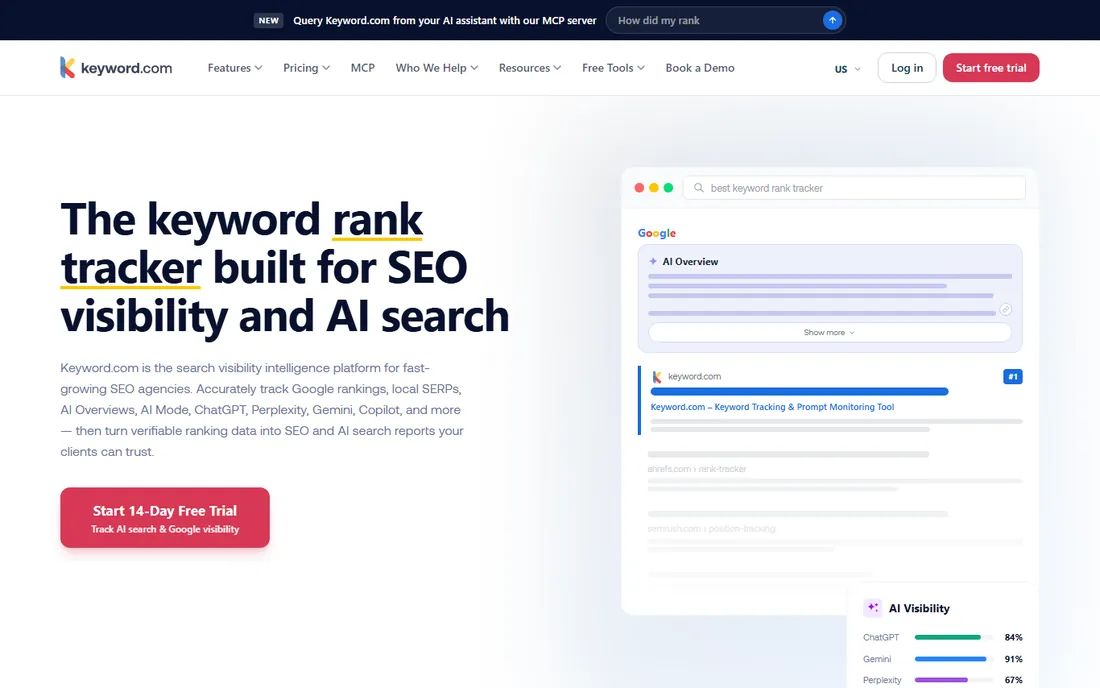
Keyword.com differentiator is proof: it captures SERP screenshots alongside ranking data, so when a client questions a position, you show them the actual search results page. That verification matters more than it sounds in agency reporting. Pricing starts around $16 per month, making it one of the cheapest daily trackers available, with a limited free plan for tiny sets.
The feature set is narrow by design: this is a rank tracker, not an SEO suite, and local tracking depth lags specialists. But narrow is fine when the job is narrow. For budget-conscious agencies that need defensible ranking reports with visual proof, Keyword.com delivers the essentials at a price competitors cannot touch.
What we like- SERP screenshots verify every ranking
- Very affordable entry pricing
- Daily tracking
Watch out for- Limited local tracking depth
- No site audit or research modules
- Smaller feature set overall
Starting priceFrom $99 per month
Free planFree trial
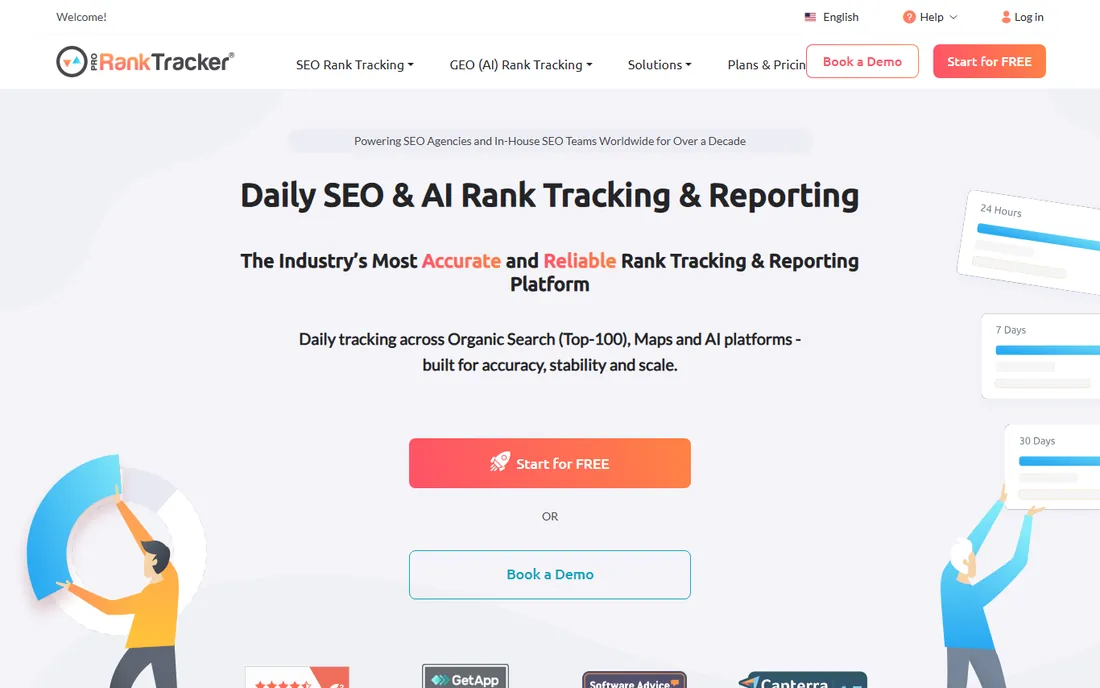
ProRankTracker serves the trackers-of-everything crowd: Google rankings, Amazon product positions, YouTube video ranks, and mobile app store positions in one dashboard. For ecommerce brands and content businesses whose visibility spans platforms, consolidating that tracking has real value. Recent additions cover AI search visibility too, and the white-label reporting is built for agencies.
Entry pricing around $99 per month sits above the budget tier, reflecting the multi-platform scope. The interface is dense, packing many data types into compact views. If your world is Google-only, simpler tools cost less. If you need to answer "where do we rank everywhere," ProRankTracker is purpose-built for the question.
What we like- Tracks Google, Amazon, YouTube, and app stores alongside each other
- AI search visibility features
- Strong white-label agency reporting
Watch out for- Higher entry price than simpler trackers
- Interface packs a lot into small spaces
How this shortlist was assembled
We selected trackers with meaningful adoption in 2026 across both dedicated and bundled categories, based on practitioner discussion, review platforms, and published tracker comparisons. Pricing was checked against vendor pricing pages and dated third-party comparisons from 2026, normalized where possible to cost per tracked keyword per month.
We weighted update frequency, local tracking precision, reporting quality, and AI search visibility support over raw feature counts. No hands-on testing was performed; this is a research-based comparison.
What to check before you buy
Start with keyword volume math. Count every keyword, location, device, and search engine combination you need, because most tools meter each combination separately: 500 keywords tracked in 10 cities on desktop and mobile is 10,000 tracked units, not 500. Price that number on two or three vendors before falling in love with any interface.
Next, verify the three features that matter most in practice: update frequency (daily versus weekly changes what you can report), local precision (country, city, or ZIP/postcode), and proof (SERP screenshots or cached results for disputed rankings). Then check reporting: white-label PDFs, scheduled email reports, and shareable dashboards determine whether the tool serves clients or just you.
Finally, confirm AI search visibility coverage if it matters to your strategy: which AI platforms are tracked, how often, and whether it costs extra. This feature is new enough that implementations vary wildly, and marketing claims outrun reality. Ask for a live demo on your own keywords.
Why AI search tracking belongs in your 2026 stack
A growing share of informational queries now gets answered by AI: ChatGPT, Perplexity, Gemini, and Google AI Overviews summarize results without the click. Traditional rank trackers cannot see this traffic, which means your reporting can show stable rankings while actual visibility erodes.
AI visibility tools track whether and how your brand appears in AI-generated answers: citation frequency, sentiment, and competitor mentions. Nightwatch, ProRankTracker, and several suites now bundle this with classic tracking. You do not need a separate AI monitoring tool yet in most cases, but you should confirm your tracker covers it. In eighteen months, reporting rankings without AI visibility will look as dated as reporting without mobile does today.
Frequently asked questions
How many keywords should I track?
Track the keywords that drive decisions: your money pages, strategic content targets, and key competitor terms, segmented by location. Most small sites need 100 to 500; agencies often need thousands per client. Resist tracking everything; unused keyword data is just cost.
Daily or weekly rank tracking?
Daily if rankings drive weekly decisions or client reporting; weekly is fine for stable sites where you review monthly. Daily data costs more in keyword allowances, so match frequency to how often you actually act on the numbers.
Can I rely on Google Search Console instead of a rank tracker?
Search Console is free and accurate for averages, but it shows sampled, averaged data without daily per-keyword-per-location precision, competitor tracking, or SERP feature details. Use it alongside a tracker, not instead of one, for any serious SEO operation.
What is share of voice and why does it matter?
Share of voice estimates your visibility across a keyword set relative to competitors, weighting by position and search volume. It turns hundreds of individual rankings into one trend line that executives understand, making it the most useful single metric in rank tracking reports.
Do rank trackers work for local SEO?
Yes, but precision varies enormously: country-level tracking is useless for a plumber serving three suburbs. Verify ZIP or postcode-level tracking and Google Business Profile integration if local rankings drive your revenue. Local Falcon-style geo-grid tools complement traditional trackers for map pack visibility.
How accurate are rank trackers?
Reputable trackers are accurate within the normal variance of personalized search results; no tool can reproduce exactly what any individual searcher sees. Tools with SERP screenshots (like Keyword.com) let you verify disputed positions directly. Treat small day-to-day movements as noise and trends as signal.
Sources we checked (5)
- https://nightwatch.io/blog/best-accuranker-alternatives/
- https://zutrix.com/blog/accuranker-alternatives/
- https://thatmarketingbuddy.com/alternatives/accuranker
- https://gizmodo.com/seo/best-tools/rank-tracker
- https://growhackscale.com/tools/rank-tracker
Is your product missing or out of date?
We review this list regularly. Vendors can request a listing, send updated pricing or ask about featured placement.

Shihab Mia · Founder, Rankite
Shihab has spent more than a decade helping SaaS and e-commerce brands grow through search. He writes Rankite's software buying guides from pricing pages, documentation and public user reviews. More about Shihab.