How we make this list: we compare pricing pages, product documentation and public user reviews. Rankite is independent; if a vendor ever pays for a featured spot, that listing is clearly labeled Partner.
Key takeaways
- The International Space Station is visible to the naked eye and crosses most locations several times a week; any app here will tell you exactly when to look up.
- ISS Detector (free, with a Pro upgrade) and Heavens-Above (free) are the most precise tools for ISS and Iridium-style pass predictions.
- Satellite Tracker by Star Walk and Night Sky are the most visual picks, with 3D views that make tracking feel like a planetarium show.
- Serious observers pair an app with Heavens-Above on the web for the deepest pass data, including radio satellites and Tiangong.
Quick comparison
| Tool | Best for | Starting price | Free plan |
|---|
 Satellite Tracker by Star Walk Satellite Tracker by Star Walk | Beginners who want satellite tracking with a visual, game-like interface | Free (Plus subscription for extras; price on the vendor site) | Yes |
 Heavens-Above Heavens-Above | Observers who want the most detailed pass predictions free | Free | Yes |
 ISS Detector ISS Detector | Never missing an ISS pass, with weather factored in | Free (Pro upgrade available; see website) | Yes |
 Night Sky Night Sky | iPhone users who want satellites inside a beautiful sky app | Free (Premium subscription; price on the vendor site) | Yes |
 SkySafari SkySafari | Telescope owners who want professional-grade sky and satellite data | See website (paid download with tiered editions) | No |
 Stellarium Mobile Stellarium Mobile | A free, accurate planetarium with satellite tracking included | Free (Plus upgrade available; see website) | Yes |
 SkyView SkyView | Point-and-identify satellite spotting with augmented reality | See website (paid download) | No |
 N2YO N2YO | Real-time satellite tracking in a browser with no install | Free | Yes |
Is your product missing or out of date?
We review this list regularly. Vendors can request a listing, send updated pricing or ask about featured placement.
The best satellite tracker app
More than 10,000 active satellites now orbit Earth, and on any clear evening several cross your sky as bright, steady lights. The apps below turn that traffic into a show: they predict passes for the ISS, Starlink trains, Hubble and Tiangong, point your phone at the right patch of sky, and wake you with an alarm minutes before a flyover. All eight are current and maintained.
#1
Satellite Tracker by Star Walk
Best for: Beginners who want satellite tracking with a visual, game-like interface
Visit vito-technology.com
Starting priceFree (Plus subscription for extras; price on the vendor site)
Free planYes

Satellite Tracker comes from Vito Technology, the team behind Star Walk, and it shows in the presentation. Satellites orbit a 3D Earth in real time, you can tap any of them for core facts, and a fly-with-satellite view puts you on board. Pass predictions cover your location with notifications for the closest flyovers, and the satellite list is organized by category: communications, weather, navigation, scientific and more.
The free version is genuinely usable for casual ISS spotting, but the paywall arrives fast if you want the full catalog and an ad-free sky. It is the best-looking tracker on this list and the easiest for a complete beginner. Precision observers will want Heavens-Above alongside it for the numbers.
What we like- Real-time 3D Earth view with satellite orbits drawn live
- Flyby timer and hand-picked pass notifications
- Satellites grouped by mission type for easy browsing
Watch out for- The most interesting satellites and features sit behind the Plus paywall
- Ads in the free tier interrupt the experience
Starting priceFree
Free planYes
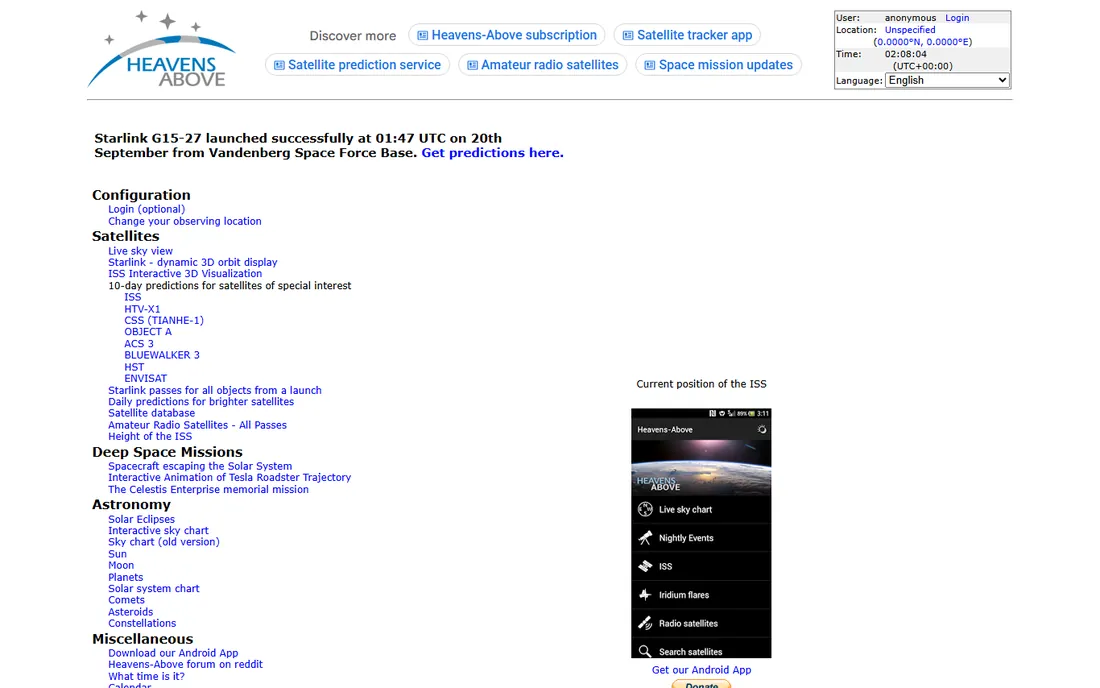
Heavens-Above is the veteran. Run by enthusiasts, it has provided free satellite predictions for decades, and its database goes far beyond the ISS: amateur radio satellites with transmitter frequencies, Chinese station passes, rocket bodies and reentry predictions. Each pass comes with a star chart, magnitude estimates and visibility notes.
The trade is usability. The site looks like it was designed in another era, and there is no polished app with push notifications. But the data is the deepest free source available, and serious satellite spotters check it before every session. Pair it with a prettier app for the field and use Heavens-Above for planning.
What we like- Completely free with no paywall on predictions
- Deep data including radio satellites, Tiangong and decay predictions
- Star charts for every pass showing exactly where to look
Watch out for- The interface is dated and dense for newcomers
- No native mobile app with push alarms (mobile web only)
Starting priceFree (Pro upgrade available; see website)
Free planYes
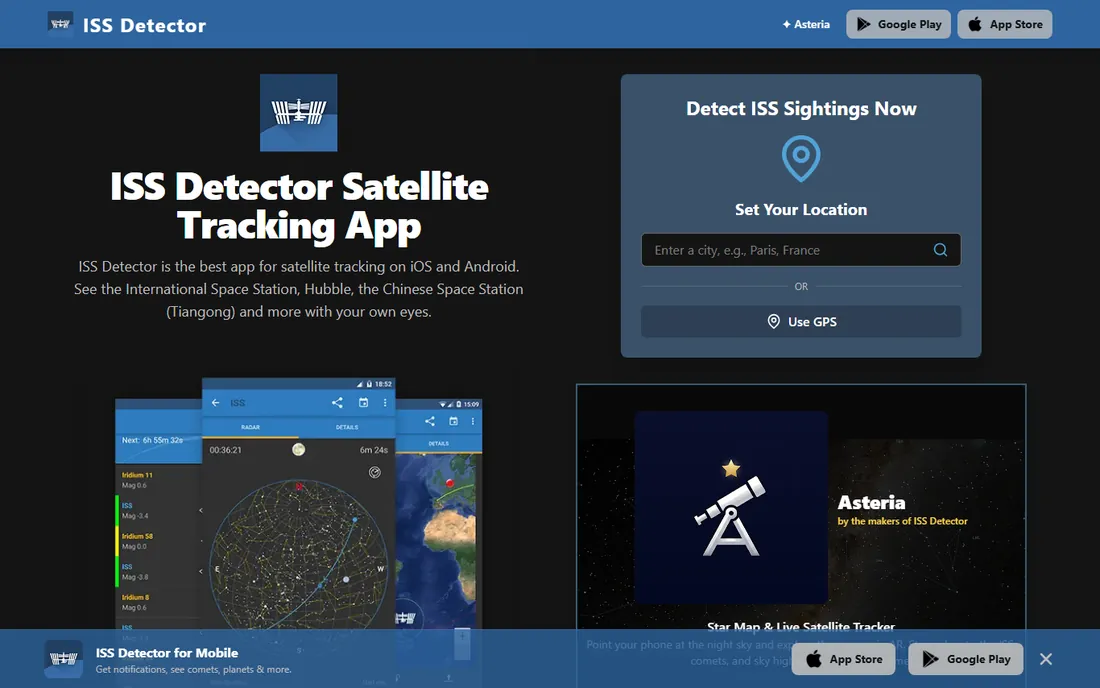
ISS Detector does one job better than anything else: it tells you when and where to look for the International Space Station, then wakes you up in time. It pulls data from NASA and Heavens-Above, adds weather from yr.no, and only alarms you when the sky is actually clear. Extensions add ham radio satellites with Doppler calculations, comets, planets and famous objects like Hubble.
It is an Android-first, function-first tool, and it looks it. But for the core use case, spotting the ISS from your backyard, nothing is more reliable. The free version covers the station; the Pro upgrade (a one-time purchase on Google Play) opens the full catalog with no ads. iPhone users should look at Satellite Tracker or Night Sky instead.
What we like- Alarms minutes before each pass so you never miss the station
- Checks local weather and warns you off cloudy nights
- Tracks Starlink trains, Hubble, Tiangong and radio satellites
Watch out for- The interface prioritizes function over beauty
- The richest object catalogs require the paid Pro version or extensions
#4
Night Sky
Best for: iPhone users who want satellites inside a beautiful sky app
Visit nightsky.com
Starting priceFree (Premium subscription; price on the vendor site)
Free planYes
Night Sky is the premium-feeling option for Apple users. Point your iPhone at the sky and it labels what you see, satellites included, with a clean AR overlay. The ISS gets its own tracking with pass alerts, and the app wraps it all in one of the nicest interfaces in astronomy software, with Apple Watch complications and home-screen widgets.
The catch is the ecosystem and the paywall. There is no Android version, and the free tier is a preview of what Premium adds. If you live in Apple's world and want one app for stars and satellites together, this is it. Android users get the same idea from Stellarium Mobile for free.
What we like- Gorgeous AR sky view that labels satellites as you point the phone
- ISS and satellite tracking integrated with stars, planets and constellations
- Apple Watch and widget support
Watch out for- IOS and Apple-ecosystem only
- The best features require the Premium subscription
Starting priceSee website (paid download with tiered editions)
Free planNo
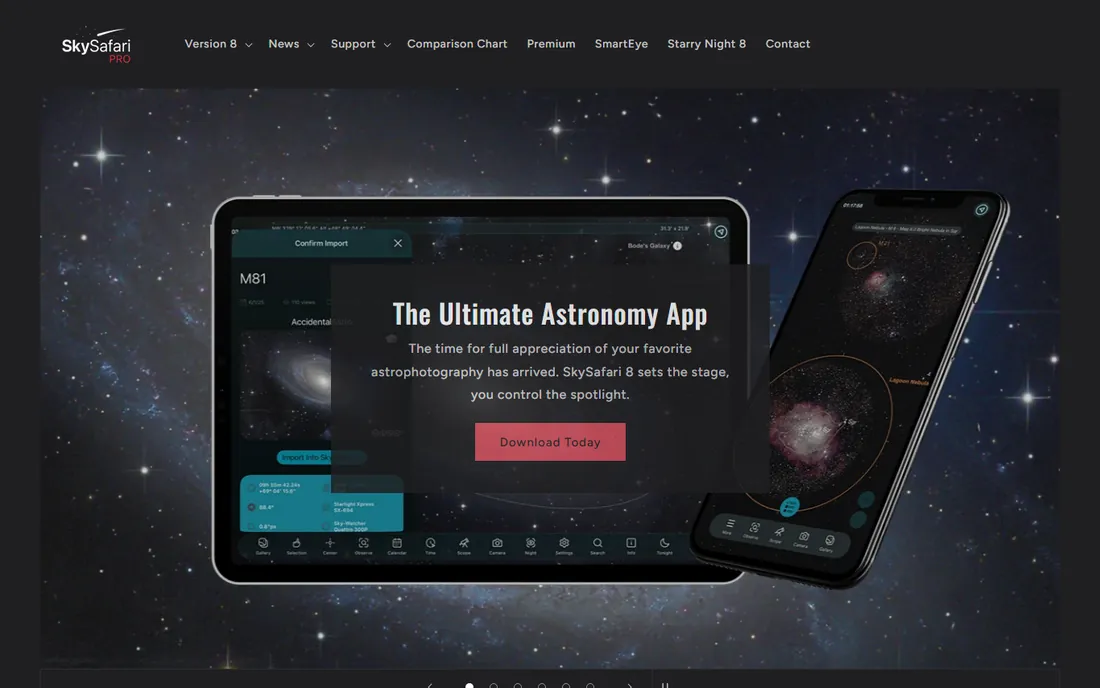
SkySafari is the serious observer's app. It combines a full planetarium with satellite tracking backed by regularly updated orbital elements, and it can drive a computerized telescope to follow what you are watching. The object database dwarfs the casual trackers, and the simulation tools let you plan observations in advance.
None of that is free, and none of it is simple. SkySafari sells in tiered editions, and the learning curve assumes you know your way around the sky. It is overkill for waving at the ISS. It is the right tool for the observer with a telescope who wants satellite passes integrated into a real observation plan.
What we like- Enormous object database with precise satellite orbital data
- Telescope control for GoTo mounts
- Detailed ephemeris data that casual apps skip
Watch out for- Paid download with no free tier
- The depth can overwhelm beginners who just want ISS alerts
Starting priceFree (Plus upgrade available; see website)
Free planYes
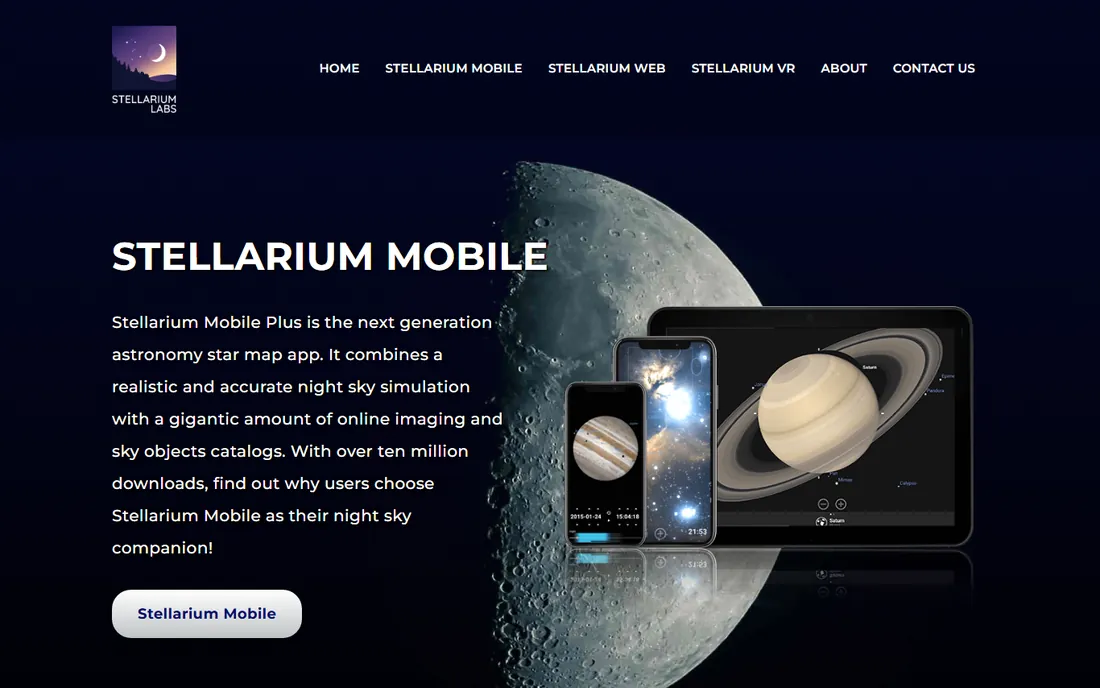
Stellarium has been the free planetarium standard on desktop for years, and the mobile version carries that DNA. The sky rendering is realistic and precise, satellites are plotted from current orbital data, and the catalog extends to nebulae, galaxies and star clusters for nights when no satellite is passing. The Plus upgrade adds more objects and features.
As a pure satellite tracker it is less focused than ISS Detector or Satellite Tracker: no flyby timer theatrics, fewer push-notification options. But as a complete free sky app that happens to track satellites accurately, it is unmatched. Beginners who want to learn the sky while they wait for the ISS should start here.
What we like- Free and open-source heritage with excellent accuracy
- Realistic sky rendering with satellites plotted against stars
- Huge catalog of deep-sky objects beyond satellites
Watch out for- Satellite features are secondary to the planetarium
- The interface assumes some astronomy knowledge
Starting priceSee website (paid download)
Free planNo
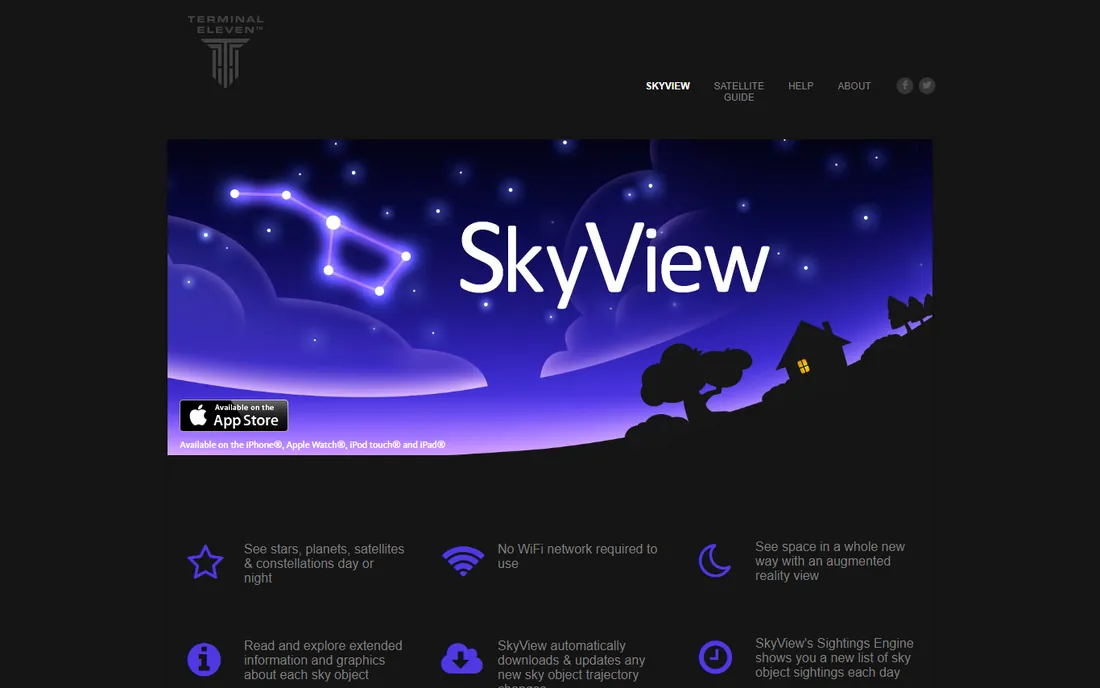
SkyView from Terminal Eleven is the point-your-phone-at-the-sky app. Its AR view labels whatever the camera sees, including satellites crossing the frame, which makes it a hit with kids and casual stargazers. It works offline, so it is handy at dark-sky sites with no signal.
It is a paid download, and the satellite database is not as deep as Heavens-Above or ISS Detector. Think of it as an identification tool first and a tracker second. For the "what is that bright thing moving across the sky" moment, it answers in seconds. For planning tomorrow's passes, use something else.
What we like- AR mode identifies satellites, stars and constellations as you point
- Simple enough for kids and complete beginners
- Works offline once the data is loaded
Watch out for- Paid app with no free tier
- Satellite catalog is thinner than the dedicated trackers
#8
N2YO
Best for: Real-time satellite tracking in a browser with no install
Visit n2yo.com
Starting priceFree
Free planYes
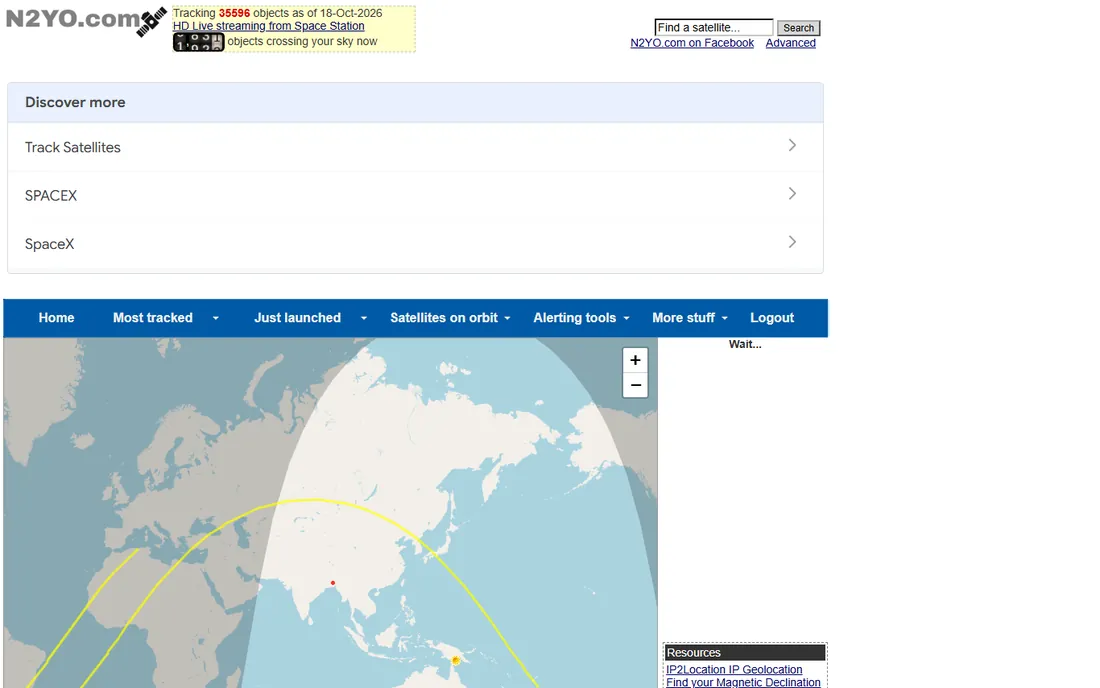
N2YO is the website the app users graduate to. Enter your location and get 10-day pass predictions for the ISS, Starlink, weather satellites and thousands more, plus live maps showing every tracked object in orbit right now. It is free, requires nothing installed, and works on any device with a browser.
What it cannot do is tap you on the shoulder. There are no alarms, no widgets, no AR. Use N2YO at your desk to plan the week's observing, then take ISS Detector or Satellite Tracker into the field for the actual passes. Together they cover the whole workflow for free.
What we like- No download or account needed
- Live tracking maps for thousands of satellites
- 10-day predictions for any location free
Watch out for- Web-only with a utilitarian design
- No push notifications or alarms
What to look for before you buy
Start with the alarm. A satellite tracker you have to remember to open is a star chart, not a tracker. ISS Detector's pre-pass alarms with weather checks are the gold standard; Satellite Tracker and Night Sky offer notifications too, but check what triggers them before you rely on them for a 5 am flyover.
Then check the catalog. Every app here tracks the ISS. Beyond that, coverage diverges: Starlink trains, Hubble, Tiangong, amateur radio satellites and rocket bodies appear in some catalogs and not others. If you are into ham radio satellites, ISS Detector's extensions or Heavens-Above are the answer. If you just want the big bright ones, any of the visual apps will do.
Finally, mind the platform. Several of the best trackers are single-platform: ISS Detector is Android-first, Night Sky is iOS-only. Check your phone's store before falling for a feature list. And remember the sky itself: no app fixes light pollution or clouds, so the free apps are the right first step for most people.
How we chose
We started with the terms skywatchers use: satellite tracker app, ISS tracker, satellite finder and track satellites. For each candidate we confirmed the app is current and maintained, checked pricing against the vendor's site or the app store listing, and compared capabilities across reviews on the App Store, Google Play and practitioner discussion on Reddit. Where a price was not published on the vendor's page, we wrote "See website" instead of quoting a store scraper. We favored apps with live orbital data and real pass predictions over static sky maps.
Frequently asked questions
Can you really see satellites with the naked eye?
Yes. The International Space Station shines brighter than most stars and crosses the sky in about six minutes. Starlink trains, Tiangong and Hubble are visible too under dark skies. The apps on this list tell you exactly when and where to look.
What is the best free satellite tracker app?
ISS Detector on Android and Satellite Tracker by Star Walk on both platforms are the best free options, with Heavens-Above the deepest free source on the web. All three cost nothing for the core job of ISS pass predictions.
How do I get notified before the ISS passes?
Use an app with pass alarms: ISS Detector sends a notification minutes before each visible pass and checks the weather first. Satellite Tracker and Night Sky also offer pass notifications. Set your location accurately, since predictions are location-specific.
Do satellite trackers work without internet?
Most need a connection to download fresh orbital data, but several cache it: SkyView works offline once loaded, and Stellarium Mobile keeps working with its last data set. For a remote dark-sky trip, open your tracker on Wi-Fi before you leave.
What is the difference between Heavens-Above and the apps?
Heavens-Above is a website with the deepest free prediction data, including radio satellites and reentries, but no push alarms. The apps wrap similar data in notifications, AR views and 3D graphics. Serious observers use both: the site for planning, an app for the field.
Can I track Starlink satellites?
Yes. ISS Detector (with extensions), Satellite Tracker, Heavens-Above and N2YO all track Starlink trains. The famous "string of lights" appears shortly after launches, when the satellites are still clustered before spreading into their orbits.
Tonight's ISS pass: a five-minute setup
Pick one app and set your location. ISS Detector on Android or Satellite Tracker on iPhone will do. Enable notifications and check tonight's passes: the app lists each visible flyover with a start time, direction and brightness. Step outside a few minutes early, face the direction shown, and watch for a bright light moving faster than a plane with no blinking. That is the station, with six or seven people aboard, 400 km overhead. The whole setup takes five minutes. The sight never quite gets old.
Sources we checked (8)
- https://www.heavens-above.com/
- https://www.issdetector.com/
- https://vito-technology.com/
- https://www.nightsky.com/
- https://skysafariastronomy.com/
- https://stellarium-labs.com/
- https://www.terminaleleven.com/
- https://www.n2yo.com/
Is your product missing or out of date?
We review this list regularly. Vendors can request a listing, send updated pricing or ask about featured placement.

Shihab Mia · Founder, Rankite
Shihab has spent more than a decade helping SaaS and e-commerce brands grow through search. He writes Rankite's software buying guides from pricing pages, documentation and public user reviews. More about Shihab.