How we make this list: we compare pricing pages, product documentation and public user reviews. Ratings come from G2, Capterra or Trustpilot, with the date we checked them.
Key takeaways
- Alchemy suits production apps that need reliability plus tooling, with 100 or more networks, advanced NFT and transfer APIs, and strong analytics.
- Infura suits Ethereum and major Layer 2 teams, with MetaMask integration, a long track record, and archive access on paid tiers.
- QuickNode suits multi-chain teams that need raw speed and broad coverage, with global multi-region infrastructure and streaming support.
- Ankr suits cost-sensitive multi-chain apps, with public endpoints, pay-as-you-go pricing, and a decentralized node network.
- Pricing units differ sharply: compute units, credits, requests, and responses all measure differently, so model your own traffic before committing.
Quick comparison
| Tool | Best for | Starting price | Free plan |
|---|
 Alchemy | Production reliability plus tooling | Pay as you go | Yes |
 Infura | Ethereum and Layer 2 apps | $50 per month | Yes |
 QuickNode | Multi-chain speed and coverage | $34 per month | Free trial |
 Ankr | Cost-sensitive multi-chain | Pay as you go | Yes |
 Chainstack | Enterprise dedicated nodes | $49 per month | Yes |
 NOWNodes | Wide network coverage | 20 euros per month | Yes |
 GetBlock | Small projects plus dedicated nodes | $29 per month | Yes |
 dRPC | Provider redundancy and routing | Pay as you go | Yes |
Is your product missing or out of date?
We review this list regularly. Vendors can request a listing, send updated pricing or ask about featured placement.
The best RPC providers for blockchain apps
Starting pricePay as you go
Free planYes
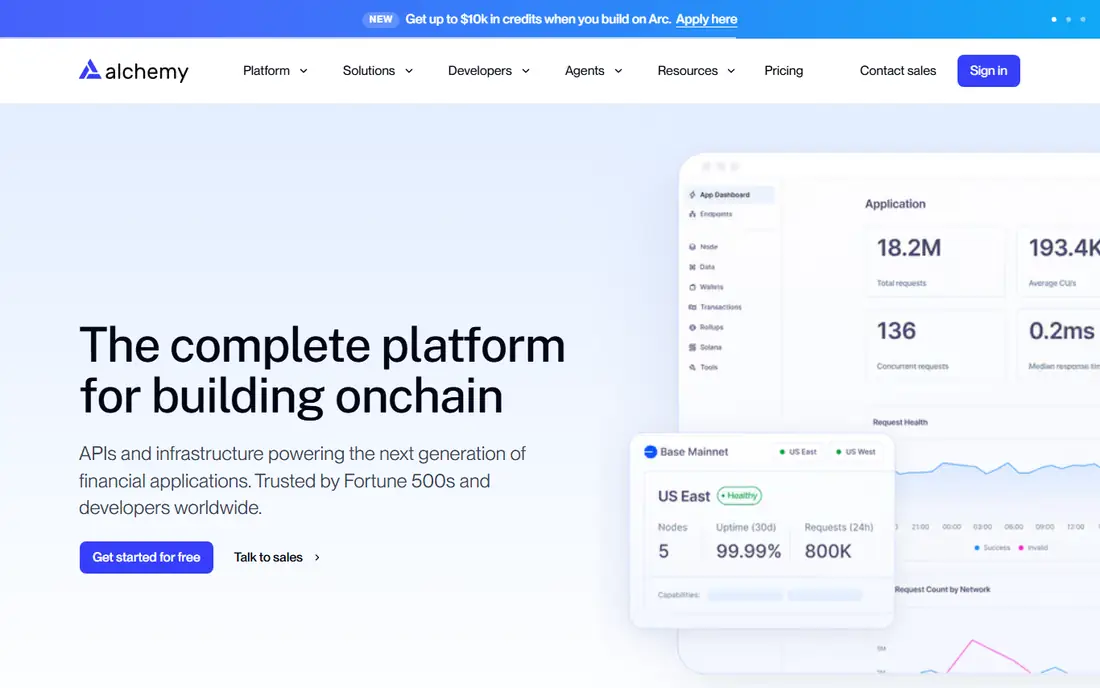
Alchemy suits production apps that need reliability plus tooling. Its 100 or more networks, advanced APIs for NFTs, transfers, and notifications, and analytics tools give developers more than raw node access, while its 99.99% uptime SLA and full archive plus account-state data suit apps that need historical queries. Its free tier covers 30M compute units per month, with pay-as-you-go at $0.525 per 1M compute units beyond that.
The trade is cost modeling. Alchemy's figures use its own suggested average of 27 compute units per request, so log-heavy traffic costs more than a simple request count suggests. Alchemy fits best for production apps that value tooling and reliability over the lowest raw request price.
What we like- 100 or more networks
- Advanced NFT, transfer, and notify APIs
- 99.99% uptime SLA on paid tiers
- Full archive plus account-state data
Watch out for- Pay-as-you-go at $0.525 per 1M compute units adds up for log-heavy traffic
- Compute unit math needs modeling
- Free tier caps at 30M compute units per month
Starting price$50 per month
Free planYes
Infura suits Ethereum and major Layer 2 teams that value a long track record and MetaMask integration. Its network covers Ethereum plus Polygon, Arbitrum, and other major Layer 2 chains, its IPFS support covers decentralized storage, and its free tier offers 3M daily credits, with a Developer plan at $50 per month for 15M daily credits. For a team building on Ethereum's core ecosystem, Infura's maturity is reassuring.
The limits are breadth and credits. Its network count trails Alchemy's and NOWNodes', WebSocket support is partial in some guides, archive access sits on paid tiers, and credits reset daily rather than monthly. Infura fits best for Ethereum-first apps that want a proven provider.
What we like- Long industry track record
- MetaMask integration
- Ethereum plus Polygon, Arbitrum, and other major Layer 2 networks
- IPFS support
Watch out for- 40 or fewer networks in some guides
- WebSocket support is partial
- Archive access sits on paid tiers
- Credits reset daily
Starting price$34 per month
Free planFree trial
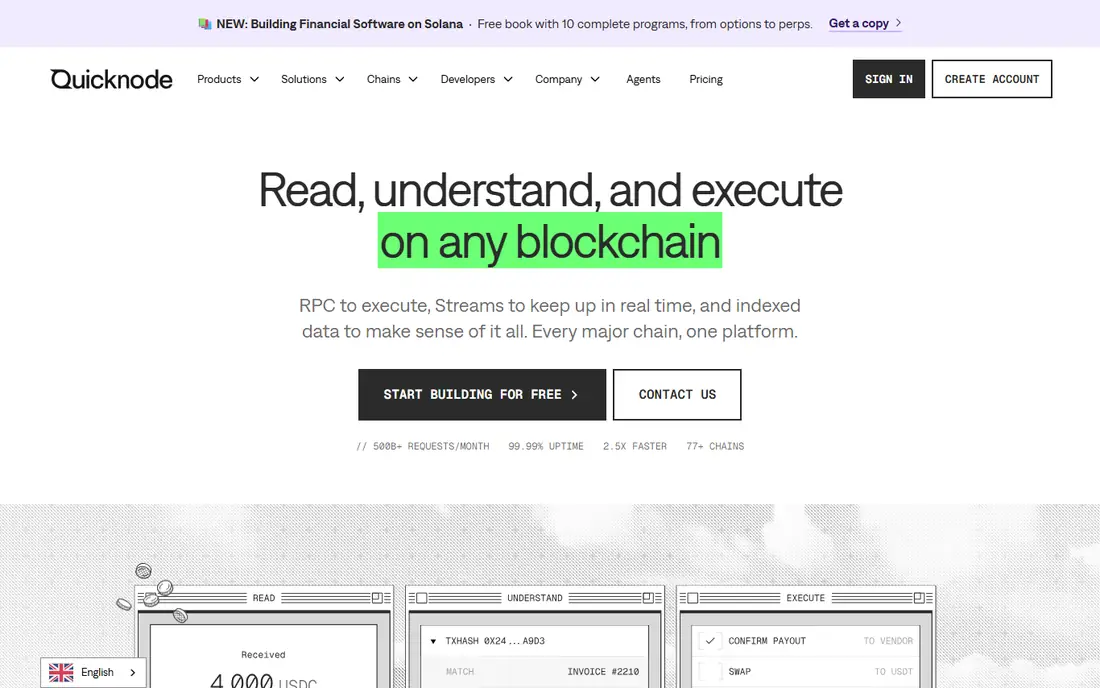
QuickNode suits multi-chain teams that need raw speed and broad coverage. Its 70 or more networks, global multi-region infrastructure, and WebSocket plus streaming support give low-latency access worldwide, while its marketplace add-ons, including smart load balancers, cut redundancy costs for Solana and BNB Chain workloads. Its Build plan starts around $34 to $49 per month depending on the guide, with 80M credits in one comparison.
The trade is free tier and pricing clarity. Its free tier is a 10M credit trial rather than a permanent free plan, and Build pricing varies by guide. QuickNode fits best for high-traffic multi-chain apps that need speed and global reach.
What we like- 70 or more networks
- Global multi-region infrastructure
- WebSocket and streaming support
- Marketplace add-ons for load balancing
Watch out for- Build plan pricing varies by guide, $34 or $49 per month
- Free tier is a 10M credit trial, not a permanent free plan
- Credit math needs modeling
Starting pricePay as you go
Free planYes
Ankr suits cost-sensitive multi-chain apps. Its 75 or more networks, free public endpoints, and pay-as-you-go pricing from about $10 per 100M credits make it among the cheapest options for high-volume traffic, while its decentralized node network adds resilience. Its Erigon upgrade for BNB Chain cuts archive storage and sync time, which suits archive-heavy workloads on that chain.
The limits are archive depth and SLA documentation. Archive depth is limited on some chains, and its uptime SLA is not documented in some guides. Ankr fits best for cost-sensitive multi-chain apps that can tolerate archive limits on some chains.
What we like- 75 or more networks
- Public endpoints free
- Pay-as-you-go from about $10 per 100M credits
- Decentralized node network
Watch out for- Archive depth is limited on some chains, around 16 hours on Solana in one guide
- Uptime SLA not documented in some guides
- Premium tiers use rate-limit multipliers
Starting price$49 per month
Free planYes
Chainstack suits enterprise teams that want dedicated nodes with compliance. Its 70 or more networks, 99.99% uptime, dedicated and bare-metal node options, and SOC 2 Type II compliance suit regulated and high-traffic apps, while its archive and dedicated nodes cover historical queries. Growth at $49 per month covers 20M requests, with a free tier at 3M requests per month for evaluation.
The trade is price and tiering. Growth is a real commitment for a small project, and enterprise features such as unlimited nodes need higher tiers. Chainstack fits best for enterprise and compliance-led teams that want dedicated infrastructure.
What we like- 70 or more networks
- 99.99% uptime
- Dedicated and bare-metal options
- SOC 2 compliance
- Archive and dedicated nodes
Watch out for- Growth at $49 per month with 20M requests
- Free tier at 3M requests per month
- Enterprise features need higher tiers
Starting price20 euros per month
Free planYes
NOWNodes suits apps that need wide network coverage, including less common chains. Its 120 or more networks cover Bitcoin, Ethereum, BNB Smart Chain, Solana, Polygon, and rarer chains such as Monero, Zcash, and Dogecoin, with RPC, WebSocket, Blockbook, and archive access varying by network. Its dedicated nodes add configurable regions, no predefined rate cap, and priority support.
The limits are request allowance and brand scale. Pro at 20 euros per month covers 1M requests, which is low for high-traffic apps, and its brand is smaller than Alchemy's or Infura's. NOWNodes fits best for multi-chain apps that need rare networks alongside majors.
What we like- 120 or more networks, including Monero, Zcash, and Dogecoin
- WebSocket on 30 or more networks
- Dedicated nodes with no predefined rate cap
Watch out for- Pro at 20 euros per month covers 1M requests, which is low for high traffic
- Smaller brand than Alchemy or Infura
- Interface quality varies by network
Starting price$29 per month
Free planYes
GetBlock suits small projects that may grow into dedicated nodes. Its 50 or more networks, 99.9% uptime, and 24/7 support cover the basics, its Starter plan is reported around $29 for 5M requests per month in one guide, and its dedicated nodes from higher tiers give a growth path without switching vendors. Its free tier covers 40,000 requests per day in one guide for evaluation.
The trade is pricing clarity. Shared plan pricing varies sharply by guide, and its Mantle multiplier is not published, making costs hard to estimate ahead of time for that chain. GetBlock fits best for small projects that want a dedicated-node growth path.
What we like- 50 or more networks
- Dedicated nodes from higher tiers
- 99.9% uptime and 24/7 support
- Free tier for evaluation
Watch out for- Shared plan pricing varies by guide, $29 or $399 per month depending on tier
- Mantle multiplier not published, making costs hard to estimate
- Smaller ecosystem than Alchemy
Starting pricePay as you go
Free planYes
dRPC suits apps that need provider redundancy. Its distributed routing spreads requests across multiple node providers, so a single provider outage does not take your app down, while its public nodes offer 210M compute units per month and its stated uptime is 99.99%. Its full archive via aggregation covers historical queries without a dedicated node.
The limits are price and novelty. Pay-as-you-go at $6 per 1M requests costs more than Ankr for raw volume, and its brand is newer than Infura's. dRPC fits best for apps where uptime and redundancy matter more than the lowest per-request price.
What we like- Distributed provider routing for redundancy
- 210M compute units per month on public nodes
- 99.99% stated uptime
- Full archive via aggregation
Watch out for- Pay-as-you-go at $6 per 1M requests is pricier than Ankr for raw volume
- Newer brand than Infura
- Routing adds a layer to debug
How we chose
We compared these providers on network coverage, WebSocket support, archive access, uptime SLA, free tier value, and pricing model, since RPC buyers weigh reliability against cost per request. Pricing figures come from vendor pages and current comparison guides checked in September and October 2026, and any figure we could not confirm is marked as See website. We did not claim hands-on testing. Instead we weighed public documentation, pricing pages, and user reviews, plus the practical difference between shared, dedicated, and distributed node models.
What to check before you pick
Start with your chains and methods. A provider that covers 120 networks is no help if it lacks archive access on your chain, and a cheap per-request price is no help if your methods cost many compute units each. Next, model your own traffic: Alchemy's average of 27 compute units per request, Infura's daily credit resets, and QuickNode's credit trials all change the bill versus a simple request count. Finally, test latency from your users' regions, since global multi-region infrastructure matters more than headline throughput for a worldwide app.
Shared, dedicated, or distributed
Shared nodes suit development and small apps, dedicated nodes suit high-traffic apps that need isolation and no rate cap, and distributed routing suits apps where uptime matters more than price. Many production apps use two providers: a primary for everyday traffic and a fallback for outages, which costs more but prevents a single provider failure from taking the app down.
Archive, WebSocket, and SLA details
Archive access, WebSocket support, and uptime SLAs vary more than marketing suggests. Infura's archive sits on paid tiers, Ankr's archive depth is limited on some chains, and dRPC's archive comes via aggregation. Confirm archive depth, WebSocket coverage, and SLA terms for your exact chains before committing, and load-test with your real methods, not just a health check.
Frequently asked questions
What is an RPC provider?
An RPC provider runs blockchain nodes that your app queries over HTTP or WebSocket to read chain data, send transactions, and listen for events, without you running your own node. Providers differ in networks covered, speed, archive depth, and pricing.
Which RPC provider is cheapest?
Ankr is among the cheapest for raw volume, with pay-as-you-go from about $10 per 100M credits, while NOWNodes Pro at 20 euros per month covers 1M requests. The cheapest provider depends on your methods: compute unit and credit weightings change the bill sharply.
Is Alchemy or Infura better?
Alchemy suits production apps that need tooling, analytics, and broad network coverage, while Infura suits Ethereum-first apps that value a long track record and MetaMask integration. Both are proven; choose by chains, tooling, and pricing model.
Do I need a dedicated node?
For most apps, no: shared nodes cover development and moderate traffic. Dedicated nodes suit high-traffic apps that need isolation, no rate cap, and priority support, or apps with strict compliance needs.
What is the difference between compute units, credits, and requests?
All three measure usage, but weight methods differently: a simple balance check may cost 1 unit, while a log-heavy query may cost dozens. That is why two providers with similar headline prices can bill very differently for the same traffic.
Can I use multiple RPC providers?
Yes, and many production apps do: a primary provider for everyday traffic plus a fallback for outages, or different providers per chain. Distributed routing services such as dRPC automate that failover.
Sources we checked (8)
- https://www.alchemy.com
- https://www.infura.io
- https://www.quicknode.com
- https://www.ankr.com
- https://chainstack.com
- https://nownodes.io
- https://getblock.io
- https://drpc.org
Is your product missing or out of date?
We review this list regularly. Vendors can request a listing, send updated pricing or ask about featured placement.

Shihab Mia · Founder, Rankite
Shihab has 5+ years in B2B and SaaS SEO. He writes Rankite's software buying guides from pricing pages, documentation and public user reviews. More about Shihab.