How we make this list: we compare pricing pages, product documentation and public user reviews. Ratings come from G2, Capterra or Trustpilot, with the date we checked them.
Key takeaways
- Vite is the best starting point for most new web apps, with fast feedback in development and Rollup-based production output.
- Library authors who want small, clean bundles should look at Rolldown first, since it keeps Rollup-style output with much faster builds.
- Teams with a large webpack codebase get the least painful upgrade path from Rspack, which keeps webpack-compatible configuration.
- esbuild is the right pick when raw transform speed matters most, such as in continuous integration pipelines.
- Parcel still wins when setup time matters more than fine control, for prototypes and small sites.
Quick comparison
| Tool | Best for | Starting price | Free plan |
|---|
 Vite | Modern single-page apps | Free (open source) | Yes |
 webpack | Large, complex enterprise apps | Free (open source) | Yes |
 esbuild | Fast transforms and CI builds | Free (open source) | Yes |
 Parcel | Zero-config prototypes | Free (open source) | Yes |
 Rspack | Modernizing webpack codebases | Free (open source) | Yes |
 Turbopack | Next.js apps | Free (open source) | Yes |
 Rolldown | Libraries and packages | Free (open source) | Yes |
 Bun | All-in-one runtime and bundler | Free (open source) | Yes |
Is your product missing or out of date?
We review this list regularly. Vendors can request a listing, send updated pricing or ask about featured placement.
The best Rollup alternatives
Starting priceFree (open source)
Free planYes
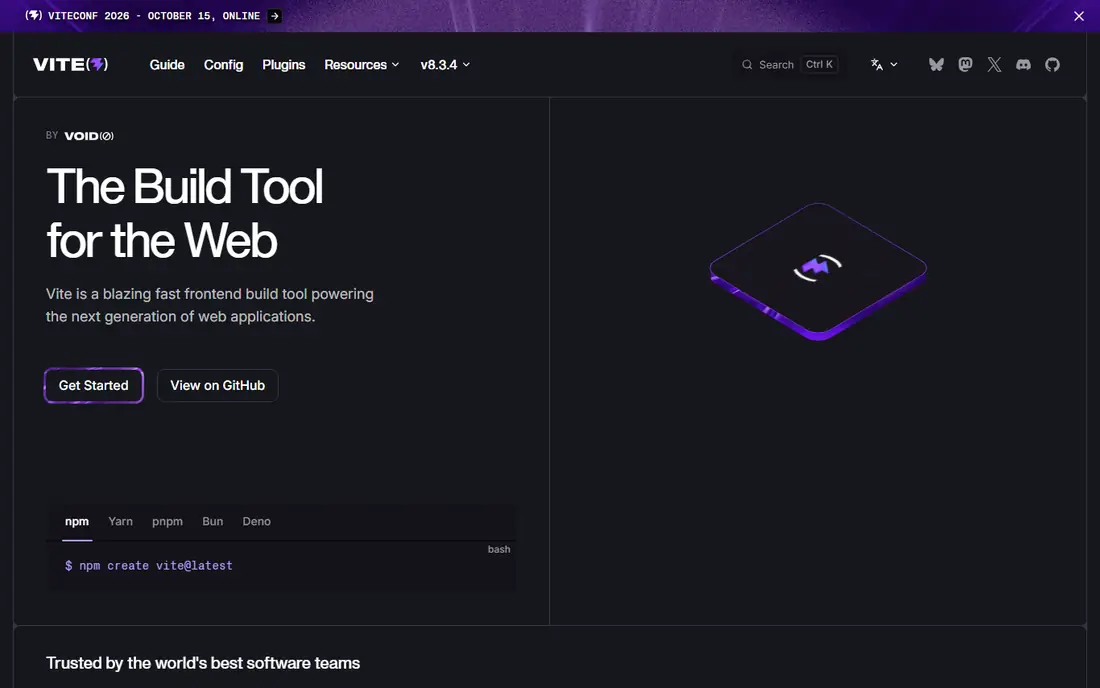
Vite serves source files to the browser as native ES modules during development instead of bundling everything first. That design keeps startup time short even as a project grows, and hot module replacement feels close to instant for most edits. The plugin system is wide, with official support for React, Vue, Svelte and other frameworks, plus a large community catalog.
For production, Vite hands the build to Rollup, so output quality stays close to what Rollup users already trust. Tree shaking, code splitting and asset handling all work out of the box. The catch is that teams moving from Rollup need to learn Vite conventions for configuration and plugins, and some Rollup plugins behave differently under Vite. Still, for a new app, Vite is the default recommendation in most comparisons published in 2026, and framework starters built on it cover a large share of new projects.
What we like- Very fast feedback in development
- Large plugin ecosystem
- Rollup-based production builds
Watch out for- Production output still depends on Rollup behavior
- Very large apps need tuning
Starting priceFree (open source)
Free planYes
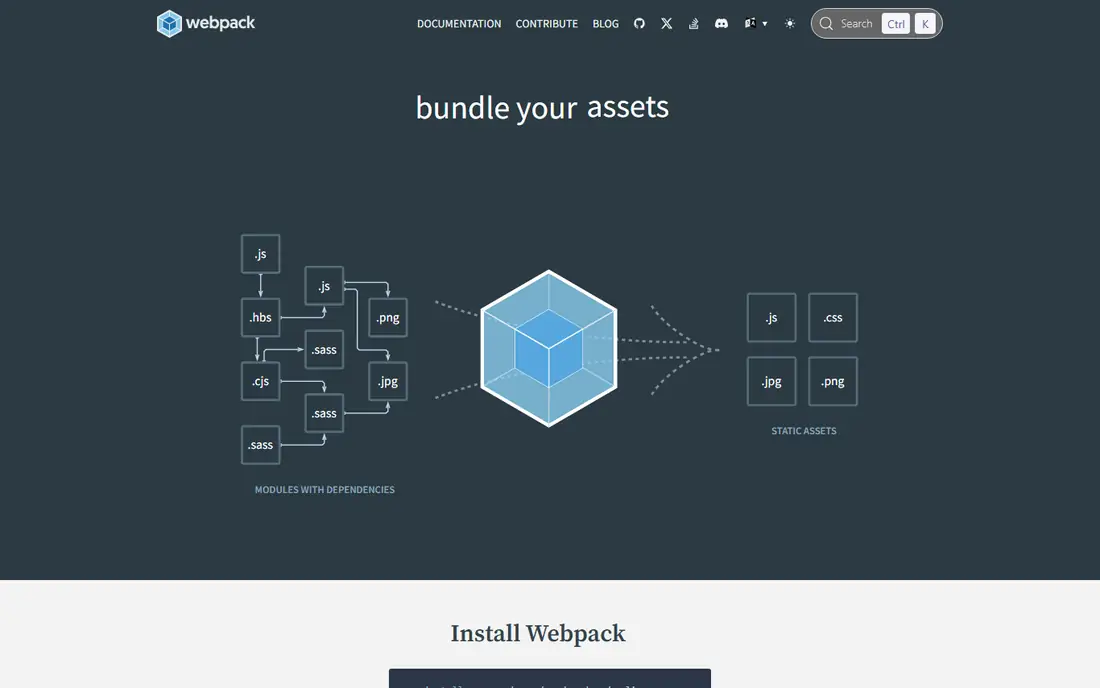
webpack remains the most flexible bundler in this list. Loaders and plugins cover CSS, images, fonts, workers, WebAssembly and many stranger asset types, and its module federation feature supports micro-frontend architectures that other tools handle less well. Large companies keep using it because years of configuration and internal knowledge already exist around it.
The price of that flexibility is setup effort. A webpack config for a serious app runs long, and build times grow with codebase size unless caching and tuning are done carefully. New teams should not pick webpack for a small project. Teams with an existing webpack app, exotic loader chains or module federation needs have good reasons to stay, and Rspack offers a faster path forward without a rewrite.
What we like- Deepest loader and plugin ecosystem
- Handles almost any asset type
- Proven at large scale
Watch out for- Configuration can get long
- Build speed lags newer tools without tuning
Starting priceFree (open source)
Free planYes
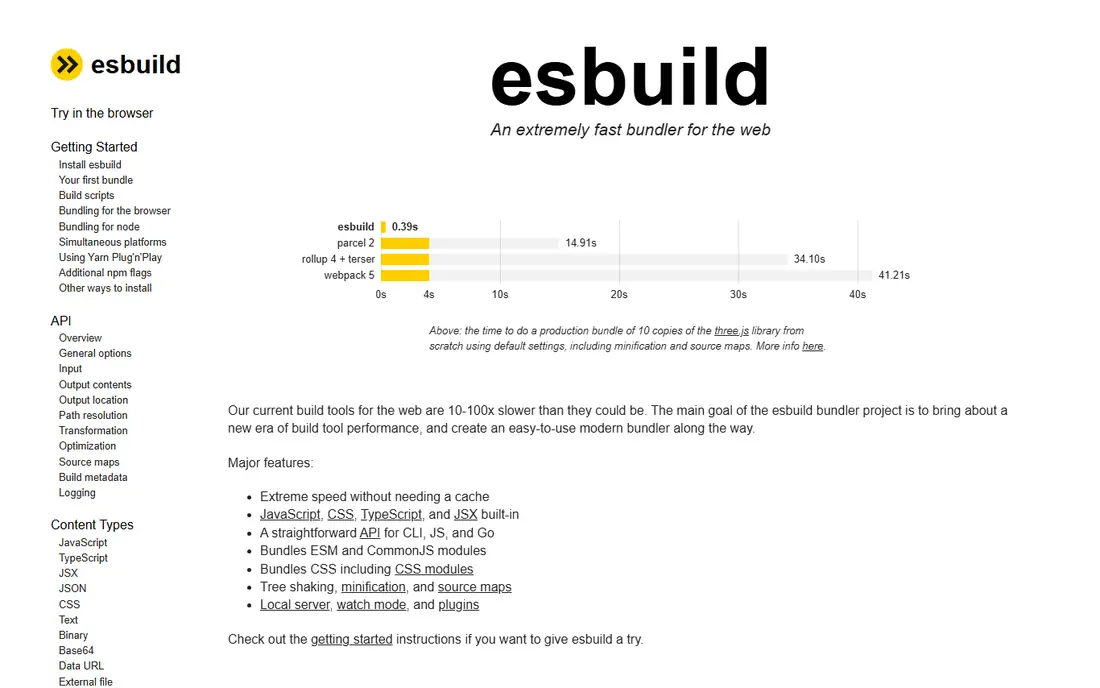
esbuild is written in Go and compiles JavaScript and TypeScript far faster than JavaScript-based bundlers. Benchmarks in 2026 put its production build of a common workload under one second, where older tools take several seconds or more. That speed makes it a natural fit for continuous integration, where every saved second multiplies across many runs per day.
Using esbuild directly means giving up some conveniences. It has no built-in dev server with hot replacement comparable to Vite, and its plugin ecosystem is leaner than webpack. Many teams use esbuild as a piece inside another tool instead, since Vite uses it for dependency pre-bundling. Pick esbuild on its own when the job is narrow: bundle a script, a CLI tool or a library quickly, with minimal configuration.
What we like- Extremely fast builds
- Simple command line use
- Small install size
Watch out for- Smaller plugin ecosystem
- Fewer built-in app features than Vite or webpack
Starting priceFree (open source)
Free planYes
Parcel takes a different approach from webpack: it detects file types and applies sensible defaults without asking for a config file. Point it at an HTML entry file and it builds JavaScript, CSS, images and more, with a dev server and hot replacement included. That makes it a strong choice for prototypes, hackathons, small marketing sites and teams where not everyone wants to learn build tooling.
The trade-off is control. When a project needs unusual output shaping, custom module handling or deep optimization, Parcel offers fewer levers than webpack or Vite. Performance is good for small and medium apps, though very large apps tend to favor Vite or Rspack. For getting something running today with the least setup, Parcel still earns its place.
What we like- Works with almost no configuration
- Built-in dev server
- Handles many file types
Watch out for- Less control over output
- Weaker fit for very large apps
Starting priceFree (open source)
Free planYes
Rspack is a Rust-based bundler built to be compatible with webpack configuration and plugin APIs. That compatibility is its main selling point: teams can move a large webpack app to Rspack and keep most of their existing setup, while getting build speeds closer to modern tools. Independent benchmarks in 2026 show dev startup around one second on a workload where webpack took over five seconds.
Because Rspack is younger, the long tail of webpack plugins is not fully covered, so teams should test their specific loader chains before committing. Documentation and community answers are thinner than webpack, though growing fast. For a team that likes webpack but is tired of slow builds, Rspack is the first option to evaluate before considering a full rewrite around another tool.
What we like- Webpack-compatible config and APIs
- Much faster builds
- Rust-based core
Watch out for- Younger ecosystem than webpack
- Some niche plugins may not carry over
Starting priceFree (open source)
Free planYes
Turbopack is the Rust-based incremental bundler built by the Next.js team, and it ships as the default bundler in current Next.js releases. Its incremental design recomputes only what changed, which keeps rebuilds quick on large applications where a full rebuild would stall feedback. For teams already on Next.js, there is little reason to look elsewhere, since Turbopack comes with the framework and its fast refresh integration.
Outside Next.js, Turbopack is a weaker fit. Standalone use is possible but the documentation and examples center on Next.js projects, and other tools offer broader framework support. Teams choosing a bundler for a framework-free or Vue or Svelte project should compare Vite or Rspack first. Inside Next.js, Turbopack is simply the path of least resistance.
What we like- Incremental builds designed for large apps
- Default in modern Next.js
- Fast refresh
Watch out for- Tied closely to the Next.js ecosystem
- Less useful outside it
Starting priceFree (open source)
Free planYes
Rolldown is the Rust-based successor to Rollup, built with the same goals: precise tree shaking, clean multi-format output and readable artifacts for published packages. It also powers the production build in newer Vite releases, which gives it a large and growing user base. Library authors get Rollup-style output quality without Rollup build times, which matters when a package is rebuilt often during development.
The project is newer than Rollup, so some Rollup plugins and edge-case behaviors are still catching up. Teams with complex Rollup plugin chains should test their exact setup before switching. For new libraries and design systems, Rolldown is a strong default in 2026, and it keeps the door open to Rollup itself if a specific plugin is missing.
What we like- Rollup-compatible output with much faster builds
- Clean ES module output
- Tree shaking
Watch out for- Newer project
- Plugin compatibility still catching up
Starting priceFree (open source)
Free planYes
Bun takes bundling further by folding it into a full JavaScript runtime. One binary covers running code, bundling it, running tests and installing packages, which removes several tools from a typical setup. Its bundler is fast, and its startup time is short, which suits CLIs, scripts and small services as well as frontend builds.
The catch is maturity. Bun is newer than Node, and while compatibility is broad, edge cases in Node APIs and native modules still appear. Teams with strict production requirements or heavy native dependencies should test carefully. For new projects where a single fast tool is appealing, and for scripts and tooling, Bun is worth a serious look alongside Vite and esbuild.
What we like- Bundler, runtime, test runner and package manager in one binary
- Very fast startup
Watch out for- Newer runtime with smaller ecosystem than Node
- Some Node behaviors differ
How we chose
We compared pricing pages, documentation and public benchmarks for each bundler, plus community discussion on G2, Capterra and Reddit where available. All eight tools are open source, so price did not separate them. Instead we weighed build speed, output quality, configuration effort, plugin ecosystem and fit for common project types: new apps, libraries, prototypes and large existing codebases. Tools that duplicate another entry without a clear difference were left out, and each entry above covers a distinct job.
What to check before you switch bundlers
Start by measuring your current build. Time a cold production build and a typical rebuild after one file change, then repeat those measurements with the candidate tool on a copy of your project. Published benchmarks help with shortlisting, but real numbers from your own codebase decide the switch, since plugin chains and asset mixes change results a lot.
Next, check plugin coverage. List every loader and plugin your current setup uses, then confirm each one has an equivalent in the new tool. This step catches most failed migrations early, especially for webpack projects with custom loaders. Also confirm output format needs: libraries need clean ES module and CommonJS output with type declarations, while apps care more about code splitting and long-term caching through content hashes.
Migration tips that save time
Keep the build behind two npm scripts, dev and build, so teammates and hosting platforms need no new knowledge when the tool changes. Migrate in a branch with the old config kept beside the new one until the new build passes all tests. Finally, review bundle output size and runtime errors in staging before shipping, since a faster build that ships broken code is not an improvement.
Frequently asked questions
Is Vite a full replacement for Rollup?
For apps, yes in most cases, since Vite uses Rollup for production builds and adds a fast dev server. For libraries, Rollup or Rolldown still give more direct control over output formats and are often the better direct choice.
Which Rollup alternative is fastest?
esbuild and Bun post the fastest raw transform times, while Rspack and Turbopack lead on dev startup and rebuild speed for large apps. The right answer depends on whether you measure cold builds, rebuilds or dev startup on your own code.
Should I still use webpack in 2026?
Yes, if you have a large existing webpack codebase, exotic loaders or module federation. New projects usually start faster with Vite, and webpack teams wanting speed should evaluate Rspack before rewriting anything.
Does Parcel work for large applications?
Parcel handles small and medium apps well with almost no configuration. Very large apps with custom build needs usually fit Vite, webpack or Rspack better, where more control over output is available.
What is the difference between Rollup and Rolldown?
Rolldown keeps Rollup goals for output quality and tree shaking but rebuilds the core in Rust for much faster builds. It also powers newer Vite production builds, while Rollup remains the mature, widely supported original.
Do I need a bundler at all for a small site?
For a few pages with light JavaScript, native ES modules and an import map can be enough, with no build step. A bundler becomes worth it once you need code splitting, minification, TypeScript or npm dependencies.
Sources we checked (9)
- https://strapi.io/blog/modern-javascript-bundlers-comparison-2025
- https://blog.openreplay.com/current-state-javascript-bundlers/
- https://vite.dev
- https://webpack.js.org
- https://esbuild.github.io
- https://parceljs.org
- https://rspack.dev
- https://rolldown.rs
- https://bun.sh
Is your product missing or out of date?
We review this list regularly. Vendors can request a listing, send updated pricing or ask about featured placement.

Shihab Mia · Founder, Rankite
Shihab has 5+ years in B2B and SaaS SEO. He writes Rankite's software buying guides from pricing pages, documentation and public user reviews. More about Shihab.