How we make this list: we compare pricing pages, product documentation and public user reviews. Rankite is independent; if a vendor ever pays for a featured spot, that listing is clearly labeled Partner.
Key takeaways
- Atera is the best overall pick for small to mid-size MSPs: per-technician pricing at $129 per month billed annually, unlimited endpoints, 30-day trial.
- NinjaOne wins on ease of use and automation depth, with per-device pricing from $1.50 to $3.75 a month depending on volume.
- Syncro pairs RMM with a full PSA at $129 per user per month billed annually, the only all-in-one with pricing you can buy off the website.
- Action1 is free for the first 200 endpoints with no feature limits, the best entry point for patching and endpoint management on a budget.
- Datto RMM, N-able N-central, Pulseway and Kaseya VSA are quote-only; get pricing in writing before comparing.
Quick comparison
| Tool | Best for | Starting price | Free plan |
|---|
 Atera Atera | small to mid-size MSPs overall | $129/technician/month (billed annually) | No (30-day trial) |
 NinjaOne NinjaOne | ease of use and automation | $1.50-$3.75/device/month (volume-based) | No (14-day trial) |
 Syncro Syncro | all-in-one RMM plus PSA | $129/user/month (billed annually) | No (14-day trial) |
 SuperOps SuperOps | modern RMM plus PSA combo | $1.50/endpoint/month (100 endpoint minimum) | No (free trial) |
 Pulseway Pulseway | mobile-first management | Quote-based (per device, tiered) | No (14-day trial) |
 Datto RMM Datto RMM | data protection depth | Quote-based (per endpoint) | No (14-day trial) |
 N-able N-central N-able N-central | large, complex environments | Quote-based (per device) | No (free trial) |
 Action1 Action1 | free tier for up to 200 endpoints | Free (first 200 endpoints) | Yes (200 endpoints free forever) |
 Kaseya VSA Kaseya VSA | Kaseya ecosystem shops | Quote-based | No (free trial) |
Is your product missing or out of date?
We review this list regularly. Vendors can request a listing, send updated pricing or ask about featured placement.
The best RMM software for MSPs
Starting price$129/technician/month (billed annually)
Free planNo (30-day trial)
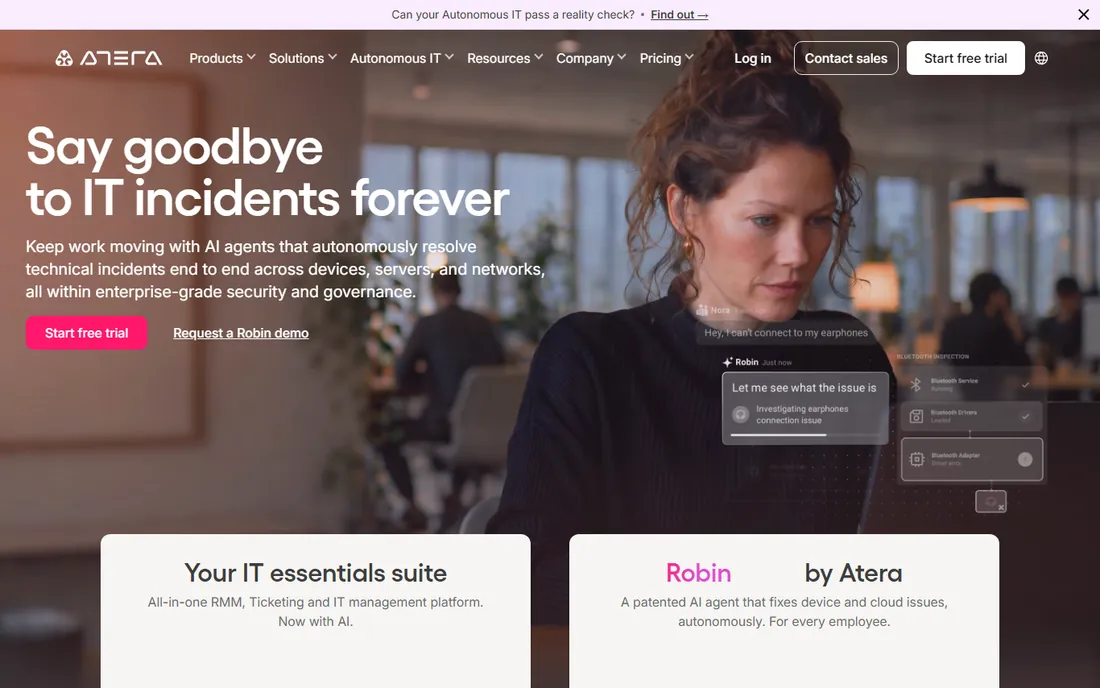
Atera is the default recommendation for MSPs that manage a lot of endpoints with few technicians. The per-technician model means one tech managing 500 devices costs the same as one managing 50, and every tier includes RMM, ticketing and the AI Copilot assistant. Pro starts at $129 per technician per month billed annually, Growth at $159 and Power at $209, with monthly billing running $10 to $40 higher per tier. There is a 30-day trial with no card.
The honest weaknesses: integrations are fewer than NinjaOne's enterprise catalog, reporting customization draws complaints in reviews, and the MSP entry tier is Windows-focused. Atera also stopped publishing its MSP tiers as prominently as before, so confirm the current plan names with sales. For shops under 20 technicians that want predictable costs and fast onboarding, it is still the easiest yes in this list.
What we like- Per-technician pricing with unlimited endpoints
- AI Copilot and Autopilot in every plan
- Transparent published pricing
Watch out for- Integration catalog is thinner than NinjaOne
- MacOS support lags Windows
Starting price$1.50-$3.75/device/month (volume-based)
Free planNo (14-day trial)
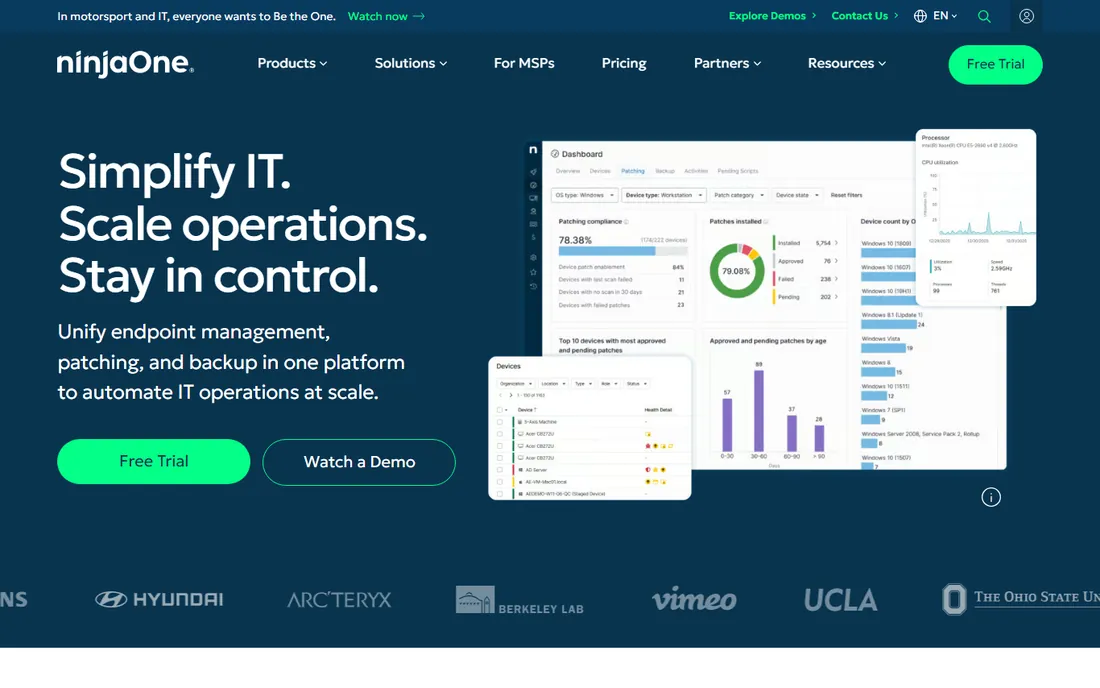
NinjaOne is the tool MSPs switch to when they are tired of fighting their RMM. The interface is the cleanest in the category, automation and scripting are deep, and patch management covers Windows, macOS and Linux with real-time monitoring across 100+ conditions. G2 ratings lead the field at 4.7 across nearly 5,000 reviews, and most teams report being fully operational in under a week.
Pricing is the friction. It is per-device, tiered by volume: roughly $3.75 per device per month at 50 or fewer endpoints down to about $1.50 at 10,000 endpoints, with exact figures by quote. That model favors MSPs with moderate device counts and punishes very large fleets compared with per-technician pricing. Note that NinjaOne is RMM-focused; the PSA is a separate product, so factor that into total cost. A 14-day trial is available.
What we like- Highest user ratings in the category
- Strong automation and patching
- Fast deployment
Watch out for- Exact pricing requires a quote
- PSA sold separately
- Some features need additional NinjaOne products
Starting price$129/user/month (billed annually)
Free planNo (14-day trial)
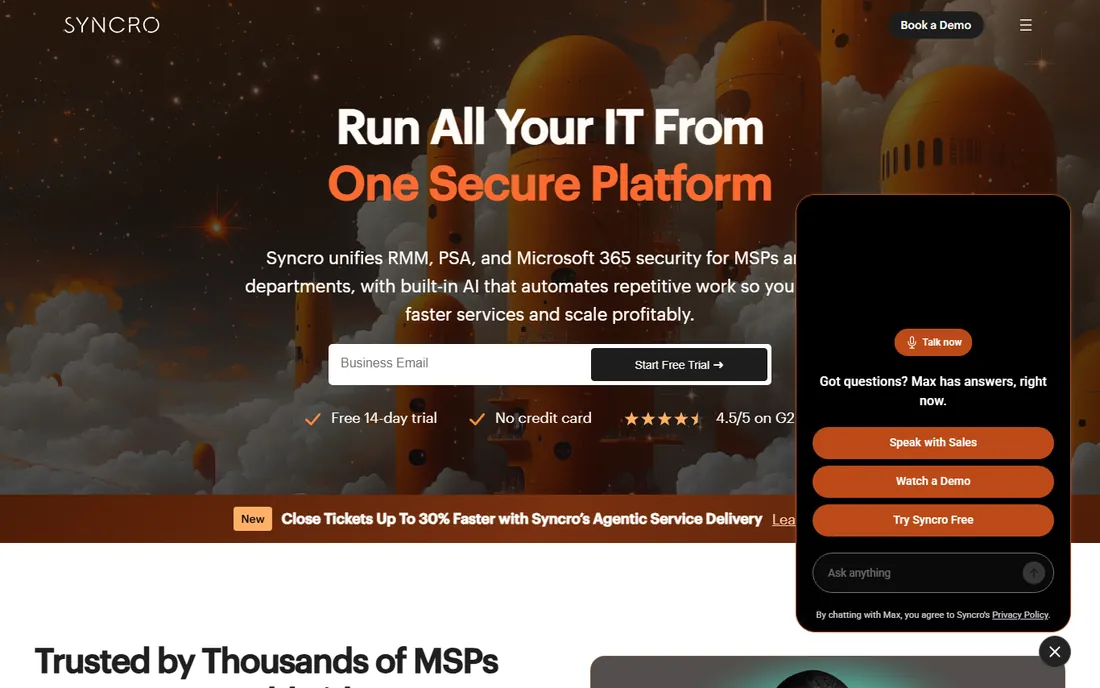
Syncro's pitch is consolidation: RMM, PSA, remote access and billing in one platform, billed per user with unlimited endpoints. Core is $129 per user per month billed annually and Team is $179, both purchasable directly from the website, which makes Syncro the only all-in-one here you can evaluate without a sales process. The 14-day trial needs no credit card.
The PSA depth is real: ticketing, contracts, invoicing and a customer portal are included, not bolted on. Weaknesses are narrower: remote access runs through Splashtop rather than a native tool, and the third-party integration list is shorter than NinjaOne's. For MSPs currently paying one vendor per device for RMM and another per tech for PSA, Syncro's single per-user bill usually cuts total cost and reconciliation work.
What we like- RMM and full PSA in one console
- Published pricing, no sales call needed
- Unlimited endpoints per user
Watch out for- Remote access leans on Splashtop integration
- Smaller review base than Atera or NinjaOne
Starting price$1.50/endpoint/month (100 endpoint minimum)
Free planNo (free trial)
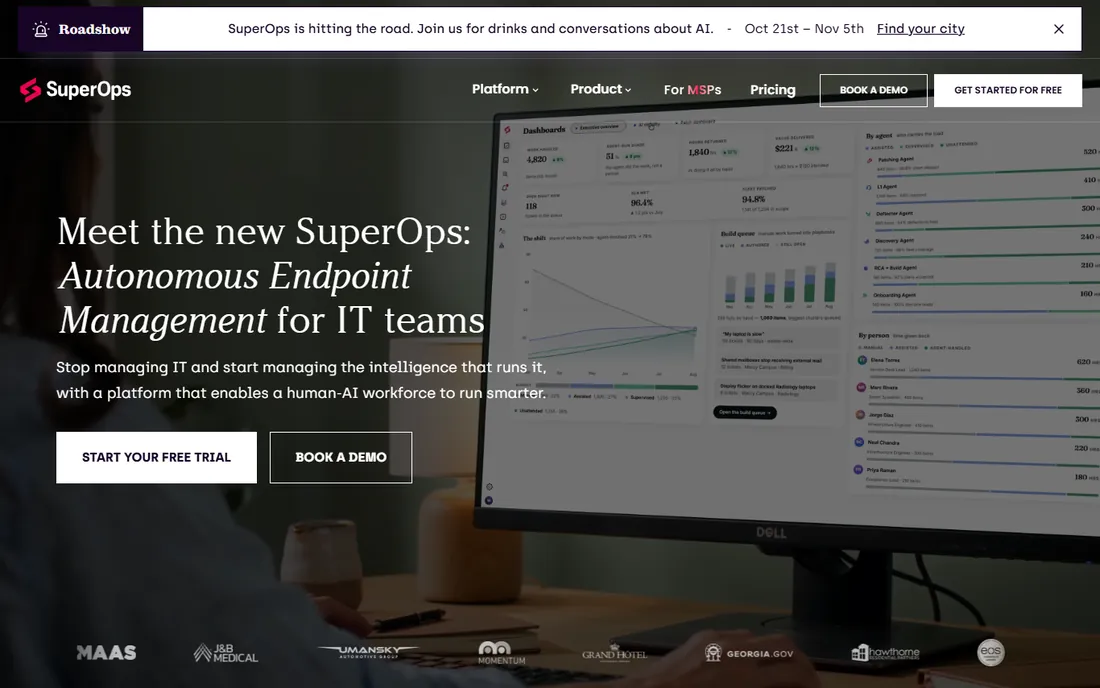
SuperOps is the newer entrant built as a direct answer to legacy RMM complexity. It combines RMM and PSA in one modern console with AI-assisted workflows, and its per-endpoint pricing at $1.50 per endpoint per month makes costs predictable per client contract. A free trial is available, and onboarding is aimed at teams switching from ConnectWise or Kaseya stacks.
The 100-endpoint minimum is the gate: very small shops cannot buy in. The integration ecosystem is also younger than the incumbents, so verify any must-have integration before committing. G2 ratings sit at 4.4, solid for a newer platform. For MSPs above 100 endpoints that want a fresh interface without the legacy baggage, SuperOps is the most credible alternative to the big three.
What we like- Modern interface with AI features
- RMM and PSA unified
- Per-endpoint pricing scales predictably
Watch out for- 100-endpoint minimum excludes the smallest shops
- Younger company with a smaller ecosystem
Starting priceQuote-based (per device, tiered)
Free planNo (14-day trial)
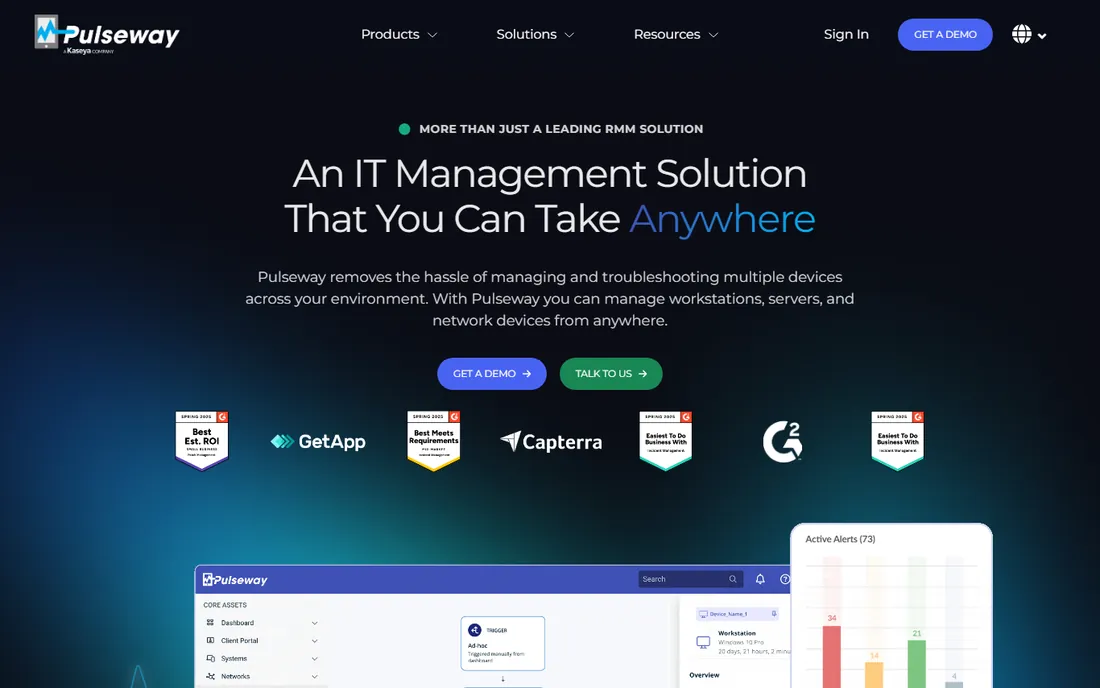
Pulseway built its reputation on the phone in your pocket. Its mobile app lets technicians monitor, alert on and fix issues from anywhere, with real-time push alerts that are genuinely faster than most rivals' email-based notification. The platform covers remote monitoring, patching, automation and remote control, with add-ons for endpoint protection, PSA and backup.
Pricing is quote-based and per-device, tiered by volume. Reviews consistently praise the mobile experience and ease of deployment while flagging that add-ons push the real cost above the headline quote, and support quality gets mixed marks. A 14-day trial is available. If your technicians work mostly from phones or you manage infrastructure across many small sites, Pulseway's mobile-first design is a real differentiator rather than a checkbox.
What we like- Best mobile app in the category
- Real-time alerting
- Quick deployment
Watch out for- Quote-only pricing
- Add-on costs accumulate
- Support quality draws mixed reviews
Starting priceQuote-based (per endpoint)
Free planNo (14-day trial)
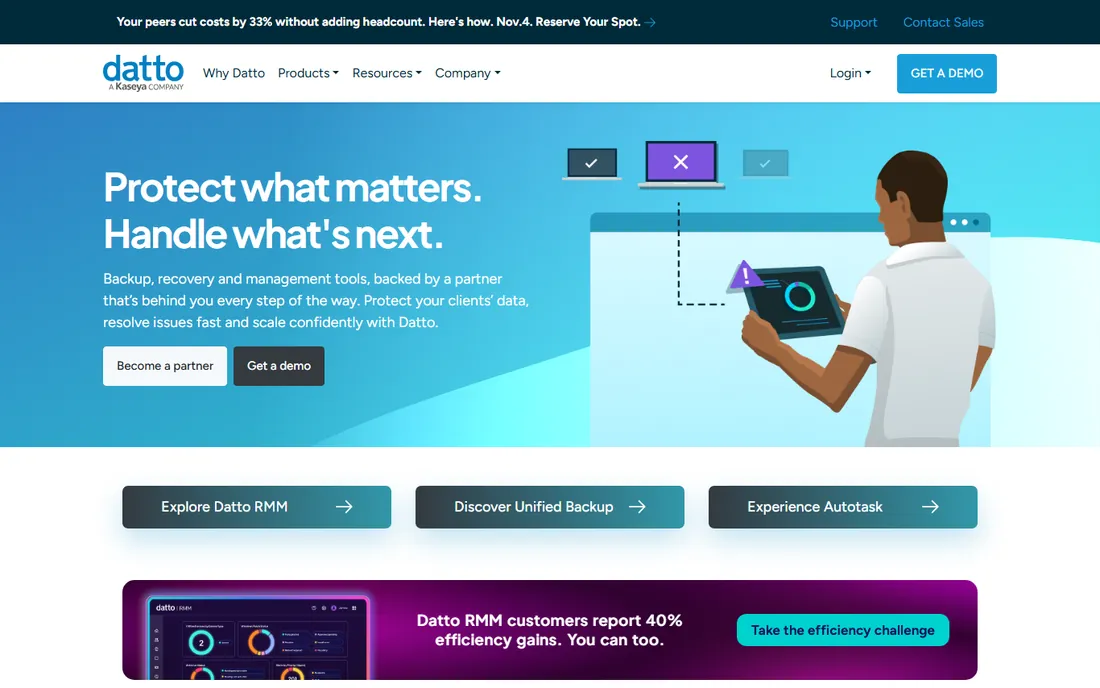
Datto RMM is the steady workhorse of the category, now part of Kaseya. Automated monitoring, intelligent alerting, remote access and patch management are the core, executed reliably across large fleets. Ransomware detection and backup integration reflect its data-protection roots, and the native integrations with Autotask and IT Glue are genuinely deep rather than API-deep.
Nobody picks Datto RMM for the interface; reviewers call it dated, and web remote reliability draws complaints. Pricing is quote-only and per endpoint, and figures circulating online are unverified, so get it in writing. The Kaseya commercial relationship has a reputation MSPs should research before signing a multi-year term. A 14-day trial is available. It fits best for MSPs already standardized on Autotask or other Kaseya products.
What we like- Strong automated monitoring and ransomware detection
- Deep Autotask and IT Glue integration
- Reliable patching
Watch out for- Quote-only pricing
- Dated interface
- Best value inside the Kaseya/Datto ecosystem
Starting priceQuote-based (per device)
Free planNo (free trial)
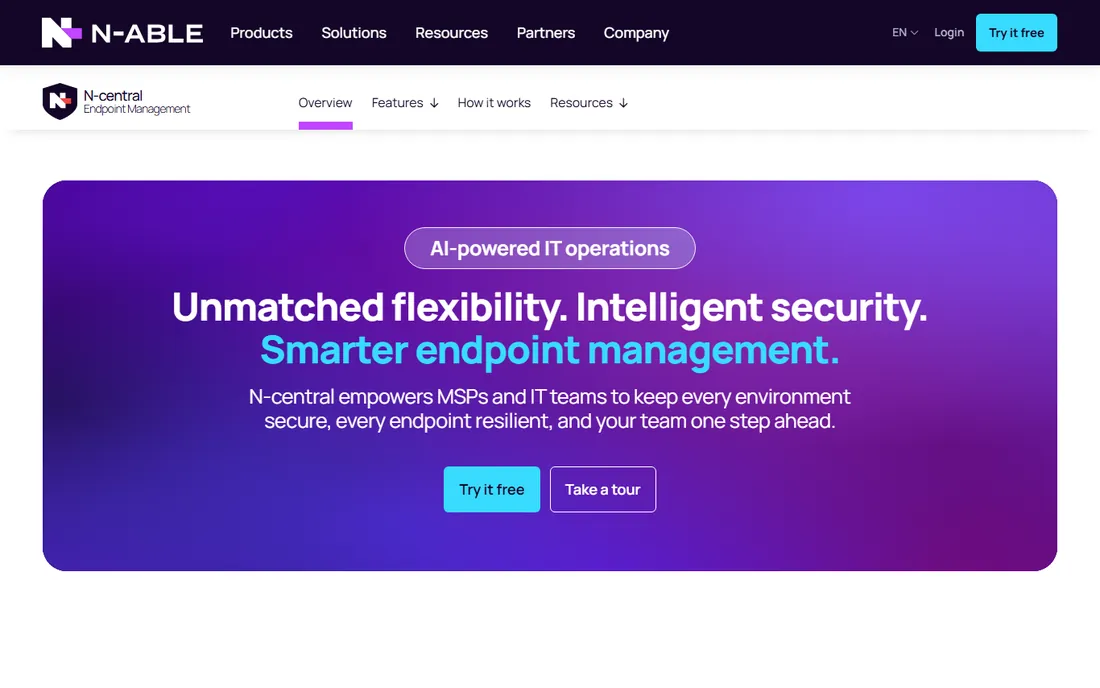
N-central is the enterprise-grade option for MSPs managing complex, heterogeneous environments. Its rules engine and automation policies are the deepest here, network device monitoring is a first-class citizen rather than an add-on, and it deploys on-premises or in the cloud. For large MSPs with compliance requirements and dedicated platform owners, that depth matters.
The cost is complexity. Onboarding is slower than Atera or NinjaOne, the interface shows its age in places, and pricing is quote-only per device. Small shops usually find it oversized; the value appears at scale with a team that can own the platform. A free trial is available. If you are leaving N-central, the usual reasons are the per-device bill and the admin overhead, and Atera or Syncro are the common landing spots.
What we like- Deepest monitoring and automation rules engine
- On-premises or cloud deployment
- Strong network device monitoring
Watch out for- Quote-only pricing
- Steeper learning curve
- Onboarding is slower than cloud-native rivals
Starting priceFree (first 200 endpoints)
Free planYes (200 endpoints free forever)
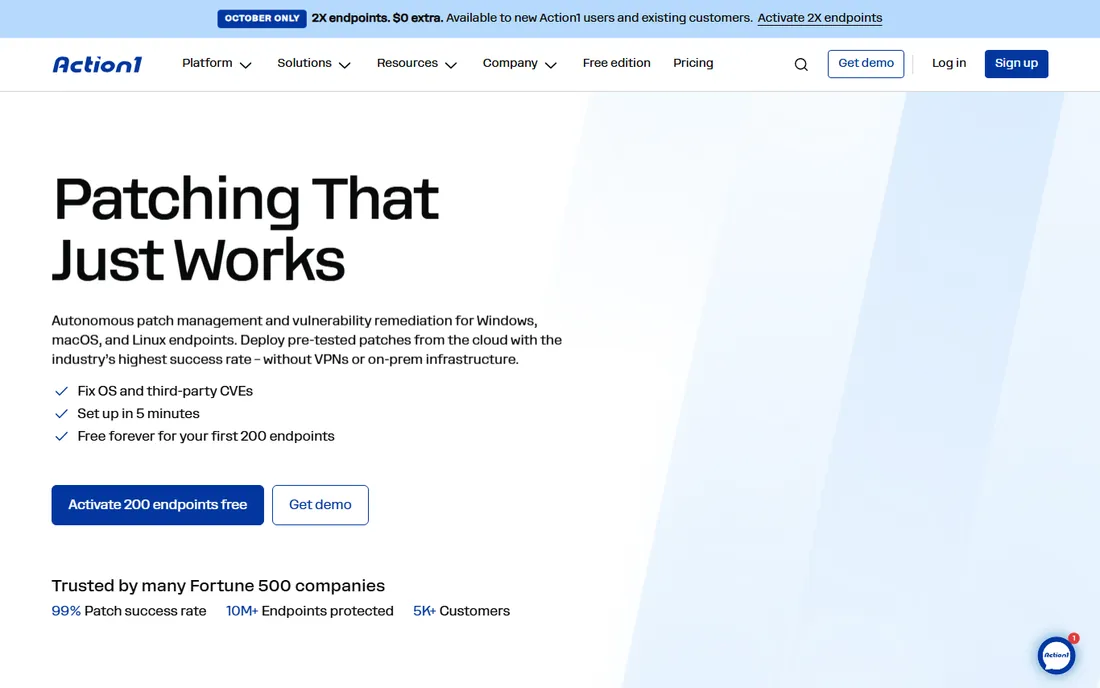
Action1 takes a different angle: it is free for your first 200 endpoints, forever, with full functionality and no expiration. That makes it the cheapest way to get real patch management, vulnerability remediation and endpoint visibility for a small fleet. Setup takes minutes, there is no on-prem server or VPN to maintain, and patching covers Windows, macOS, Linux and third-party applications from a cloud console.
Above 200 endpoints, pricing is quote-based, so larger MSPs need a sales conversation. It is also more of a patching and endpoint management platform than a full RMM suite: ticketing, PSA and deep automation are not its game. For internal IT teams and small MSPs whose biggest pain is patching, the free tier is the best deal in this entire roundup.
What we like- Free for 200 endpoints with no feature limits
- Cloud-native, no on-prem infrastructure
- Strong patching
Watch out for- Full RMM breadth is narrower than dedicated RMM suites
- Pricing above 200 endpoints is quote-based
Starting priceQuote-based
Free planNo (free trial)
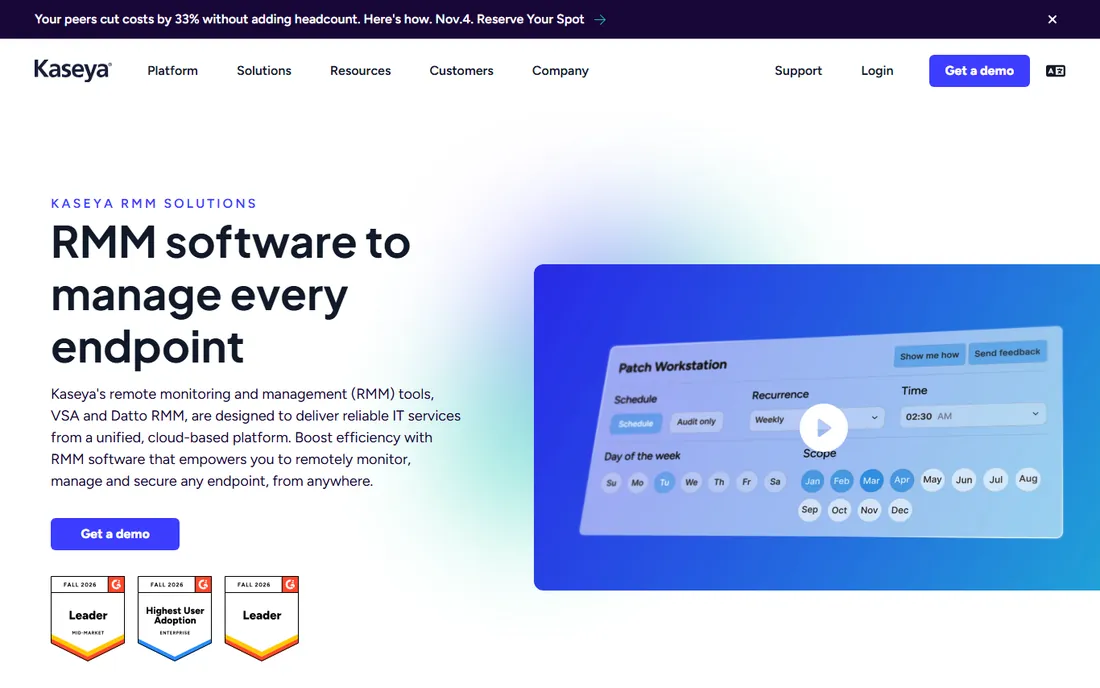
Kaseya VSA is the RMM at the center of the Kaseya universe. Automation, scripting and endpoint management are deep and mature, and if you run BMS, IT Glue, Datto or other Kaseya products, the cross-product integration is the reason to stay. It handles large fleets with policy-based management that smaller tools cannot match.
The caveats are commercial, not technical. Pricing is quote-only, and Kaseya's contract terms and auto-renewal practices are the most complained-about in the industry, so have legal read everything and negotiate renewal caps up front. The interface trails NinjaOne and SuperOps on modernity. A free trial is available. Choose VSA when you are committed to the Kaseya stack; otherwise the standalone specialists usually cost less hassle.
What we like- Deep automation and scripting
- Tight integration across the Kaseya portfolio
- Mature feature set
Watch out for- Quote-only pricing
- Kaseya commercial terms need careful review
- Interface less modern than rivals
How we chose
We shortlisted RMM platforms that MSPs actually buy in 2026, covering per-technician, per-device and per-endpoint models. For each we checked the vendor's pricing page or published rate cards, confirmed trial terms, reviewed feature documentation and public reviews on G2, Capterra and Reddit, and noted PSA integration, deployment options and company-size fit. We weighted pricing transparency heavily, since quote-only models hide the total cost. We did not run hands-on trials; workflow notes come from published reviews and vendor documentation.
Per-technician vs per-device: doing the math
The billing unit decides your bill more than the feature list. Per-technician pricing (Atera, Syncro) charges per human and covers unlimited endpoints, so the economics improve as devices per technician grow. A shop with 5 technicians and 1,000 endpoints pays Atera $645 a month on annual billing regardless of endpoint growth. Per-device pricing (NinjaOne, SuperOps, Pulseway) charges per endpoint, so the same 1,000 endpoints at $3 per device cost $3,000 a month.
The break-even sits around 40 to 50 devices per technician. Above that, per-technician wins; below it, per-device can be cheaper, especially with NinjaOne's volume tiers. Watch minimums: SuperOps requires 100 endpoints, and quote-only vendors often have minimum commits buried in the contract. Model your cost at the endpoint count you expect in two years, not today, and get every quote in writing with the billing unit spelled out.
What to ask on the sales call
Quote-only vendors control the information asymmetry, so bring a checklist. Ask for the per-unit price at your exact endpoint and technician counts, the contract term and auto-renewal clause, and what happens to pricing at renewal. Ask which features in the demo are add-ons: backup, EDR, PSA modules and advanced automation are commonly licensed separately. Ask about onboarding cost and timeline, data export format if you leave, and whether the trial is the full product or a limited build.
Push on two specifics. First, patch management depth: OS patching is table stakes, but third-party application patching is where MSPs bleed time, and not every RMM covers it well. Second, remote access: some vendors bundle a native tool, others resell Splashtop or ScreenConnect, which changes both cost and the technician experience. Get the answers in the quote document, not just on the call.
Frequently asked questions
What does RMM software do?
Remote monitoring and management software lets MSPs and IT teams monitor endpoints, automate patching, run scripts, send alerts and provide remote support from one console. It replaces driving to client sites and manual checkups with policies that run automatically across the fleet.
How much does RMM software cost?
Published pricing in 2026 runs from free (Action1, up to 200 endpoints) to $129 per technician or user per month for Atera and Syncro, and $1.50 to $3.75 per device per month for NinjaOne and SuperOps. Quote-only vendors (Datto, N-able, Pulseway, Kaseya) vary widely; expect volume discounts and minimum commits.
Should an MSP choose per-technician or per-device pricing?
Per-technician pricing wins when each technician manages many endpoints, roughly 50 or more. Per-device pricing can be cheaper for small fleets or when device counts fluctuate. Model both at your two-year endpoint projection before deciding, since switching RMM platforms later is expensive.
Do I need a PSA if I buy an RMM?
Not always, but most growing MSPs end up with both. Syncro and SuperOps bundle PSA with RMM; NinjaOne sells it separately; Atera includes ticketing but its PSA is light. If you already run ConnectWise PSA or Autotask, a standalone RMM like NinjaOne or Datto RMM may integrate better than replacing everything.
Can I try RMM software before buying?
Yes. Atera offers a 30-day trial, NinjaOne, Syncro, Pulseway and Datto RMM offer 14-day trials, and Action1 is free up to 200 endpoints with no time limit. Run the trial against a real client environment, not a lab, and test patching, alerting and remote access under load.
How hard is it to switch RMM vendors?
Harder than the sales demo suggests. Agent deployment across the fleet, monitoring policy rebuilds, script migration and PSA integration rework take weeks. Negotiate onboarding assistance and confirm data export options before signing, and avoid long initial terms until the platform proves itself in production.
Sources we checked (12)
- https://www.channelinsider.com/channel-business/helpdesk-itsm-and-other-tools/best-msp-rmm/
- https://www.channelinsider.com/channel-business/helpdesk-itsm-and-other-tools/atera-ninjaone-msp-rmm-comparison/
- https://www.channelinsider.com/security/ninjarmm-review/
- https://syncrosecure.com/blog/all-in-one-msp-software/
- https://www.flamingo.run/blog/ninjaone-pricing-per-device
- https://slashdot.org/software/comparison/Kaseya-VSA-vs-Pulseway-vs-Syncro/
- https://Sourceforge.net/software/compare/Pulseway-vs-Syncro/
- https://slashdot.org/software/comparison/Datto-RMM-vs-N-able-N-central/
- https://sourceforge.net/software/compare/Datto-RMM-vs-Kaseya-VSA-vs-Syncro/
- https://www.pdq.com/blog/best-rmm-tools-and-alternatives-for-internal-it-teams/
- https://www.infrassist.com/blog/top-noc-tools-for-msps/
- https://www.action1.com/
Is your product missing or out of date?
We review this list regularly. Vendors can request a listing, send updated pricing or ask about featured placement.

Shihab Mia · Founder, Rankite
Shihab has spent more than a decade helping SaaS and e-commerce brands grow through search. He writes Rankite's software buying guides from pricing pages, documentation and public user reviews. More about Shihab.