How we make this list: we compare pricing pages, product documentation and public user reviews. Ratings come from G2, Capterra or Trustpilot, with the date we checked them.
Quick comparison
Is your product missing or out of date?
We review this list regularly. Vendors can request a listing, send updated pricing or ask about featured placement.
Key takeaways
- There is no single best risk assessment software for every company. Enterprise platforms suit large programs; automated compliance tools suit startups and mid-market teams.
- Two rebrands happened in 2026: AuditBoard is now Optro, and StandardFusion is now TeamMate Risk & Compliance after its acquisition by Wolters Kluwer.
- None of the nine vendors on this list publishes pricing on its own site. Every option below requires a demo or quote.
- If you need SOC 2, ISO 27001, or HIPAA quickly, start with Drata, Vanta, or Hyperproof. If you need SOX, audit management, or enterprise risk registers, start with Optro, LogicGate, or MetricStream.
The best risk assessment software
Risk assessment software lives or dies on fit: a startup chasing SOC 2 needs something very different from an enterprise running SOX audits. None of the vendors below publish pricing, so expect a demo and a quote.
These nine cover automated compliance platforms, enterprise GRC suites, and mid-market all-in-ones.
Starting priceSee website
Free planNo
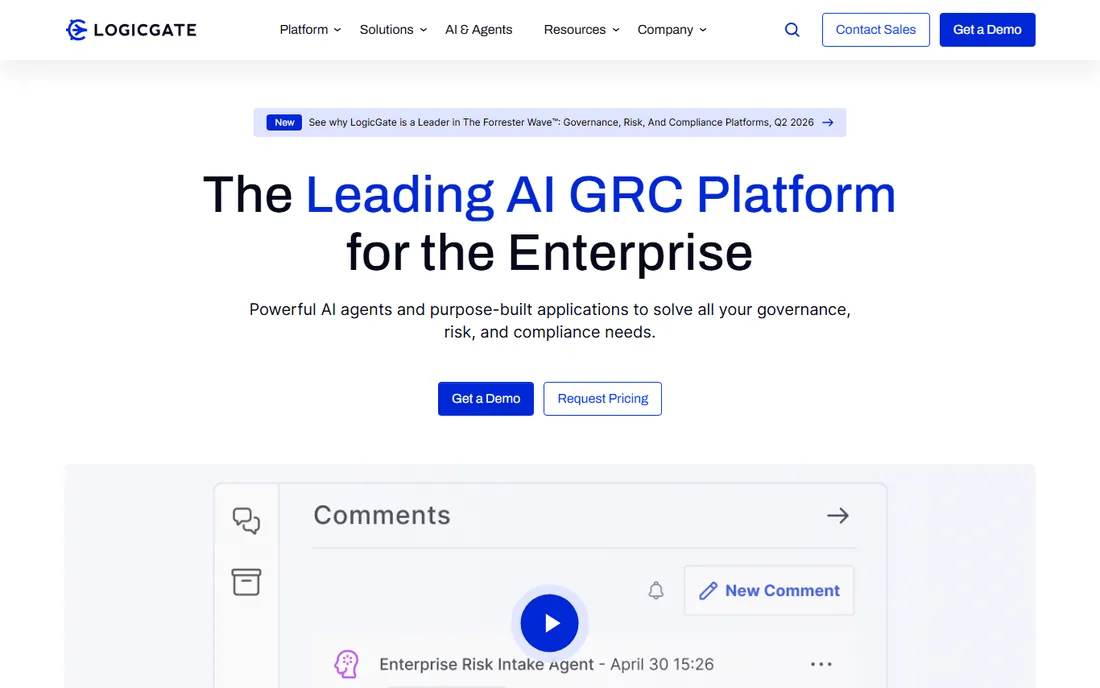
Risk Cloud by LogicGate sits at the enterprise end of this list. The platform's signature piece is a no-code graph database that links controls, assets, and risks in one connected view, so program owners can trace how a single risk touches multiple programs without digging through separate systems.
AI is now front and center. LogicGate launched GRC Agents plus Config Newton, described on its site as an agentic assistant that builds and scales GRC programs in minutes rather than weeks. Automated control testing moves teams from ad-hoc checks toward continuous compliance, with notifications when issues arise.
Pricing is quote-based and not shown publicly. LogicGate publishes no free plan or trial on its site; demos are the standard entry point. Its homepage notes recognition from Gartner, Forrester, and G2, which is consistent with its positioning as an enterprise leader.
What we like- No-code graph database, AI GRC agents, fast implementation for its class
Watch out for- Pricing is not published, enterprise focus may be heavy for small teams
Starting priceSee website
Free planNo
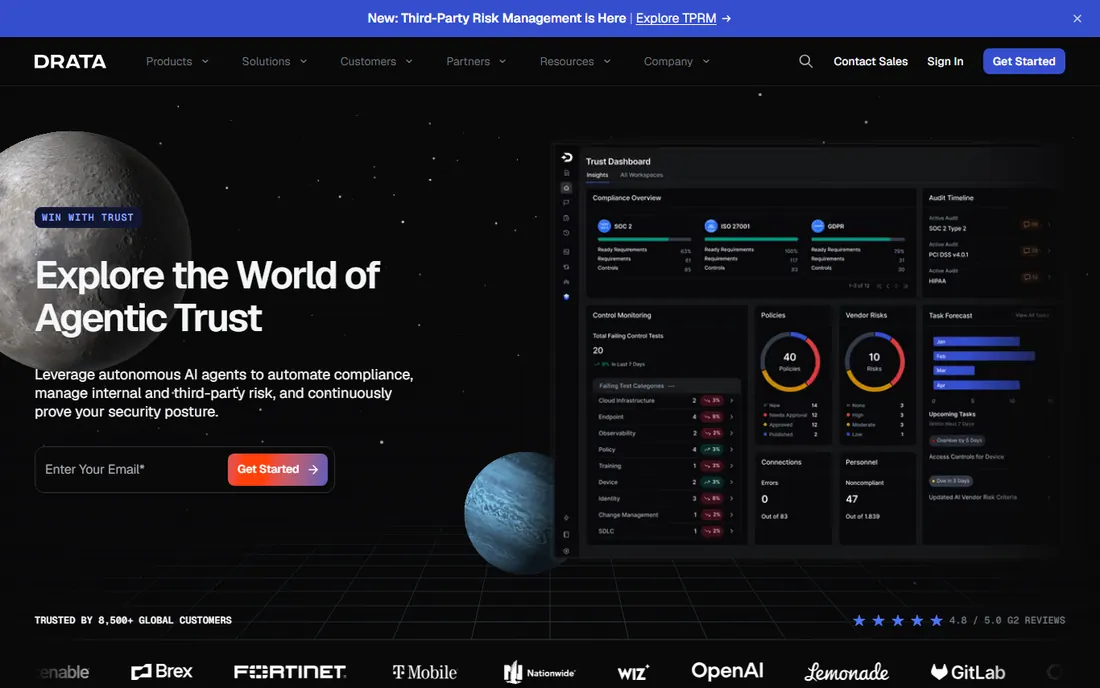
Drata takes the opposite approach: continuous automation for compliance-heavy companies. The platform collects evidence automatically, monitors controls around the clock, and cross-maps a single control set to multiple frameworks such as SOC 2, ISO 27001, HIPAA, and PCI DSS.
Two features stand out for risk assessment. Its risk management module brings controls, risks, policies, and evidence into one system for standardized governance. Its AI agents can now draft answers to security questionnaires and run criteria-based vendor assessments for third-party risk.
Drata does not publish pricing or a free tier on its website. Some third-party directories quote figures, but those are not the vendor's own numbers, so we list them as unverifiable. Expect a sales-led quote based on company size and frameworks.
What we like- Continuous control monitoring, broad integrations, AI questionnaire agents
Watch out for- Pricing is not published, compliance automation focus rather than deep risk modeling
Starting priceSee website
Free planNo
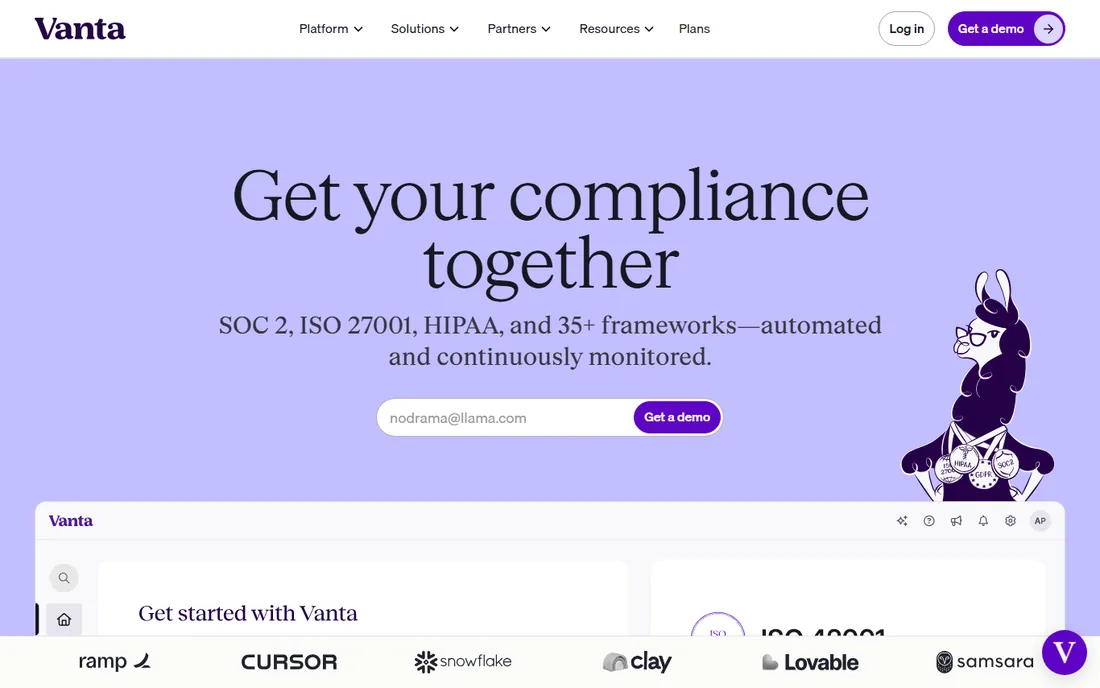
Startups that need a SOC 2 report before the next funding round usually land on Vanta. The platform automates the evidence collection, policy drafting, and control monitoring that make SOC 2 painful for small teams without a compliance department.
Vanta's homepage states it is trusted by more than 16,000 customers, from startups to enterprise. Its trust center and questionnaire automation turn compliance from a sales blocker into an asset, since prospects can review your security posture without starting a two-week email thread.
Pricing is not published on the site. Vanta sells through demos and custom quotes. For companies whose main goal is proving compliance to customers rather than running a full enterprise risk program, it is often the shortest path on this list.
What we like- Fastest path to SOC 2 for small teams, large customer base, trust center included
Watch out for- Pricing is not published, lighter on traditional enterprise risk workflows
Starting priceSee website
Free planNo
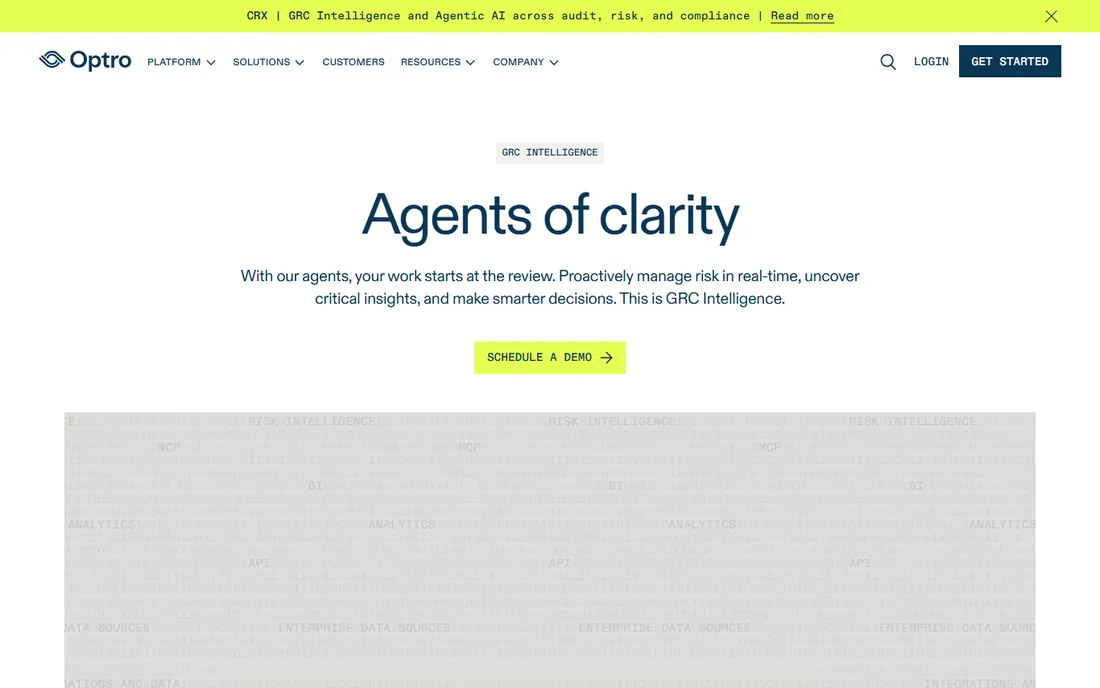
If your team still calls it AuditBoard, update the name on your shortlist. The company rebranded to Optro in 2026, a fact confirmed on the auditboard.com homepage itself. The product covers audit, risk, infosec, compliance, and AI governance under one banner.
Optro grew out of internal audit and SOX management, which remains its strongest differentiator. Risk-based audits, connected risk views, and autonomous testing speak directly to audit teams, while newer AI agents handle the repetitive review work that slows programs down.
Pricing is custom and not published. Optro lists no free plan on its site. Its homepage cites recognition from Forrester and Gartner for 2026 and 2025 respectively, plus heavy Fortune 500 adoption. For audit-led GRC programs, it is one of the safest enterprise picks.
What we like- Deep audit management roots, AI agents for GRC, strong enterprise adoption
Watch out for- Pricing is not published, can be more platform than small teams need
Starting priceSee website
Free planNo
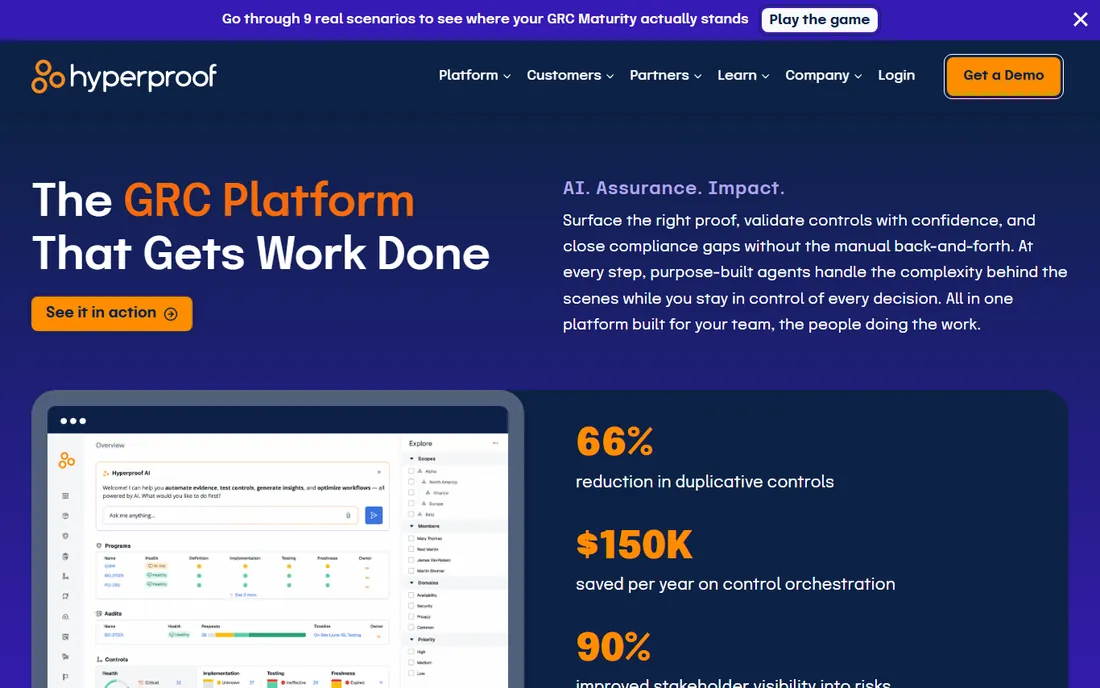
Hyperproof organizes GRC around the word proof, and that is the whole point. The platform automates control mapping, connects controls to risks, and keeps a common control set across compliance, risk, audit, trust, third-party risk, and governance modules.
Its differentiator for regulated teams is Hyperproof Gov, which runs in a FedRAMP Certified environment for high-security organizations. With more than 200 integrations listed on its site, including AWS, Azure, Slack, Jira, and ServiceNow, evidence collection pulls directly from the tools teams already use.
Pricing is quote-based with no public numbers. Hyperproof sells demos rather than self-serve plans. If your risk assessment program must satisfy government-grade requirements, its Gov offering puts it ahead of most mid-market options here.
What we like- 200+ integrations, FedRAMP-certified Gov environment, strong TPRM coverage
Watch out for- Pricing is not published, broad platform may need guidance to configure
Starting priceSee website
Free planNo
MetricStream is the heavyweight here. The company describes its platform as an AI-first connected GRC solution covering risk, audit, compliance, cyber, and resilience, and it is aimed squarely at large organizations with complicated programs.
Analyst recognition is a recurring theme. Chartis Research ranks MetricStream as the top vendor in enterprise GRC and a leader across seven categories, and its site cites leadership placements from Gartner, IDC, Forrester, and Verdantix. Customer names on the homepage include large banks, energy companies, and insurers.
Pricing is fully custom. MetricStream offers demos and guided enterprise evaluations rather than trials. For a small or mid-sized business, this is likely more platform than you need. For a regulated enterprise running many frameworks at once, it belongs on the shortlist.
What we like- Deepest enterprise GRC coverage, strong analyst recognition, AI-first platform
Watch out for- Pricing is not published, enterprise scale means longer implementations
Starting priceSee website
Free planNo
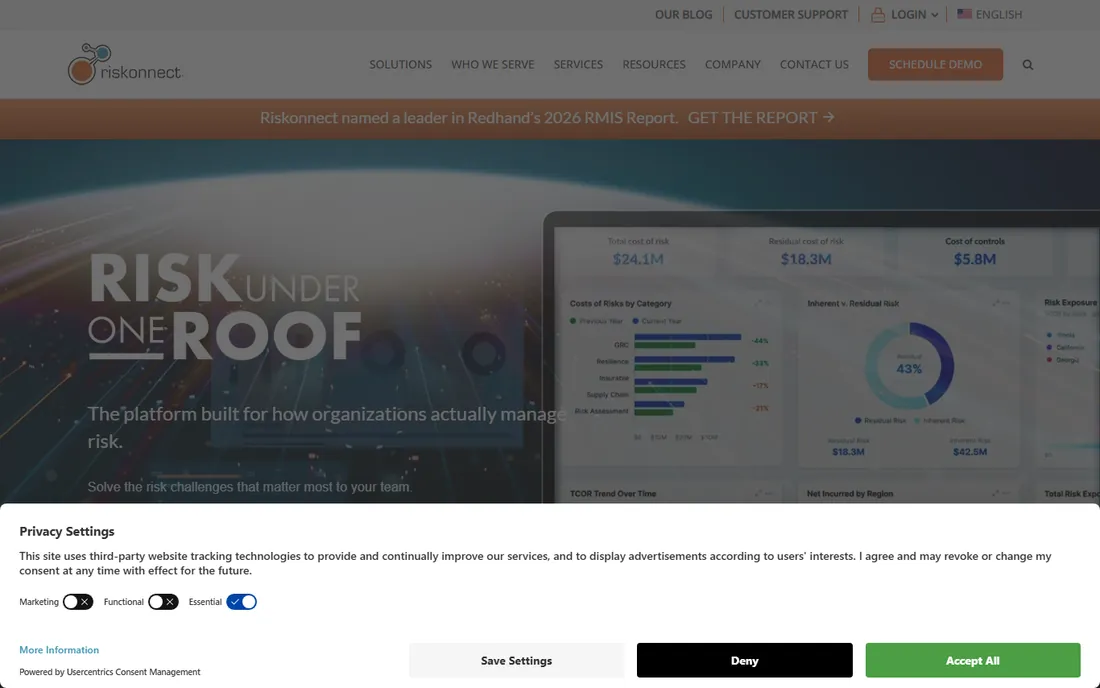
Riskonnect grew up outside pure cyber compliance. Its platform covers enterprise risk, claims management, and business continuity, which makes it a natural fit for companies where risk means physical operations, insurance costs, and regulatory exposure rather than just security controls.
The homepage leads with customer stories from companies such as IHG Hotels & Resorts, Wendy's, and the U.S. Army. Features include an active risk manager for building a risk-aware culture, plus a monthly webinar series that carries CPE credits for risk professionals.
Pricing is quote-based and not published. Riskonnect offers demos, not free plans. If your risk register includes operational and insurable risks alongside cyber, few tools on this list cover that ground as directly.
What we like- Integrated risk and claims management, strong customer proof points, CPE training
Watch out for- Pricing is not published, cyber compliance is not its core strength

#8
TeamMate Risk & Compliance (formerly StandardFusion)
Best for: Mid-market teams that want all-in-one GRC
Visit standardfusion.com
Starting priceSee website
Free planNo
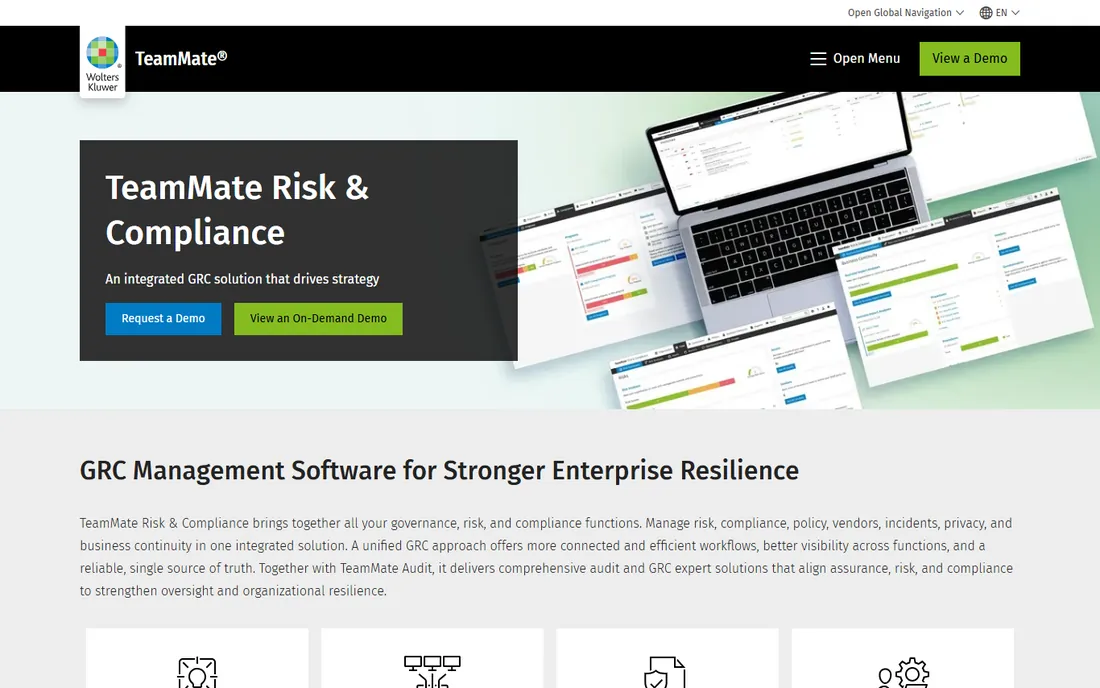
TeamMate Risk & Compliance is the new name on a familiar product. Following Wolters Kluwer's acquisition of StandardFusion, the cloud GRC solution was folded into TeamMate, and the standardfusion.com homepage now carries the TeamMate branding. Buyers who knew the old name should treat them as the same lineage.
The platform is modular: risk, compliance, policy, vendor, privacy, business continuity, and incident management work together or stand alone. A library of more than 150 frameworks ships out of the box, covering ISO 27005, NIST, FAIR, and BIA among others, with custom methodologies available.
Pricing is quote-based. Some third-party directories quote figures, but those are not the vendor's own numbers and cannot be verified. For mid-market teams that want one system without enterprise-level consulting bills, the modular design keeps costs and complexity in check.
What we like- 150+ frameworks out of the box, modular design, configurable workflows
Watch out for- Pricing is not published, rebrand may confuse buyers who knew StandardFusion
Starting priceSee website
Free planNo
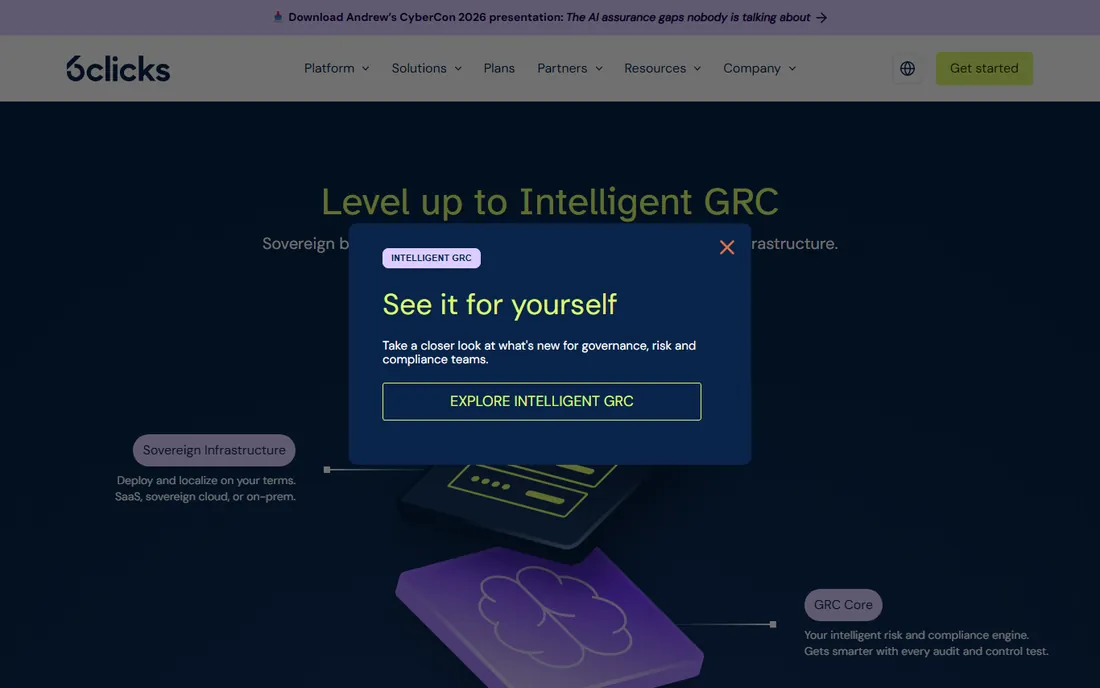
6clicks is the youngest company on this list and the most approachable for smaller teams. Its AI engine, called Hailey, handles compliance mapping and policy gap analysis in seconds, which cuts the manual work that usually makes GRC painful for understaffed teams.
The platform's Hub & Spoke architecture gives a single view across distributed organizations, and it supports SaaS, sovereign cloud, and on-premises deployment. A content library ships with frameworks such as ISO 27001 and the NIST Cybersecurity Framework built in, so teams are not starting from blank spreadsheets.
Pricing is not published and the site funnels buyers toward a strategy call. 6clicks announced a $20 million investment round in early 2026 to expand its AI and GRC footprint, suggesting it plans to stay aggressive in this market.
What we like- AI engine for compliance mapping, Hub & Spoke architecture, sovereign deployment options
Watch out for- Pricing is not published, smaller brand than the enterprise leaders
Two name changes worth knowing in 2026
Two tools on this list changed names this year, and outdated shortlists still carry the old ones. AuditBoard rebranded to Optro, as confirmed on the auditboard.com homepage. StandardFusion was acquired by Wolters Kluwer and became TeamMate Risk & Compliance, as confirmed on the standardfusion.com homepage.
Neither change altered the underlying products. If an older review, RFP, or colleague recommendation mentions AuditBoard or StandardFusion, you are looking at the same platforms under new names. Searching for the old names still works, since both companies keep the old domains live.
We opened the homepage of every vendor on this list in October 2026 and copied each URL directly from the browser address bar after all redirects. That is also how we caught the 2026 rebrands, since both AuditBoard and StandardFusion now resolve to their new names.
For features, we used each vendor's own product pages and documentation rather than marketing summaries. For pricing and plans, we checked the vendor's own pricing pages only. Where pricing was not published, we wrote "See website" instead of quoting third-party directory numbers we could not verify on the vendor's own site.
For fit, we weighed public reviews on G2 and Capterra, discussion threads on Reddit, the breadth of each integration list, and which company sizes each vendor actually serves. The result mixes enterprise leaders with smaller, more approachable vendors so teams of any size can find a starting point.
How to pick the best risk assessment software
Start with your frameworks. A team chasing SOC 2 and ISO 27001 needs automated evidence collection, which points to Drata, Vanta, or Hyperproof. A team managing SOX, internal audits, and enterprise risk registers needs audit depth, which points to Optro, LogicGate, or MetricStream.
Next, check the integration list. The best risk assessment software pulls evidence from your existing stack, such as AWS, Azure, Okta, Jira, or Slack, instead of asking you to upload screenshots by hand. Every tool on this list publishes an integration catalog; compare yours against it before booking a demo.
Then weigh the deployment effort. Automated compliance tools can be running in weeks. Enterprise GRC platforms often take months and may need implementation partners. Match the platform's weight to the size of your team and the complexity of your program.
Finally, demand a real demo. Since no vendor here publishes pricing, you will talk to sales regardless. Ask for a walkthrough built around your actual frameworks, not a generic tour, and ask how long similar customers took to reach their first completed assessment.
Frequently asked questions
What is risk assessment software?
Risk assessment software identifies, scores, and tracks risks across an organization. It typically combines risk registers, control libraries, evidence collection, and reporting so teams can measure exposure, assign mitigation work, and prove to auditors that controls are working.
How much does risk assessment software cost?
Most options are quote-based. Vendors price on company size, number of users, and frameworks, and none of the nine tools on this list publishes pricing on its own site. Expect to request a demo and speak with sales for an accurate number.
Is there free risk assessment software?
The tools on this list do not offer free plans. Most provide demos or guided evaluations. Free and open-source options exist outside this list, but they require significant setup and lack the automation these commercial platforms provide.
What is the difference between GRC software and risk assessment software?
Risk assessment software is the narrower category: it focuses on identifying and managing risk. GRC software is broader, covering governance, risk, and compliance together. In practice, most modern platforms combine both, which is why this list includes tools marketed under either name.
How long does implementation take?
Automated compliance tools such as Vanta or Drata can be running in weeks. Enterprise GRC platforms such as MetricStream or Optro often take several months, especially when they require data migration, framework configuration, and implementation partners.
Which frameworks do these tools support?
Coverage varies by vendor. Most support common frameworks such as SOC 2, ISO 27001, NIST, HIPAA, and PCI DSS. TeamMate lists more than 150 frameworks, while enterprise platforms let you add custom frameworks. Confirm your specific frameworks are covered before you commit.
Sources we checked (9)
- http://logicgate.ai/
- https://drata.com/
- https://vanta.com/
- https://auditboard.com/
- https://hyperproof.io
- https://www.metricstream.com
- https://riskonnect.com/
- https://standardfusion.com/
- https://www.6clicks.com/
Is your product missing or out of date?
We review this list regularly. Vendors can request a listing, send updated pricing or ask about featured placement.

Shihab Mia · Founder, Rankite
Shihab has 5+ years in B2B and SaaS SEO. He writes Rankite's software buying guides from pricing pages, documentation and public user reviews. More about Shihab.
 LogicGate
 Drata
Drata Vanta
Vanta Optro (formerly AuditBoard)
 Hyperproof
 MetricStream
 Riskonnect
 6clicks