How we make this list: we compare pricing pages, product documentation and public user reviews. Rankite is independent; if a vendor ever pays for a featured spot, that listing is clearly labeled Partner.
Key takeaways
- MetricStream, LogicGate, and Archer lead the analyst rankings, but each targets a different buyer: MetricStream for breadth, LogicGate for configurability, Archer for regulated industries.
- AuditBoard has been renamed to Optro; the platform and the auditboard.com domain continue under the new brand.
- Resolver was acquired by Kroll and continues as a Kroll business; we replaced it with Predict360 by 360factors to keep this list focused on independent ERM platforms.
- ServiceNow GRC is the pick when risk must live on the same platform as IT service management and workflows.
- Every tool here is quote-based enterprise pricing; budget for six-figure annual contracts and multi-month implementations.
Quick comparison
| Tool | Best for | Starting price | Free plan |
|---|
 LogicGate LogicGate | teams that want to configure their own GRC without consultants | See website | No |
 Optro (formerly AuditBoard) Optro (formerly AuditBoard) | audit-led organizations that want connected risk, compliance, and ESG | See website | No |
 MetricStream MetricStream | large enterprises that want the broadest GRC product portfolio | See website | No |
 Archer Archer | banks and regulated enterprises with mature GRC programs | See website | No |
 Riskonnect Riskonnect | integrated risk management with claims and RMIS heritage | See website | No |
 ServiceNow GRC ServiceNow GRC | enterprises already standardized on ServiceNow | See website | No |
 LogicManager LogicManager | mid-market companies that want ERM with predictable pricing | See website | No |
 Predict360 Predict360 | banks, credit unions, and financial institutions | See website | No |
 Fusion Fusion | operational resilience and business continuity-led risk programs | See website | No |
Is your product missing or out of date?
We review this list regularly. Vendors can request a listing, send updated pricing or ask about featured placement.
The best enterprise risk management software
#1
LogicGate
Best for: teams that want to configure their own GRC without consultants
Visit logicgate.com
Starting priceSee website
Free planNo
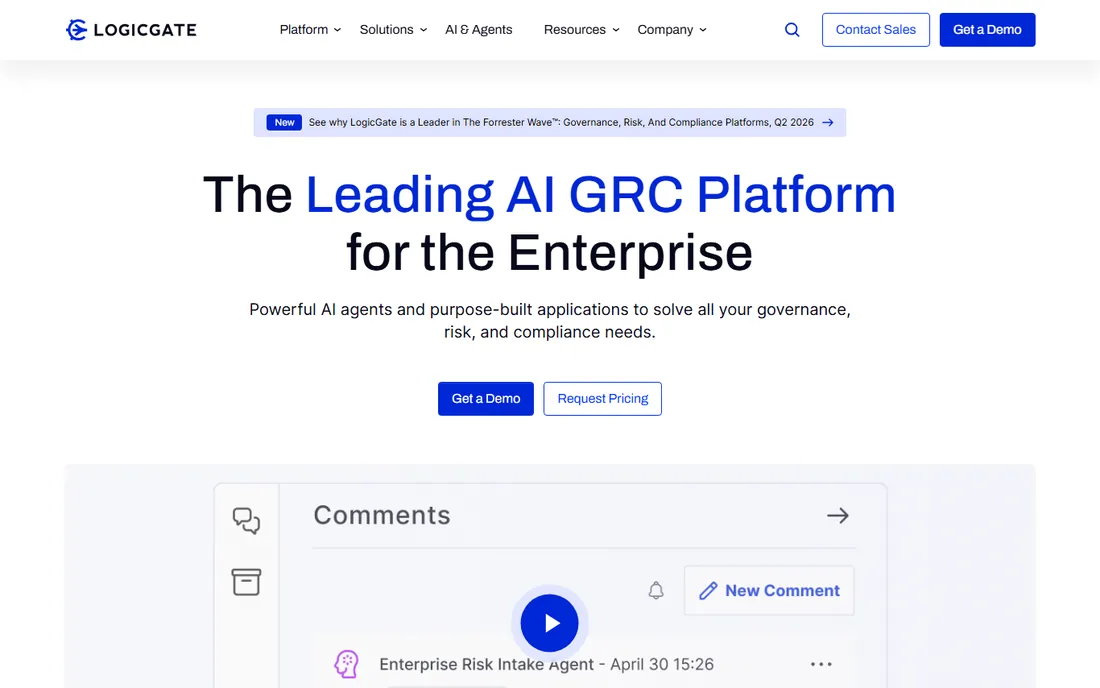
LogicGate's Risk Cloud is built on a no-code graph database that connects controls, assets, and risks, letting program owners build and reshape GRC applications with drag-and-drop tooling instead of custom code or consultants. The company reports average implementations of 96 days against an industry average of six to twelve months, and its AI agents handle evidence review, form autofill, and workflow orchestration. It is recognized as a Leader by Gartner and Forrester in GRC.
The trade-off of a do-it-yourself platform is that you do more yourself: teams without GRC maturity can under-configure. Pricing is quote-based and enterprise-grade. But for organizations that want one flexible engine for ERM, third-party risk, cyber risk, and compliance rather than a set of rigid modules, LogicGate's configurability is the differentiator.
What we like- No-code graph database and drag-and-drop workflow builder
- Fast implementation (weeks, not months)
- Strong GRC AI agents
Watch out for- Quote-only pricing
- Configurability means you build more yourself
- Smaller partner ecosystem than MetricStream
#2
Optro (formerly AuditBoard)
Best for: audit-led organizations that want connected risk, compliance, and ESG
Visit auditboard.com
Starting priceSee website
Free planNo
AuditBoard renamed itself to Optro in 2026; the platform, team, and auditboard.com domain continue under the new brand, and Gartner named Optro (formerly AuditBoard) a Leader in its 2025 Magic Quadrant for GRC. The platform grew out of audit and SOX management, which gives it unusual depth in controls testing, evidence collection, and continuous assurance. More than half of the Fortune 500 use it, and its AI agents now support risk scenario planning and real-time risk oversight.
The audit heritage cuts both ways: ERM teams that want a risk-first (rather than controls-first) view sometimes find the platform compliance-flavored. Pricing is quote-based. If your ERM program sits alongside internal audit and SOX, Optro's connected platform is the natural home for it.
What we like- Top-rated usability and fast-growing customer base
- Strong audit and SOX heritage
- AI agents for continuous testing
Watch out for- Quote-only pricing
- Audit-centric DNA can feel compliance-heavy for pure ERM buyers
- Rebrand may confuse during evaluation
#3
MetricStream
Best for: large enterprises that want the broadest GRC product portfolio
Visit metricstream.com
Starting priceSee website
Free planNo
MetricStream is the largest independent GRC pure play, with an AI-first platform spanning risk, compliance, audit, cyber GRC, third-party risk, and resilience on a low-code/no-code cloud foundation. Chartis ranked it #1 in Enterprise GRC and a category leader across all seven categories it covers; its customer roster includes Nordea, Shell, Siemens Energy, and London Stock Exchange Group. A Forrester Total Economic Impact study cited 133% ROI for customers.
Breadth is the risk: implementations are enterprise-scale projects, and the platform is more than most mid-market companies need. Pricing is quote-based and aimed at large budgets. For global enterprises that want one vendor covering every GRC domain with industry-specific depth, MetricStream is the reference choice.
What we like- Ranked #1 in Enterprise GRC by Chartis across seven categories
- Deep industry-specific products
- Trusted by major banks and energy firms
Watch out for- Quote-only enterprise pricing
- Broad suite can mean long, complex implementations
- Heavier than mid-market buyers need
#4
Archer
Best for: banks and regulated enterprises with mature GRC programs
Visit archerirm.com
Starting priceSee website
Free planNo
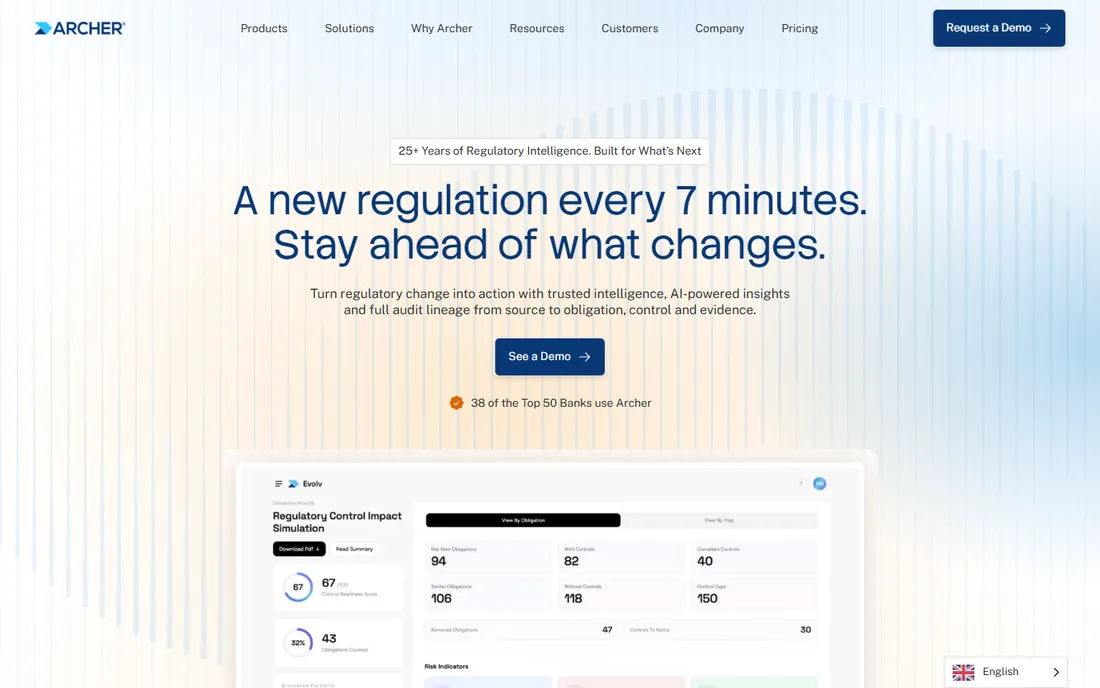
Archer is the pioneer of the integrated risk management category, with more than two decades in the market and a customer base including over half of the Fortune 500; 38 of the top 50 banks use it. The new Archer Evolv portfolio adds AI-powered compliance, risk, and intelligence capabilities that deploy alongside existing Archer GRC without a costly rebuild, addressing the platform's historic heaviness. Continuous controls monitoring and regulatory change management are current strengths.
Archer's history is also its baggage: older on-premises deployments are complex, and the Evolv transition needs a roadmap conversation. Pricing is quote-based. For regulated industries that need proven, deep GRC with modern AI layered on top, Archer remains the incumbent to beat.
What we like- 25+ years of GRC pedigree with 1,200+ customers
- New Archer Evolv AI platform modernizes without migration
- Strong in financial services
Watch out for- Quote-only pricing
- Legacy GRC implementations can be heavy
- Product line transitions require planning
#5
Riskonnect
Best for: integrated risk management with claims and RMIS heritage
Visit riskonnect.com
Starting priceSee website
Free planNo
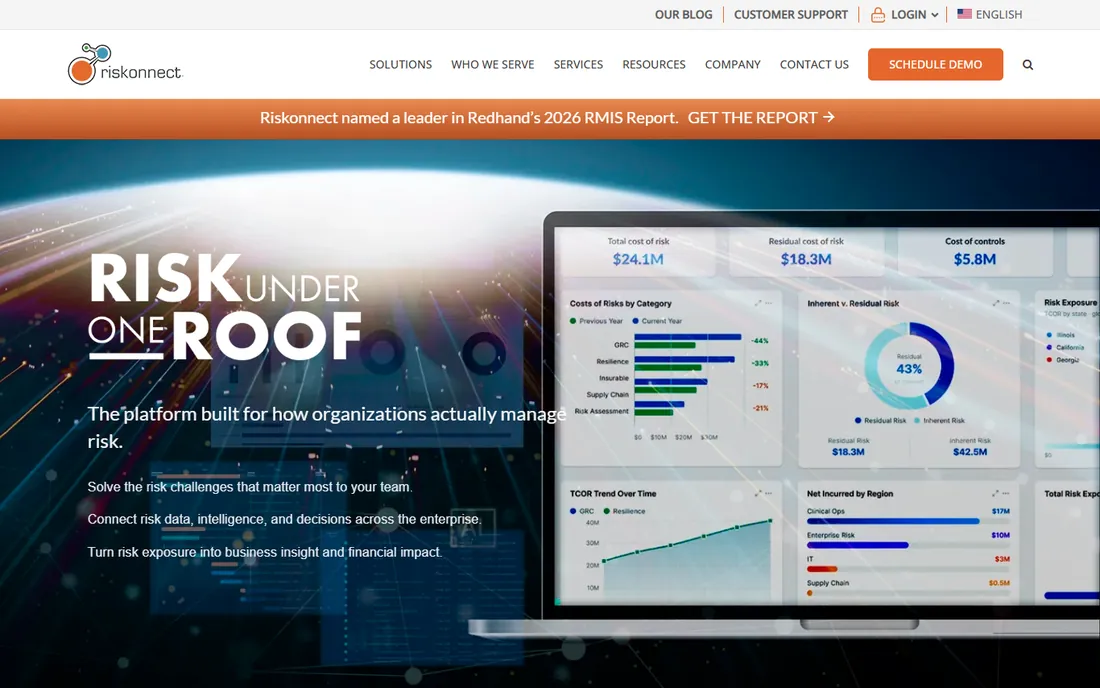
Riskonnect positions itself as the leading integrated risk management provider, serving over 2,500 customers across six continents with technology that correlates risk data across the extended enterprise. Its heritage in risk management information systems (RMIS) gives it unusual strength in claims administration, health and safety, and incident management, areas where pure GRC vendors are thinner. Acquisitions of Ventiv, ICIX, and Camms have broadened the portfolio into ESG and APAC markets.
The acquisition spree means buyers should ask about product integration roadmaps. Pricing is quote-based. For organizations where insurable risk, claims, and operational risk matter as much as compliance risk, Riskonnect's correlated view is distinctive.
What we like- Unique risk-correlation technology across 2,500+ customers
- Strong in claims, health and safety, and business continuity
- Active acquirer still investing
Watch out for- Quote-only pricing
- RMIS roots can show in UX
- Broad portfolio from acquisitions needs integration attention
Starting priceSee website
Free planNo
ServiceNow's GRC offering unifies integrated risk management, business continuity management, third-party risk management, and privacy management on the Now Platform, with AI insights and automated workflows. The pitch is architectural: when risk data, IT assets, and service workflows live in one system, control attestation and incident response get dramatically faster. Customers cite large efficiency gains in compliance work.
The honest assessment is that ServiceNow GRC shines brightest for ServiceNow shops; bought standalone, it competes less well against MetricStream or Archer on GRC depth. Pricing is quote-based and enterprise-scale. If your IT organization already runs on ServiceNow, extending it into GRC is the lowest-friction path to integrated risk.
What we like- Risk workflows on the same platform as ITSM
- Integrated risk, BCM, third-party risk, and privacy modules
- Massive ecosystem
Watch out for- Quote-only pricing
- Best value only if you already use ServiceNow
- GRC depth trails pure-play specialists
Starting priceSee website
Free planNo
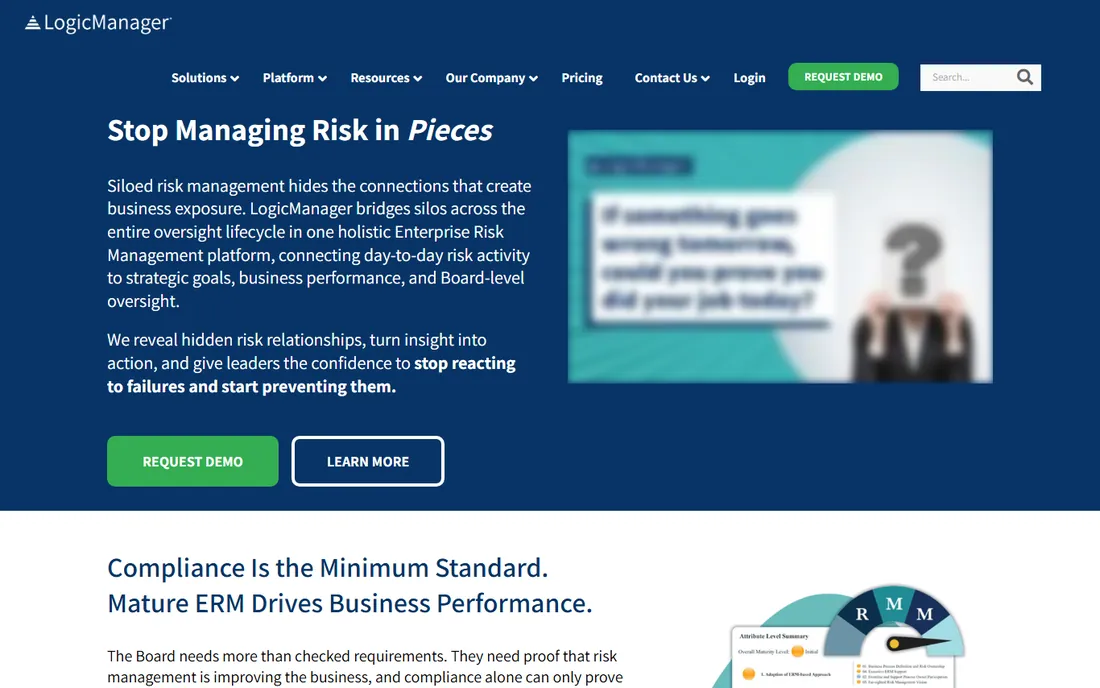
LogicManager takes a different commercial approach: fixed, all-inclusive pricing with unlimited licensed users and advisory services bundled in, backed by a 90-day satisfaction guarantee. The platform's taxonomy technology connects risks, controls, policies, and incidents across departments, and its LMX AI assistant guides non-experts through assessments. It serves thousands of organizations with a Boston-based support team.
The company does not publish pricing figures, so "fixed" still requires a conversation. It is also a smaller vendor with less analyst coverage than the leaders. For mid-market buyers who find the big platforms overpriced and overcomplex, LogicManager's predictable economics and hands-on advisory model are genuinely different.
What we like- Fixed all-inclusive pricing with unlimited users
- Strong advisory support included
- Taxonomy-based approach connects risks across the org
Watch out for- No public pricing numbers
- Smaller vendor than the leaders
- Less analyst visibility than top-tier competitors
Starting priceSee website
Free planNo
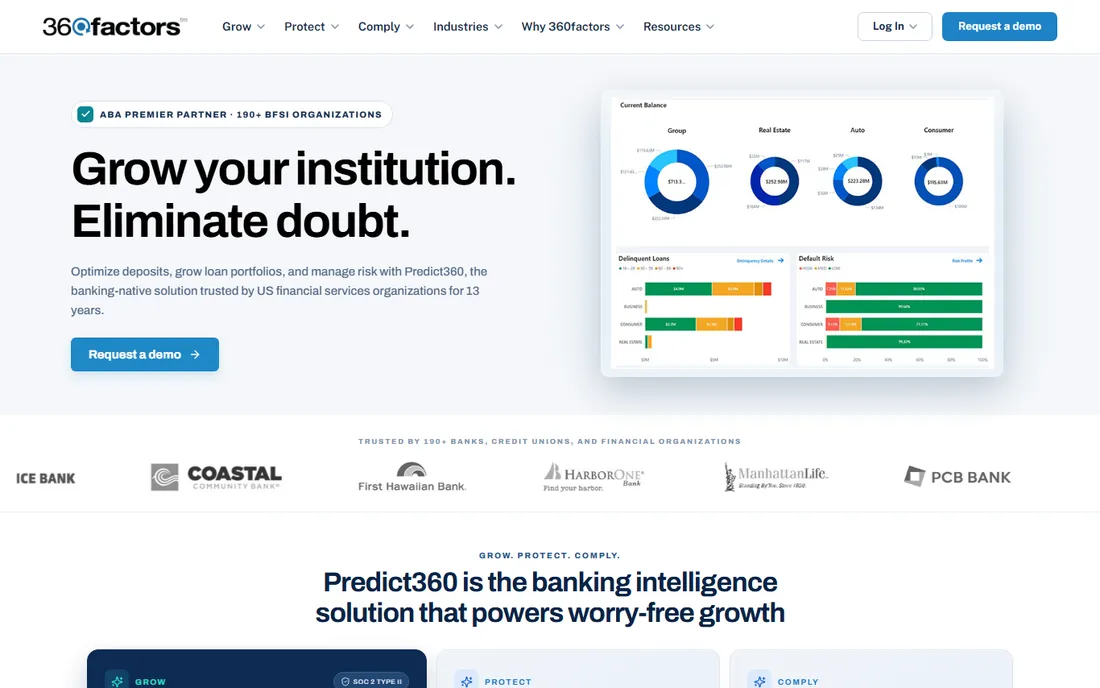
Predict360 by 360factors is a risk and compliance intelligence platform built around AI: it integrates regulations, policies, risks, controls, audits, and training in one cloud platform, with predictive analytics for operational risk. Its Ask Kaia AI assistant is trained on federal banking regulations and can summarize rules, draft policy language, and flag which policies need updates. The American Bankers Association exclusively endorses it for compliance management.
The specialization is the limitation: outside banking and financial services, the regulatory content advantage fades. Pricing is quote-based. For financial institutions that want ERM fused with compliance in an AI-native platform, Predict360 is purpose-built in a way the generalists are not.
What we like- AI-powered risk and compliance intelligence
- Exclusive ABA endorsement for compliance
- Strong regulatory content out of the box
Watch out for- Financial-services focus limits other industries
- Quote-only pricing
- Smaller ecosystem than generalist platforms
#9
Fusion
Best for: operational resilience and business continuity-led risk programs
Visit fusionrm.com
Starting priceSee website
Free planNo
Fusion approaches enterprise risk through operational resilience: one system connecting business continuity, risk management, IT disaster recovery, and crisis management, with scenario testing that lets organizations model severe-but-plausible disruptions in real time. It counts major global banks and financial institutions among its 400+ customers, and its community of resilience practitioners is unusually active.
Fusion is less of a general ERM platform than a resilience platform with ERM capabilities; buyers wanting a classic risk-register-and-assessment program may find the framing different. Pricing is quote-based. For organizations where the board's risk question is "can we keep operating through disruption," Fusion answers it directly.
What we like- Resilience-first approach linking continuity, risk, and crisis
- Scenario testing for severe-but-plausible events
- Strong in financial services
Watch out for- Quote-only pricing
- Resilience framing is narrower than full ERM
- Less known outside continuity circles
How to evaluate
Start with your program's center of gravity. Audit-led programs fit Optro; compliance-led programs fit MetricStream or Archer; resilience-led programs fit Fusion or Riskonnect; IT-led programs fit ServiceNow. Demand a live demo on your own risk taxonomy, not the vendor's sample data, and ask specifically about implementation timelines, since six-month rollouts are common. Check how each platform handles the risks you actually manage: a bank's operational risk needs differ from a manufacturer's supply chain risks. Finally, talk to reference customers in your industry before signing, because every vendor on this list will tell you they do everything.
Frequently asked questions
What is enterprise risk management software?
ERM software centralizes how an organization identifies, assesses, monitors, and reports risks across all business units. It replaces spreadsheets with connected workflows for risk assessments, controls, incidents, and board reporting.
How much does enterprise risk management software cost?
All major platforms are quote-based. Expect annual contracts in the tens to hundreds of thousands of dollars depending on user count, modules, and implementation scope. LogicManager's fixed-pricing model is the exception to per-module quoting.
What is the difference between ERM and GRC software?
GRC (governance, risk, and compliance) is the broader category covering compliance and audit as well as risk. ERM is the risk-specific discipline within it. Most platforms on this list cover both, with different centers of gravity.
Which ERM software is best for banks?
Archer, MetricStream, and Predict360 all have deep financial-services footprints. Predict360 is the most banking-specific; Archer and MetricStream offer the broadest enterprise coverage.
Did AuditBoard change its name?
Yes. AuditBoard rebranded to Optro in 2026. The platform, the team, and the auditboard.com website continue under the new name.
How long does ERM software take to implement?
It varies widely: LogicGate reports average implementations around 96 days, while large MetricStream or Archer deployments can take six to twelve months. Ask vendors for timelines from customers similar to your size.
Sources we checked (11)
- https://logicgate.com/
- https://auditboard.com/
- https://www.metricstream.com
- https://www.archerirm.com
- https://riskonnect.com/
- https://www.servicenow.com/products/governance-risk-and-compliance.html
- https://www.logicmanager.com
- https://www.360factors.com
- https://www.fusionrm.com/
- https://www.psgequity.com/portfolio/logicgate
- https://semiconductors.einnews.com/pr_news/837107862/resolver-launches-risk-event-management-to-help-teams-uncover-emerging-risk-impact-and-strengthen-resilience
Is your product missing or out of date?
We review this list regularly. Vendors can request a listing, send updated pricing or ask about featured placement.

Shihab Mia · Founder, Rankite
Shihab has spent more than a decade helping SaaS and e-commerce brands grow through search. He writes Rankite's software buying guides from pricing pages, documentation and public user reviews. More about Shihab.