How we make this list: we compare pricing pages, product documentation and public user reviews. Ratings come from G2, Capterra or Trustpilot, with the date we checked them.
Key takeaways
- Chargebee is the friendliest entry point, with a free Starter plan up to $250K in cumulative billing and a $599/month Performance tier for scaling SaaS teams.
- Salesforce Revenue Cloud is the natural pick if you already run Salesforce, at $150 to $200 per user per month, but it requires a Sales Cloud license on top.
- Zuora, BillingPlatform, and Aria Systems target complex enterprise billing with quote-only pricing, so budget for a longer evaluation.
- Maxio (born from the Chargify and SaaSOptics merger) is the strongest fit for B2B SaaS finance teams that need billing plus audit-ready revenue recognition in one place.
- If your billing is mostly simple subscriptions, half of this list is overkill; Recurly or Chargebee will get you live faster and cheaper.
Quick comparison
| Tool | Best for | Starting price | Free plan |
|---|
 Zuora Zuora | Large companies running complex subscription models | See website | No |
 Chargebee Chargebee | SaaS and AI startups scaling to mid-market | Free Starter plan; $599/month Performance (billed annually) | Yes (Starter free up to $250K cumulative billing) |
 Maxio Maxio | B2B SaaS finance teams that live in their revenue numbers | $599/month Grow (billed annually) | Free trial (30 days) |
 Salesforce Revenue Cloud Salesforce Revenue Cloud | Companies already standardized on Salesforce | $150 per user/month Growth (billed annually) | No |
 Conga Conga | Enterprises unifying pricing, contracts, and billing | See website | No |
 Recurly Recurly | Subscription businesses obsessed with recovering failed payments | $249/month Starter + 0.9% of billing volume | Free trial (90 days) |
 BillingPlatform BillingPlatform | Enterprises with high-volume, complex monetization models | See website | No |
 Ordway Ordway | Mid-market finance teams automating order-to-revenue | See website | No |
 Aria Systems Aria Systems | Large enterprises with real-time, high-scale charging needs | See website | No |
Is your product missing or out of date?
We review this list regularly. Vendors can request a listing, send updated pricing or ask about featured placement.
The best revenue lifecycle management software
#1
Zuora
Best for: Large companies running complex subscription models
Visit zuora.com
Starting priceSee website
Free planNo
Zuora has been the default enterprise subscription billing answer since 2007, and the platform depth shows it. Billing, revenue recognition, CPQ, collections, and payments run as one system, which matters when your pricing mixes subscriptions, usage, and one-time charges and finance still has to close the books cleanly. The company went private in 2025 under Silver Lake and GIC, but the product direction has stayed consistent, with recent work focused on AI-driven billing and usage monetization.
The honest catch is that Zuora buys like enterprise software, not SaaS. Expect a sales-led process, a quote instead of a price list, and an implementation measured in months rather than days. Teams with straightforward monthly subscriptions will find it heavy and expensive relative to simpler tools. It earns its place when billing complexity is genuinely high: multi-entity operations, intricate usage models, and revenue recognition rules your auditors will actually inspect.
What we like- Full quote-to-cash suite (Billing, Revenue, CPQ, Collect, Payments)
- Strong usage-based and hybrid billing
- Audit-ready revenue recognition
Watch out for- Pricing is quote-only and enterprise-grade
- Implementations typically take months and need partner help
Starting priceFree Starter plan; $599/month Performance (billed annually)
Free planYes (Starter free up to $250K cumulative billing)
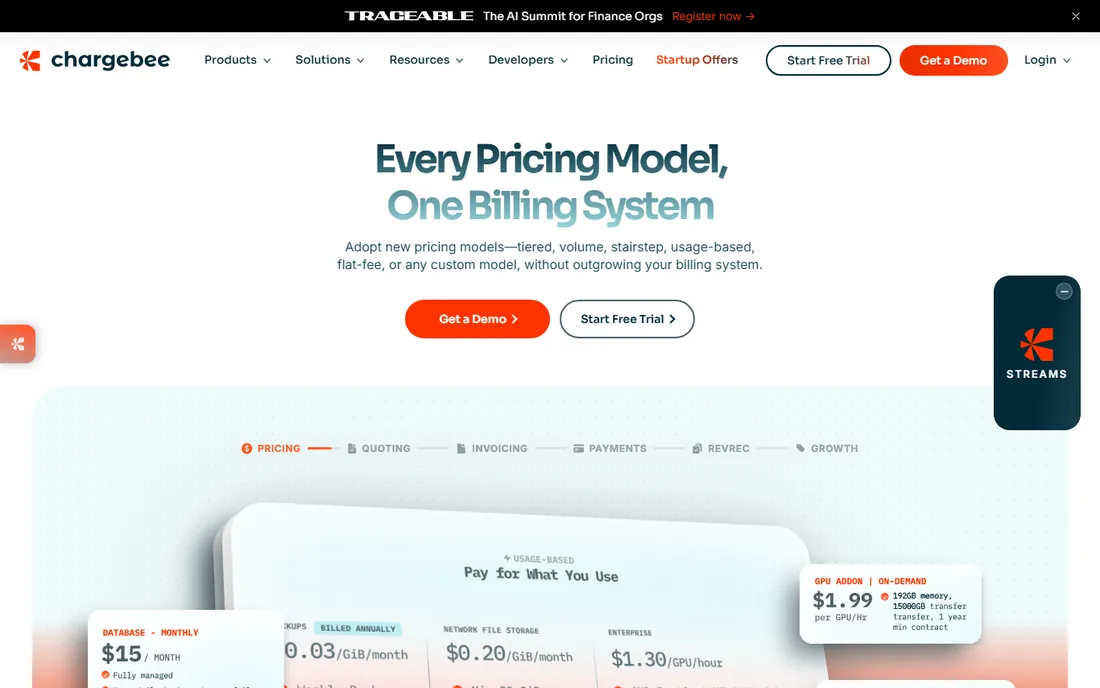
Chargebee wins on accessibility. The Starter plan is genuinely free until you pass $250K in cumulative billing, which gives early-stage teams production-grade subscription billing without a contract. Performance at $599 per month covers companies up to $100K in monthly billing, with 0.75% overage beyond that. The platform has expanded well past basic subscriptions: usage-based and credit-based billing, a native CPQ (the first 50 quotes are free), revenue recognition, and dunning all ship in the box.
Watch the math as you grow. Percentage-of-volume pricing is painless at $50K a month and noticeable at $500K, so model your costs at your 18-month volume, not today's. Performance needs an annual contract, and downgrades need 90 days notice. For SaaS and AI companies that want to move fast without hiring a billing team, though, Chargebee remains the easiest yes on this list.
What we like- Free Starter tier with real features
- 40+ payment gateways and 100+ currencies
- Built-in ASC 606 revenue recognition and CPQ
Watch out for- Costs scale as a percentage of billing volume
- Multi-entity and advanced features sit behind Enterprise pricing
#3
Maxio
Best for: B2B SaaS finance teams that live in their revenue numbers
Visit maxio.com
Starting price$599/month Grow (billed annually)
Free planFree trial (30 days)

Maxio is what you get when Chargify and SaaSOptics merge: a billing engine fused with a finance team's reporting stack. The Grow plan at $599 per month covers billing up to $100K in monthly volume, and notably there are no per-user fees, so your whole finance team can live in the product. Revenue recognition compliant with GAAP and IFRS is core rather than an add-on, and the one-click financial reports (ARR, deferred revenue, DSO) are the kind controllers actually use.
The trade is focus. Maxio is unapologetically a B2B SaaS tool; media or consumer subscription businesses will find Recurly or Chargebee more natural. Advanced needs like AR management, expense amortization, and multi-entity support push you to the quote-based Scale tier. Implementation is sales-led, so plan for a real onboarding project. If your buyer is a CFO rather than a product manager, Maxio speaks their language better than anything else here.
What we like- Billing plus GAAP and IFRS revenue recognition in one platform
- No per-seat charges
- Strong SaaS metrics and reporting
Watch out for- Built for B2B SaaS, weaker fit for consumer subscriptions
- Advanced modules cost extra on the Scale tier
#4
Salesforce Revenue Cloud
Best for: Companies already standardized on Salesforce
Visit salesforce.com
Starting price$150 per user/month Growth (billed annually)
Free planNo
If your sales team lives in Salesforce, Revenue Cloud removes the integration tax every other tool on this list charges. Growth at $150 per user per month covers CPQ and subscription management; Advanced at $200 adds contracts, orders, consumption billing, invoicing, and AI analytics. Because everything runs on the Salesforce platform, quotes, contracts, and billing share the same data your reps already use, which kills a whole category of reconciliation work.
The catch is the stack cost. Revenue Cloud is an add-on, so you are paying for the CRM license plus $150 to $200 per user per month, and Salesforce confirmed there is no free trial. Annual contracts are required. Implementation almost always involves a partner, and first-year services often exceed the license cost. It is the right call when Salesforce is already your system of record; it is a hard sell as a standalone billing decision.
What we like- Native CPQ, contracts, orders, and billing inside Salesforce
- Growth ($150) and Advanced ($200) editions with clear feature splits
Watch out for- Requires a Sales Cloud, Service Cloud, or CRM license on top
- Per-user pricing adds up
- No free trial
#5
Conga
Best for: Enterprises unifying pricing, contracts, and billing
Visit conga.com
Starting priceSee website
Free planNo
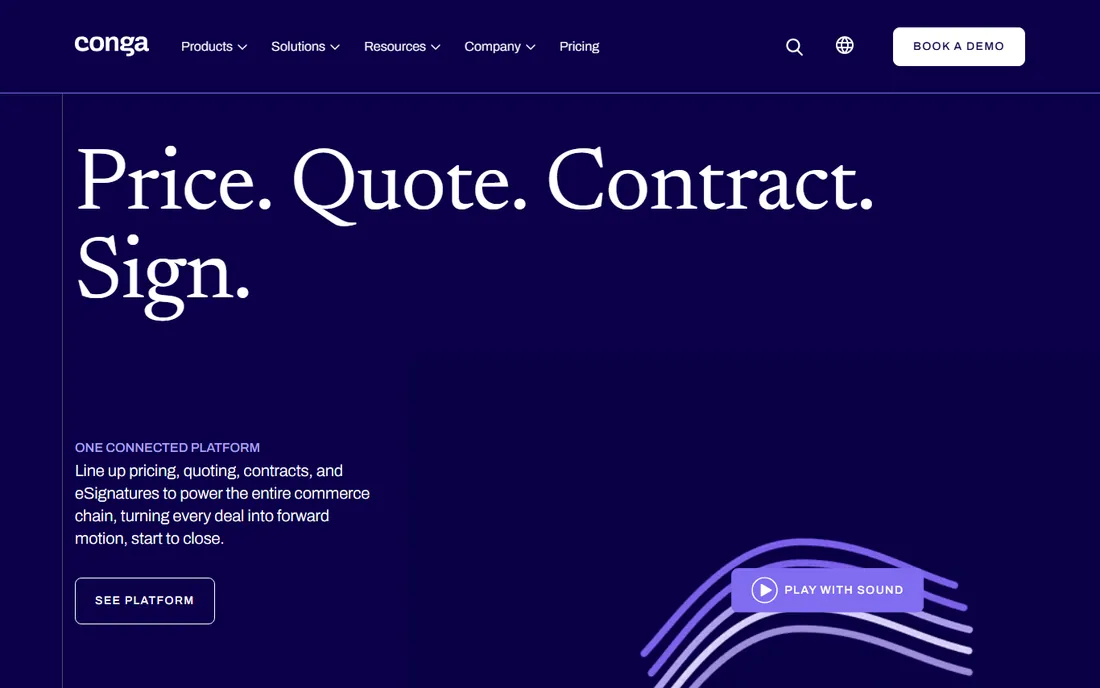
Conga approaches the revenue lifecycle from the document and contract side, which is a useful difference. Where pure billing tools start at the invoice, Conga starts at the quote: configure-price-quote, contract lifecycle management, fulfillment, billing, and renewals on a single platform that now runs on any cloud, not just Salesforce. That matters for companies where the contract itself is the complexity, with negotiated terms, approval chains, and redlines that have to flow into billing without retyping.
There is no price list and no self-serve signup. Conga sells to enterprises through a consultative process, and getting value out of the CLM side takes real implementation work. Smaller teams will find it heavy. For large organizations where sales, legal, and finance all touch revenue and currently do it in disconnected tools, Conga's breadth is the point.
What we like- Full revenue lifecycle on one open platform (CPQ, CLM, billing, renewals)
- Works with any CRM, ERP, or cloud
- Strong document automation
Watch out for- Enterprise sales motion with quote-only pricing
- Best results need experienced implementation partners
#6
Recurly
Best for: Subscription businesses obsessed with recovering failed payments
Visit recurly.com
Starting price$249/month Starter + 0.9% of billing volume
Free planFree trial (90 days)
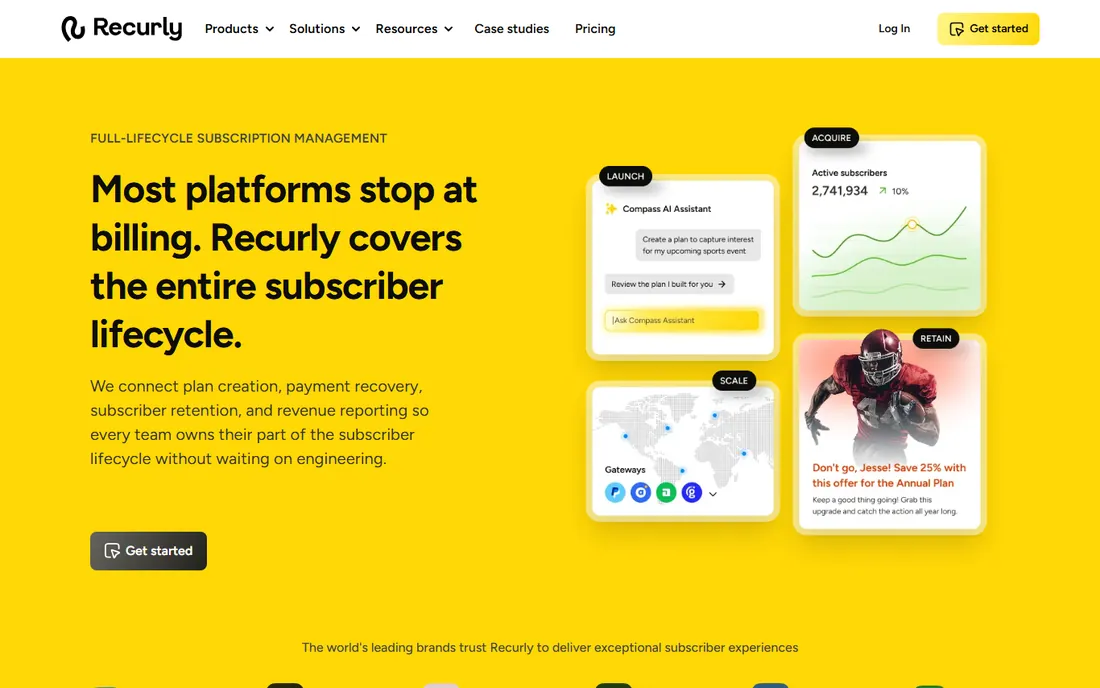
Recurly built its reputation on one unglamorous superpower: getting paid. Its dunning engine, smart retry logic, and account updater recover revenue that most billing tools quietly lose, and the higher tiers add machine-learning retries and multiple dunning campaigns. Starter at $249 per month plus 0.9% of volume includes the first $40K of monthly billings at no percentage fee, plus a 90-day trial, which makes it easy to test against your current failed-payment rate.
Remember that Recurly is not a payment processor; it orchestrates billing across gateways you supply, so processing fees are separate. The volume percentage means costs grow with you, and the full All-Access tier wants $1M in billing volume and an annual commitment. For subscription businesses where involuntary churn is the leak, Recurly's recovery math often pays for itself, and that is the right lens to evaluate it through.
What we like- Excellent dunning and intelligent payment retries
- Gateway-agnostic with 20+ processors
- Transparent published pricing
Watch out for- Percentage-of-volume fee on top of the base
- You bring your own payment gateway
- Advanced recovery features are plan-gated
Starting priceSee website
Free planNo
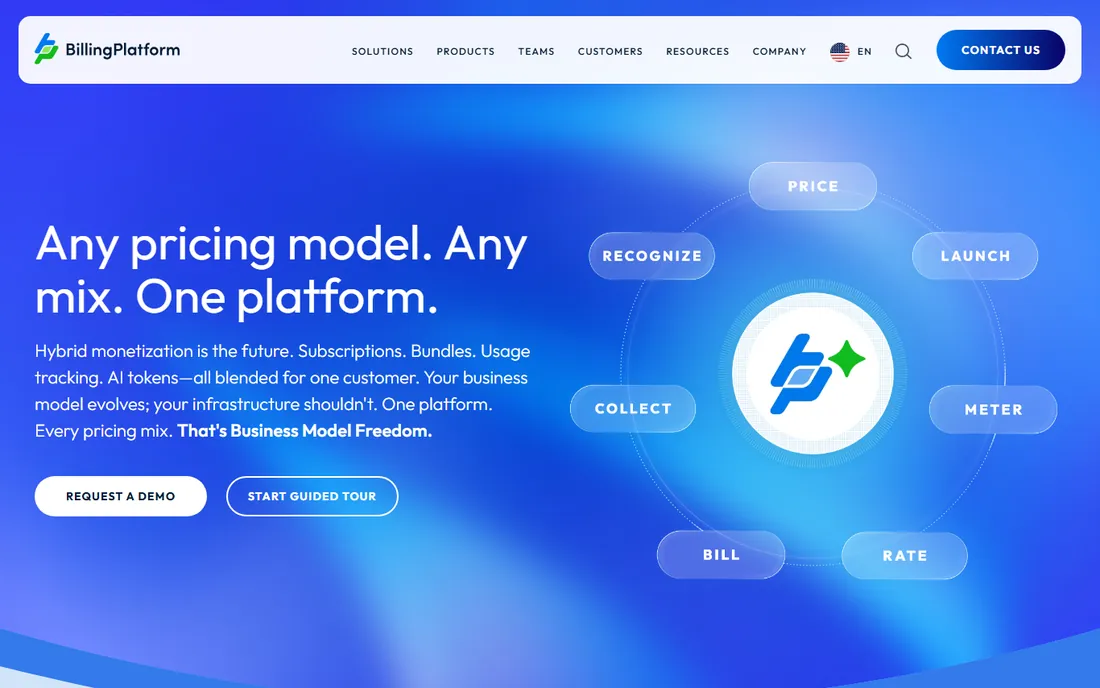
BillingPlatform plays at the heavy end of this market: an AI-native usage-to-cash platform that meters, bills, and recognizes revenue on one model. Its sweet spot is companies with genuinely difficult monetization, think telecom-style usage volumes, hybrid subscription-plus-consumption pricing, or AI products where token and agent activity has to become an invoice. Native revenue recognition and collections are built in rather than bolted on, and the platform processes huge event volumes without breaking a sweat.
This is not a tool you evaluate in an afternoon. Pricing is entirely quote-based, the platform's flexibility demands skilled configuration, and the interface reflects its enterprise audience. Mid-market teams will get to value faster elsewhere. But when your billing requirements make other vendors wince, BillingPlatform's depth is exactly what you are paying for.
What we like- Real-time usage rating and mediation at scale
- ASC 606 and IFRS 15 compliance across 180+ countries
- Strong analyst recognition
Watch out for- Quote-only pricing aimed at large deals
- Configuration depth means a steep learning curve
Starting priceSee website
Free planNo
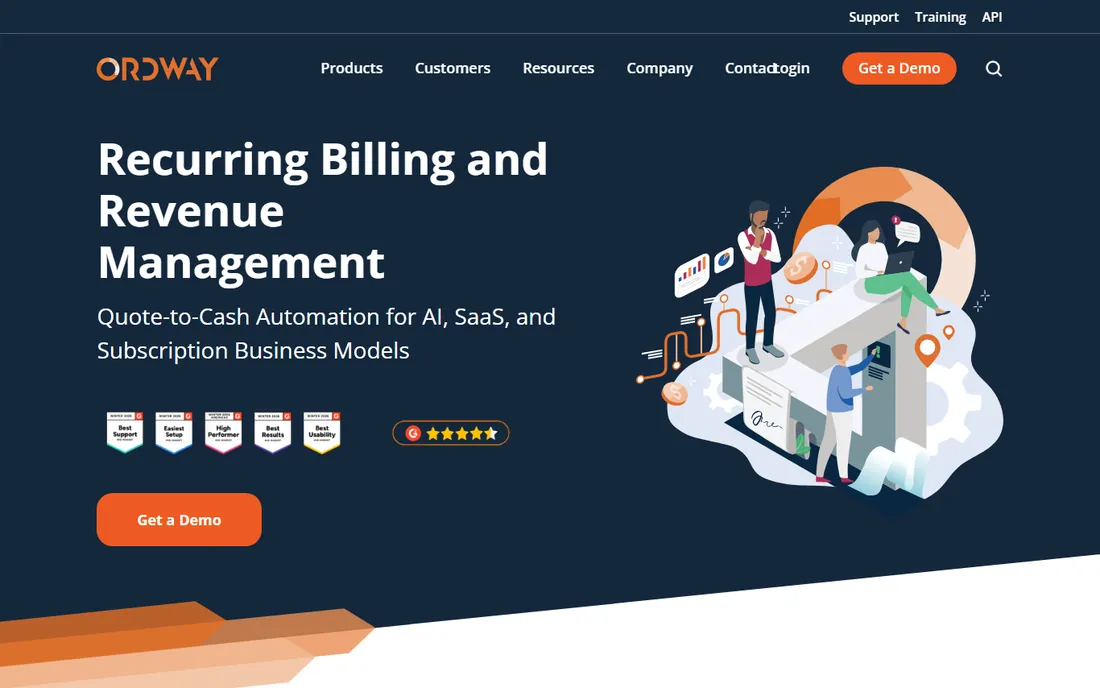
Ordway is the quiet workhorse of this list. It automates the full order-to-revenue cycle: contracts come in from the CRM, invoices go out, collections and dunning run, revenue gets recognized, and SaaS metrics like MRR, churn, and net dollar retention land on dashboards finance can trust. Pricing models span fixed subscriptions, usage-based, and even percentage-of-transaction, which covers most mid-market complexity without enterprise overhead.
The trade-offs are scale-related. Ordway does not have Zuora's brand or Salesforce's ecosystem, and you will talk to sales to get a number. Integration breadth is narrower than the giants, so check your specific CRM, ERP, and gateway combination early. For a mid-market SaaS or fintech company that has outgrown QuickBooks-plus-spreadsheets billing, Ordway hits a practical middle ground between startup tools and enterprise platforms.
What we like- Covers billing, AR, revenue recognition, and SaaS metrics in one platform
- Handles subscription, usage, and transaction pricing
- Solid G2 ratings
Watch out for- Smaller vendor with less market presence
- Pricing requires a sales conversation
- Fewer third-party integrations than larger rivals
#9
Aria Systems
Best for: Large enterprises with real-time, high-scale charging needs
Visit ariasystems.com
Starting priceSee website
Free planNo
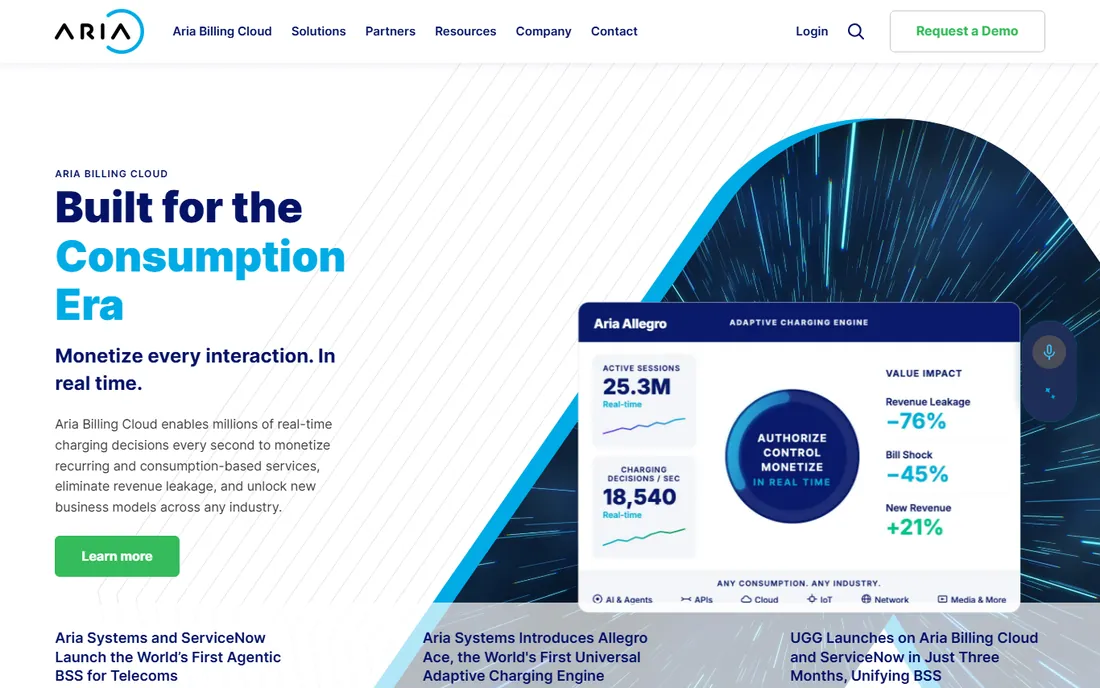
Aria Systems operates where billing looks more like infrastructure than software. Its Billing Cloud and real-time charging engine handle millions of charging decisions per second, which is why telecom, media, and large digital providers trust it with complex monetization. The Salesforce and ServiceNow partnerships mean it slots into enterprise stacks as the billing brain behind the CRM, and its AI billing features target the consumption-era pricing models other tools are still catching up to.
None of that comes cheap or fast. Aria sells exclusively through enterprise engagements, pricing is quoted per deal, and implementations are measured in quarters. A 200-person SaaS company does not need this. But if your billing events number in the hundreds of millions and downtime is measured in lost millions, Aria's pedigree in high-scale charging is hard to match.
What we like- Real-time charging engine built for massive event volumes
- Strong telecom and media pedigree
- Strategic Salesforce and ServiceNow partnerships
Watch out for- Enterprise-only motion with quote pricing
- Overkill for standard subscription billing
- Long sales and implementation cycles
How we chose
We started from the category as analysts define it: software covering quoting, billing, collections, and revenue recognition, not just recurring invoicing. We pulled the vendor shortlist from G2 and Gartner coverage, then checked each product's own site, pricing page, and documentation to confirm it is live and fits the category today. Pricing and free-tier details come from vendor pricing pages and official plan documentation; where vendors keep pricing behind sales, we say so instead of guessing. Public reviews on G2, Capterra, and TrustRadius plus Reddit threads from finance and RevOps practitioners shaped the strengths and weaknesses, with extra weight on fit for small and mid-size US companies.
What to check before you sign a revenue lifecycle contract
Start with your pricing models, not the feature list. Write down every way you charge today and every way you plan to charge in the next two years: flat subscriptions, per-seat, tiered, usage-based, credits, one-time services. Then ask each vendor to demo your two weirdest scenarios live. Every platform on this list handles simple subscriptions; the differences appear when you mix models, and that is where expensive surprises hide.
Next, map who pays and how. Per-user pricing (Salesforce Revenue Cloud) punishes broad adoption, while percentage-of-volume pricing (Chargebee, Recurly) punishes growth. Flat platform fees (Maxio's Grow) are the most predictable but come with volume ceilings. Ask about overage rates, what counts toward them, and what happens when you exceed a tier mid-contract. Get the answers in the order form, not just the demo.
Finally, budget the implementation, not just the license. Enterprise tools here routinely cost more to implement in year one than the software itself, and data migration (customers, subscriptions, payment tokens) is the part vendors gloss over. Ask for a fixed-scope implementation quote, a named timeline, and references from companies your size. A billing migration gone wrong touches every customer, so this diligence is worth more than a 10% discount.
Where the real costs hide
The sticker price is rarely the total price. Implementation, data migration, and payment-token transfers can add 25 to 75% on top of year-one license fees for enterprise platforms. Percentage-based pricing looks small until you do the math at scale: 0.75% of $500K monthly billing is $3,750 a month, every month, before processing fees.
Then there are the gates. Advanced revenue recognition, multi-entity support, and premium support tiers are commonly reserved for the top plan or sold as add-ons, so the plan that fits your feature needs may cost double the advertised starting price. Contract terms matter too: annual commitments with 90-day downgrade notice periods are standard, which means a wrong-sized plan follows you for a year. Ask each vendor for a three-year total cost model at your projected volume before you compare.
Frequently asked questions
What is revenue lifecycle management software?
It is software that manages revenue from first quote to recognized revenue: CPQ, contract management, subscription and usage billing, invoicing, collections, and revenue recognition. Unlike basic invoicing tools, it keeps the whole chain in one data model so sales, finance, and operations work from the same numbers.
How is it different from subscription billing software?
Subscription billing is one piece of the lifecycle. Revenue lifecycle platforms add quoting, contract lifecycle management, complex usage rating, and audit-ready revenue recognition on top of billing. If you only need to charge cards monthly, a subscription billing tool is enough; if finance struggles to close the books, you need the fuller platform.
How much does revenue lifecycle management software cost?
Chargebee starts free and Performance runs $599 per month, Maxio's Grow is $599 per month, and Recurly's Starter is $249 per month plus volume fees. Salesforce Revenue Cloud runs $150 to $200 per user per month plus the CRM license. Enterprise platforms like Zuora, Conga, BillingPlatform, Ordway, and Aria quote per deal, and six-figure annual contracts are common.
Do I need it if I already use QuickBooks or Xero?
Probably not yet. Accounting tools handle the general ledger, but they are poor billing engines once you have subscriptions, usage, or complex contracts. The usual trigger is finance spending days each month on spreadsheets to bill and recognize revenue; that is when a dedicated platform pays for itself.
How long does implementation take?
For mid-market tools like Chargebee or Maxio, expect 4 to 12 weeks including migration. Enterprise platforms like Zuora, Conga, or Aria typically take 3 to 9 months with partner help. The long pole is usually data migration and revenue recognition configuration, so ask vendors for a fixed timeline with milestones.
Can I switch vendors later without disrupting customers?
Yes, but plan carefully. Payment tokens must transfer securely between vaults, subscription histories need mapping, and billing dates should not shift mid-migration. Most vendors offer migration assistance, and running the old and new systems in parallel for one billing cycle catches errors before customers see them.
Sources we checked (12)
- https://www.zuora.com/
- https://www.chargebee.com/
- https://www.chargebee.com/pricing/
- https://www.maxio.com/
- https://www.maxio.com/pricing/
- https://www.salesforce.com/
- https://www.salesforce.com/sales/revenue-lifecycle-management/pricing/?bc=OTH
- https://conga.com/
- https://www.recurly.com/
- https://billingplatform.com/
- https://ordwaylabs.com/
- https://ariasystems.com/
Is your product missing or out of date?
We review this list regularly. Vendors can request a listing, send updated pricing or ask about featured placement.

Shihab Mia · Founder, Rankite
Shihab has 5+ years in B2B and SaaS SEO. He writes Rankite's software buying guides from pricing pages, documentation and public user reviews. More about Shihab.