How we make this list: we compare pricing pages, product documentation and public user reviews. Ratings come from G2, Capterra or Trustpilot, with the date we checked them.
What is the best retail management software for furniture stores?
The best retail management software for furniture stores is Lightspeed Retail, because it handles large-item inventory, special orders, multi-location stock and supplier purchase orders in one system built for specialist retailers. Furniture stores need more than a generic till. They sell big items with long lead times, take custom orders in specific fabrics and finishes, schedule deliveries and installations, and keep a showroom that differs from warehouse stock. Lightspeed covers those needs while staying usable at the counter. Shopify POS is the best choice when online sales matter as much as showroom sales, and Square is the best free starting point for a small furniture shop.
Key takeaways
- Lightspeed Retail is the top pick for furniture stores that need special orders, delivery scheduling and multi-location inventory.
- Shopify POS is the strongest option when your website drives a large share of orders.
- Square costs nothing to start and suits small shops with simple inventory.
- Heartland Retail fits stores that want payments, POS and back office from one vendor.
- PayPal Point of Sale (formerly Zettle) is the cheapest way to take card payments at a market stall or pop-up.
- Special order and delivery tracking separate real furniture software from generic retail POS.
How furniture stores should choose retail management software
Furniture retail has inventory problems other shops do not have. A sofa exists in several fabrics, colours and sizes, and the showroom piece is not the piece the customer takes home. Custom orders can take weeks to arrive from the supplier. The software should track variants properly, keep showroom stock separate from warehouse stock and follow a special order from deposit to delivery without losing the details.
Delivery is a second deciding factor. Furniture is heavy, and delivery and installation are part of the sale. The software should schedule deliveries, record the delivery address and access notes, and track which items are waiting for a delivery slot. A system without delivery tracking forces the store back to spreadsheets, which is where delivery mistakes happen.
Price should be judged on total cost, not the headline monthly fee. Payment processing fees often cost more than the software subscription. Compare the software fee plus processing on your actual monthly card volume before deciding.
Quick comparison
| Tool | Best for | Starting price | Free plan |
|---|
 Lightspeed Retail | Furniture stores that need special orders, variants and multi-location stock control | $89 per month billed annually ($109 month to month), checked 23 Nov 2026 | No free plan; paid plans only |
 Square | Small furniture shops that want a free POS with fast setup | $0, checked 23 Nov 2026 | Yes, free POS with pay-as-you-go card processing |
 Shopify POS | Furniture stores where online sales matter as much as showroom sales | $89 per month per location for POS Pro, plus a Shopify plan from $29 per month billed annually, checked 23 Nov 2026 | No free plan; POS Lite is included with a Shopify plan |
 Heartland Retail | Furniture stores that want payments, POS and back office from one vendor | $89 per month starting, per the vendor page checked 23 Nov 2026; older third-party reads showed $69 per selling station, flagged for spot check | No free plan |
 Clover | Furniture stores that want counter hardware and payments bundled together | From $49.95 per month for Register, checked 23 Nov 2026 | No free plan |
 Epos Now | Budget-conscious furniture shops that want a cloud POS with optional add-ons | $39 per month for software only, checked 23 Nov 2026 | No free plan |
 KORONA POS | High-volume furniture stores that need flexible pricing and strong inventory | $59 per terminal per month for Core, checked 23 Nov 2026 | No free plan |
 PayPal Point of Sale | Pop-up stalls, market stands and mobile furniture selling | $0 monthly, card fee 2.29 percent plus 9 cents per transaction, checked 23 Nov 2026 | Yes, free to sign up with no monthly fee |
Is your product missing or out of date?
We review this list regularly. Vendors can request a listing, send updated pricing or ask about featured placement.
The best retail management software for furniture stores
#1
Lightspeed Retail
Best for: Furniture stores that need special orders, variants and multi-location stock control
Visit lightspeedhq.com
Starting price$89 per month billed annually ($109 month to month), checked 23 Nov 2026
Free planNo free plan; paid plans only
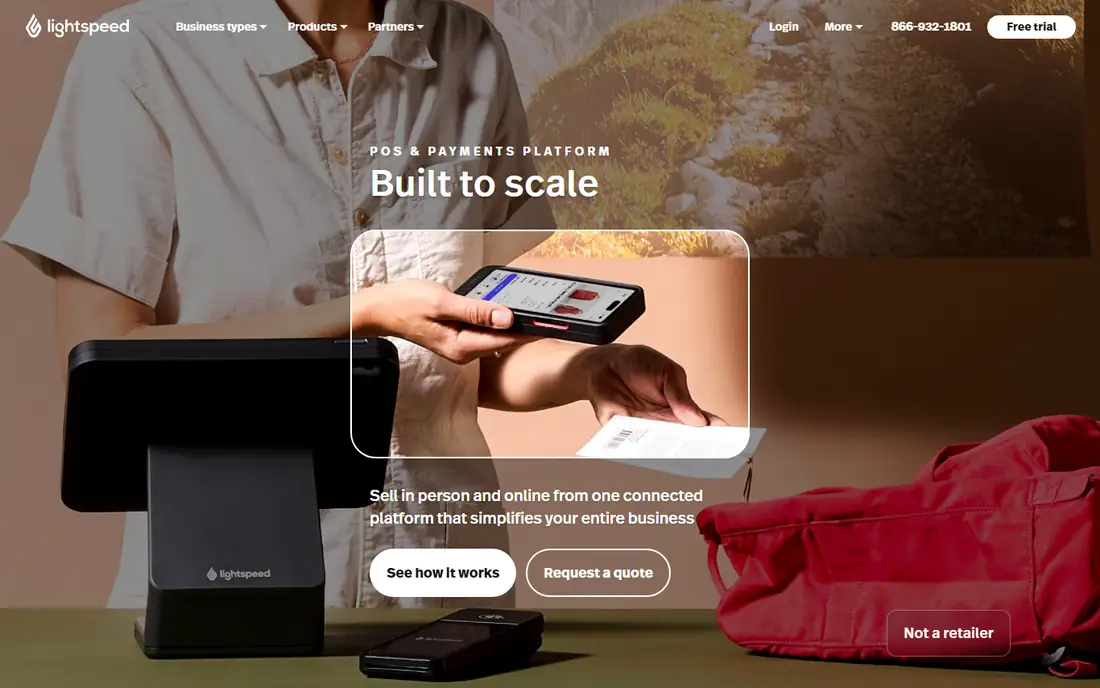
Lightspeed Retail is built for specialist retailers, and furniture is one of the categories it serves best. Variants handle the fabric, colour and size combinations of a sofa range without creating a separate product for each one. Special orders can be recorded with a deposit, linked to the supplier order and tracked until delivery. Multi-location stock is visible from any till, so staff can check the warehouse or another branch instead of losing a sale. Purchase orders flow from supplier catalogues, and low-stock alerts warn before a popular line runs out. The reporting breaks sales down by category, brand and margin, which helps a buyer see which ranges earn money. The main drawback is price. At $89 per month billed annually, a small single-location shop pays a real subscription before processing fees. Implementation also takes longer than a simple POS because the inventory structure needs setting up properly.
What we like- Strong variant and special order tools, multi-location inventory, supplier purchase orders, built-in ecommerce, detailed reporting by category and brand
Watch out for- Monthly cost is high for a single small shop, and setup takes time because the inventory system is deep
#2Square
Best for: Small furniture shops that want a free POS with fast setup4.6/5 on
G2 (1,208 reviews, checked Oct 2026)
Visit squareup.com
Starting price$0, checked 23 Nov 2026
Free planYes, free POS with pay-as-you-go card processing
Square is the easiest way to open a furniture shop and start selling the same day. The free plan includes the POS app, inventory tracking, a customer directory and sales reports, and the card reader is inexpensive. A small shop selling ready-made furniture and home accessories can run the whole counter on Square without a monthly subscription. The inventory tools cover stock counts, low-stock alerts and purchase orders at a basic level, which is enough for a single location with a few hundred lines. The limits show as the business grows. Special orders, fabric variants and delivery scheduling need workarounds or third-party apps. Card processing is charged per transaction, so a shop with high monthly card volume may pay more in fees than it would save on subscription elsewhere. Square fits a new or small furniture store that values speed and low fixed cost over deep inventory control.
What we like- No monthly fee to start, hardware is affordable, inventory and customer directory included, online store add-on available
Watch out for- Special order and delivery tracking is basic, and card processing fees add up at higher volumes
#3Shopify POS
Best for: Furniture stores where online sales matter as much as showroom sales4.4/5 on
G2 (368 reviews, checked Oct 2026)
Visit shopify.com
Starting price$89 per month per location for POS Pro, plus a Shopify plan from $29 per month billed annually, checked 23 Nov 2026
Free planNo free plan; POS Lite is included with a Shopify plan
Shopify POS makes sense for a furniture store whose website is a real sales channel rather than a brochure. Stock, customers and orders are shared between the online store and the till, so a sofa sold in the showroom is immediately unavailable online and a web order can be collected in store or scheduled for delivery. POS Pro adds staff roles, smart inventory management, low-stock reports and unlimited registers, which matter when several staff handle high-value items. The app marketplace adds special order, delivery scheduling and variant tools that the core product lacks. The cost is the catch. POS Pro is $89 per month per location on top of a Shopify plan from $29 per month, so a two-location store pays several hundred dollars a month before processing.
What we like- Online and in-store stock stay in sync, strong ecommerce platform, staff permissions and smart inventory tools on POS Pro, large app marketplace
Watch out for- Full retail features need POS Pro, and the combined monthly cost rises with each location
#4
Heartland Retail
Best for: Furniture stores that want payments, POS and back office from one vendor
Visit heartland.us
Starting price$89 per month starting, per the vendor page checked 23 Nov 2026; older third-party reads showed $69 per selling station, flagged for spot check
Free planNo free plan
Heartland Retail combines a cloud POS with payment processing from the same company, which simplifies support when something goes wrong. The inventory tools cover matrix inventory, purchase orders, transfers between locations and customer purchase history, all useful for furniture. Multi-location stores can see stock across branches and move items where they sell. The customer tools support loyalty and targeted marketing, helpful for a store that depends on repeat buyers for rooms and accessories. The weakness is pricing transparency. The vendor page shows plans starting at $89 per month, while older third-party listings quoted $69 per selling station, so buyers should get a written quote before signing.
What we like- Payments and POS from one provider, strong inventory and customer management, multi-location support, US-based support
Watch out for- Pricing is not fully transparent on the public site, and the system is geared to US merchants
#5Clover
Best for: Furniture stores that want counter hardware and payments bundled together3.8/5 on
G2 (108 reviews, checked Oct 2026)
Visit clover.com
Starting priceFrom $49.95 per month for Register, checked 23 Nov 2026
Free planNo free plan
Clover sells the whole counter as a package: terminal, software and payments from one vendor. The Register plan starts at $49.95 per month and covers the core POS, inventory and reporting. The hardware is well made and suits a busy furniture showroom, with options for customer-facing displays and barcode scanners. The app marketplace adds features the core product lacks, including deeper inventory, employee management and loyalty tools. Offline mode keeps card sales running if the internet drops, which matters during a busy sale weekend. The costs stack up though. Hardware is bought or leased separately, and several of the apps that furniture stores need carry their own monthly fees. Inventory depth is weaker than Lightspeed out of the box, and special order tracking needs an add-on. Clover fits a store that values a tidy hardware bundle and simple setup over the deepest inventory control.
What we like- Polished counter hardware, app marketplace for inventory and loyalty, payments built in, offline mode for card sales
Watch out for- Hardware costs add up, and advanced inventory features need paid apps
#6Epos Now
Best for: Budget-conscious furniture shops that want a cloud POS with optional add-ons4.6/5 on
G2 (29 reviews, checked Oct 2026)
Visit eposnow.com
Starting price$39 per month for software only, checked 23 Nov 2026
Free planNo free plan
Epos Now is one of the cheapest ways to get a cloud POS into a furniture shop. At $39 per month for software only, a small store gets till, inventory, customer records and reporting without a large subscription. Because it runs in the cloud, the owner can check sales and stock from anywhere, and the system works on the shop's own tablets or terminals. The app store adds ecommerce, accounting, loyalty and staff management, so the store can add features as it grows instead of paying for them on day one. The trade-offs are real. Public reviews report uneven support, and several features that other systems include by default are paid add-ons here, so the true monthly cost depends on which apps are needed. Special order and delivery tracking also need add-ons. Epos Now suits a small furniture shop that wants low fixed costs and is comfortable assembling its setup from apps.
What we like- Low starting price, cloud-based with remote access, large app store, works on own hardware
Watch out for- Support quality varies in public reviews, and key features sit behind paid add-ons
#7KORONA POS
Best for: High-volume furniture stores that need flexible pricing and strong inventory4.7/5 on
G2 (72 reviews, checked Oct 2026)
Visit koronapos.com
Starting price$59 per terminal per month for Core, checked 23 Nov 2026
Free planNo free plan
KORONA POS is built for retailers that move a lot of stock and need pricing flexibility. It handles unlimited products, complex price rules, promotions and customer-specific pricing, which helps a furniture store running clearance on older ranges, bundle offers on room sets and trade pricing for designers. Inventory is strong, with stock tracking, purchase orders and detailed margin reporting. Multi-location and franchise tools are included, so a growing chain can manage all branches from one back office. There is no long-term contract on the core plans, which lowers the risk of trying it. The interface is less polished than Lightspeed or Square, and getting the system configured takes more effort up front. For a high-volume furniture store that cares about pricing control and inventory depth more than a pretty screen, KORONA POS is a practical choice.
What we like- Unlimited products and custom price rules, strong inventory and reporting, franchise and multi-location tools, no long-term contract on core plans
Watch out for- Interface looks dated next to newer rivals, and setup needs more configuration
#8
PayPal Point of Sale
Best for: Pop-up stalls, market stands and mobile furniture selling
Visit paypal.com
Starting price$0 monthly, card fee 2.29 percent plus 9 cents per transaction, checked 23 Nov 2026
Free planYes, free to sign up with no monthly fee
PayPal Point of Sale, formerly Zettle, is the simplest way to take card payments away from the shop. There is no monthly fee, signup is free, and the card reader pairs with a phone or tablet in minutes. Tap to Pay on iPhone removes the need for a reader at all for small sellers. The app includes basic inventory and sales reports, enough for a stall selling cushions, lamps and small homeware at a market or a pop-up. It is not a full retail management system. There is no special order tracking, no delivery scheduling and no multi-location stock control, so it cannot run a proper furniture store on its own. It works best as a second till for events, a mobile selling tool, or a low-risk way for a new seller to start taking cards before investing in a full POS. The per-transaction fee of 2.29 percent plus 9 cents is fair for low volume but adds up as sales grow.
What we like- No monthly fee, quick setup, card reader and Tap to Pay on iPhone, inventory and sales reports in the app
Watch out for- No deep inventory, special order or delivery features, and it is not built to run a full shop
What furniture stores should check before buying
Check variant handling first. Ask the vendor to show how one sofa is listed in six fabrics and three sizes without creating dozens of separate products. Next, test the special order workflow: take a deposit, link the order to a supplier, and follow it through to delivery. Check the ecommerce sync too: sell an item in store and watch the website update. Finally, work out the full monthly cost, including card processing on your real volume, hardware and any paid apps, before signing a contract.
How to set up retail software in a furniture store
Start with a clean stock count. Count every item, separate showroom stock from warehouse stock and remove dead lines before importing anything. Set up suppliers and purchase orders next, so reordering follows real stock levels instead of memory. Train staff on special orders, deposits and delivery scheduling before launch day. Run the new till alongside the old one for a few days if possible, then switch fully once the team is confident.
Frequently asked questions
What is retail management software for furniture stores?
Retail management software for furniture stores combines a point of sale with inventory, customer and reporting tools tuned to furniture retail. It tracks variants such as fabric and size, follows special orders from deposit to delivery and schedules deliveries and installations. The best systems also sync stock with an online store and manage purchase orders from furniture suppliers. For a small shop, a simple POS may be enough, but a store with custom orders and several locations needs the deeper inventory features.
Do furniture stores need special order tracking?
Yes, when custom orders are a real part of the business. A special order ties a customer deposit to a supplier order and a delivery date, and losing any part of that chain creates refunds and bad reviews. Systems such as Lightspeed Retail record the order, the deposit and the supplier link in one place, while simpler POS tools need workarounds or spreadsheets to do the same. Stores that only sell floor stock can manage without it.
Which retail POS is best for a small furniture shop?
Square is the best starting point for a small furniture shop because there is no monthly fee and setup takes minutes. It covers the till, basic inventory and card payments in one free plan. A shop that grows into special orders, deliveries and multiple locations will usually move to Lightspeed Retail or Shopify POS later. The right choice depends on whether the shop needs deep inventory control now or can start simple and upgrade later.
How much does retail management software cost for a furniture store?
Costs range from $0 per month for Square or PayPal Point of Sale to $89 per month for Lightspeed Retail or Shopify POS Pro, plus card processing fees on every sale. Hardware, paid apps and extra locations add to the total. A small shop can start free and pay only processing fees, while a multi-location store should budget several hundred dollars a month for software, processing and apps combined.
Can retail software handle furniture delivery scheduling?
Some systems can, with limits. Lightspeed Retail and Shopify POS handle delivery scheduling through third-party apps, while dedicated delivery software does the job better for a delivery-led business. Before buying, ask the vendor to show a delivery being booked, assigned to a van and confirmed with the customer. If delivery is half the business, a dedicated scheduling tool linked to the POS may serve the store better than a POS with a delivery add-on.
Sources we checked (9)
- https://www.lightspeedhq.com/pricing/
- https://squareup.com/us/en/pricing
- https://www.shopify.com/pos/pricing
- https://www.heartland.us/retail
- https://www.clover.com/pricing
- https://www.eposnow.com/us/pricing/
- https://www.koronapos.com/pricing/
- https://www.paypal.com/us/business/pos-system
- https://rankite.com/blog/best-retail-management-software
Is your product missing or out of date?
We review this list regularly. Vendors can request a listing, send updated pricing or ask about featured placement.

Shihab Mia · Founder, Rankite
Shihab has 5+ years in B2B and SaaS SEO. He writes Rankite's software buying guides from pricing pages, documentation and public user reviews. More about Shihab.