How we make this list: we compare pricing pages, product documentation and public user reviews. Ratings come from G2, Capterra or Trustpilot, with the date we checked them.
Key takeaways
- PostHog gives startups the most complete free starting point: analytics, session replay, feature flags, experiments and surveys in one open-source-friendly platform.
- Mixpanel and Amplitude both offer generous free tiers, but their pricing climbs fast once event volume grows, so model your scale early.
- Heap's autocapture answers questions you did not know to ask, which suits tiny teams without a dedicated analytics engineer.
- Pendo and June trade breadth for focus: in-app guidance for Pendo, B2B SaaS simplicity for June.
Quick comparison
| Tool | Best for | Starting price | Free plan |
|---|
 PostHog PostHog | All-in-one free starting stack | See website | Yes |
 Mixpanel Mixpanel | Self-serve funnels and cohorts | See website | Yes |
 Amplitude Amplitude | Deep behavioral analysis | See website | Yes |
 Heap Heap | Autocapture without instrumentation | See website | Yes |
 Pendo Pendo | Analytics plus in-app guidance | See website | Yes |
 June June | Simple B2B SaaS analytics | See website | Yes |
 FullStory FullStory | Session replay with insights | See website | Yes |
 LogRocket LogRocket | Frontend monitoring for product teams | See website | Yes |
Is your product missing or out of date?
We review this list regularly. Vendors can request a listing, send updated pricing or ask about featured placement.
Startups do not need enterprise analytics; they need answers fast, before the next sprint. The right product analytics tool tells you where users drop off, which features stick and what to build next, without a data team to run it. Eight platforms that fit startup budgets and team sizes.
Starting priceSee website
Free planYes
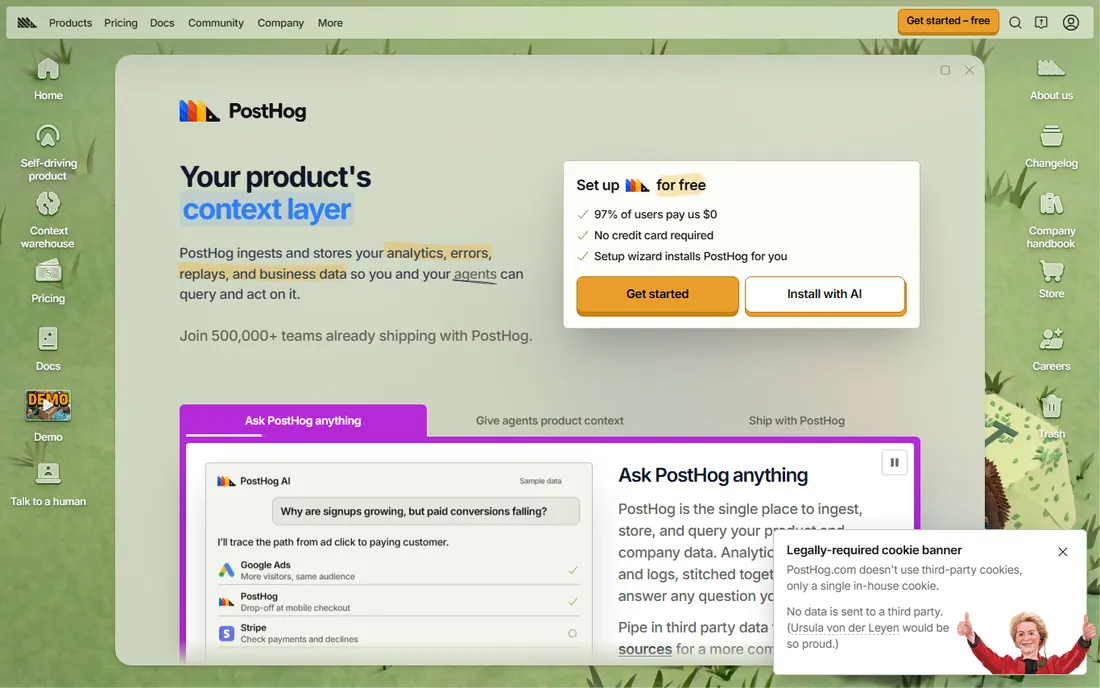
PostHog is the startup default for good reason: one platform replaces a stack of single-purpose tools. Product analytics, session recordings, feature flags, A/B experiments, surveys and heatmaps share one event pipeline and one generous free tier, so a two-person team gets enterprise-grade instrumentation without enterprise procurement.
The trade-off is depth versus breadth: Mixpanel's funnels and FullStory's replay are each more refined in isolation. But for startups, consolidation wins. PostHog fits teams that want the whole product toolkit on day one, with self-hosting available for the privacy-conscious.
What we like- Generous free tier covering analytics, session replay, feature flags, experiments and surveys
- Open-source with self-hosting option
- Usage-based pricing scales smoothly
Watch out for- Breadth means some individual tools are less deep than specialists
- Self-hosting needs engineering time
Starting priceSee website
Free planYes
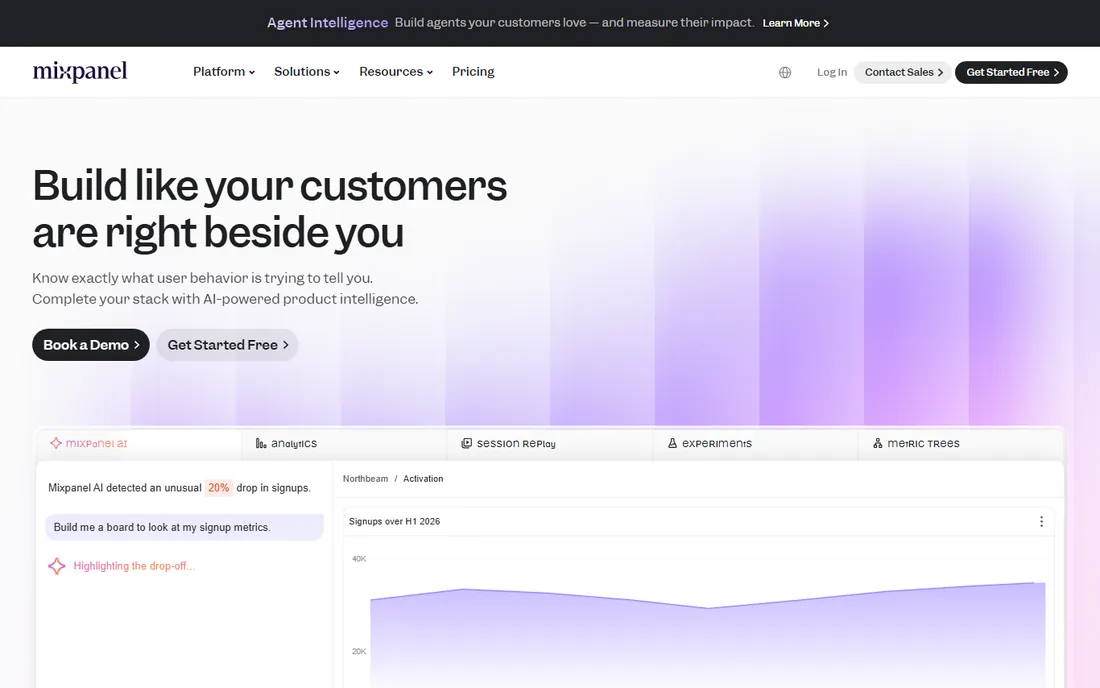
Mixpanel made product analytics accessible to product managers. Funnels, cohorts, retention curves and user flows are genuinely pleasant to build, and the free tier covers early-stage volumes comfortably. Teams adopt it fast because the learning curve is kind.
The renewal shock is the industry's worst-kept secret: event-based pricing climbs steeply as you scale, and several popular comparisons flag it. Model your event volume at 10x current size before committing. Mixpanel fits startups that want polished self-serve analysis and will watch volume costs closely.
What we like- Best-in-class funnel, cohort and retention analysis
- Friendly for non-technical users
- Solid free tier to start
Watch out for- Pricing escalates sharply with event volume
- Advanced features sit behind higher tiers
Starting priceSee website
Free planYes
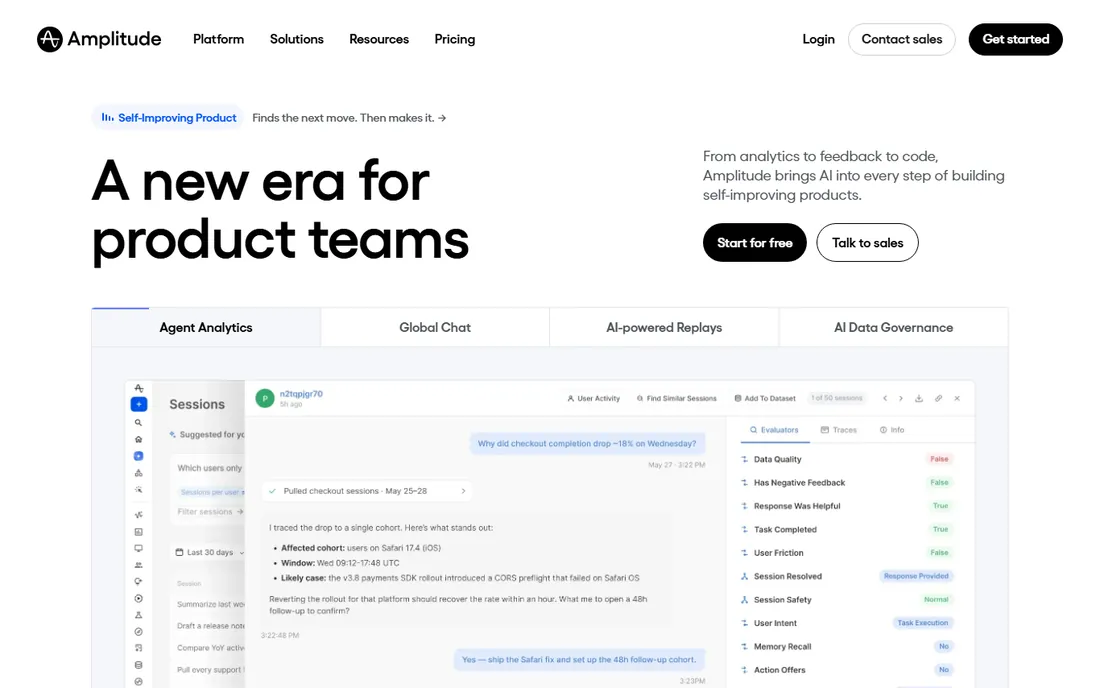
Amplitude is the analyst's choice: behavioral cohorts, predictive churn and LTV, experimentation and deep segmentation that reward teams with analytics maturity. The free tier is genuinely generous, giving startups room to grow before paying.
Small teams sometimes find the depth intimidating; the product assumes someone cares about taxonomy and instrumentation. If your team has or wants analytics rigor, Amplitude rewards it. It fits startups building a data-driven product culture from the start.
What we like- Deepest behavioral analytics and predictive features
- Generous free tier
- Strong for data-informed product organizations
Watch out for- Complexity can overwhelm small teams
- Enterprise pricing tiers are expensive
#4
Heap
Best for: Autocapture without instrumentation
Visit heap.io
Starting priceSee website
Free planYes
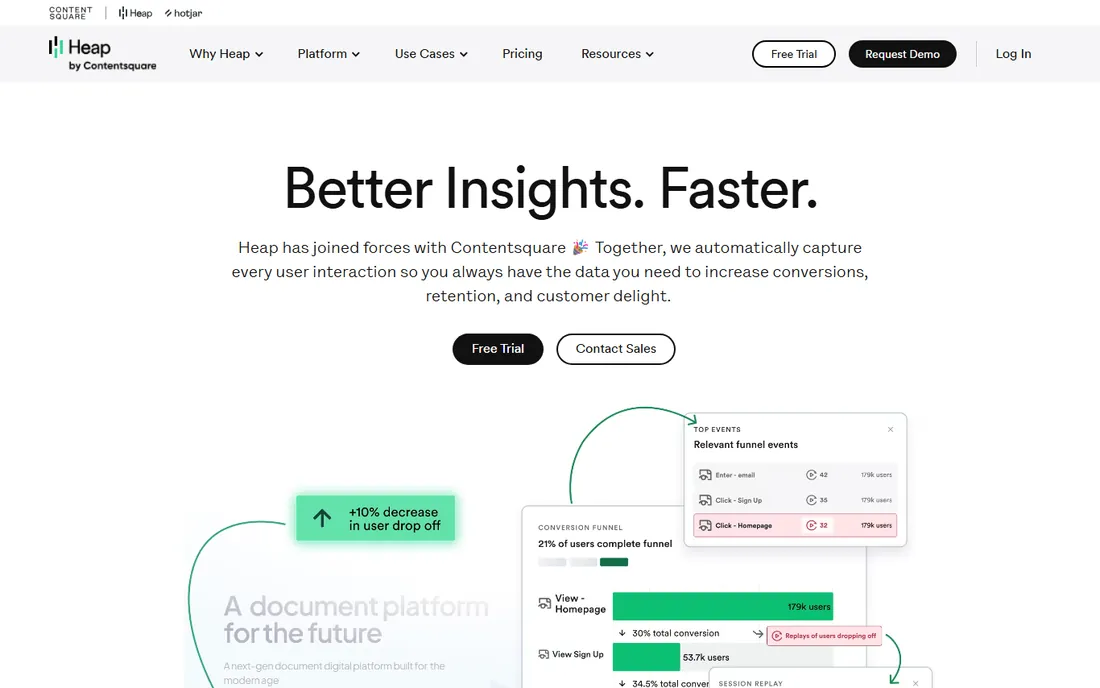
Heap's pitch is freedom from instrumentation: drop in the snippet and every click, tap and form interaction is captured automatically. When a question arises months later, the data is already there to analyze retroactively. For startups without analytics engineers, that is transformative.
The acquisition adds roadmap uncertainty worth asking about on sales calls. And autocapture's completeness means event volumes, and bills, can grow unexpectedly. Heap fits tiny teams that want analytics without a tracking plan.
What we like- Autocapture records every interaction automatically
- Retroactive analysis answers questions about past behavior
- Minimal engineering setup
Watch out for- Acquired, so long-term roadmap is less certain
- Data volume from autocapture can surprise on pricing
Starting priceSee website
Free planYes
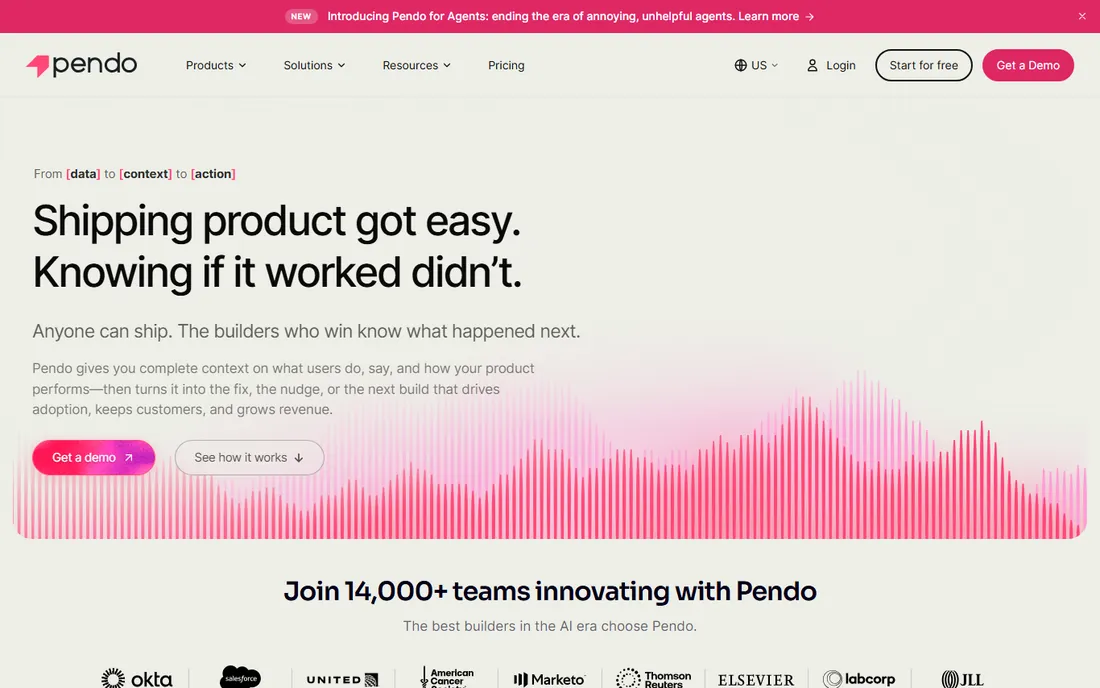
Pendo answers two startup questions at once: what are users doing, and how do we guide them? Product analytics sit alongside in-app onboarding flows, feature announcements and NPS surveys, with a free tier for products under 500 monthly active users.
If you only need analytics, the guidance suite is overhead. But product-led startups often need both, and buying them together beats stitching vendors. Pendo fits PLG startups that want analytics and in-app engagement from one vendor.
What we like- Combines product analytics with in-app guides, onboarding and feedback
- Free tier for small products
- Strong for PLG motions
Watch out for- Quote-based pricing for scale
- The guidance features matter less if you only want analytics
Starting priceSee website
Free planYes
June skips the generic and goes straight at B2B SaaS: company profiles, account-level funnels and report templates designed around how SaaS teams actually think. Setup to first insight is measured in minutes, not sprints.
The focus is also the limit: consumer apps and complex custom analysis outgrow it. June fits early B2B SaaS startups that want answers about accounts and activation without building dashboards from scratch.
What we like- Purpose-built for B2B SaaS with company-level reporting
- Templates get you from install to insight fast
- Clean, focused interface
Watch out for- Narrower feature set than the generalists
- Smaller company with less ecosystem
Starting priceSee website
Free planYes
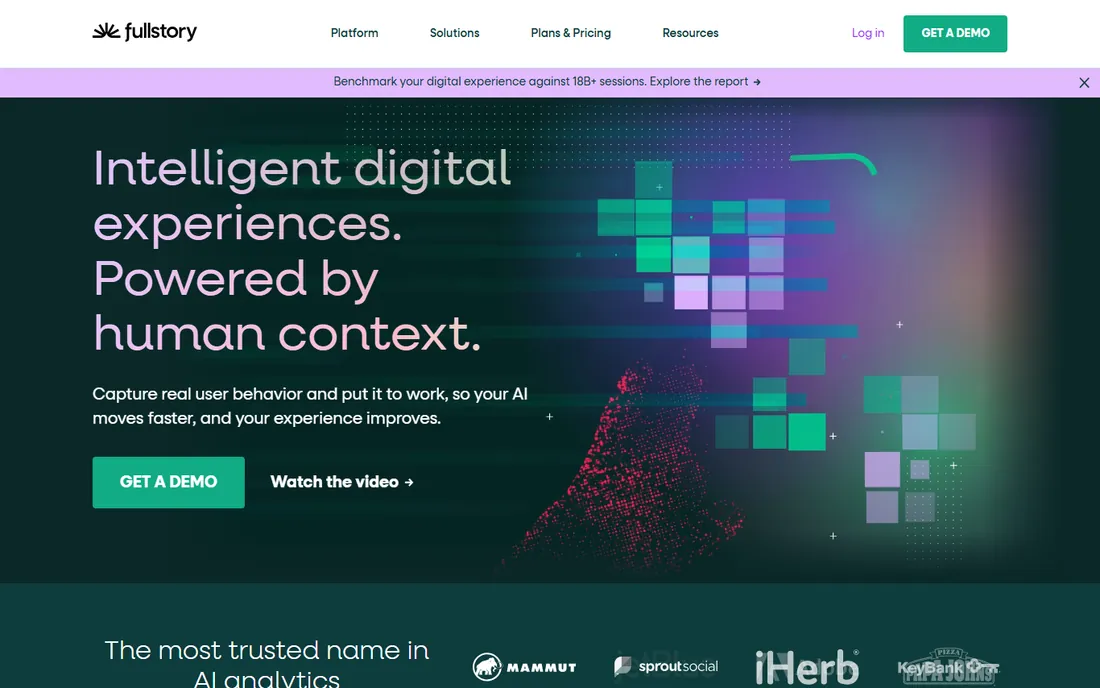
FullStory shows you what numbers cannot: actual user sessions, with AI flagging frustration signals, rage clicks and confusing flows. Watching five sessions of users struggling with your onboarding teaches more than a funnel chart.
It is not a funnel-and-cohort replacement; quantitative analysis is thinner than Mixpanel or Amplitude. The free tier covers small session volumes. FullStory fits startups that learn by watching, especially during onboarding redesigns and conversion work.
What we like- Excellent session replay with frustration signals like rage clicks
- AI summaries of sessions
- Free tier for low session volumes
Watch out for- Custom pricing for scale
- Replay-first design means quantitative analytics are secondary
Starting priceSee website
Free planYes
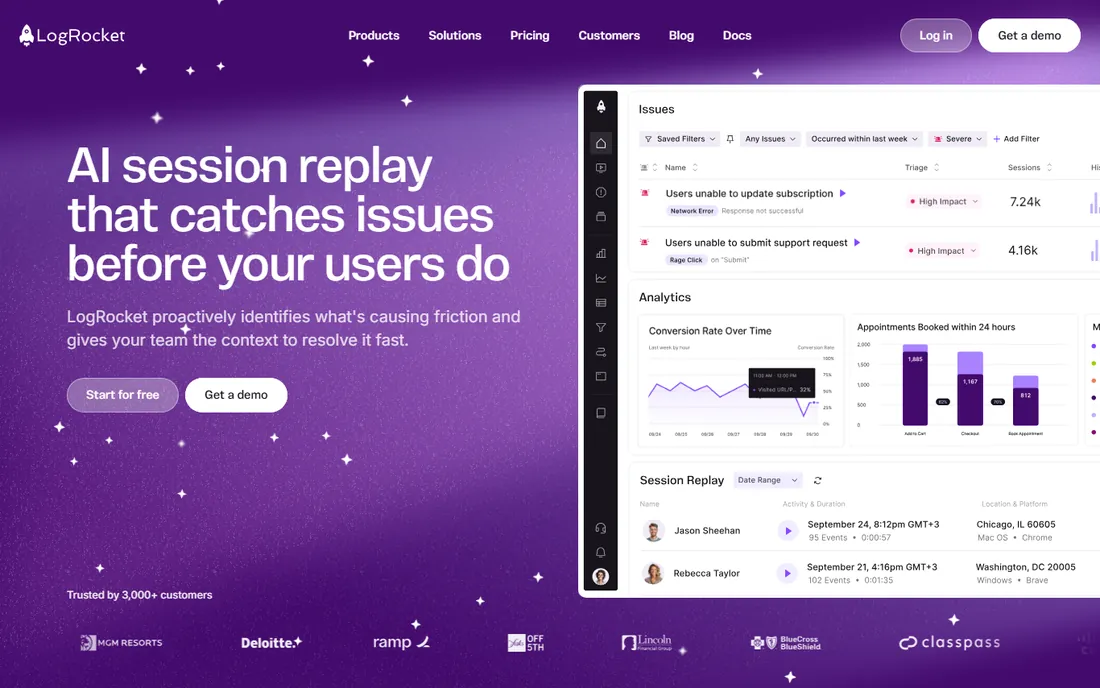
LogRocket sits between engineering and product: session replays annotated with console errors, network timing and stack traces, so a bug report comes with the full context to fix it. Product teams use it to quantify how frontend issues affect conversion.
Non-technical users may find it oriented toward developers. It complements rather than replaces product analytics. LogRocket fits startups where frontend quality directly affects revenue and engineers want replay evidence, not just error counts.
What we like- Session replay tied to console logs, network requests and errors
- Built for engineering and product collaboration
- Free tier available
Watch out for- Engineering-centric, less friendly for non-technical PMs
- Analytics depth trails the pure product tools
What to check before you buy
Start with your event volume math. Free tiers are generous but finite; project your events at 12 months of growth and price that, not today. The vendors that look cheapest at 100k events often look different at 10M.
Check the instrumentation burden against your team size. Autocapture (Heap) and all-in-one suites (PostHog) suit teams without analytics engineers; deep tools (Amplitude) reward teams that will invest in tracking plans. Verify data residency and privacy compliance for your markets, since analytics touches personal data. Finally, test the actual workflows you will use daily: building a funnel, defining a cohort, sharing a dashboard, not just the marketing tour.
The three reports every startup needs weekly
Startups drown in dashboards and starve for insight. Three weekly reports, reviewed religiously, cover most of what a founding team needs to know.
The acquisition report answers: where did users come from, and which channels brought users who stayed? Break signups by channel and cohort, then look at week-one retention per channel, not just volume. The channel with the most signups is rarely the channel with the best users. This report kills the vanity of top-line growth and forces the question every startup must answer: what actually works?
The activation report answers: are new users reaching the "aha" moment? Define the core action (not signup, the thing that delivers value), measure the percentage of new users who complete it within the first session and first week, and funnel the steps before it. When activation dips, something changed: onboarding, traffic mix, performance, or the product itself. Founders should know this number the way pilots know airspeed.
The retention report answers: are we building something people keep using? Plot retention curves by weekly cohort for the core action. Flat curves mean product-market fit is forming; declining curves mean you are pouring users into a leaky bucket. Segment by anything that might matter (plan, platform, acquisition channel, onboarding variant) but resist segmenting by everything; three cuts that drive decisions beat thirty that decorate a dashboard.
The discipline matters more than the tooling. Same definitions, same day, every week, discussed for fifteen minutes. Definitions must be written down: what counts as active, what counts as retained, what the core event is. Teams that argue about definitions monthly have a data culture problem that no tool fixes.
Add a fourth report only when a decision needs it. Revenue, engagement depth, feature adoption: all valuable, all secondary until acquisition, activation and retention are understood. Most startups that fail do not fail for lack of data; they fail for lack of attention to the data they had.
How we chose
We selected product analytics platforms with live products, real startup customer bases and workable free or low-cost entry points, using vendor sites, documentation and public comparisons. Pricing in this category is volume-dependent and changes often, so every starting price is listed as See website. We did not instrument test applications.
Frequently asked questions
What is product analytics?
The practice of tracking how users interact with your product: which features they use, where they drop off, what drives retention. It answers "what are users doing?" as opposed to marketing analytics ("how did they arrive?").
Do startups need product analytics or is Google Analytics enough?
Google Analytics tells you about acquisition and pageviews. Product analytics tells you about behavior inside the product: funnels, retention, feature adoption. Most startups outgrow GA for product questions within months.
How much do these tools cost at scale?
Free tiers typically cover up to around a million events monthly. Paid plans then scale with event or user volume; costs can reach thousands monthly for high-volume products. Always model your projected volume, not your current one.
What is autocapture?
Technology (pioneered by Heap) that automatically records all user interactions without manual event instrumentation. It lets you analyze behavior retroactively, at the cost of higher data volumes.
Should we self-host analytics?
Self-hosting (PostHog offers it) gives data control and can help with privacy compliance, but it costs engineering time to maintain. Most startups start on cloud and reconsider only when compliance or scale demands it.
How long does implementation take?
Snippet-based tools (Heap, PostHog, June) deliver first insights within hours. Deep instrumentation for tools like Amplitude takes longer if you want clean taxonomies. Budget a sprint for doing it properly.
Sources we checked (9)
- https://posthog.com
- https://mixpanel.com
- https://amplitude.com
- https://heap.io
- https://www.pendo.io/
- https://www.june.so
- https://fullstory.com
- https://logrocket.com
- https://github.com/ishandutta2007/awesome-event-based-product-analytics
Is your product missing or out of date?
We review this list regularly. Vendors can request a listing, send updated pricing or ask about featured placement.

Shihab Mia · Founder, Rankite
Shihab has 5+ years in B2B and SaaS SEO. He writes Rankite's software buying guides from pricing pages, documentation and public user reviews. More about Shihab.