How we make this list: we compare pricing pages, product documentation and public user reviews. Rankite is independent; if a vendor ever pays for a featured spot, that listing is clearly labeled Partner.
Key takeaways
- Ramp and Brex both offer genuinely free starting tiers, which makes them the lowest-risk way to bring spend under control before committing budget.
- BILL and Melio fit teams that mainly need to pay vendor bills, with BILL adding deeper AP automation and Melio keeping things simple and cheap for small businesses.
- Tipalti, Zip and Precoro are the serious procurement picks: Tipalti for high-volume global payouts, Zip for intake control, and Precoro for mid-sized teams that want published pricing.
- Watch the add-ons. Transaction fees, platform fees and per-approver seats can double the headline price, so model your real cost before signing anything.
Quick comparison
| Tool | Best for | Starting price | Free plan |
|---|
 Ramp Ramp | Growing teams replacing spreadsheets and expense reports | $0 per user/month (Core); Plus $15 per user/month | Yes |
 BILL BILL | Finance teams automating bill pay and approvals | $49 per user/month (Essentials) | Free trial |
 Tipalti Tipalti | Companies paying large numbers of global suppliers or partners | $99 per month (unlimited users) | No |
 Zip Zip | Mid-market and enterprise teams with strict intake controls | See website (custom quote) | Free trial |
 Precoro Precoro | Mid-sized companies that want procurement without an ERP | $499 per month (Core, billed annually) | Free trial (14 days) |
 Procurify Procurify | Companies standardizing purchasing across departments | See website (custom quote) | No |
 Brex Brex | Startups and finance teams combining cards with spend control | $0 per user/month (Essentials) | Yes |
 Melio Melio | Small businesses that want to pay vendor bills by card | $0 per month (Go); paid plans from $25 per month | Yes |
 Tradogram Tradogram | Small to mid-sized teams buying their first procurement tool | $99 per month (Essentials; $950.40 per year billed annually) | Free trial |
Is your product missing or out of date?
We review this list regularly. Vendors can request a listing, send updated pricing or ask about featured placement.
The best procurement software to streamline payments
#1
Ramp
Best for: Growing teams replacing spreadsheets and expense reports
Visit ramp.com
Starting price$0 per user/month (Core); Plus $15 per user/month
Free planYes
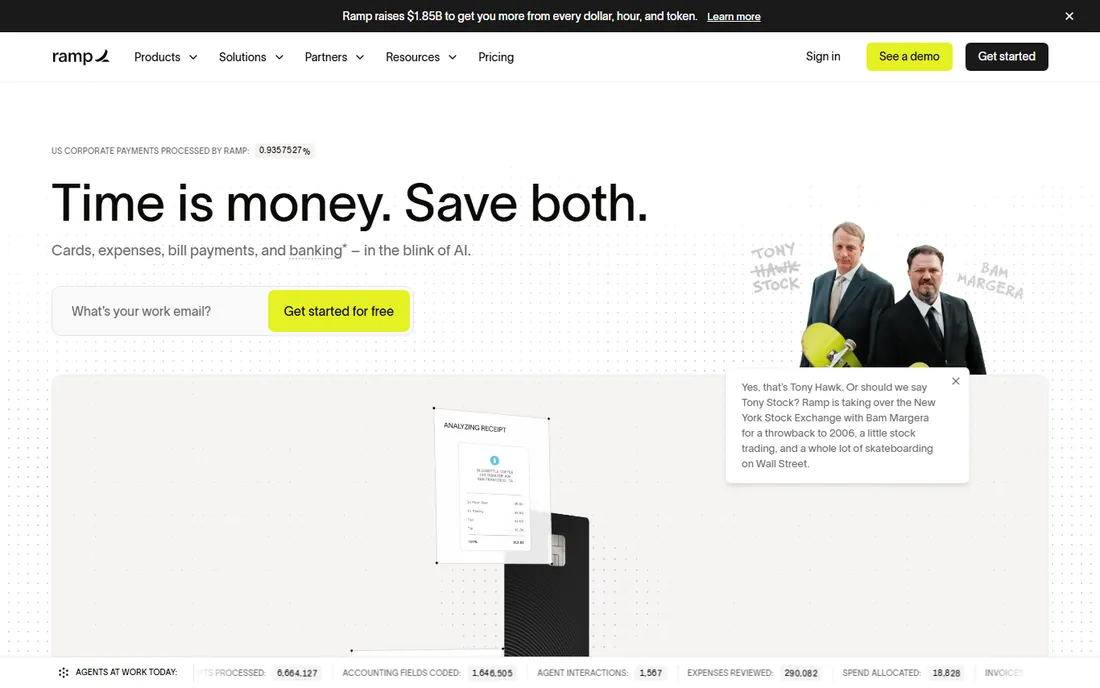
Ramp started as a corporate card and expense platform and grew into procurement, which shows in how well it handles the money side. The free Core tier covers cards, expense tracking and basic approvals, so a team of twenty can run real spend management without paying anything. Receipt matching runs automatically, and approval chains are easy to configure by department or amount.
The catch is the Plus plan. It costs $15 per user per month plus a platform fee that only appears during the sales conversation, which makes it hard to model total cost upfront. Support on the free tier can also be slower than what paying customers get. Ramp is still stronger on spend management than on deep procurement features like catalogs or intake forms, so teams with formal purchasing processes may outgrow it.
What we like- Free Core tier covers cards, expenses and approvals
- Automatic receipt matching
- Strong accounting integrations
Watch out for- Plus plan adds an undisclosed platform fee
- Deeper procurement features sit behind paid tiers
- Support can be slow on the free plan
#2
BILL
Best for: Finance teams automating bill pay and approvals
Visit bill.com
Starting price$49 per user/month (Essentials)
Free planFree trial
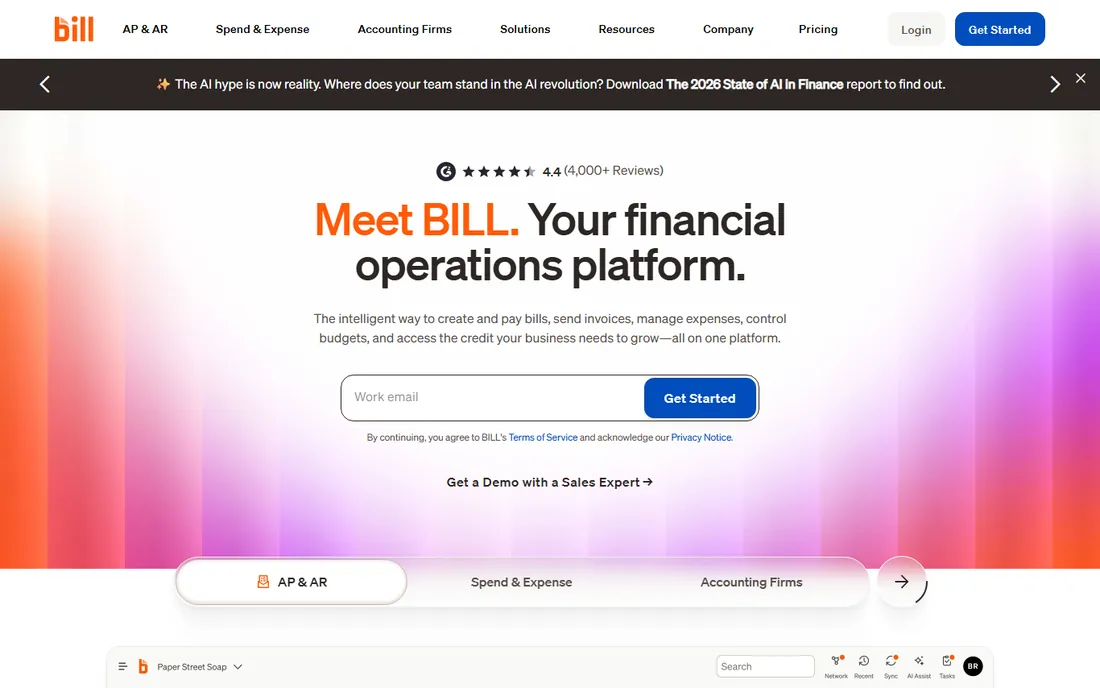
BILL is built for the accounts payable side of procurement, and it does that job well. You upload an invoice, it routes for approval, and payment goes out by ACH, check, card or international wire from the same screen. The vendor network means many suppliers are already in the system, which shortens onboarding for new payees.
Prices start at $49 per user per month on Essentials, but note that procurement features like purchase orders and two-way matching are only included on the Corporate plan at $89 per user per month. Transaction fees stack on top of the subscription: $0.59 per ACH, $1.99 per mailed check, $19.99 per international USD wire. Teams with many approvers should watch seat costs, since every Essentials and Team user is billed as a full seat.
What we like- Procurement features on the Corporate plan
- Large vendor network speeds onboarding
- Clear per-transaction fees
Watch out for- Per-user pricing adds up for large teams
- Full procurement needs the $89 Corporate tier
- Transaction fees stack on top
#3
Tipalti
Best for: Companies paying large numbers of global suppliers or partners
Visit tipalti.com
Starting price$99 per month (unlimited users)
Free planNo
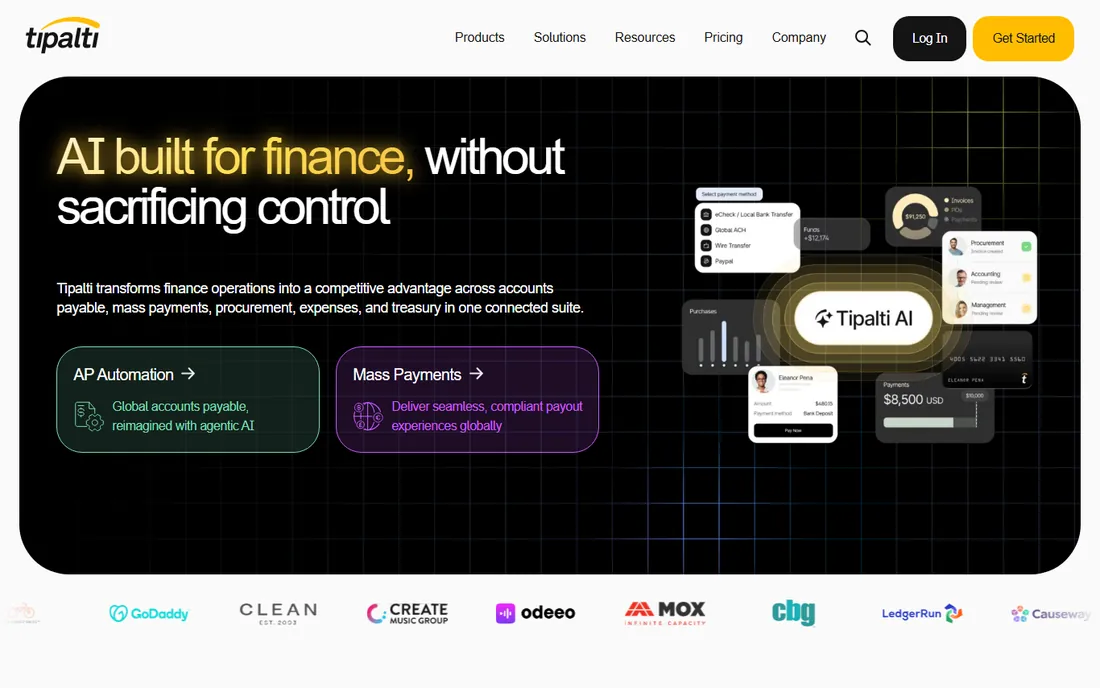
If you pay hundreds of freelancers, affiliates or suppliers across countries, Tipalti is built for that exact headache. Pricing is flat at $99 per month with unlimited users, which is unusual in this category and a real advantage for large finance teams. It handles tax forms, supplier onboarding and compliance checks in each country, so your team stops chasing paperwork.
The downside is the barrier to entry. There is no free plan or trial, only a sales demo, and implementation takes weeks rather than days because the platform is configured around your payout rules. For a company with ten vendors, it is more machine than you need. For a marketplace or media company paying creators worldwide, it is close to purpose-built.
What we like- Mass payout engine built for high volume
- Handles tax forms and compliance by country
- Unlimited user seats included
Watch out for- No free plan or trial, demo only
- Implementation takes weeks
- Overkill for teams with a handful of vendors
#4
Zip
Best for: Mid-market and enterprise teams with strict intake controls
Visit ziphq.com
Starting priceSee website (custom quote)
Free planFree trial
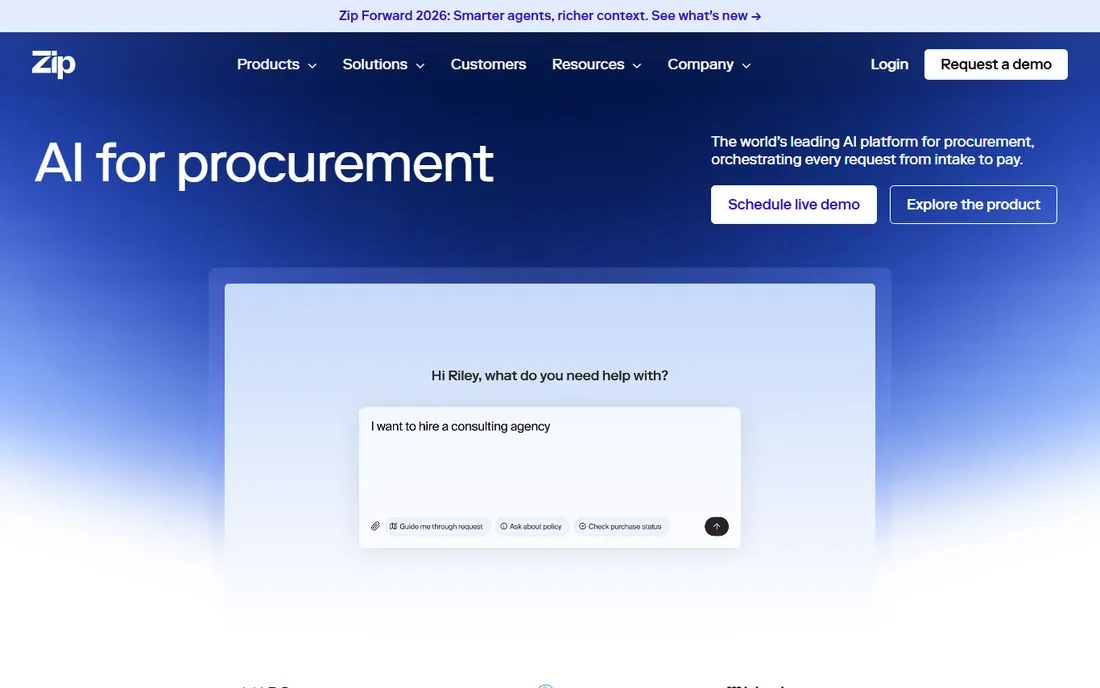
Zip focuses on the intake side, the messy part where employees request purchases and finance has no visibility. Everything from request to approval to purchase order lives in one workflow, with policy checks applied automatically. That control is why mid-market and enterprise teams choose it over simpler AP tools.
The tradeoff is access to information. Pricing is custom and quote-only, so you cannot compare costs without a sales process, and the evaluation runs through sales as well. Smaller companies will likely find the product heavier and pricier than they need, since Zip is designed for organizations with formal procurement policies and dedicated buyers.
What we like- Intake-to-pay workflow in one place
- Strong approval policy controls
- Integrates with major ERPs
Watch out for- Quote-only pricing makes budgeting hard
- Aimed at bigger teams
- Evaluation runs through sales
#5
Precoro
Best for: Mid-sized companies that want procurement without an ERP
Visit precoro.com
Starting price$499 per month (Core, billed annually)
Free planFree trial (14 days)
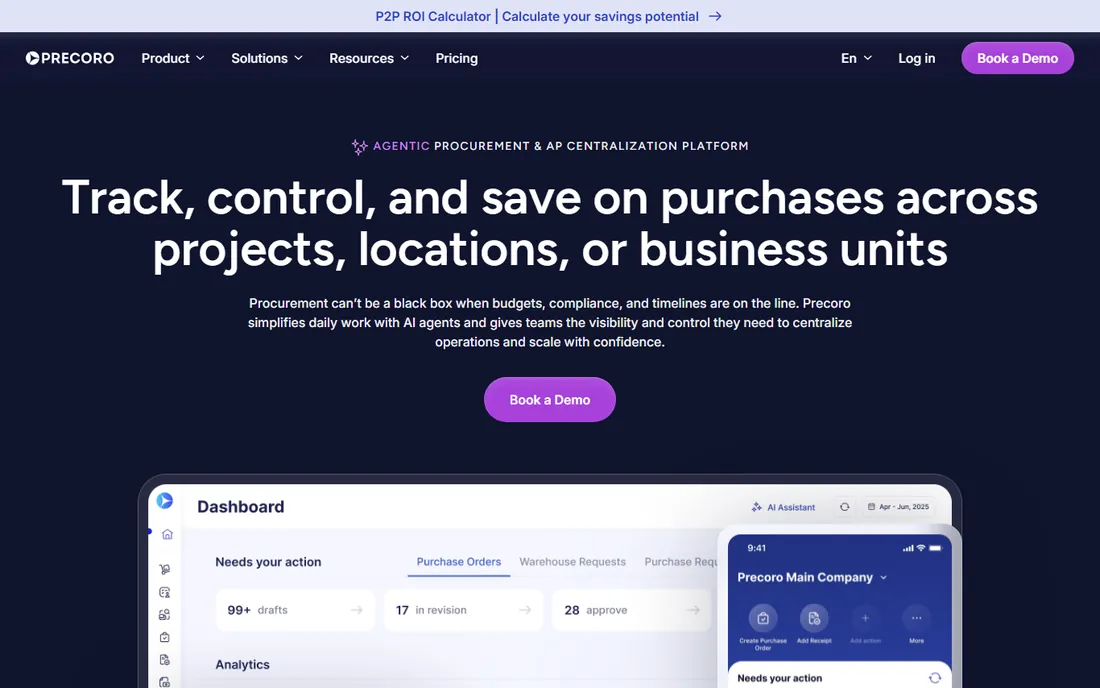
Precoro is one of the few procurement tools that publishes clear pricing, which buyers tend to appreciate. The Core plan starts at $499 per month billed annually and covers purchase requests, approvals and budgets. A 14-day trial needs no credit card, so you can test it with a real requisition cycle before talking to anyone.
The product covers the basics well, including catalogs and inventory, but there is no free tier for very small teams. The Core plan's limits show up quickly if your org chart is complex or you need multi-entity support, and add-ons push the monthly bill higher than the headline number. Still, for a mid-sized company buying its first real procurement system, the transparency is a plus.
What we like- Clear published pricing
- 14-day trial with no credit card
- Catalogs, budgets and approvals in one dashboard
Watch out for- No free tier for tiny teams
- Core plan limits show up for complex orgs
- Add-ons raise the monthly bill
#6
Procurify
Best for: Companies standardizing purchasing across departments
Visit procurify.com
Starting priceSee website (custom quote)
Free planNo
Procurify takes a different approach to pricing. Basic users are unlimited and free, and you only pay for Pro users who need full purchasing power. That model keeps seat costs low for companies that want everyone to submit requests without paying per head. Approval workflows and audit trails are solid, which matters for teams replacing email-based approvals.
On the other hand, pricing is custom and modular, so the final number depends on your quote and you cannot model it yourself. There is no self-serve way to evaluate the product; you start with a demo or tour. For very small teams, the platform can feel like more process than the problem requires, but for companies rolling out purchasing controls department by department, the unlimited-requester model is genuinely useful.
What we like- Unlimited basic users keep seat costs down
- Modular pricing around Pro users
- Solid approval audit trail
Watch out for- No published prices
- Evaluation starts with a demo
- Can feel heavy for very small teams
#7
Brex
Best for: Startups and finance teams combining cards with spend control
Visit brex.com
Starting price$0 per user/month (Essentials)
Free planYes
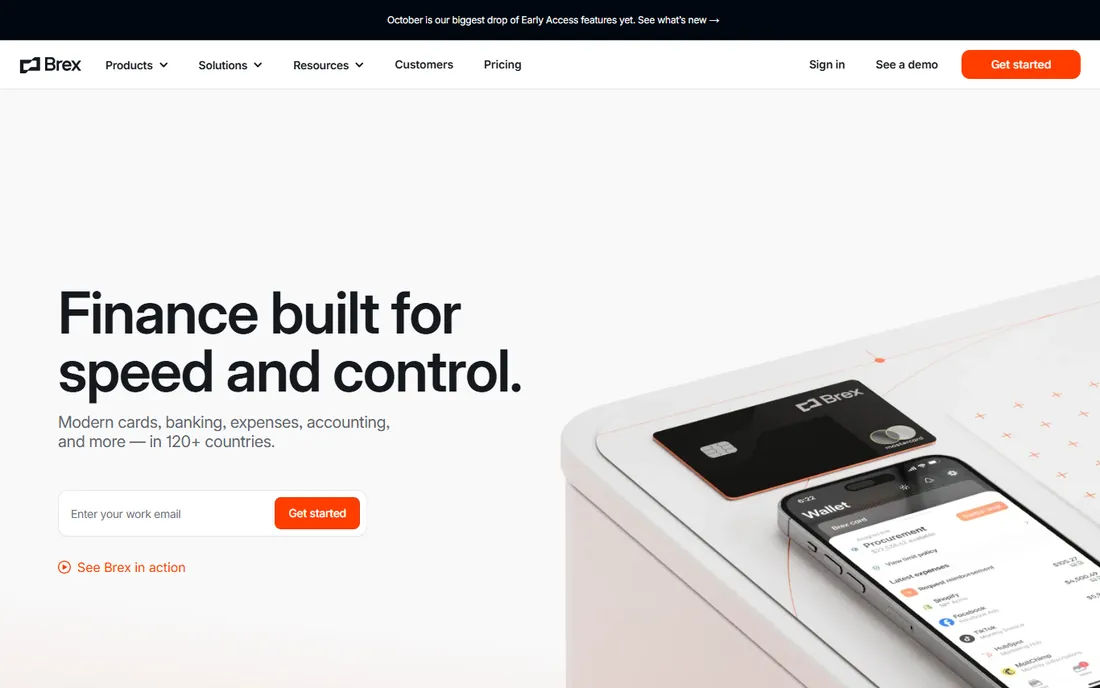
Brex combines corporate cards, expense management and procurement controls in one free-to-start platform. The Essentials plan costs nothing per user and still includes cards, expense tracking and basic approvals, which is generous. The Smart Card product adds procurement-specific workflows for teams that buy software and services regularly.
One thing to know: Capital One closed its acquisition of Brex in April 2026. The product still operates independently with published pricing, but buyers should read the terms carefully as the integration unfolds. Brex's credit-based model ties spending limits to your cash balance, which works for funded startups but can frustrate others. Procurement depth is also lighter than dedicated tools, so complex intake workflows may not fit.
What we like- Free tier with real functionality
- Smart Card product for procurement workflows
- Expense management built in
Watch out for- Credit-based limits tied to cash balance
- Procurement depth is lighter than pure-play tools
- Ownership changed in 2026
#8
Melio
Best for: Small businesses that want to pay vendor bills by card
Visit melio.com
Starting price$0 per month (Go); paid plans from $25 per month
Free planYes
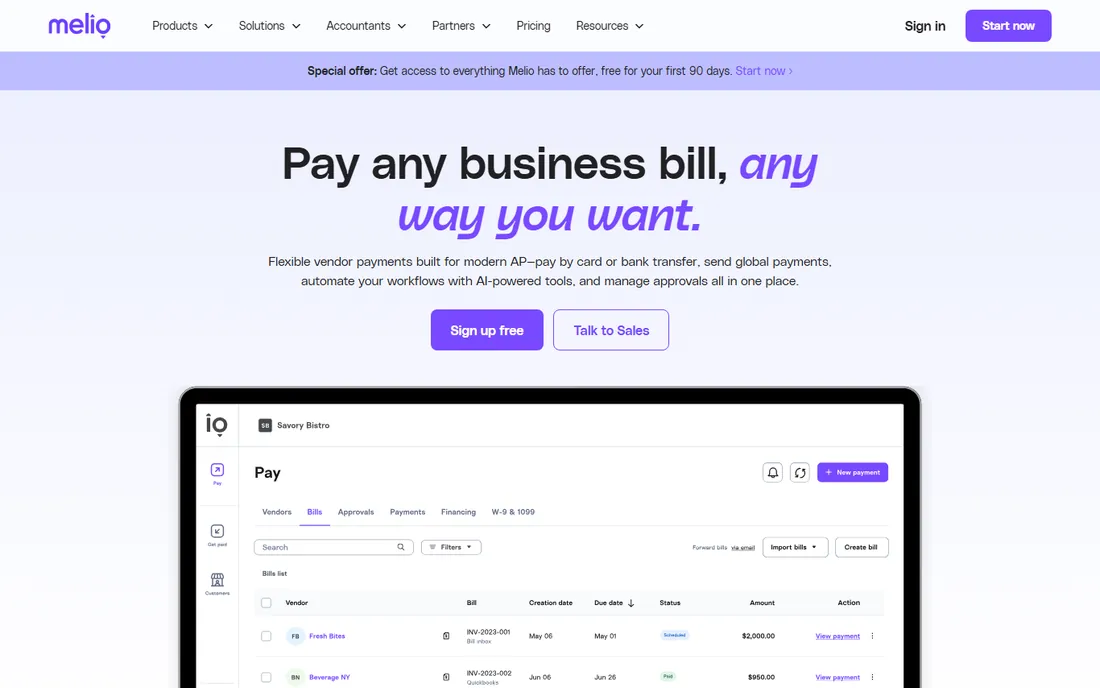
Melio solves a narrow problem well: paying vendor bills, with the option to pay by card even when the vendor does not accept cards. The Go plan is free forever for one user with five free ACH payments a month, which covers a freelancer or tiny business. Paid plans start at $25 per month ($20 when billed annually) and add users and automation, with a 90-day free promo running on paid tiers.
Accounting integrations with QuickBooks and Xero keep the books in sync. The card-payment convenience costs 2.9% per transaction, which adds up on large bills, so it is best used strategically rather than for everything. The free tier's limits push growing teams to paid plans quickly. Think of Melio as bill pay with light approvals, not a full procurement suite.
What we like- Free Go plan with free ACH payments
- Pay vendors by card even if they don't accept cards
- 90-day promo on paid plans
Watch out for- Card payments carry a 2.9% fee
- Free plan limited to 1 user and 5 free ACH a month
- Fewer procurement controls than AP suites
#9
Tradogram
Best for: Small to mid-sized teams buying their first procurement tool
Visit tradogram.com
Starting price$99 per month (Essentials; $950.40 per year billed annually)
Free planFree trial
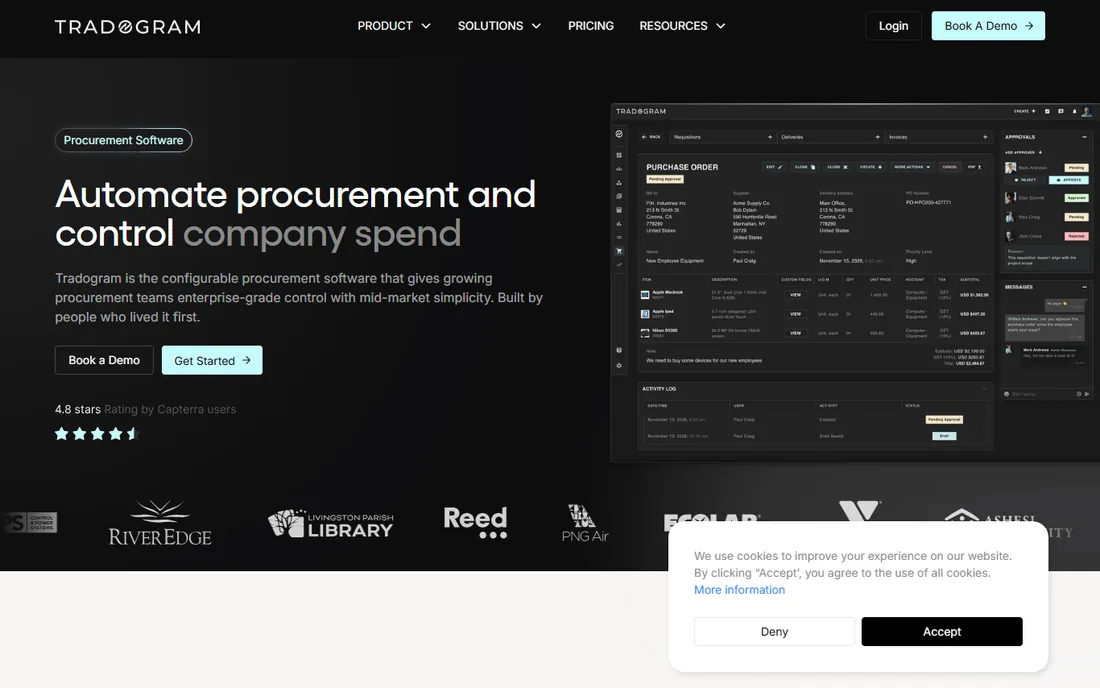
Tradogram is a straightforward pick for small to mid-sized teams buying their first procurement platform. The Essentials plan costs $99 per month, or $950.40 per year on the annual plan, with published pricing and no mystery. It handles purchasing, approvals and basic inventory in one dashboard, and setup is quick compared with enterprise tools.
The tradeoff is maturity. Tradogram has fewer integrations and less name recognition than the bigger players, and reporting is basic next to tools that cost five times more. Premium and Scale tiers are custom quotes, so pricing clarity ends at Essentials. For a team moving off spreadsheets, though, it delivers the core workflow at a fair price.
What we like- Published pricing with an annual discount
- Covers purchasing, approvals and inventory basics
- Quick to set up
Watch out for- Fewer integrations than bigger players
- Basic reporting
- Premium and Scale tiers are custom quotes
How we chose
We started with the procurement and AP tools that show up most often in buyer shortlists, then checked each one against three filters: it must exist and be purchasable today, it must handle at least part of the procure-to-pay flow, and its pricing must be verifiable from the vendor's own pages. We read vendor pricing pages, product documentation and feature lists, and cross-checked with public reviews on G2 and Capterra plus buyer discussions on Reddit. One well-known name, Airbase, was dropped from this list because it now sells only through Paylocity's quote process after its acquisition, which makes it impossible to evaluate or buy standalone. We did not claim hands-on testing; this ranking reflects documented features, published pricing and reported buyer experience.
How to choose without overbuying
The biggest mistake buyers make in this category is purchasing an enterprise intake platform when they needed bill pay, or vice versa. Start from your actual workflow and work outward.
Match the tool to your spend volume
If you pay fewer than fifty vendors a month and most are domestic, a bill pay tool like Melio or BILL will cover you. If you run hundreds of purchase requests across departments, you need intake and approvals, which points to Zip, Precoro or Procurify. If you pay creators, freelancers or suppliers in dozens of countries, Tipalti's payout engine is built for that volume.
Look at approval depth before the demo
Ask how many approval steps a purchase order can have, whether policies can vary by department or amount, and what the audit trail looks like. Simple tools handle one or two approvers fine. Multi-entity companies need conditional routing, which is where the pricier platforms earn their keep.
Count the real cost, not the headline price
Per-user seats are only the start. Add transaction fees (ACH, check, wire), platform fees that appear only in quotes, and the cost of add-on modules. A $49 per user tool with twenty approvers and heavy wire volume can cost more than a $99 flat-rate tool. Model your actual monthly volume before comparing.
Check integrations and data export
At minimum, the tool should sync with your accounting software and export clean CSVs of every transaction. If you run NetSuite or Intacct, confirm the integration is automatic two-way sync and not manual CSV import, because that distinction decides whether month-end close gets faster or stays painful.
Trial terms and contracts
Prefer tools with a real trial that does not require a credit card. When a vendor only offers a sales-led evaluation, ask for a pilot with your own data and a written list of every fee, including implementation, before you sign an annual contract.
What procurement software actually costs
Pricing in this category follows three patterns, and most tools mix at least two of them. Per-seat pricing charges for each user, which punishes companies with many approvers; unlimited-requester models like Procurify's exist specifically to fix that. Flat monthly pricing, like Tipalti's $99 or Tradogram's $99, is the easiest to budget but usually covers a narrower feature set. Transaction fees are the quiet third component: ACH, checks, wires and card payments each carry a fee, and high-volume payers should treat these as part of the subscription cost. Implementation ranges from self-serve signup to multi-week onboarding, and enterprise tools often add platform or success fees that never appear on the pricing page. Always ask for the complete fee schedule in writing.
Frequently asked questions
What is the cheapest procurement software for a small business?
Ramp and Brex both offer free tiers that cover cards, expenses and basic approvals, which is enough for many small teams. Melio's free Go plan handles basic bill pay for a single user. If you need purchase orders and formal approvals, Tradogram at $99 per month is the cheapest published option with real procurement features.
Do I need procurement software or just bill pay?
If your problem is paying invoices faster, bill pay software like BILL or Melio is enough. If your problem is controlling what gets bought in the first place, with requests, approvals and budgets, you need procurement software like Precoro, Zip or Procurify. Many companies start with bill pay and add procurement controls when headcount passes fifty or so.
How long does procurement software take to set up?
Self-serve tools like Melio, Ramp and Tradogram can be running in days. Mid-market platforms like Precoro typically take two to four weeks including approval workflow configuration. Enterprise tools like Zip and Tipalti often take six weeks or more, since they are configured around your policies and payout rules.
Can these tools pay vendors internationally?
Most can, but the details matter. Tipalti is the strongest for high-volume international payouts with local compliance. BILL charges $19.99 per international USD wire with free local transfers where supported. Check FX fees and delivery times for your specific countries before committing, since those vary widely.
Will procurement software work with QuickBooks, Xero or NetSuite?
Nearly all the tools here integrate with QuickBooks and Xero. NetSuite and Intacct support is common on mid-market and enterprise tiers but sometimes limited to manual CSV import on entry plans, so verify the integration type on the plan you intend to buy.
Sources we checked (9)
- https://ramp.com/blog/top-zip-alternatives
- https://www.bill.com/pricing
- https://tipalti.com/resources/learn/tipalti-vs-ramp/
- https://procurementaiagents.com/agents/zip
- https://precoro.com/pricing
- https://www.procurify.com/pricing/
- https://www.brex.com/pricing
- https://meliopayments.com/pricing/
- https://www.tradogram.com/pricing
Is your product missing or out of date?
We review this list regularly. Vendors can request a listing, send updated pricing or ask about featured placement.

Shihab Mia · Founder, Rankite
Shihab has spent more than a decade helping SaaS and e-commerce brands grow through search. He writes Rankite's software buying guides from pricing pages, documentation and public user reviews. More about Shihab.