How we make this list: we compare pricing pages, product documentation and public user reviews. Rankite is independent; if a vendor ever pays for a featured spot, that listing is clearly labeled Partner.
Key takeaways
- Most source to pay suites are quote-only: Coupa, SAP Ariba, JAGGAER, GEP SMART, Ivalua and Zycus publish no prices, so get license, implementation and integration costs in writing separately.
- Oracle is the exception at the enterprise end: its own US price list shows Oracle Fusion Procurement at $625 per hosted named user, with self-service users at $8.
- Precoro is the only entry here with published SMB-friendly pricing: Core from $499 per month and Automation from $999 per month, both billed annually.
- Mid-market teams that want flat, predictable spend control without a six-figure contract should shortlist Precoro and Procurify and skip the enterprise suites entirely.
Quick comparison
| Tool | Best for | Starting price | Free plan |
|---|
 Coupa Coupa | Mid-market and large companies wanting the leading independent S2P platform | See website (custom quote) | No (no free trial advertised) |
 SAP Ariba SAP Ariba | Enterprises standardized on SAP or needing the largest supplier network | See website (custom quote) | No (no free trial advertised) |
 JAGGAER JAGGAER | Manufacturers, higher education and public sector organizations with complex sourcing needs | See website (custom quote) | No (no free trial advertised) |
 Oracle Fusion Cloud Procurement Oracle Fusion Cloud Procurement | Companies already standardized on Oracle Fusion Cloud ERP | $625/hosted named user (Oracle US price list) | No (no free trial advertised) |
 GEP SMART GEP SMART | Enterprises wanting an AI-native S2P platform plus advisory services from one vendor | See website (custom quote) | No (no free trial advertised) |
 Ivalua Ivalua | Large enterprises needing deeply configurable no-code procurement workflows | See website (custom quote) | No (no free trial advertised) |
 Zycus Zycus | Global enterprises prioritizing agentic AI across the source-to-pay cycle | See website (custom quote) | No (no free trial advertised) |
 Precoro Precoro | Mid-sized companies with distributed purchasing that want published, predictable pricing | $499/month (Core, billed annually) | No (no free trial advertised) |
 Procurify Procurify | Mid-market finance teams wanting flat, predictable spend control | See website (custom quote) | No (no free trial advertised) |
Is your product missing or out of date?
We review this list regularly. Vendors can request a listing, send updated pricing or ask about featured placement.
The best source to pay software
Your procurement team runs on spreadsheets, approvals live in email threads, and nobody can say with confidence who spent what with which supplier last quarter. Source to pay software fixes that: one system from sourcing and contracts through purchase orders, invoices and payments. The catch is that most of these platforms are sold like enterprise software, with custom quotes, long implementations and services bills that can double the license cost. These nine cover both ends of the market.
#1
Coupa
Best for: Mid-market and large companies wanting the leading independent S2P platform
Visit coupa.com
Starting priceSee website (custom quote)
Free planNo (no free trial advertised)
Coupa is the default independent pick in source to pay for one reason: network density. The platform connects requisitioning, sourcing, contracts, purchasing, invoicing, payments and expenses on one data model, and suppliers transact on the network without extra fees. For companies managing $500 million to $5 billion in spend, Coupa positions itself as the easiest enterprise suite to buy and implement.
Coupa publishes no prices, and third-party benchmarks put mid-market annual licensing from $48K to $90K for a 50-user deployment. Implementation through consulting partners typically adds a third to a half of the year-one software cost again. If you are not prepared for a sales-led process and a real implementation project, the mid-market tools at the bottom of this list will serve you better.
What we like- Largest independent business trade network with millions of buyers and suppliers transacting on one platform
- One unified system spanning procurement, invoicing, payments, expenses and supply chain
- Community benchmarking data drawn from trillions in spend
Watch out for- No published pricing, so every deal is a negotiation and every implementation needs scoping
- Enterprise deployments commonly require consulting partners, adding 35 to 50 percent of year-one software cost in services per third-party estimates
- Buyer-side network benefits matter less if your suppliers are not on the platform
#2
SAP Ariba
Best for: Enterprises standardized on SAP or needing the largest supplier network
Visit ariba.com
Starting priceSee website (custom quote)
Free planNo (no free trial advertised)
SAP Ariba is the network play. If your suppliers already transact on the SAP Business Network, onboarding friction drops sharply, and the suite covers strategic sourcing (RFx, auctions, bid analysis), contracts, guided buying, invoicing and spend analysis, now with SAP's Joule AI assistants. Suppliers can join the network on free or low-cost tiers.
Ariba sells in modules and every number is negotiated; third-party benchmarks describe standalone sourcing starting around $100K per year and full suites at $1M plus for large global deployments. Integration outside the SAP stack takes more work, and reviewers consistently describe Ariba as the most implementation-heavy option here. Buy Ariba when your ERP is SAP or your supply base lives on the network. Otherwise the quote will be hard to justify.
What we like- SAP Business Network, the largest B2B trading network in this set, already hosts millions of suppliers
- Deepest native integration with SAP S/4HANA and SAP ECC
- Modular product line lets you buy sourcing, procurement or contracts standalone
Watch out for- Fully quote-based pricing with six-figure annual floors typical for full-suite deals per third-party contract data
- Implementations are heavy and slow compared with cloud-native rivals
- Integration is strongest with SAP, weaker with Oracle or Microsoft Dynamics stacks
#3
JAGGAER
Best for: Manufacturers, higher education and public sector organizations with complex sourcing needs
Visit jaggaer.com
Starting priceSee website (custom quote)
Free planNo (no free trial advertised)
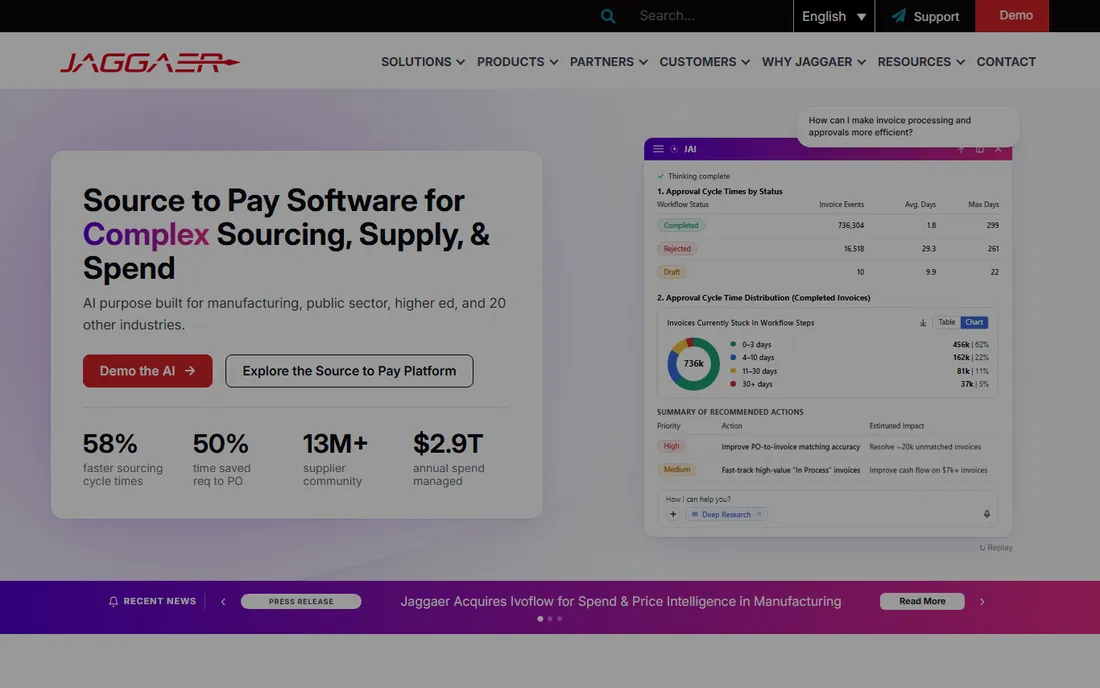
JAGGAER One is the sourcing specialist that grew into a full suite. Its strength is complex sourcing events: multi-round negotiations, several auction types, optimization that models award scenarios against constraints, and direct-materials sourcing with multi-tier BOMs and should-cost models. That makes it the natural pick for manufacturers and regulated buyers in higher education, healthcare and government.
Unlike suites that force an all-or-nothing deal, JAGGAER lets you start with eProcurement or sourcing and add contract management or analytics later, and third-party benchmarks describe it as often the lowest-cost enterprise entry point. The tradeoff is depth that takes time to configure, and reviewers note inconsistent support experiences. Budget for training and a 12 to 16 week rollout per module.
What we like- Strongest direct-materials and BOM sourcing in this set, with cost-breakdown and award-scenario modeling
- Modular architecture lets you buy only the modules you need and add more later
- 40-plus prebuilt ERP connectors and a public-sector heritage with real procurement controls
Watch out for- No published commercial pricing
- Reviewers describe a steep learning curve and slow configuration for custom workflows
- Enterprise integrations have room to grow for very complex IT stacks per reviewer notes
#4
Oracle Fusion Cloud Procurement
Best for: Companies already standardized on Oracle Fusion Cloud ERP
Visit oracle.com
Starting price$625/hosted named user (Oracle US price list)
Free planNo (no free trial advertised)
Oracle Fusion Cloud Procurement is the incumbent play for Oracle shops. It covers sourcing, supplier qualification, contract management, requisitioning and invoicing as native Fusion modules, so a purchase order, a budget check and a journal entry all live in one system. For companies already on Oracle Fusion Financials, that native fit removes an entire integration project.
Oracle publishes a US price list showing $625 per hosted named user for the procurement module and $8 for self-service users, a list anchor before negotiation. Commercial buyers typically negotiate discounts, and implementation through Oracle or a partner is a separate line. If your ERP is not Oracle, there is no reason to start here. If it is, this is the shortest path to a working S2P process.
What we like- Native module inside Oracle Fusion Cloud Applications, so procurement shares data, security and workflows with financials and HCM
- Oracle's own US price list publishes list pricing ($625 per hosted named user, $8 for self-service users)
- Generative AI built into the Redwood interface for sourcing and contract review
Watch out for- List pricing is a starting point and real deals are negotiated
- Procurement depth for direct materials often requires adjacent Oracle SCM modules
- The value case weakens sharply outside an Oracle ERP estate
#5
GEP SMART
Best for: Enterprises wanting an AI-native S2P platform plus advisory services from one vendor
Visit gep.com
Starting priceSee website (custom quote)
Free planNo (no free trial advertised)
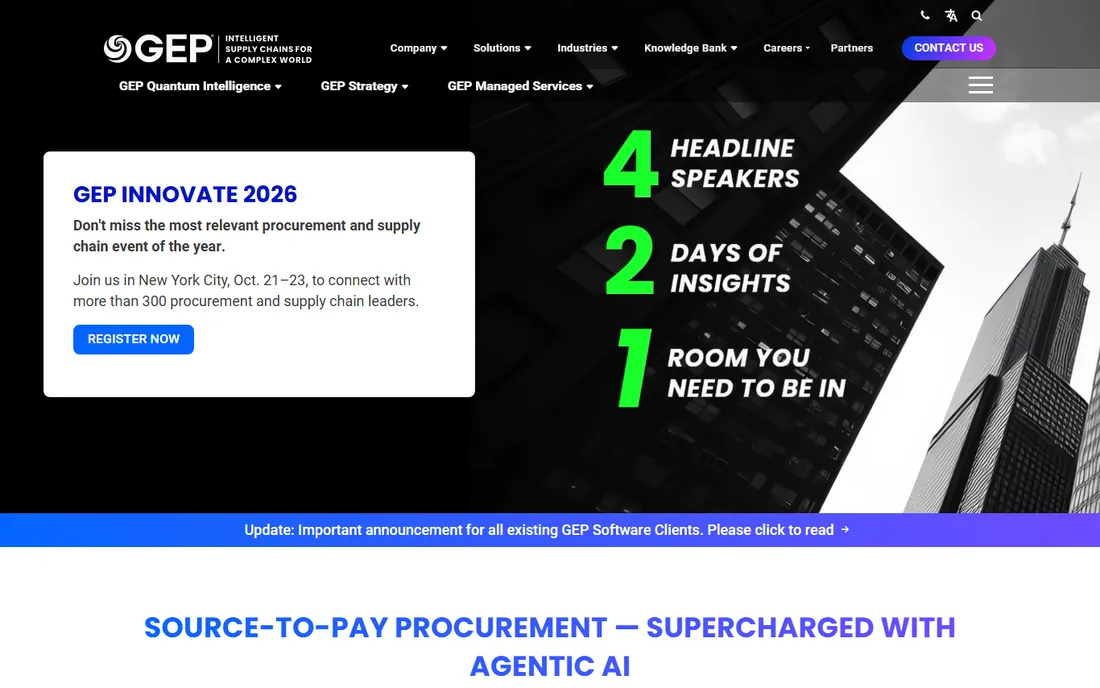
GEP SMART is the sourcing-first suite, historically strong in spend analysis and strategic sourcing: RFx management, e-auctions, supplier performance and savings tracking, now wrapped in GEP Quantum Intelligence, its agentic AI layer. It handles direct and indirect spend in one environment with native BOM-level costing for manufacturing bids, and integrates with SAP, Oracle, Workday and other ERPs.
GEP is also a consulting and managed-services firm, so buyers who want the software and the procurement transformation from one vendor can get it. Third-party benchmarks describe GEP as roughly 15 to 20 percent below Coupa for comparable scope, with typical mid-market deals between $54K and $108K annually for 50 users. The AI features buyers most want often sit at premium tiers, so negotiate which AI capabilities are included in base licensing before signing.
What we like- One AI-native platform covering direct and indirect spend with sourcing-first strengths in spend analysis and supplier intelligence
- GEP pairs software with its own strategy and managed-services practices, so transformation help comes from the same vendor
- Typically priced below SAP Ariba for comparable scope per third-party benchmarks
Watch out for- Fully quote-based enterprise pricing with no public list
- Invoice automation and advanced contract lifecycle features sit in add-ons
- Enterprise weight means real implementation timelines even though they run faster than Ariba's per benchmarks
#6
Ivalua
Best for: Large enterprises needing deeply configurable no-code procurement workflows
Visit ivalua.com
Starting priceSee website (custom quote)
Free planNo (no free trial advertised)
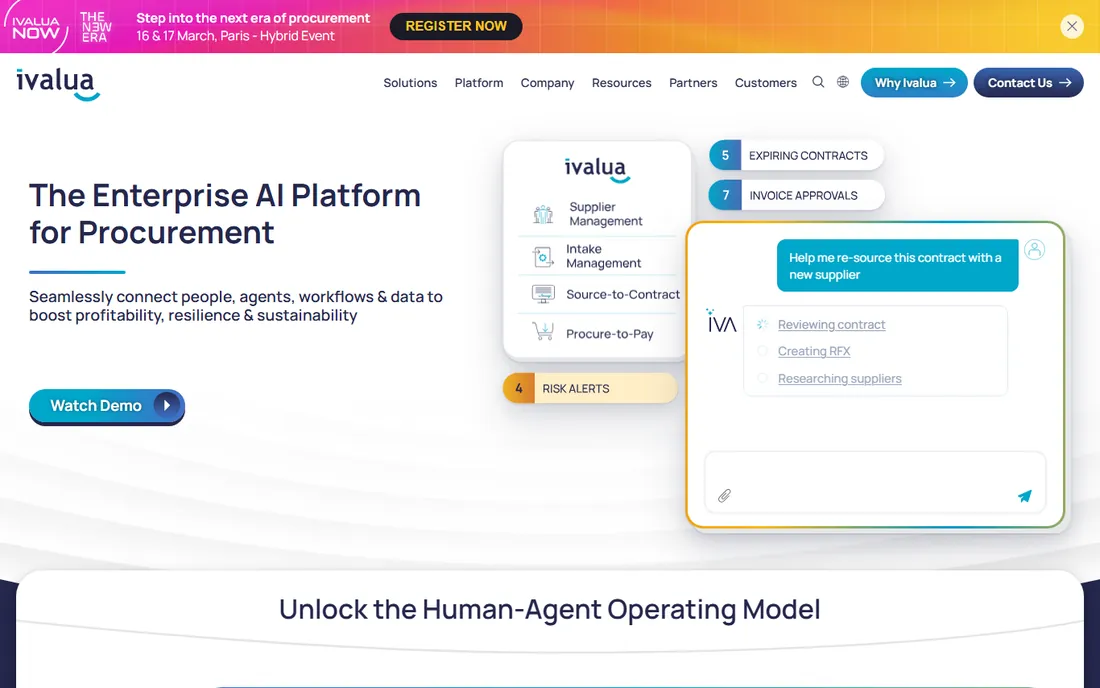
Ivalua is the configurability pick. Its no-code engine lets you design procurement processes around how your company actually buys, which matters for global enterprises with different rules per country or business unit. The platform covers the full source-to-pay cycle on one data model, from supplier risk and sourcing through contracts, eProcurement, invoicing and payments.
Pricing is fully custom, scoped on organization size, modules and implementation, with third-party comparisons placing entry around $150,000 per year. Reviewers praise the interface for everyday users but warn the breadth overwhelms newcomers and deep tailoring takes specialist help.
What we like- No-code and low-code configuration lets procurement teams adapt workflows, approval chains and rules without developers
- One unified platform covering sourcing, supplier management, contracts, eProcurement, invoicing and spend analytics
- Strong fit for organizations with different processes across business units and regions
Watch out for- Enterprise-scale commitment with no published pricing and third-party estimates starting around $150,000 annually
- Reviewers describe a steep learning curve from the breadth of features
- Deep customizations can still require specialized IT help or consultants
#7
Zycus
Best for: Global enterprises prioritizing agentic AI across the source-to-pay cycle
Visit zycus.com
Starting priceSee website (custom quote)
Free planNo (no free trial advertised)
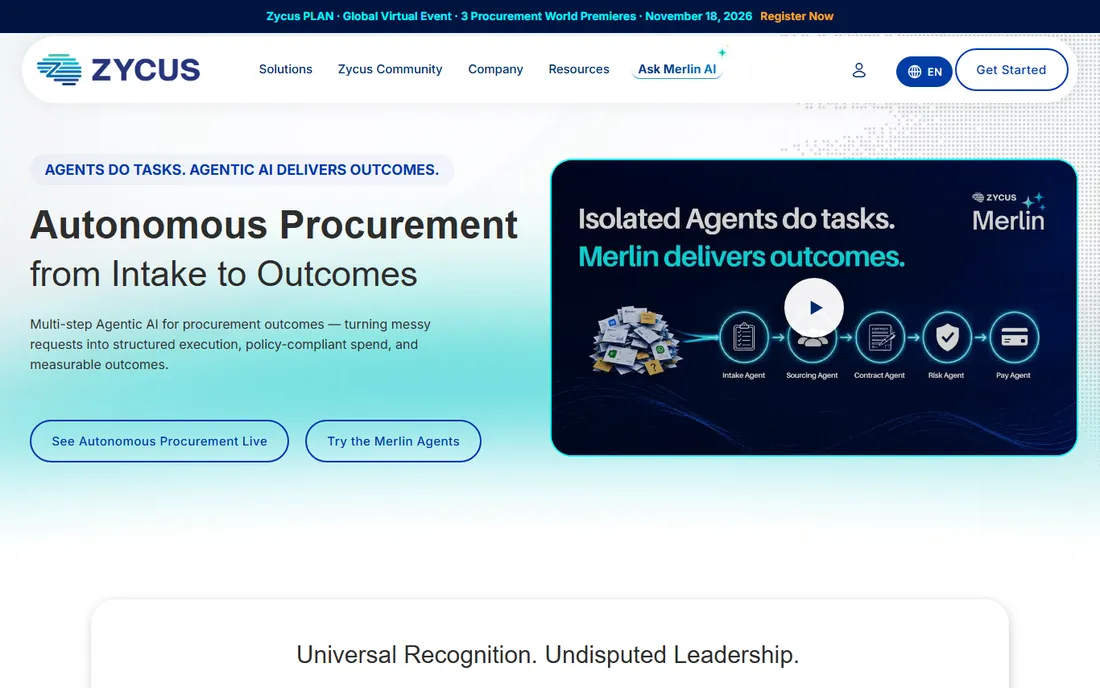
Zycus is the AI-first challenger in this set. Its Merlin platform runs agentic AI as one governed flow: Merlin Intake takes requests in natural language inside Teams or Slack, Merlin Agentic Sourcing turns a request into a sourcing strategy and event, and the Autonomous Negotiation Agent negotiates tail spend on price, payment terms and warranties. The pitch is moving from source-to-pay to intake-to-outcomes, where agents execute inside policy and raise only exceptions.
The suite is broad: spend analytics, e-sourcing with reverse auctions, contract management with e-signatures, supplier management and procure-to-pay, all built organically rather than assembled through acquisition. There is no published pricing, the supplier network is thinner than the two network giants, and the breadth means a real implementation project. Zycus suits enterprises that want autonomous procurement and can accept a four to six month rollout.
What we like- Merlin agentic AI platform with autonomous agents for intake, sourcing strategy, tail-spend negotiation and spend analytics
- Organically built suite on one data model with prebuilt connectors for SAP and Oracle plus over a thousand published APIs
- Conversational intake through Microsoft Teams and Slack
Watch out for- Quote-only pricing scoped on spend, users and modules with no published rates
- Supplier network reach is smaller than SAP Ariba's or Coupa's
- Rollouts average four to six months for multi-module deployments per third-party comparisons
#8
Precoro
Best for: Mid-sized companies with distributed purchasing that want published, predictable pricing
Visit precoro.com
Starting price$499/month (Core, billed annually)
Free planNo (no free trial advertised)
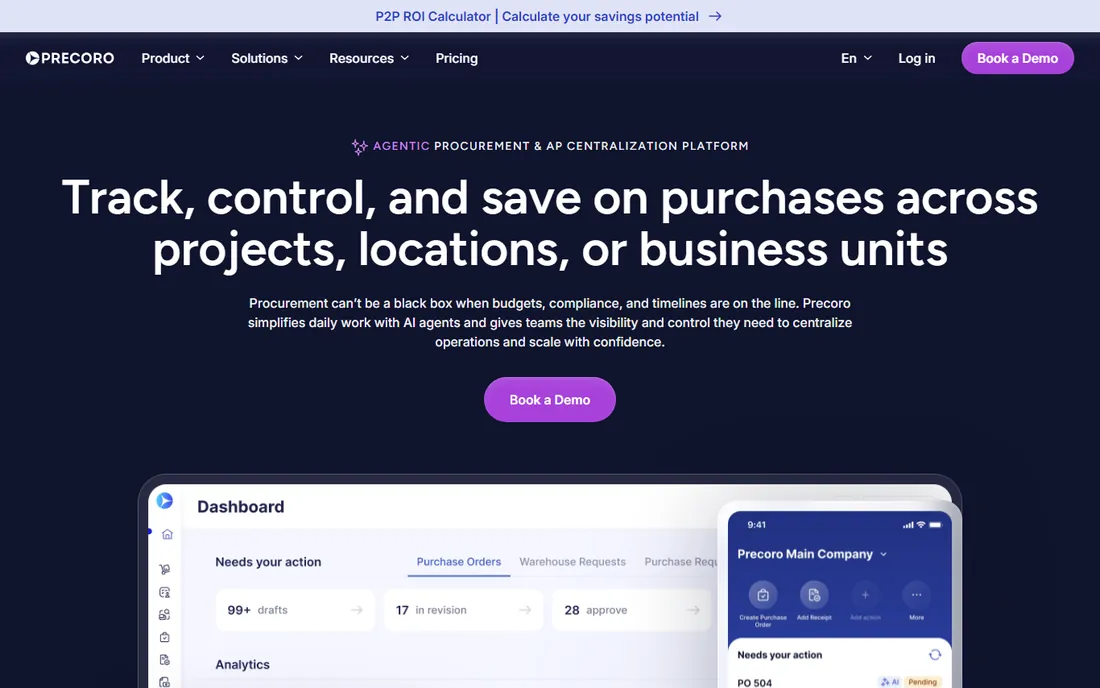
Precoro is the mid-market answer to the quote-only enterprise suites. It centralizes intake, purchasing, approvals, budgets, suppliers, invoices and payments for companies with purchasing spread across locations, projects and departments. Pricing is published: Core starts at $499 per month and Automation at $999 per month, billed annually, with a custom Enterprise tier. Most teams go live in two to eight weeks.
The feature set is practical: guided intake forms, automated approval routing, purchase orders, receipts, three-way invoice matching, real-time budgets, a supplier portal and payments via ACH, wire or international transfer. Reviewers praise the interface and support while flagging the NetSuite integration and a mobile app that lacks desktop parity. If your buying problem is purchase-order control and budget visibility, Precoro gives you a price on day one, which none of the suites above will.
What we like- Transparent published pricing (Core from $499 per month, Automation from $999 per month, Enterprise custom), rare in this category
- Typical go-live in two to eight weeks with no IT involvement
- Real-time budget tracking with three-way matching and a supplier portal
- Native integrations with QuickBooks Online, Xero, NetSuite, Sage Intacct and Dynamics 365 Business Central
Watch out for- Strategic sourcing depth is lighter than the enterprise suites (RFPs arrive on Automation, not Core)
- Pricing is tiered so growing teams step up plans
- Advanced AI document processing and payments sit on higher tiers
#9
Procurify
Best for: Mid-market finance teams wanting flat, predictable spend control
Visit procurify.com
Starting priceSee website (custom quote)
Free planNo (no free trial advertised)
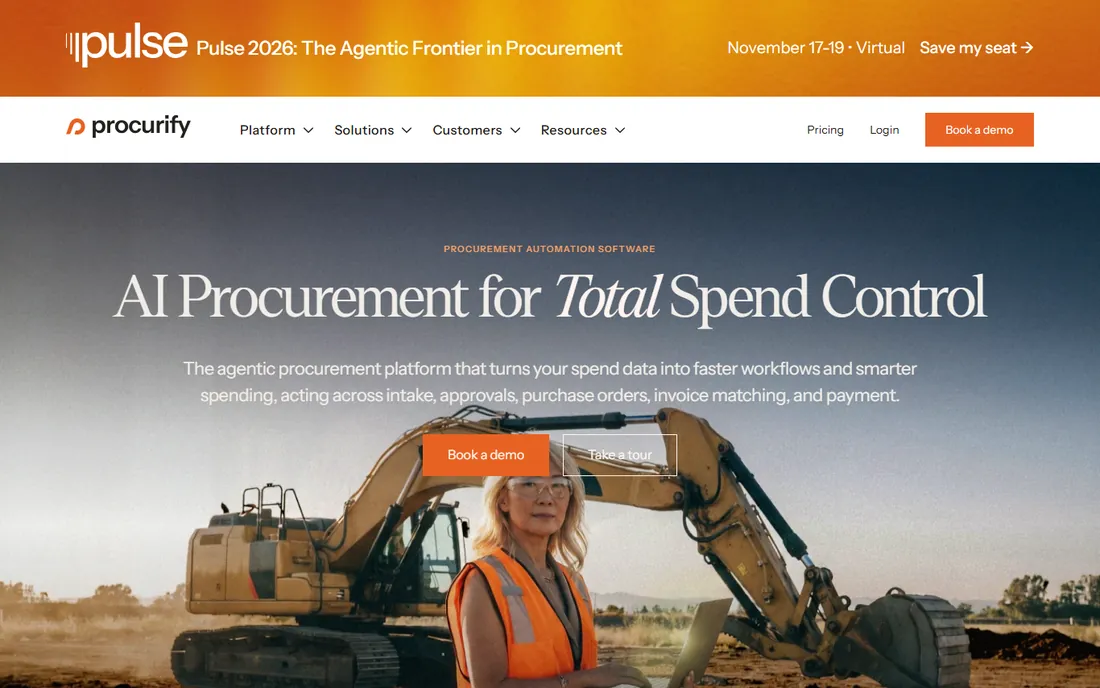
Procurify takes the lighter path: straightforward purchasing, approval routing, budgets and expense tracking without the strategic sourcing apparatus of a full suite. The hook is flat pricing rather than per-user seats, so a company with 200 occasional requesters does not pay 200 licenses. It covers requests, purchase orders, invoicing and bill payments with AI assistance, and integrates with NetSuite, QuickBooks, Sage Intacct, Dynamics 365 Business Central and Slack.
Reviewers like the speed of ordering and the audit trail. The honest gaps are the integration list, which reviewers call thin, the absence of inventory tracking, and a UI that some users find sluggish. Pricing is custom-quoted, so you will still talk to sales, but the deal sizes are mid-market, not enterprise. Pick Procurify when your priority is getting every purchase request visible and approved fast, at a predictable monthly cost.
What we like- Flat company-wide pricing model instead of per-seat licensing, which suits organizations with many casual approvers
- Fast adoption with ready-made templates and autofill for recurring orders
- Audit logs capture every edit, approval and receipt for clean compliance records
Watch out for- Pricing is quote-based with no public list (third-party comparisons cite around $1,000 per month as a starting point)
- Reviewers flag a thin integration list with no QuickBooks connector and no native inventory tracking
- The interface draws complaints about slowness in heavy sessions
Source to pay is really two markets wearing one name. The enterprise suites (Coupa, Ariba, JAGGAER, Oracle, GEP, Ivalua, Zycus) manage strategic sourcing, contracts, supplier risk and global compliance for companies with dedicated procurement teams and six or seven figures of annual software spend. The mid-market tools (Precoro, Procurify) handle intake, purchase orders, approvals, budgets and AP automation for companies with a one-person procurement team, or none at all.
Match the tool to the buyer, not the feature list. If you run sourcing events and manage hundreds of suppliers, the suite depth matters and the quote process is the cost of entry. If your problem is that employees buy things without approval and finance finds out at month end, a suite is overkill: you need request-to-pay visibility with a price you can read today. A common mistake is buying a suite for a mid-market problem, then using ten percent of it while paying for all of it.
The integration question decides more deals than features do. Oracle's procurement module is the obvious pick inside an Oracle Fusion estate, and Ariba's where SAP runs finance. Outside those estates, prefer the platform with prebuilt connectors to your actual ERP, and confirm during the demo that supplier, PO, invoice and payment data sync both ways. Ask every vendor for license, implementation and integration costs as three separate lines before you compare totals.
What source to pay software actually costs
Almost nobody in this category publishes prices. Enterprise suites are quoted on modules, users or spend under management, and third-party contract benchmarks describe mid-market annual licensing from roughly $50K for a focused deployment to $500K-plus, with large global enterprises paying $1M or more. Implementation services typically add another 30 to 100 percent of the year-one software cost.
The two anchors you can verify: Oracle's own US price list shows Fusion Procurement at $625 per hosted named user, and Precoro publishes Core at $499 per month and Automation at $999 per month, billed annually. Everything else here is a conversation with sales. Lock down five things in writing: the license metric and what counts as a user, the implementation scope and timeline, integration costs for your ERP, renewal and price-increase caps, and which AI features are included in base licensing. Suites increasingly gate AI at higher tiers, and that is where surprise costs hide.
How we chose
We started with the categories buyers search: source to pay software, S2P software, procurement software and spend management software. For each candidate we opened the vendor's own site, checked whether pricing was published, and compared scope, supplier network, ERP fit and company-size fit against public reviews on G2, Capterra and TrustRadius plus practitioner discussion on Reddit and analyst comparisons. Where a price could not be verified on the vendor's own page we wrote "See website" rather than guessing, and third-party benchmarks are identified as such.
Frequently asked questions
What is source to pay software?
Source to pay (S2P) software manages the full procurement lifecycle in one system: sourcing, contracts, purchase orders, receiving, invoicing and payment. It connects the strategic upstream work (sourcing, contracts) with the downstream buying and payment workflows, giving finance visibility into spend, suppliers and compliance.
How much does source to pay software cost?
Enterprise suites are quote-only: third-party contract data describes mid-market deals from roughly $50K per year to several hundred thousand, plus implementation services. Precoro publishes $499 to $999 per month billed annually. Oracle's own US price list shows $625 per hosted named user. Get license, implementation and integration costs as separate lines in writing.
What is the difference between source to pay and procure to pay?
Source to pay covers the cycle from identifying suppliers and running sourcing events through contracts, purchasing, invoicing and payment. Procure to pay is the downstream subset: everything from the purchase requisition to payment once a supplier is already contracted. Full S2P suites do both; lighter tools like Precoro and Procurify focus on the procure-to-pay half.
Which source to pay software is best for a mid-sized business?
Precoro and Procurify are built for mid-market buyers: faster implementations, published or mid-market pricing, and no strategic-sourcing apparatus you will never use. Coupa is the most accessible enterprise suite if you expect to grow into six-figure procurement software. Avoid buying a suite for a purchase-order control problem.
Do I need source to pay software if I already have an ERP?
ERPs record transactions; S2P platforms manage the buying process: intake, approvals, sourcing events, contract workflows and supplier collaboration. If your ERP is Oracle Fusion, the native procurement module is the shortest path. If approvals live in email and sourcing in spreadsheets, a dedicated S2P layer adds real value on top of any ERP.
How long does source to pay implementation take?
Mid-market tools go live in weeks: Precoro cites two to eight weeks. Enterprise suites take months: Zycus averages four to six months for multi-module deployments, JAGGAER runs about 12 to 16 weeks per module, and Ariba and Coupa rollouts commonly take longer with consulting partners involved. Scope your timeline to the modules you are actually deploying.
Sources we checked (17)
- https://www.coupa.com
- https://ariba.com
- https://jaggaer.com
- https://www.oracle.com
- https://www.gep.com
- https://www.ivalua.com
- https://www.zycus.com
- https://precoro.com/pricing/
- https://procurify.com/
- https://www.oracle.com/ee/a/ocom/docs/corporate/pricing/us-public-sector-3904395.pdf
- https://www.selecthub.com/procurement-software/ivalua-vs-ziphq/
- https://www.selecthub.com/procurement-software/zycus-vs-procurify/
- https://www.selecthub.com/procurement-software/jaggaer-one-vs-procurify/
- https://procurementaiagents.com/blog/s2p-platform-pricing-coupa-ariba-gep
- https://procurementaiagents.com/blog/best-source-to-pay-ai-platforms-2026
- https://www.g2.com/categories/procurement
- https://www.capterra.com/procurement-software/
Is your product missing or out of date?
We review this list regularly. Vendors can request a listing, send updated pricing or ask about featured placement.

Shihab Mia · Founder, Rankite
Shihab has spent more than a decade helping SaaS and e-commerce brands grow through search. He writes Rankite's software buying guides from pricing pages, documentation and public user reviews. More about Shihab.