How we make this list: we compare pricing pages, product documentation and public user reviews. Ratings come from G2, Capterra or Trustpilot, with the date we checked them.
Key takeaways
- Sanity is the developer led default for SaaS content: structured content, real time editing, and pricing from $15 per seat per month on the Growth plan.
- Storyblok gives marketers a visual editor on a headless base, from $99 per month, which suits SaaS teams whose writers are not engineers.
- Contentful is the enterprise tier of the same idea at $300 per month for its Lite plan, with governance the smaller tools charge extra for or skip.
- HubSpot Content Hub wins when the CRM is already HubSpot, because the blog, landing pages, and lead data share one system.
- Writer and AirOps cover the production side: governed AI writing and SEO content workflows that sit on top of whichever CMS you choose.
Quick comparison
| Tool | Best for | Starting price | Free plan |
|---|
 Sanity | Developer led SaaS content operations | $15 per seat per month | Yes |
 Storyblok | Visual editing on a headless CMS | $99 per month | Yes |
 Contentful | Enterprise content across many products | $300 per month | Yes |
 HubSpot Content Hub | Content tied directly to a HubSpot CRM | $20 per seat per month | Yes |
 Webflow | Design led marketing sites and blogs | $14 per month | Yes |
 Writer | Governed AI content for brand teams | See website | No |
 AirOps | AI driven SEO content workflows | See website | No |
 Contently | Enterprise content programs with freelancers | See website | No |
Is your product missing or out of date?
We review this list regularly. Vendors can request a listing, send updated pricing or ask about featured placement.
The best content platforms for SaaS
#1Sanity
Best for: Developer led SaaS content operations4.7/5 on
G2 (926 reviews, checked Oct 2026)
Visit sanity.io
Starting price$15 per seat per month
Free planYes
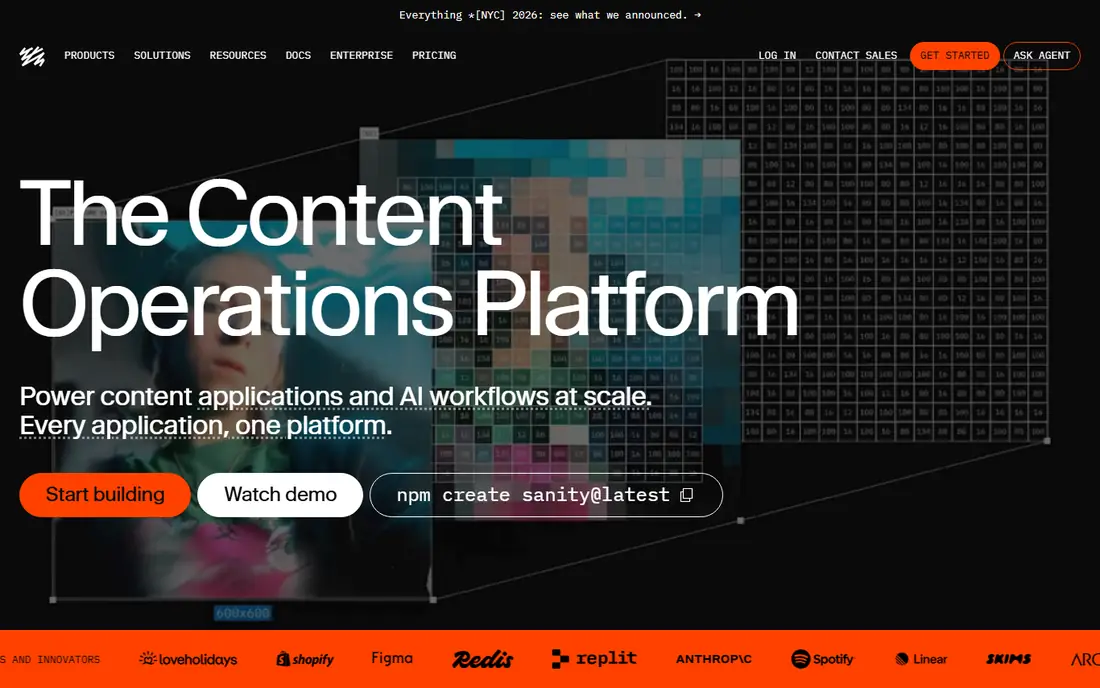
Sanity is the platform SaaS engineering and content teams most often choose together. Content lives as structured data behind an API, edited in a Studio your developers shape to match how your team actually writes: a blog post, a pricing page block, a changelog entry, and a help article can all draw on the same components. Growth pricing is listed at $15 per seat per month, and the free tier is generous enough to run a real pilot.
The commitment is real. Sanity gives you no website out of the box; your team builds the front end, usually in Next.js on Vercel or Netlify, and owns it from then on. For a SaaS company with engineers, that is the point: content that behaves like product data. For a team without them, pick Storyblok or Webflow instead.
What we like- Content is structured data, so one asset feeds site, app, and docs
- The Studio editor is customisable to your exact workflow
- Real time collaboration like a shared document
- Free plan is genuinely usable for small teams
Watch out for- Your developers build and maintain the front end and the Studio setup
- Usage based costs grow with API traffic
- Advanced admin features such as SAML sit on expensive add ons
- Marketers used to page builders face a learning curve
#2Storyblok
Best for: Visual editing on a headless CMS4.5/5 on
G2 (592 reviews, checked Oct 2026)
Visit storyblok.com
Starting price$99 per month
Free planYes
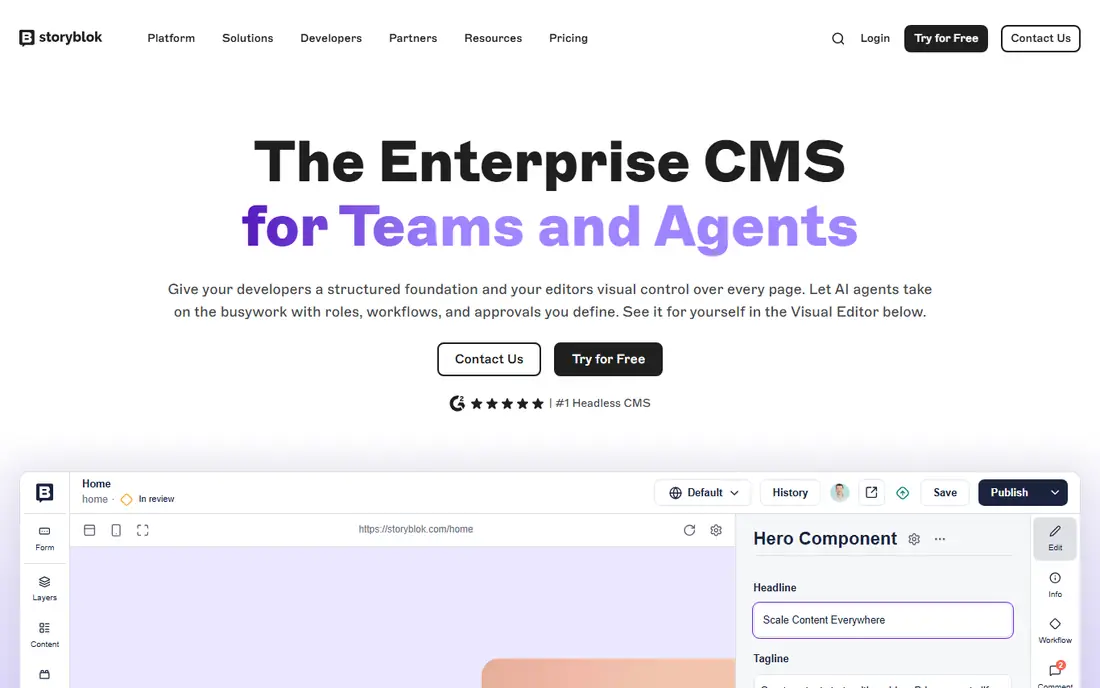
Storyblok answers the main complaint about headless CMS: writers hate editing blind. Its visual editor renders the real page beside the fields, so a marketer building a landing page sees the result as they type, while the architecture stays headless and component based underneath. SaaS marketing teams that ship campaign pages weekly feel the difference immediately.
Entry pricing is listed at $99 per month for the Growth plan with a free plan below it. Watch the tier edges: recent reporting describes steep increases when projects cross content and traffic limits, so model your second year, not your first month. For marketer friendly headless, Storyblok is the benchmark the others answer to.
What we like- Visual editor shows writers the actual page while they edit
- Component based content suits SaaS design systems
- Free plan for evaluation
- Strong agency and multi site story
Watch out for- Pricing has risen in recent years, with users reporting sharp jumps at tier boundaries
- Per project and seat maths needs care as you scale
- Deepest features sit on the $299 plus tiers
- Developer setup still required up front
#3Contentful
Best for: Enterprise content across many products4.3/5 on
G2 (399 reviews, checked Oct 2026)
Visit contentful.com
Starting price$300 per month
Free planYes
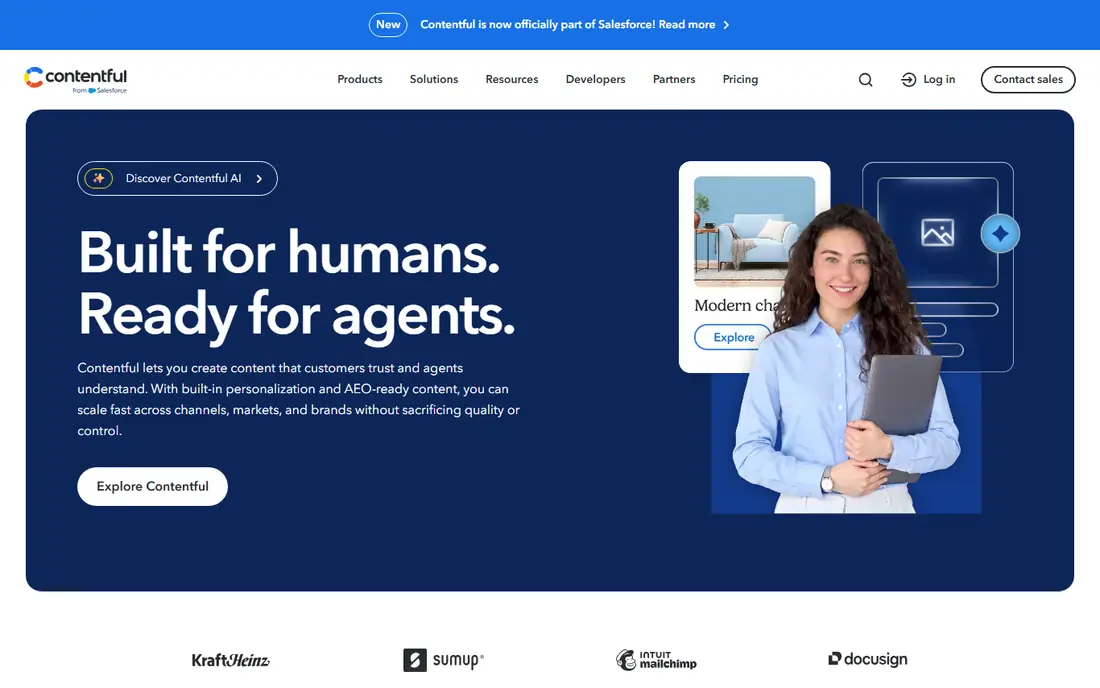
Contentful is where big SaaS and enterprise brands land when content spans many products, regions, and languages and somebody has to govern all of it. Its workflows, permissions, and environment management are built for organisations where a pricing page in twelve markets is a compliance exercise, not a blog post.
That maturity costs money. The Lite plan lists at $300 per month, mid tier pricing is less public than rivals, and one 2026 cost analysis estimated near $489 per month for a typical small team once real usage is counted. Smaller SaaS companies get better value from Sanity or Storyblok. Companies with genuine governance needs get the platform those tools grow into.
What we like- The most established enterprise headless platform
- Governance, roles, and workflows for large content teams
- Deep integrations with commerce, personalisation, and translation tools
- Global delivery infrastructure
Watch out for- Lite plan at $300 per month is the priciest entry here
- The free tier is tightly limited
- Costs climb with usage and spaces in ways that surprise finance teams
- Marketer experience trails Storyblok's visual editing
#4HubSpot Content Hub
Best for: Content tied directly to a HubSpot CRM4.5/5 on
G2 (2,207 reviews, checked Oct 2026)
Visit hubspot.com
Starting price$20 per seat per month
Free planYes
HubSpot Content Hub, the successor to its CMS Hub, makes a simple trade: give up some design freedom, gain a content system that knows every reader. Because the CRM is underneath, a SaaS team can see which posts and pages produced which deals, personalise pages by segment, and automate follow up without connectors. For the large share of SaaS companies already on HubSpot, that is decisive.
Paid seats are listed from about $20 per month at Starter level, with promotions sometimes lower, and free tools cover a basic start. The honest limit is the walled garden: content tooling this convenient assumes HubSpot stays your centre. If it is, Content Hub is the lowest effort platform on this list.
What we like- Blog, pages, and forms share data with the CRM, so content ties to pipeline
- Built in SEO guidance and A/B testing
- No separate analytics or lead capture stack to wire up
- Free tools to start, paid seats from around $20 per month
Watch out for- The value collapses if your CRM is not HubSpot
- Design flexibility trails Webflow and headless setups
- Seat pricing across HubSpot products stacks up
- Migrating a large structured content library in is a project
#5Webflow
Best for: Design led marketing sites and blogs4.4/5 on
G2 (995 reviews, checked Oct 2026)
Visit webflow.com
Starting price$14 per month
Free planYes
Webflow is where SaaS design teams go to own the marketing site. Its visual canvas produces clean, fast websites, its CMS handles the blog and resource centre, and site plans start at a listed $14 per month billed yearly with a free plan to build on. Many well known SaaS homepages run on it because a designer can ship a page the day it is approved.
The boundary is scope. Webflow publishes websites; it does not feed content into your app, your docs, and your partner portal from one model the way Sanity does. For a SaaS company whose content problem is the marketing site itself, that boundary does not matter, and Webflow is the fastest route to a site that looks like the product deserves.
What we like- Pixel level design control without writing code
- CMS collections handle blogs, glossaries, and resource libraries well
- Hosting, SSL, and CDN are included in site plans from $14 per month
- Fast to launch a polished marketing site
Watch out for- It is a website platform, not a multi channel content API
- Large CMS item counts and traffic push you up tiers
- Localisation and enterprise features cost extra
- Developers hit its ceiling on complex product sites
Starting priceSee website
Free planNo
Writer is the AI platform for companies that worry about what AI writes. Instead of a chat box, it gives content teams agents and apps built on their own style guide, claims library, and terminology, so a product description or a help article comes out on brand and fact checked against approved sources. SaaS companies with legal, security, or medical reviewers use it to scale content without scaling risk.
Writer sits on top of your stack, not instead of it. You still need Sanity or HubSpot underneath to publish. The pairing is the modern SaaS content engine: governed generation where drafts start, human editors where they finish, and a CMS where they live. Pricing is enterprise and quoted.
What we like- AI writing built for enterprise control: style guides, terminology, and brand rules enforced in the tool
- Agents and workflows for repeatable content jobs
- Strong compliance posture for regulated industries
- Works inside the tools writers already use
Watch out for- Enterprise pricing by quote
- It produces and governs content but is not your CMS or website
- Value depends on having real content volume
- Setup needs style and terminology work up front
Starting priceSee website
Free planNo
AirOps is the workflow engine behind many SaaS SEO programs. Teams build step by step flows, pull keyword and competitor data, research sources, draft with AI models, run brand and fact checks, add human review, and publish into the CMS, to produce content at a pace a writing team alone cannot match. Programmatic and comparison pages are its home turf.
The honest caution belongs in every AirOps plan: search engines reward content that helps readers, and a workflow that ships thin pages at scale will eventually be judged as one. Used with real editorial standards, AirOps multiplies a good team's output. Used as a content hose, it manufactures tomorrow's cleanup. Pricing is quoted per platform use.
What we like- Workflow builder chains research, briefs, drafts, and optimisation steps
- Built for SEO content programs that target hundreds of pages
- Connects to common CMS platforms to publish
- Human review steps can be placed where you want them
Watch out for- Output quality depends on the workflow design and your review discipline
- Pricing by quote
- Not a CMS, it feeds one
- AI generated content at scale carries search risk if published unedited
#8Contently
Best for: Enterprise content programs with freelancers4.6/5 on
G2 (96 reviews, checked Oct 2026)
Visit contently.com
Starting priceSee website
Free planNo
Contently is the platform for a SaaS company that buys content as much as it makes it. It combines content planning and workflow software with a managed marketplace of freelance journalists and creators, plus compliance tooling that routes drafts through legal review, a workflow financial and healthcare SaaS companies know well.
It is the oldest model on this list and still the right one for some teams: a central platform where strategy, freelancers, approvals, and measurement live, while your CMS, likely one of the tools above, handles publishing. Pricing is enterprise and quoted. For a content program that runs on outside talent, Contently is the established home.
What we like- Platform plus a vetted freelance network of writers, designers, and videographers
- Editorial workflow, briefs, and compliance checks built in
- Strong for regulated industries with legal review needs
- Content performance analytics included
Watch out for- Enterprise pricing by quote
- You are buying a program, not just software
- Less relevant for product led SaaS with in house teams
- Freelance quality still needs your editors' judgement
How we chose
We defined the category as a SaaS marketing team would: the platforms that plan, produce, manage, and publish content for a software company. Pricing and plan facts come from vendor pages and October 2026 comparisons on PagePro, FocusReactive, G2, and Rankite's own content management roundup. We mixed systems of record with production platforms because SaaS teams buy both, and we said which is which in every entry. We left out standalone AI writing chatbots with no workflow or governance, general website builders with no real CMS, and agencies, which sell people rather than platforms.
What to look for in a content platform for SaaS
Decide who ships the page. If marketers must publish without engineers, the editor experience decides everything, and Storyblok, Webflow, and HubSpot win their places on it. If content must flow into the product, the docs, and three regional sites, structured content and APIs decide, and Sanity and Contentful pull ahead. Write your three most common publishing jobs down and test each finalist on exactly those.
Then price the whole engine. The CMS licence is the small number next to implementation, front end hosting, and the production tools layered on top; one 2026 analysis put first year implementation for a mid size headless setup between $40,000 and $120,000. Finally, plan the exit. Content you cannot export in structured form is content you rent. Every platform here exports, but check the format on a real library before your whole archive depends on it.
Frequently asked questions
What is the best content platform for a small SaaS company?
Sanity or Storyblok for most teams. Sanity's free plan and $15 per seat Growth pricing suit developer led startups; Storyblok suits teams where marketers need to see the page. A very small team already on HubSpot's CRM should start with Content Hub and skip the separate CMS entirely until publishing volume forces the question.
Is a headless CMS worth it for SaaS content?
When content must appear in more than one place, the website, the product, the help centre, partner pages, yes: one structured source beats four copies drifting apart. For a single marketing site and blog, headless adds a front end you must build and host, and Webflow or HubSpot will usually serve you faster and cheaper.
Can AI platforms replace a SaaS content team?
No, and the credible vendors do not claim it. Writer and AirOps multiply a team's output on researchable, repeatable content: comparisons, programmatic pages, product updates. They do not supply the original insight, customer stories, and data that make SaaS content rank and convert. Budget AI tooling as a force multiplier for editors, not as their replacement.
How much does a SaaS content platform cost in total?
The licence ranges from free to $300 a month at entry in this list, and enterprise tiers run far higher. The real budget is implementation and operation: front end build for headless setups, commonly tens of thousands of dollars in year one, plus production tools and the people running them. Model two years of total cost before choosing, because migration is the most expensive line of all.
Sources we checked (0)
Is your product missing or out of date?
We review this list regularly. Vendors can request a listing, send updated pricing or ask about featured placement.

Shihab Mia · Founder, Rankite
Shihab has 5+ years in B2B and SaaS SEO. He writes Rankite's software buying guides from pricing pages, documentation and public user reviews. More about Shihab.