How we make this list: we compare pricing pages, product documentation and public user reviews. Ratings come from G2, Capterra or Trustpilot, with the date we checked them.
Key takeaways
- Manufacturing content is two different jobs: marketing content that wins orders, and technical content, manuals, spec sheets, and service guides, that the law and your customers require.
- MadCap and Paligo are built for the technical job, with structured authoring and content reuse that can publish one component into hundreds of product manuals.
- Adobe Experience Manager and HubSpot cover the marketing job at enterprise and mid market levels; WordPress remains the budget workhorse.
- Translation is where costs hide. Component level reuse can cut translation bills sharply; AMD reported cutting costs by half across 21 languages with MadCap's IXIA CCMS.
- Match the platform to the content type first. A great marketing CMS will mangle a 400 page manual, and a documentation system will bore your prospects.
Quick comparison
| Tool | Best for | Starting price | Free plan |
|---|
 MadCap Software | Technical manuals and help at product scale | See website | No |
 Paligo | Cloud based structured documentation | See website | No |
 Adobe Experience Manager | Enterprise marketing and product sites | See website | No |
 HubSpot Content Hub | Mid market marketing tied to a CRM | $20 per seat per month | Yes |
 WordPress | Affordable websites and resource centres | Free | Yes |
 Storyblok | Product sites with visual editing | $99 per month | Yes |
 Seismic | Sales and dealer enablement content | See website | No |
 Bynder | Brand and product asset management | See website | No |
Is your product missing or out of date?
We review this list regularly. Vendors can request a listing, send updated pricing or ask about featured placement.
The best content platforms for manufacturing
Starting priceSee website
Free planNo

MadCap is the name technical writing teams in manufacturing reach for first. Its Flare tool authors manuals and help systems, and its IXIA CCMS manages content as reusable components under the DITA standard, so one specification, written once, assembles into hundreds of product publications. MadCap's own customer stories cite Analog Devices documenting more than 75,000 SKUs and AMD handling 16,000 plus topics, with translation costs cut by half across 21 languages through component reuse.
That is the manufacturing content problem in one paragraph: the same warning, the same torque figure, the same procedure, repeated across a catalogue, in every language, always correct. MadCap's pricing is quoted and the DITA learning curve is real. For documentation at catalogue scale, it is the specialist benchmark.
What we like- Flare for authoring plus IXIA CCMS for component management in one vendor
- Write a component once and reuse it across every product variant
- Component level translation management cuts localisation cost
- Publishes to PDF, HTML5, portals, and chatbots
Watch out for- DITA structured authoring has a real learning curve
- Enterprise pricing by quote
- Desktop authoring heritage shows in parts of the workflow
- Overkill for a company with three products
#2Paligo
Best for: Cloud based structured documentation4.6/5 on
G2 (57 reviews, checked Oct 2026)
Visit paligo.net
Starting priceSee website
Free planNo
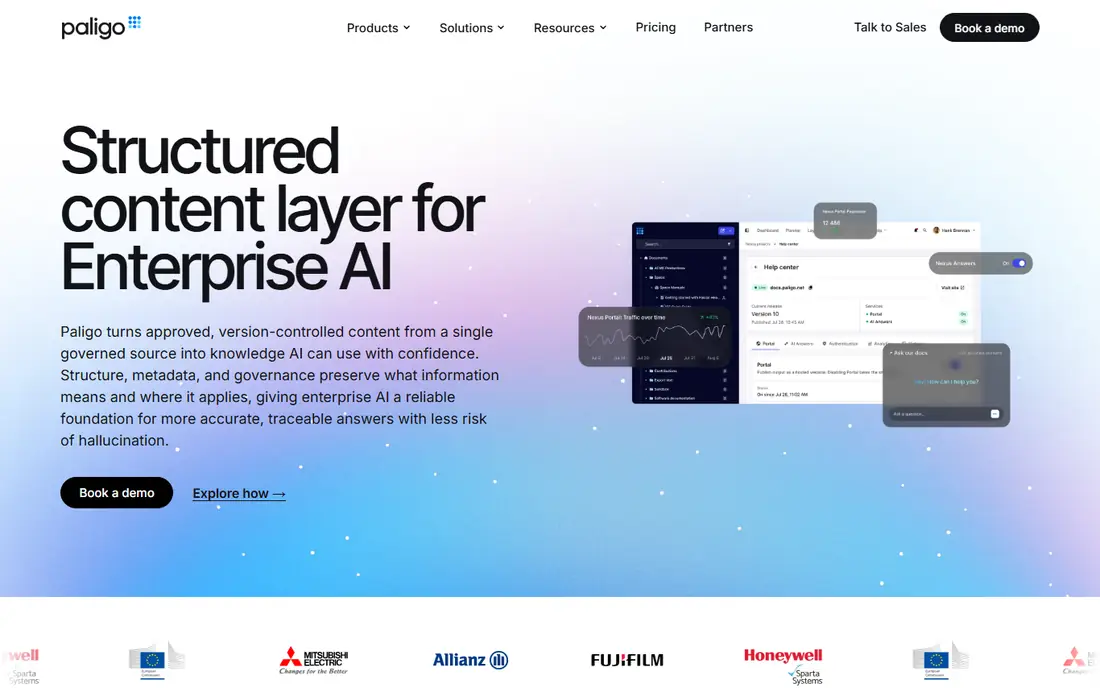
Paligo takes the component content idea and makes it approachable. Writers work in a friendly web editor while the system keeps content structured underneath, so topics can be reused across manuals, filtered by product variant, translated as components, and published to print and web from one source. Teams moving from Word documents and shared drives find it the gentlest route into structured documentation.
Paligo's scope is its honesty: it does documentation, not campaigns. A manufacturer would pair it with one of the marketing platforms below and let each do its own job. For mid size manufacturers whose manuals have outgrown folders of Word files, Paligo is usually the practical first step into component content.
What we like- Structured authoring in a browser, no XML expertise needed to start
- Strong content reuse and single sourcing
- Translation workflows built in
- Far easier onboarding than traditional CCMS tools
Watch out for- Documentation only, it will not run your marketing site
- Pricing by quote
- Fewer enterprise governance features than IXIA class systems
- Smaller vendor than the suite giants
#3Adobe Experience Manager
Best for: Enterprise marketing and product sites4.2/5 on
G2 (699 reviews, checked Oct 2026)
Visit adobe.com
Starting priceSee website
Free planNo
Adobe Experience Manager is the enterprise marketing platform: the website, the product catalogue front end, the campaign pages, and the asset library behind them, governed centrally and localised across every market. Large manufacturers with several brands and regions use it to keep thousands of product pages consistent and current.
AEM is a commitment measured in licences, implementation partners, and administrators, and none of that is priced in public. It also stops where documentation starts; manuals belong in MadCap or Paligo. For a global manufacturer's marketing estate, though, AEM is the heavyweight option, and its asset management half alone justifies the evaluation for image and video heavy catalogues.
What we like- Enterprise grade sites, assets, and forms in one suite
- Strong digital asset management for product imagery and video
- Global scale, localisation, and governance for many brands
- Deep personalisation through the Adobe stack
Watch out for- The most expensive route here, licensed and implemented at enterprise cost
- Needs specialist partners and administrators
- Far more platform than a single plant or brand needs
- Documentation depth is not its purpose
#4HubSpot Content Hub
Best for: Mid market marketing tied to a CRM4.5/5 on
G2 (2,207 reviews, checked Oct 2026)
Visit hubspot.com
Starting price$20 per seat per month
Free planYes
HubSpot fits the mid market manufacturer whose marketing team is three people and a CRM. Content Hub runs the website, the blog, the landing pages for trade shows and webinars, and the resource library of spec sheets and case studies, and every download lands in the CRM where sales can see it. For a company selling through quotes and relationships, that connection is the product.
The limits mirror the SaaS case: it is a marketing platform, so manuals live elsewhere, and the pricing model rewards companies that consolidate onto HubSpot. Paid seats start around $20 per month with free tools below that. For a manufacturer modernising from a brochure site and a spreadsheet of leads, HubSpot is the shortest path.
What we like- Website and blog sit on the CRM, so content ties to quotes and pipeline
- Built in SEO guidance, forms, and email in the same system
- Far easier to run than enterprise suites
- Free tools to start and paid seats from about $20 per month
Watch out for- Value depends on adopting HubSpot's CRM
- Design flexibility is good, not limitless
- No technical documentation capability
- Seat and hub pricing accumulates across a growing team
#5WordPress
Best for: Affordable websites and resource centres4.4/5 on
G2 (9,546 reviews, checked Oct 2026)
Visit wordpress.org
Starting priceFree
Free planYes
WordPress runs a large share of manufacturing websites for a simple reason: it is free, familiar, and good enough for the marketing job at most companies. A competent agency can build a product catalogue, a dealer locator, a careers section, and a resource centre of PDFs and videos on it, and hand over a site the marketing team can update without help.
Its limits are the familiar ones. There is no vendor to call, security is your maintenance contract's problem, and it will not manage DITA components or translation memory. Manufacturers with serious documentation needs pair WordPress for the public site with a documentation platform behind it. For the site itself, the economics keep WordPress on every shortlist.
What we like- Free open source software with the largest theme and plugin ecosystem in the world
- Any agency anywhere can build and maintain it
- Plugins cover catalogues, dealer locators, and document libraries
- Total cost is hosting and care, not licences
Watch out for- You own security, updates, and backups
- Plugin quality varies and bloat is a real risk
- Structured documentation and reuse are not its strengths
- Large multilingual catalogues need careful architecture
#6Storyblok
Best for: Product sites with visual editing4.5/5 on
G2 (592 reviews, checked Oct 2026)
Visit storyblok.com
Starting price$99 per month
Free planYes
Storyblok suits the manufacturer whose product site has become a development bottleneck. Its headless architecture lets engineers build fast product pages, configurators, and dealer portals once, while the visual editor lets marketers update ranges, launch products, and localise pages without a ticket. Component based content matches how product families actually work: shared blocks, per model variations.
Entry pricing is listed at $99 per month with a free plan below it. Storyblok will not produce your service manuals, and its localisation story, while workable, is shallower than the component systems above. As the marketing and product content layer for a modern manufacturer, it is a strong, current choice.
What we like- Visual editor lets marketing staff build product pages without developers
- Component based content suits product ranges and configurators
- API delivery feeds sites, portals, and apps from one source
- Free plan and entry pricing from $99 per month
Watch out for- Front end development is required up front
- Not a documentation system, no DITA or print manual workflow
- Pricing tiers rise with traffic and projects
- Translation management is lighter than CCMS tools
#7Seismic
Best for: Sales and dealer enablement content4.6/5 on
G2 (1,805 reviews, checked Oct 2026)
Visit seismic.com
Starting priceSee website
Free planNo
Manufacturers rarely sell alone. Reps, distributors, and dealers all present the product, and the content they use, the current deck, the correct spec sheet, the approved claim, decides what customers hear. Seismic is the enablement platform that governs that layer: one library, version control, and delivery into the CRM and email tools sellers live in, with analytics on what gets used and what wins.
Seismic creates nothing and publishes nothing public; it distributes what marketing and technical teams produce in the platforms above. For a manufacturer whose problem is fifty dealers emailing three year old brochures, that distribution layer is the fix. Pricing is enterprise and quoted.
What we like- One governed library for the decks, sheets, and videos sellers and dealers use
- Content finds reps inside the tools they work in
- Analytics show which content moves deals
- Strong fit for distributed and channel sales teams
Watch out for- Enablement, not publishing: it does not run your website or manuals
- Enterprise pricing by quote
- Value depends on sales team adoption
- Content must still be created elsewhere
#8Bynder
Best for: Brand and product asset management4.5/5 on
G2 (1,184 reviews, checked Oct 2026)
Visit bynder.com
Starting priceSee website
Free planNo
Behind every manufacturer's content sits an asset problem: ten thousand product images, renders, videos, logos, and translations of each, scattered across drives and agencies. Bynder is the digital asset management platform that centralises them, with metadata, rights, versions, and a portal where dealers and partners download the approved files themselves.
It is deliberately one layer of the stack. Bynder will not write your manual or build your product page; it makes sure the image on that page is the current, approved, correctly sized one. For manufacturers whose brand leaks through outdated assets in the field, that control is worth a line in the budget. Pricing is quoted.
What we like- One library for product photos, renders, video, and brand files
- Brand guidelines and approval workflows built in
- Portals let dealers and partners self serve approved assets
- Integrations with the major creative and CMS tools
Watch out for- Asset management only, no pages, no documents, no publishing
- Pricing by quote and aimed at mid market and up
- Taxonomy setup takes real work at the start
- Overlaps with the DAM inside suites such as Adobe's
How we chose
We split the category the way manufacturers organise it, into marketing content and technical content, and picked the leading platform for each job, using vendor pages and 2026 component content system comparisons from Ingeniux, Slashdot, and SourceForge, checked in October 2026. The scale stories in the MadCap entry come from MadCap's own published customer material. We included the asset and enablement layers, Bynder and Seismic, because in practice they are bought in the same budget conversation. We left out generic enterprise suites with no manufacturing footprint and print only catalogue tools with no digital publishing.
What to look for in a content platform for manufacturing
Start by counting your content types honestly. If the pain is manuals in fourteen languages with shared procedures across 300 models, that is a component content problem, and no marketing CMS will solve it; the reuse maths decides. One component translated once and reused 200 times is where CCMS vendors earn their licence, and AMD's reported 50 percent translation saving is the shape of the prize.
If the pain is leads, quotes, and a website sales cannot update, that is the marketing platform decision, and CRM connection matters more than page building tricks. Then check the field: dealers and service partners consume more of your content than your own staff do, so portals, permissions, and self service asset access deserve a line in the evaluation. Finally, assign an owner. Manufacturing content rots quietly: a superseded manual or an old spec sheet is a safety and liability issue, not a typo, and the platform is only as good as the team retiring old versions.
Frequently asked questions
Why do manufacturers need a different kind of content platform?
Because of documentation. A manufacturer must publish manuals, safety instructions, and service guides that are legally required, identical in meaning across languages, and correct for each product variant. That work needs structured, reusable components, the CCMS model, which marketing platforms do not offer. Most manufacturers end up with one platform for marketing and one for documentation, chosen separately.
What is a CCMS and DITA?
A component content management system stores documentation as small reusable topics rather than whole documents. DITA is the XML standard most of them use to structure those topics. A writer updates a procedure once, and every manual, help site, and PDF that includes it updates too, including its translations. MadCap's IXIA CCMS and Paligo are the examples on this list.
How much do these platforms cost?
The marketing end ranges from free, WordPress software, through HubSpot seats from about $20 per month and Storyblok from $99 per month, up to Adobe Experience Manager at full enterprise licensing. The documentation and enablement platforms, MadCap, Paligo, Seismic, and Bynder, price by quote based on users, content volume, and modules. Implementation and migration usually cost more than year one licences; budget for both.
Can one platform do marketing and manuals?
A few suites claim both, and most manufacturers who try end up compromising the manuals, because print ready, variant controlled, translated documentation obeys different rules from web pages. The common pattern is a marketing platform for the site, a CCMS for documentation, and shared asset management underneath. That sounds like three purchases, but each replaces a mess that was already costing money.
Sources we checked (0)
Is your product missing or out of date?
We review this list regularly. Vendors can request a listing, send updated pricing or ask about featured placement.

Shihab Mia · Founder, Rankite
Shihab has 5+ years in B2B and SaaS SEO. He writes Rankite's software buying guides from pricing pages, documentation and public user reviews. More about Shihab.