How we make this list: we compare pricing pages, product documentation and public user reviews. Rankite is independent; if a vendor ever pays for a featured spot, that listing is clearly labeled Partner.
Key takeaways
- For most outpatient PT clinics, the real decision comes down to WebPT (the market standard), PROMPT (the automation-first challenger) and StrataPT (billing and EMR in one package).
- Jane is the only tool on this list with fully published pricing ($59 to $99 per month), which makes it the easiest quote you will get in this category.
- Almost nobody else publishes prices: WebPT, PROMPT, StrataPT, Raintree, TheraOffice and MedBridge all price by quote or demo, so budget for a sales conversation.
- Pediatric practices should start with Fusion Web Clinic; large multi-location groups should start with Raintree or StrataPT.
Quick comparison
| Tool | Best for | Starting price | Free plan |
|---|
 WebPT WebPT | PT practices of any size that want the market-leading EMR | See website (custom quote) | No (demo available) |
 PROMPT PROMPT | Growing outpatient rehab groups that want automation | See website (custom quote) | No (demo available) |
 StrataPT StrataPT | Clinics that want billing and EMR in one package | See website (custom quote) | No (demo available) |
 HENO HENO | PT-owned practices that want marketing built into the EMR | See website (customized per-provider or transaction-based pricing) | No (demo available) |
 Jane Jane | Cash-based and hybrid PT practices that want simple, published pricing | $59/month (Balance plan, up to 20 appointments per month) | First month free |
 Raintree Raintree | Large multi-location therapy organizations | See website (custom quote) | No (demo available) |
 Empower EMR Empower EMR | Budget-conscious clinics that want a customizable EMR | See website (modular pricing, quote-based) | No (demo available) |
 TheraOffice TheraOffice | Clinics that want deep customization and an ONC-certified EMR | See website (custom quote) | No (demo available) |
 Fusion Web Clinic Fusion Web Clinic | Pediatric PT, OT and speech practices | See website (custom quote) | No (demo available) |
 MedBridge MedBridge | Clinics that need HEP, telehealth and clinician education in one subscription | See website (custom quote) | No (demo available) |
Is your product missing or out of date?
We review this list regularly. Vendors can request a listing, send updated pricing or ask about featured placement.
The best physical therapy software
Pick the wrong physical therapy software and you will feel it every day: notes that take 30 minutes to finish, claims that bounce back, a front desk juggling three different logins. Pick the right one and documentation shrinks to minutes while billing mostly runs itself. The problem is that nearly every vendor in this space hides its pricing behind a demo form and promises the same all-in-one magic.
These ten tools are the real options in 2026, from the market standard to niche picks for pediatric and cash-based practices. We checked every vendor's own site for published pricing and marked "See website" wherever the price only comes out on a sales call.
#1
WebPT
Best for: PT practices of any size that want the market-leading EMR
Visit webpt.com
Starting priceSee website (custom quote)
Free planNo (demo available)

WebPT is the default choice in outpatient rehab for a simple reason: scale. Hundreds of thousands of therapists use it, which means new hires often arrive already trained and third-party tools tend to integrate with it first. The platform covers the whole clinic workflow, from intake and scheduling through documentation, billing and revenue cycle management, with patient marketing tools on top. Recent additions include AI-assisted documentation that turns patient conversations into draft notes and compliance checks that flag audit risk in real time.
The honest catch is the buying process. WebPT publishes no prices, so you cannot compare it against a budget without sitting through demos and quotes. Small practices should ask exactly which modules are included in the quote, because the full suite is built for bigger operations and the price reflects that. If your clinic runs five or more therapists and bills insurance heavily, WebPT is usually worth the conversation. If you are a solo cash-based practice, it is likely more platform than you need.
What we like- The most widely adopted rehab therapy platform, so staff you hire probably already know it
- Documentation, billing and RCM, scheduling and patient marketing in one system
- AI-assisted documentation and compliance checks built in
Watch out for- No published pricing, so every quote starts with a sales conversation
- The full platform is more than a small cash-pay clinic needs
- Onboarding a large team takes real project time
Starting priceSee website (custom quote)
Free planNo (demo available)

PROMPT positions itself as the modern operating system for outpatient rehab, and the pitch is automation everywhere. Online scheduling, electronic intake, documentation, billing, reporting and patient relationship tools all live in one database, so nothing gets retyped between systems. The company publishes detailed case results from its customer base, including claims of lower documentation time and higher per-clinician revenue, which at minimum shows where the product team focuses its energy.
What gives buyers pause is opacity on price. There is no pricing page and no starter tier advertised, which usually means the product is sold to practices with real budgets rather than startups. Clinics planning to grow past two or three locations are the natural fit; everyone else should confirm the price fits a smaller operation first.
What we like- One system for scheduling, documentation, billing, patient management and CRM-style marketing
- Heavy automation focus, including AI documentation and revenue forecasting
- Built-in clearinghouse for claims
Watch out for- No published pricing and no pricing page on the site
- The enterprise positioning means it is built for groups, not solo clinics
- Switching from a legacy system still requires a migration project
Starting priceSee website (custom quote)
Free planNo (demo available)
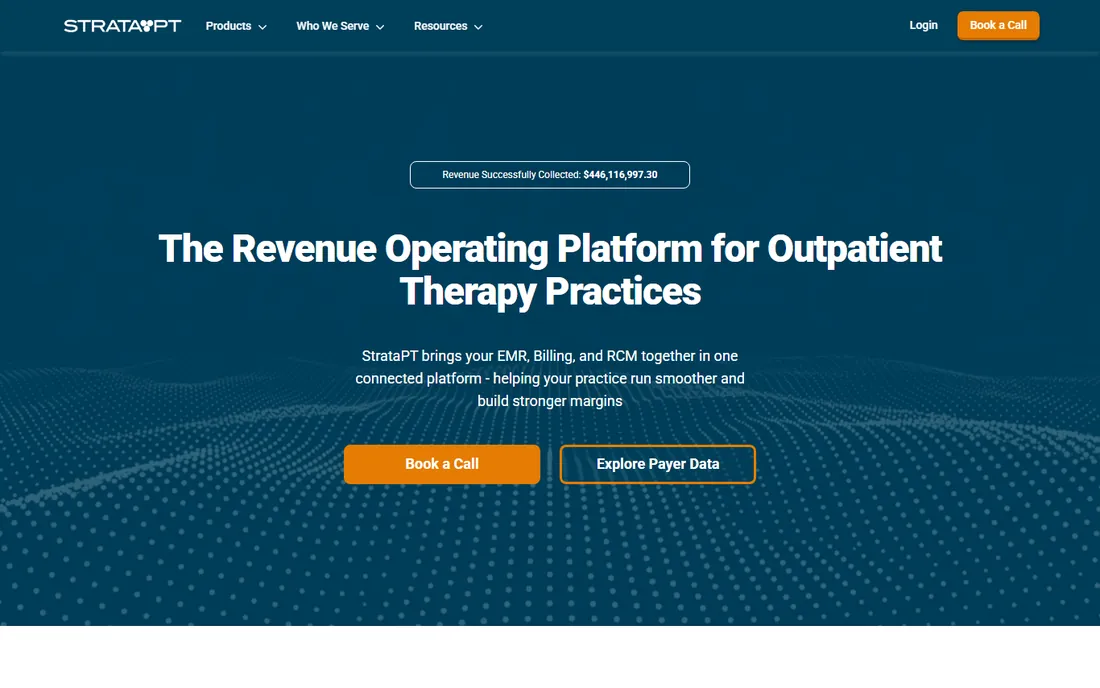
StrataPT takes a different angle from the pure software vendors: it pairs its EMR with billing services, so the same company that built your documentation templates is responsible for getting your claims paid. For owners who are tired of managing a biller or a billing company separately, that single point of accountability is the whole argument. The platform includes scheduling, customizable documentation templates, reporting and denial-prevention workflows aimed at first-pass clean claims.
The trade-off is flexibility. If you already have billing handled and just want software, a bundled model can feel like paying for something you do not need, so ask whether a software-only option exists and what it costs. For a clinic owner who wants billing off their plate, StrataPT deserves a demo alongside WebPT.
What we like- Billing services and EMR in a single package, so one vendor owns the revenue cycle
- KLAS Research named it the top EMR and billing system in its category for 2025 and 2026, per the company's site
- US-based support with guided onboarding
Watch out for- No published pricing
- The bundled billing-service model does not suit clinics that want software only
- Smaller company than WebPT or Raintree, so check the roadmap
#4
HENO
Best for: PT-owned practices that want marketing built into the EMR
Visit heno.io
Starting priceSee website (customized per-provider or transaction-based pricing)
Free planNo (demo available)
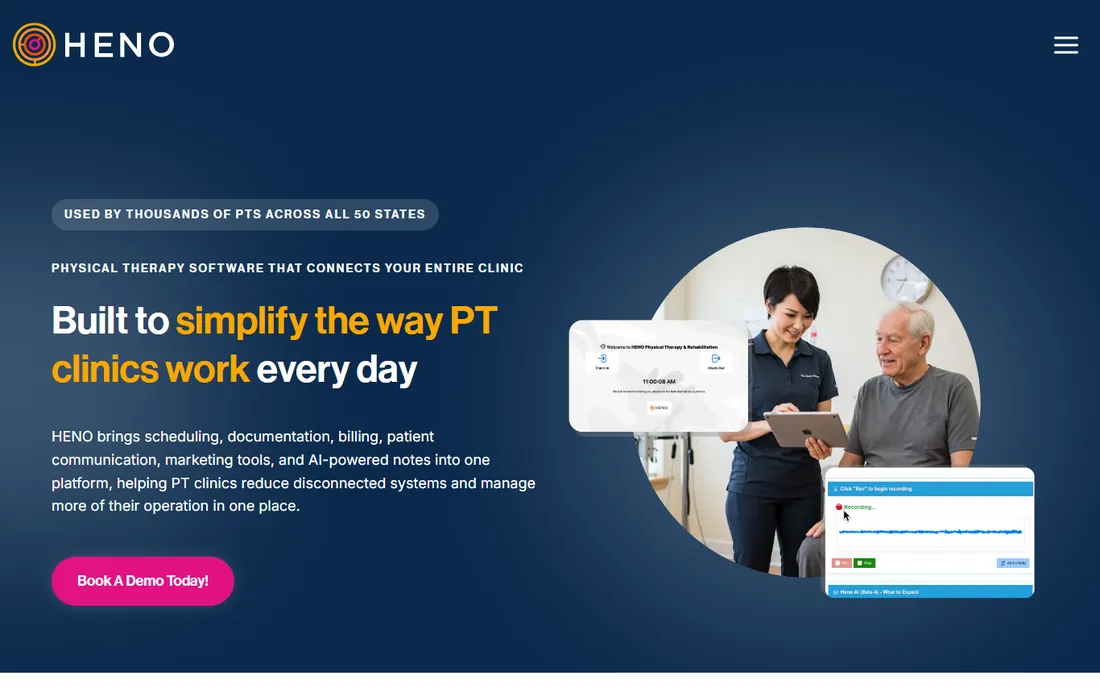
HENO was built by a PT clinic owner who got tired of stitching systems together, and that origin shows in the feature list. Beyond scheduling, documentation and billing, it includes the growth tools most EMRs leave to third parties: automated text and email campaigns to win back lost patients, mass texting for waitlists, landing pages with intake forms and a retail module for cash-based packages. The AI scribe generates SOAP notes from patient conversations, which is the feature most likely to win over skeptical therapists.
Pricing is customized per clinic, either per provider or transaction-based, with PRN discounts advertised for part-time staff. HENO fits owner-operators who want one system and like the idea of marketing automation inside the EMR. If you already have a marketing stack you like, some of the value is wasted.
What we like- Founded and run by a practicing physical therapist, with the product shaped by real clinic workflows
- AI scribe that turns conversations into SOAP notes
- Marketing automation, mass texting and landing pages included rather than bolted on
Watch out for- No published prices, with plans customized per clinic
- A smaller vendor, so integrations are fewer than the big platforms
- The marketing features add surface area you may never use
#5
Jane
Best for: Cash-based and hybrid PT practices that want simple, published pricing
Visit jane.app
Starting price$59/month (Balance plan, up to 20 appointments per month)
Free planFirst month free
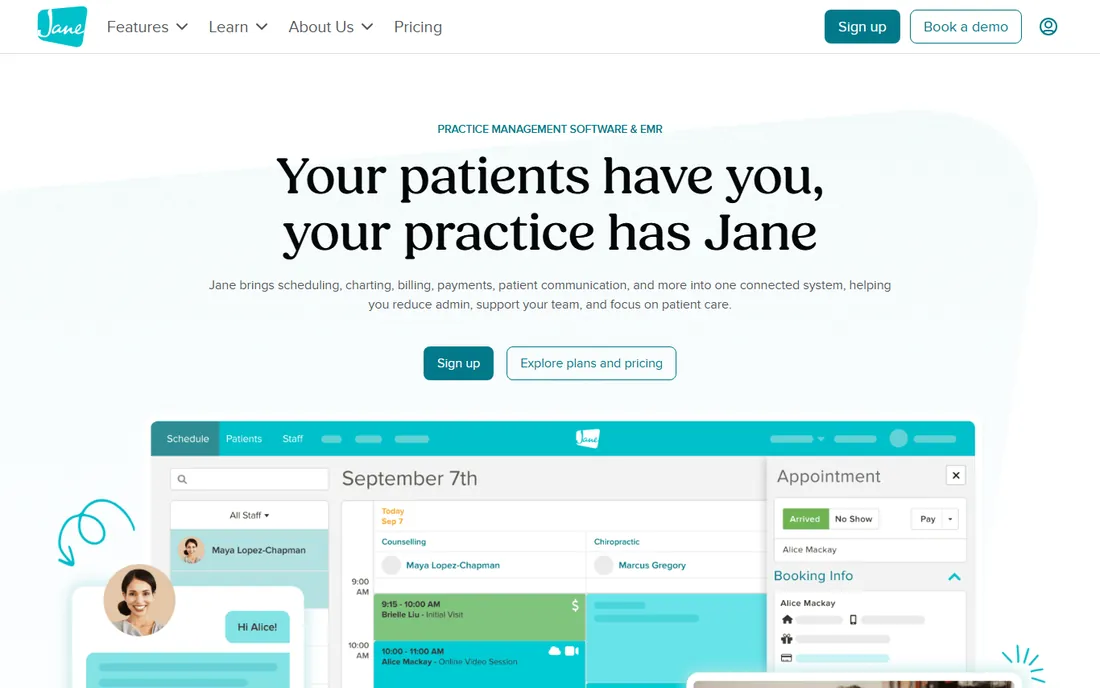
Jane is the outlier on this list: a practice management platform for allied health that actually publishes its prices. The Balance plan at $59 per month covers online booking, charting templates, intake forms, secure messaging and integrated payments for up to 20 appointments a month. Practice at $79 adds unlimited appointments and staff profiles, and Thrive at $99 adds packages, memberships and advanced scheduling. The first month is free, so you can run a real pilot before committing.
The honest catch is depth. Jane handles cash, insurance and hybrid billing, but its documentation templates are built for many disciplines, so a high-volume ortho clinic may find them thinner than WebPT's or PROMPT's PT-specific libraries. Insurance billing works through an add-on and a clearinghouse integration rather than being the product's center of gravity.
What we like- Fully published pricing from $59 to $99 per month with no sales call required
- Online booking, charting, billing, payments and telehealth in one clean interface
- Integrates with Physitrack for home exercise programs
Watch out for- The cheapest plan caps at 20 appointments per month
- Insurance billing is an add-on rather than the core strength
- Built for allied health broadly, not PT documentation depth specifically
Starting priceSee website (custom quote)
Free planNo (demo available)
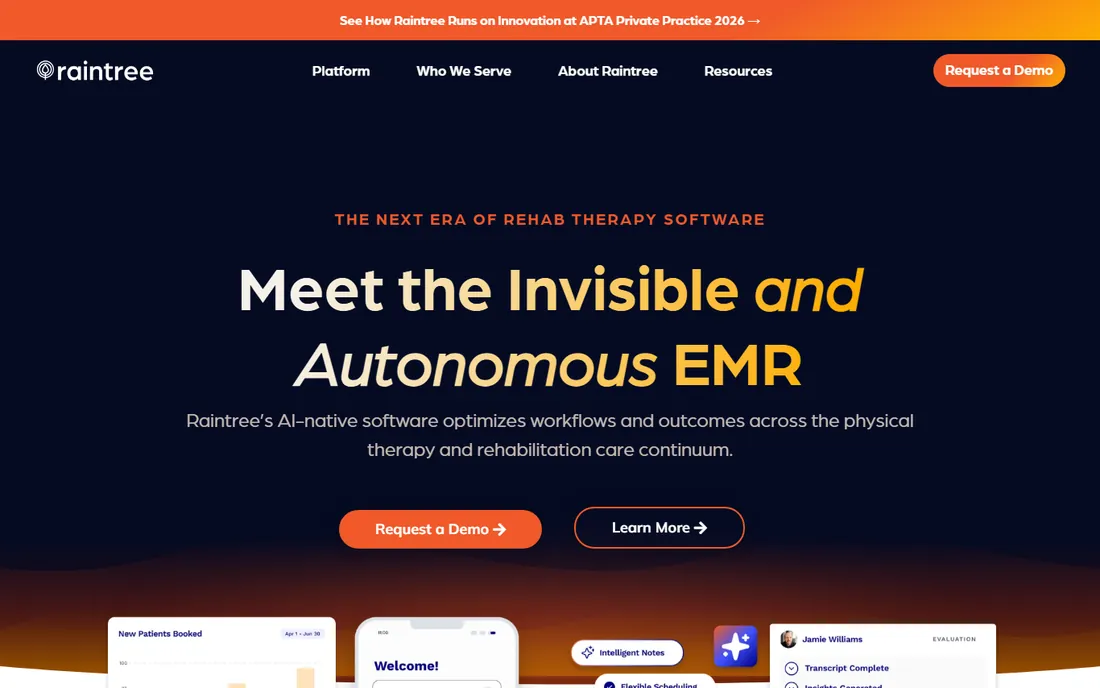
Raintree plays at a different scale from everyone else here. Its customer base includes large therapy organizations running thousands of locations, and the product is engineered around that reality: centralized reporting across locations, standardized workflows, revenue cycle management and an AI layer that drafts documentation and optimizes schedules. The company leans hard into AI positioning, with tools for documentation, scheduling and patient engagement under one roof.
For a small practice, that is mostly irrelevant. Raintree does not publish prices, sells through an enterprise process and implements like an enterprise system, which means months of onboarding rather than weeks. It belongs on the shortlist when you operate ten or more locations, run hospital-based outpatient programs or need multi-entity financial reporting.
What we like- Built for enterprise scale, with customers running hundreds to thousands of locations
- AI documentation (NoteIQ) and smart scheduling (SchedulerIQ) aimed at cutting admin time
- ONC-certified EHR with deep analytics
Watch out for- Enterprise focus means it is overkill for a one- or two-location clinic
- No published pricing and an enterprise sales cycle
- Implementation is a project, not a signup
#7
Empower EMR
Best for: Budget-conscious clinics that want a customizable EMR
Visit mwtherapy.com
Starting priceSee website (modular pricing, quote-based)
Free planNo (demo available)
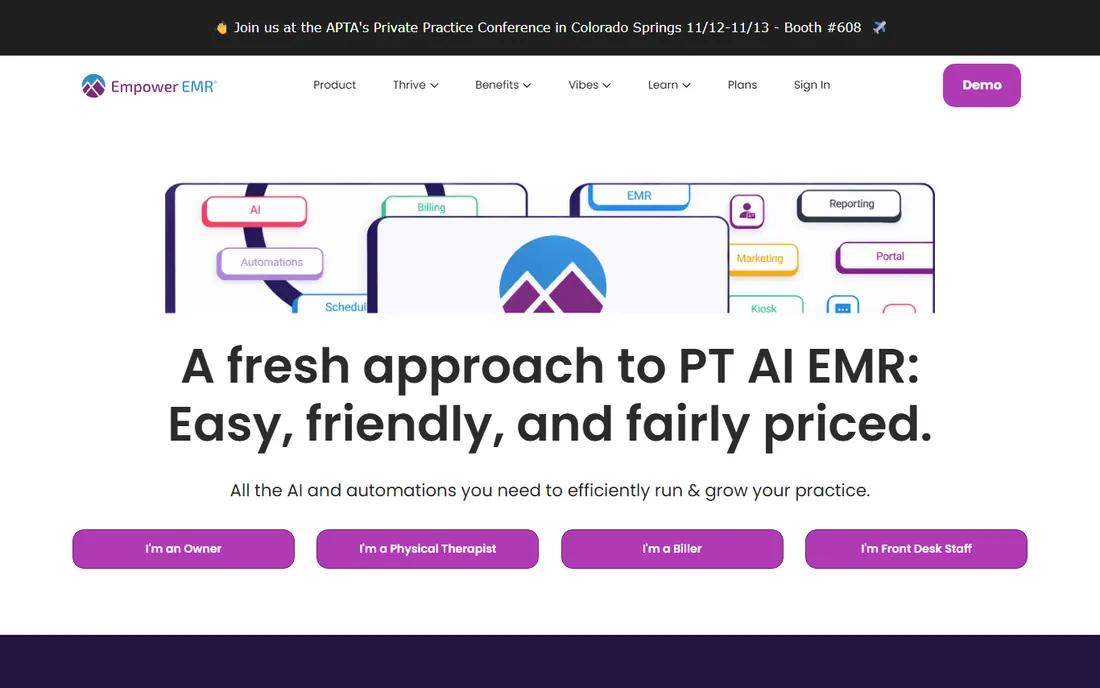
Empower EMR is the current name for the product long known as MWTherapy, built by MerlinWave. The pitch is value: a customizable, cloud-based EMR where clinics select from plans to build an affordable setup, with AI features woven through documentation, scheduling and billing. The company emphasizes fair and flexible pricing and the ability to scale the subscription up or down as the practice changes.
The rebrand is worth knowing about because review sites, Reddit threads and colleague recommendations still say MWTherapy. Functionally it is the same lineage: a PT-focused EMR with customizable templates, billing and scheduling. Pricing is quote-based despite the value positioning, so the affordability claim needs verification on a call.
What we like- Modular pricing where you pay for the pieces you need
- 100 percent web-based with no servers to maintain
- AI features for documentation, waitlist management and faxing
Watch out for- Recently rebranded from MWTherapy, so older reviews and references use the old name
- No published prices on the site
- A smaller vendor with less third-party integration depth
#8
TheraOffice
Best for: Clinics that want deep customization and an ONC-certified EMR
Visit theraoffice.com
Starting priceSee website (custom quote)
Free planNo (demo available)
TheraOffice has been in the rehab software business since 2001, which makes it one of the oldest names on this list. It is now part of Netsmart, and the product page reflects that backing: an ONC-certified EMR with deep template customization, scheduling with a schedule optimizer, integrated billing and collections tools, telehealth, e-faxing and newer AI documentation features. The company claims daily notes can be completed in one to two minutes with its templates, which speaks to the customization-first design.
The Netsmart ownership cuts both ways. You get the stability and compliance resources of a large health IT company, but the boutique vendor relationship that long-time customers praise may not survive the transition. Pricing is quote-based, and TheraOffice fits clinics with unusual workflows that need the software to bend.
What we like- ONC-certified EMR with 40-plus customizable documentation templates across PT, OT, SLP and specialties
- AI-powered documentation tools and integrated payments
- Can run on-site or in the cloud
Watch out for- Now part of Netsmart, so the small-company feel of the original vendor is gone
- No published pricing
- The breadth of options can overwhelm small teams
Starting priceSee website (custom quote)
Free planNo (demo available)

Fusion Web Clinic is the specialist pick: a web-based EMR built specifically for pediatric occupational, speech and physical therapy. Pediatric documentation has requirements that general PT systems handle awkwardly, from school-based plan formats to family communication, and a purpose-built tool avoids the workarounds. Scheduling, documentation, billing and a patient portal come in the one system.
The specialization is also the limitation. If your caseload is mostly adult orthopedics, the pediatric-first design works against you, and the smaller vendor footprint means fewer integrations and a thinner user community than WebPT. Pricing is quote-based, but for a pediatric practice, starting the search here rather than adapting a general EMR usually saves months of frustration.
What we like- Built specifically for pediatric therapy workflows, including school-based documentation needs
- Web-based with scheduling, documentation and billing in one system
- Patient portal for families
Watch out for- The pediatric focus makes it a poor fit for adult ortho or neuro practices
- A smaller company with a narrower integration ecosystem
- No published pricing
#10
MedBridge
Best for: Clinics that need HEP, telehealth and clinician education in one subscription
Visit medbridge.com
Starting priceSee website (custom quote)
Free planNo (demo available)

MedBridge is not an EMR, and that distinction matters. It is the leading education and patient engagement platform for rehab: thousands of accredited CEU courses, a huge home exercise program library with video, patient education materials, telehealth and remote therapeutic monitoring tools. Many clinics run MedBridge alongside their EMR, using it for HEP delivery, staff training and compliance education.
The honest catch is that it solves a different problem from the rest of this list. If your documentation and billing are already handled, MedBridge fills the patient engagement and education gap better than anything else. If you are shopping for your primary practice management system, MedBridge is a complement, not a replacement.
What we like- Large exercise video library (the company cites over 8,000 video exercises) for home exercise programs
- 2,500-plus accredited continuing education courses across 15-plus disciplines
- Telehealth, remote therapeutic monitoring and outcomes tracking included
Watch out for- Not a full EMR: it will not replace your documentation and billing system
- Pricing is quote-based with no public tiers
- The breadth means you may pay for education features you do not need
How we chose
We started with the categories buyers actually search: physical therapy software, PT EMR, physical therapy practice management software and rehab therapy billing software. For each candidate we opened the vendor's own homepage and pricing pages, checked whether prices were actually published or only available on a sales call, and compared feature depth, specialty fit and company size fit against public reviews on G2 and Capterra and practitioner discussion on Reddit. Tools that had been shut down, acquired into a different product or renamed were checked against the vendor's current site. Where a price could not be verified on the vendor's own page, we wrote "See website" instead of guessing.
What to look for in physical therapy software before you buy
Documentation speed decides whether your therapists like the software or resent it. Ask for a timed demo of a real evaluation note, not a scripted walkthrough, and find out how much of the note the templates, carry-forward and AI features actually complete. A system that saves ten minutes per note pays for itself in a busy clinic; one that adds clicks will cost you staff goodwill within a month.
Billing depth is the second filter. Some tools on this list are documentation-first with billing bolted on, while StrataPT and HENO treat the revenue cycle as the core product. If you bill insurance heavily, ask who handles claim scrubbing, denial follow-up and ERA posting, and whether that is software, a service or your problem. Then check the pricing model: per-provider, per-location, transaction-based or bundled with billing services. Model it against your actual visit volume, because a cheap per-provider fee with per-claim charges can beat an expensive flat fee, or the reverse.
Finally, check compliance and exit terms. Confirm HIPAA compliance in writing, ask about MIPS reporting support if you treat Medicare patients, and read the contract for term length, auto-renewal and data export.
The real cost of switching PT software
The software license is the smallest part of a switch. Data migration comes first: patient demographics, open balances, active plans of care and historical notes all need to move, and every vendor promises this is easy while every clinic owner has a story about the one that was not. Ask for two references who migrated from your current system specifically, and ask what broke.
Then comes retraining. Budget two to four weeks of reduced productivity per therapist, because documentation speed always drops before it improves. Most successful switches run the old and new systems in parallel for at least one full billing cycle, which means paying for both temporarily. The best time to switch is your slowest season, never December, because year-end reporting across two systems is miserable. Get the implementation timeline, the migration scope and the training plan in writing before you sign, and make the go-live date contingent on the migration actually working.
Frequently asked questions
How much does physical therapy software cost?
Most vendors price by quote, so honest ranges are hard to publish. Jane is the exception at $59 to $99 per month with public pricing. For the quote-based EMRs, small single-location clinics typically land in the low hundreds per month per provider once modules and fees are included, while enterprise platforms price annually by location count. Always ask for the all-in number including clearinghouse, implementation and training fees.
What is the difference between PT software and a general EHR?
PT-specific systems build their documentation, billing rules and compliance checks around rehab therapy workflows: timed codes, the 8-minute rule, functional limitation reporting and MIPS. A general EHR can be configured for PT, but you will spend months building templates the specialists ship on day one. Unless you are part of a hospital system standardized on one EHR, the specialty tool wins.
Do I need separate billing software if my EMR has billing?
It depends on whether the billing module is software or a service. Tools like WebPT and PROMPT include billing software you or your biller operate; StrataPT and HENO can pair the software with billing services where their team works your claims. If your denial rate is already low and you have a good biller, software alone is fine. If claims are your biggest headache, the service model is worth pricing.
Can physical therapy software handle telehealth?
Most of the tools on this list include telehealth now, including Jane, TheraOffice and MedBridge, and several support remote therapeutic monitoring billing. If virtual visits are a real part of your practice rather than a backup option, confirm the telehealth is built in rather than a third-party integration, and check that documentation templates work the same for virtual and in-person visits.
How long does PT software implementation take?
For a small clinic moving to a cloud EMR like Jane or HENO, two to six weeks is typical. Mid-size practices moving to WebPT or PROMPT should plan six to twelve weeks including data migration and training. Enterprise rollouts on Raintree can run several months across locations. Whatever the vendor quotes, add a buffer: migrations slip more often than they finish early.
Sources we checked (12)
- https://webpt.com/
- https://promptemr.com/
- https://stratapt.com/
- https://heno.io/
- https://jane.app
- https://raintreeinc.com/
- https://www.mwtherapy.com
- https://theraoffice.com/
- https://fusionwebclinic.com
- https://medbridge.com/
- https://www.g2.com/categories/physical-therapy
- https://www.capterra.com/physical-therapy-software/
Is your product missing or out of date?
We review this list regularly. Vendors can request a listing, send updated pricing or ask about featured placement.

Shihab Mia · Founder, Rankite
Shihab has spent more than a decade helping SaaS and e-commerce brands grow through search. He writes Rankite's software buying guides from pricing pages, documentation and public user reviews. More about Shihab.