How we make this list: we compare pricing pages, product documentation and public user reviews. Ratings come from G2, Capterra or Trustpilot, with the date we checked them.
Key takeaways
- Simplifi and Copilot publish clear prices, at $3.99 a month billed annually for Simplifi and $7.92 a month billed yearly for Copilot, while most rivals require a pricing-page visit.
- YNAB suits hands-on budgeters who assign every dollar a job, while Monarch, Empower, and PocketSmith suit households that want a full net worth picture with less daily effort.
- Empower's dashboard is free, with paid advisory services on top, making it the best no-cost starting point for investment tracking.
- Tiller is the pick for spreadsheet lovers, since it feeds bank data into Google Sheets or Excel templates you own and control.
- This guide is general information, not financial advice: investment and budgeting choices depend on your own situation, so consider professional advice for large decisions.
Quick comparison
| Tool | Best for | Starting price | Free plan |
|---|
 Quicken Simplifi | All-in-one budgeting and net worth | From $3.99/month | No |
 YNAB | Hands-on zero-based budgeting | See website | No |
 Monarch Money | Couples and households managing money together | See website | No |
 Empower | Free dashboard with investment tracking | See website | Yes |
 PocketSmith | Long-range cash flow forecasting | See website | No |
 Copilot Money | Apple-first design with smart categorization | From $7.92/month | No |
 Tiller | Spreadsheet-based money management | See website | No |
 Goodbudget | Envelope budgeting for households | See website | No |
Is your product missing or out of date?
We review this list regularly. Vendors can request a listing, send updated pricing or ask about featured placement.
The best personal financial management software
Starting priceFrom $3.99/month
Free planNo

Quicken Simplifi is the personal plan in Quicken's lineup, aimed at individuals and couples managing budgeting, savings, and investments. Its homepage shows Simplifi at $3.99 a month billed annually, marked down from $6.99, alongside a Business and Personal plan at $4.99 a month billed annually. Quicken reports that its cloud users reduce debt within two years and that Simplifi users see finances improve within a year, based on internal data from over 200,000 users.
Simplifi's appeal is completeness: accounts, budgets, savings goals, and investments in one place, from a company trusted for more than 40 years, with support from real humans. The main caution is price: the $3.99 figure is promotional, so confirm the renewal rate before subscribing. For a household that wants one mature app for everything, Simplifi is a strong default.
What we like- Tracks budgeting, savings, and investments in one app
- Trusted brand for over 40 years
- Bank-grade security with a promise never to sell personal data
Watch out for- No free plan
- The $3.99 rate is a promotional price billed annually, with a higher regular rate shown alongside it
#2YNAB
Best for: Hands-on zero-based budgeting4.5/5 on
G2 (30 reviews, checked Oct 2026)
Visit ynab.com
Starting priceSee website
Free planNo
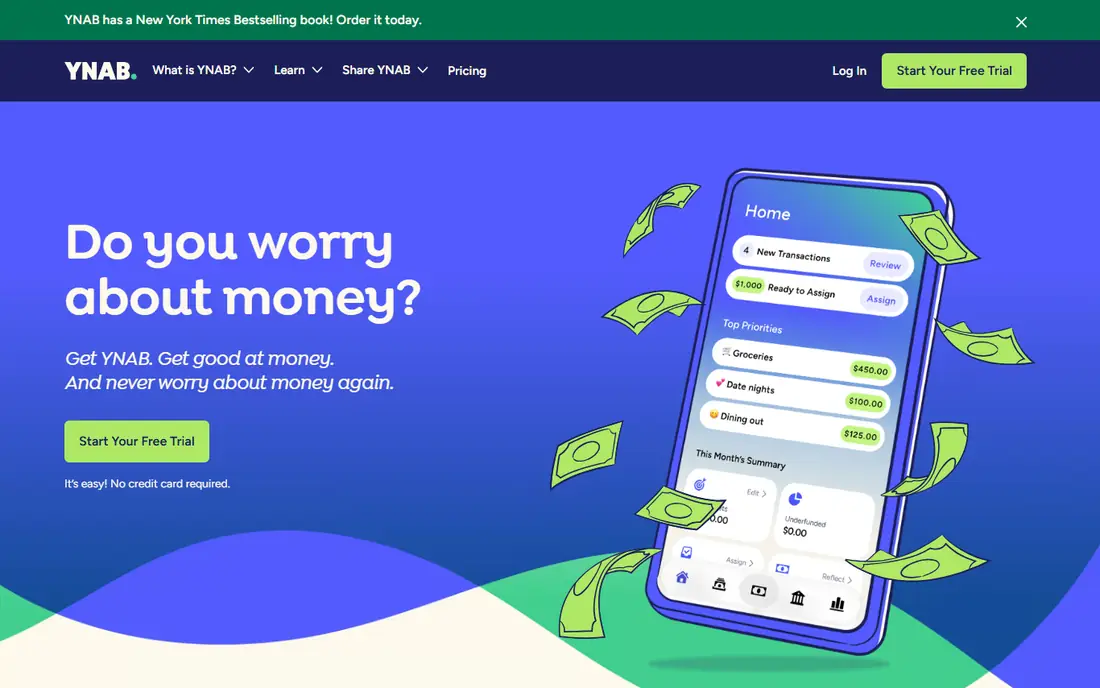
YNAB, short for You Need A Budget, teaches a specific method: give every dollar a job before you spend it, build a flexible plan, and adjust as life changes. Its homepage reports that 92 percent of users feel less stressed since starting, 90 percent say their finances are in a better place, and the average user saves $600 in the first month and $6,000 in the first year. A free 34-day trial lets new users test the method with no credit card required.
YNAB's strength is behavior change, not just tracking: users who engage with the method tend to stick with it. The trade-off is effort, since the method asks for regular attention rather than passive tracking, and there is no permanent free plan. For a household that wants to change spending habits rather than just watch balances, YNAB is the best-tested choice here.
What we like- Proven budgeting method with a 34-day free trial
- 92 percent of users feel less money stress
- Average user saves $600 in the first month by YNAB's account
Watch out for- No free plan
- Method requires regular hands-on attention, which not every household wants
#3Monarch Money
Best for: Couples and households managing money together4.7/5 on
G2 (3 reviews, checked Oct 2026)
Visit monarchmoney.com
Starting priceSee website
Free planNo
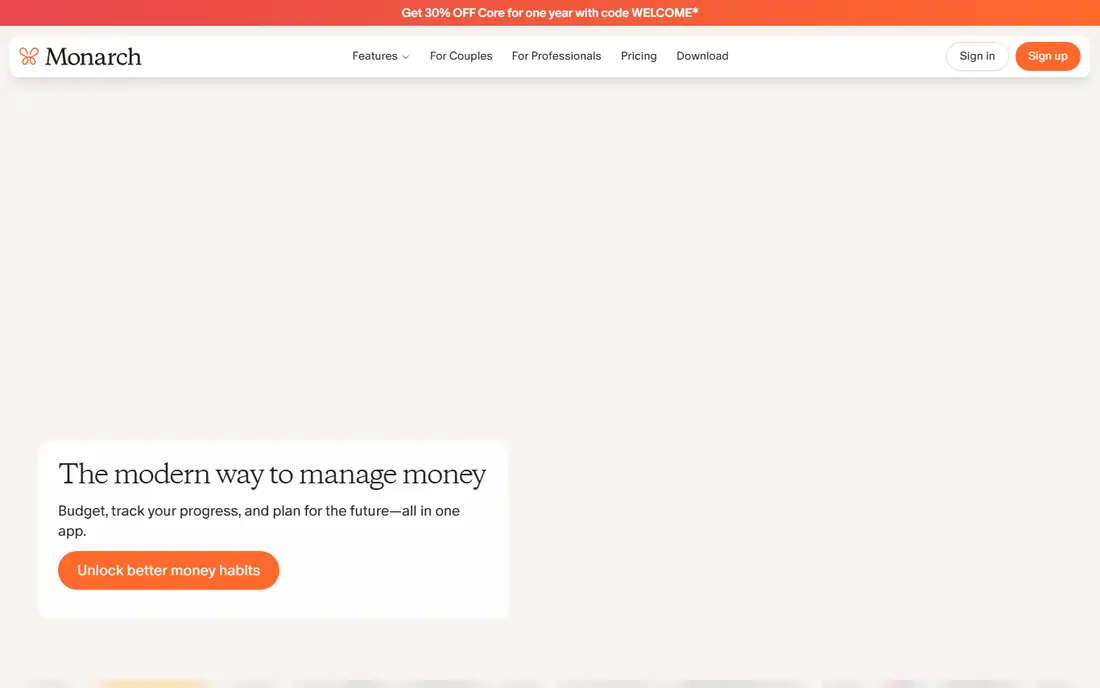
Monarch calls itself a home base for money clarity, bringing bank accounts, credit cards, loans, real estate, and investments into one view. Its standout feature for households is collaboration: when both partners sync accounts, they get a shared view at no extra cost, making joint planning easier. It also detects recurring subscriptions automatically, so forgotten charges surface quickly, and it offers customizable reports, goal tracking, and a 50,000-plus member Reddit community.
Monarch suits couples and households that want a modern dashboard with strong customization, and many reviewers cite it as the best replacement for the discontinued Mint app. The main drawback is the lack of a free plan and unpublished homepage pricing. For a household managing money together, Monarch is the most collaboration-friendly option here.
What we like- Shared view for partners at no extra cost
- Automatic categorization and recurring subscription detection
- Customizable reports and goal tracking
Watch out for- No free plan
- Pricing requires a visit to the pricing page
Starting priceSee website
Free planYes
Empower is a large financial services firm, reporting 94,000-plus retirement plans under administration and $2.2 trillion in assets under administration as of June 2026. Its free dashboard securely connects all accounts in one place, showing investments, cash, credit, and more, with encryption, multi-factor authentication, and fraud protection. Paid advisory services sit on top: its Personal Strategy service requires $100,000 or more, and Private Client requires $1,000,000 or more.
Empower's dashboard suits investors who want a free, full-picture view of net worth and retirement progress without paying a subscription. It is less focused on day-to-day budgeting than YNAB or Monarch, and its advisory upsell is aimed at larger portfolios. For an investor starting out, Empower is the best free entry point on this list.
What we like- Free dashboard connecting investments, cash, credit, and other accounts
- Strong security with encryption and multi-factor authentication
- $2.2 trillion in assets under administration
Watch out for- Advisory services are paid and require minimum investments
- Dashboard is less budgeting-focused than YNAB or Monarch
Starting priceSee website
Free planNo
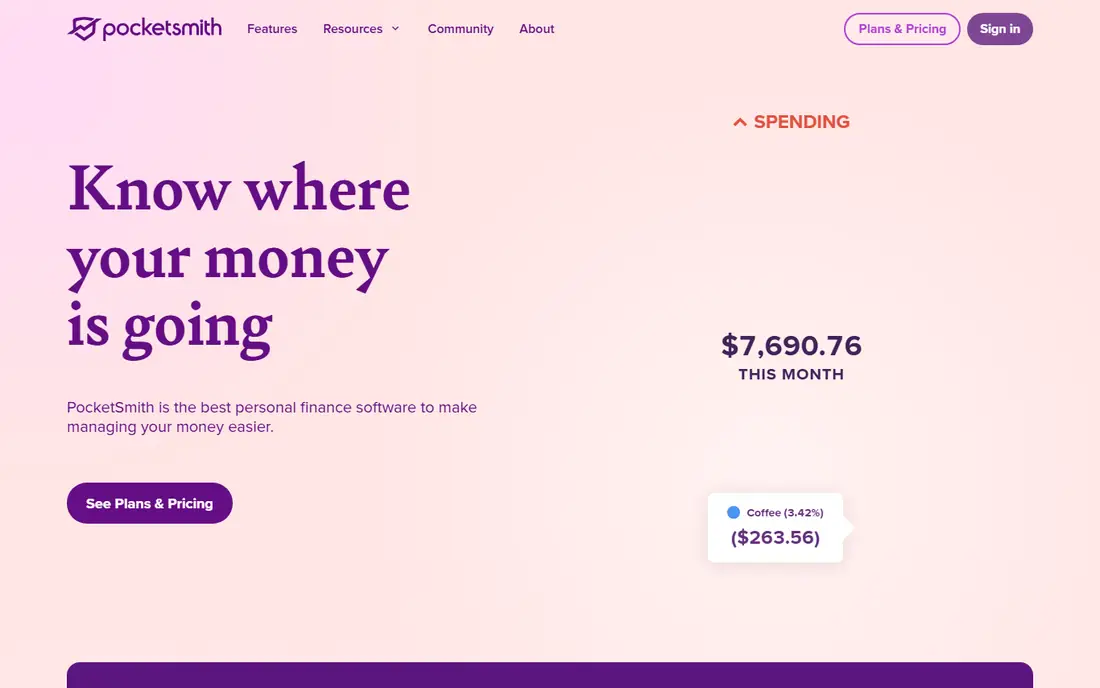
PocketSmith is personal finance software built around one distinctive feature: a calendar that forecasts daily account balances up to 60 years into the future, letting users see the long-term effect of today's decisions. It adds clear graphs and charts, custom dashboards, flexible budgeting, in-depth reports, file management beside transactions, and an AI integration that connects ChatGPT, Claude, and other assistants to financial data through an MCP server. It reports automatic bank feeds from thousands of institutions worldwide and multi-currency budgeting.
PocketSmith suits planners who think in decades: retirement timing, mortgage payoff, and long savings goals all benefit from its forecast view. Its awards include an Open Banking Expo Awards 2026 win and FinTech Australia Finnies finalist places. The main drawback is that no free plan is confirmed on its homepage, so budget for a subscription. For long-range planning, no other tool here matches its forecasting horizon.
What we like- Forecasts daily balances up to 60 years ahead
- Multi-currency budgeting
- Bank feeds from thousands of institutions worldwide
- Custom dashboards and file management
Watch out for- No free plan confirmed on the homepage
- Forecasting depth may exceed what a simple budgeter needs
Starting priceFrom $7.92/month
Free planNo

Copilot Money organizes all accounts, spending, and investments with automatic tracking, and its homepage leads with design: Apple Design Awards finalist, Editor's Choice, and Must-Have Finance Apps recognition. Its AI learns spending patterns and tags transactions automatically, and features include budget rollovers for unspent money, cash flow summaries, subscription spotting, net worth tracking with stocks, crypto, and real estate, and live investment performance. Pricing is published plainly: $7.92 a month billed yearly at $95, or $13 a month billed monthly, with no ads and no hidden fees.
Copilot suits Apple users who want a polished, mostly automatic money app and are willing to pay for design quality. Its limits are platform focus, since it is built for iPhone, iPad, Mac, and web, and the lack of a permanent free plan. For an Apple household that values a clean daily money view, Copilot is the most refined option here.
What we like- Beautiful Apple-native design with Editor's Choice recognition
- AI learns spending patterns and tags transactions automatically
- Budget rollovers and subscription spotting
- $7.92 a month billed yearly
Watch out for- Apple-focused, so Android users should look elsewhere
- No free plan, though a free trial and test drive are offered
#7Tiller
Best for: Spreadsheet-based money management4.0/5 on
G2 (2 reviews, checked Oct 2026)
Visit tillerhq.com
Starting priceSee website
Free planNo
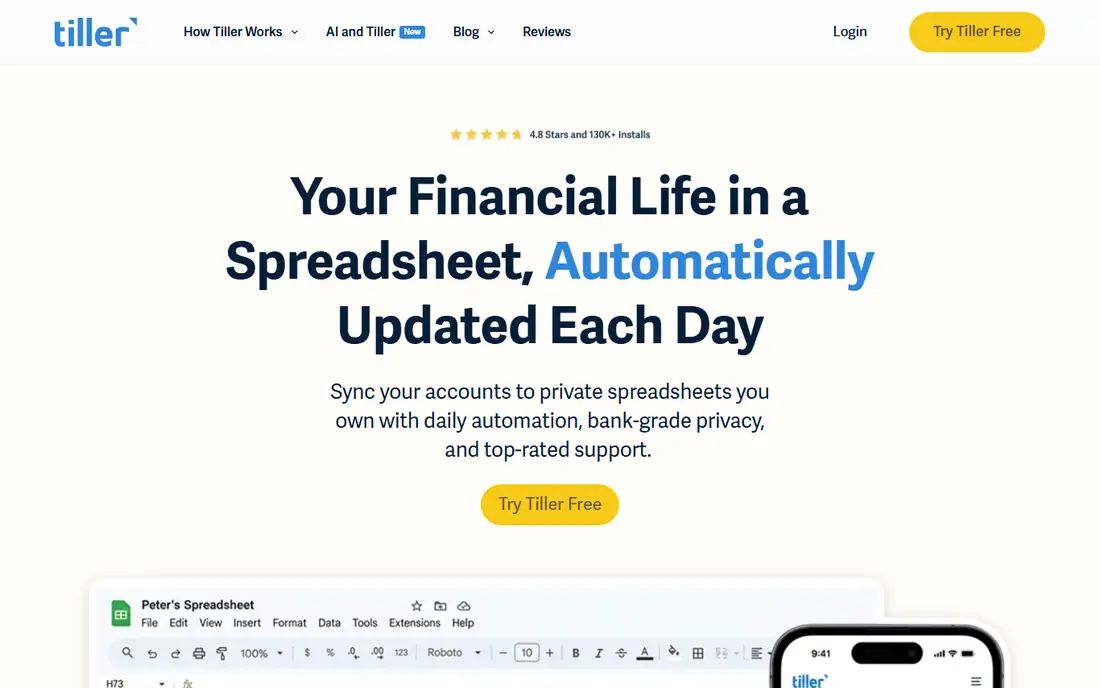
Tiller takes a different approach: instead of a closed app, it feeds daily spending, income, debt, and balances into private spreadsheet templates in Google Sheets or Excel that the user owns. Its homepage stresses bank-grade privacy, top-rated support, and a model funded only by subscriptions, with no ads and no data selling. It also positions its spreadsheets as AI-ready: users can point ChatGPT, Claude, or Gemini at their own spreadsheet rather than giving AI access to bank accounts.
Tiller suits people who already live in spreadsheets and want full control over categories, reports, and custom analysis, including solo business income and expenses under one subscription. The trade-off is effort: Tiller is a toolkit more than a finished app, and it needs spreadsheet comfort. For a spreadsheet lover, it is the most flexible and privacy-friendly option here.
What we like- Bank data feeds daily into Google Sheets or Excel templates you own
- No ads and no data selling
- AI-ready spreadsheets that keep AI away from your bank accounts
Watch out for- Requires comfort with spreadsheets
- No free plan
- Less of a ready-made app experience than rivals
Starting priceSee website
Free planNo
Goodbudget is a budget tracker built on the envelope method: money is divided into virtual envelopes for groceries, rent, savings, and other categories, so spending stops when an envelope is empty. Its homepage stresses budgeting with a purpose, syncing and sharing budgets with family and friends, saving for big expenses, and paying off debt, with apps for iPhone, Android, and web. It has been recommended by outlets including The Guardian, Forbes, and CNET.
Goodbudget suits households that want a simple, shared budgeting discipline without connecting every account, and it works well for couples and families learning to budget together. Its limits are that bank syncing is not emphasized on its homepage, so expect more manual entry than with Monarch or Copilot, and pricing is not shown there. For an envelope-budgeting household, Goodbudget is the most focused tool here.
What we like- Time-tested envelope budgeting method
- Sync and share budgets with family
- Helps save for big expenses and pay off debt
- Available on iPhone, Android, and web
Watch out for- No bank sync emphasis on the homepage, so tracking may be more manual
- Pricing not shown on the homepage
How we chose
We compared software that manages personal finances across budgeting, account tracking, net worth, and investments, and we opened each vendor homepage to confirm it loads and belongs to that product. We weighed budgeting method, automation, forecasting, platform coverage, and price, using only prices confirmed on vendor homepages and listing "See website" elsewhere. Note that a standalone simplifi.com check failed during our work, so Simplifi is covered here through Quicken's verified homepage, which shows its pricing directly. This guide is general information, not financial advice.
Buying guide: how to pick personal finance software
Start with your budgeting style. If you want a hands-on method that changes habits, YNAB or Goodbudget's envelope system fits. If you want automatic tracking with a clear dashboard, Monarch, Copilot, or Empower fits better. If you think in spreadsheets, Tiller is the only real choice. If you think in decades, PocketSmith's 60-year forecast is unmatched.
Next, check bank connections for your institutions, since a tool that cannot sync your main bank will demand manual entry and quickly lose its appeal. Then compare the full price: promotional rates such as Simplifi's $3.99 a month may rise at renewal, and advisory fees at Empower apply only to managed portfolios, not the free dashboard.
Finally, try the trial with real accounts for at least two weeks, including a full pay cycle, and watch whether you actually open the app. The best finance software is the one you keep using after the novelty fades, not the one with the longest feature list.
Frequently asked questions
What is personal financial management software?
It is software that connects bank, card, loan, and investment accounts, tracks spending and budgets, and shows net worth and goals in one place, helping households understand and manage their money.
Is free personal finance software safe?
Reputable tools use bank-grade encryption and multi-factor authentication, but any tool that connects to bank accounts deserves care: check its security page, use a strong unique password, and enable every available protection.
Should I use a budgeting app or a spreadsheet?
An app suits most people because it syncs accounts and categorizes spending automatically. A spreadsheet suits people who want full control, custom analysis, and data ownership, which is Tiller's entire model.
What is envelope budgeting?
Envelope budgeting divides money into categories, or envelopes, for each spending purpose, and spending stops when an envelope is empty. It is a simple discipline that Goodbudget digitizes for households.
Can finance software replace a financial adviser?
No. Software tracks and organizes money, while an adviser gives personalized advice on investing, tax, and retirement. Tools such as Empower offer both, with a free dashboard and paid advisory services for larger portfolios.
Sources we checked (0)
Is your product missing or out of date?
We review this list regularly. Vendors can request a listing, send updated pricing or ask about featured placement.

Shihab Mia · Founder, Rankite
Shihab has 5+ years in B2B and SaaS SEO. He writes Rankite's software buying guides from pricing pages, documentation and public user reviews. More about Shihab.