How we make this list: we compare pricing pages, product documentation and public user reviews. Rankite is independent; if a vendor ever pays for a featured spot, that listing is clearly labeled Partner.
Key takeaways
- The goals spreadsheet nobody opens is why this software exists: the shortlist is Weekdone (free for 3 users) for small teams, Perdoo (free for 5 users) for startups, and Quantive (free Essentials) for the most generous free tier.
- 15Five ($4/employee/month) and Lattice ($8/person/month) bundle OKRs into broader performance platforms; buy them for the suite, not the OKRs alone.
- Microsoft Viva Goals was retired on December 31, 2025: do not buy it, and migrate now if you were on it.
- WorkBoard is quote-only enterprise; Mooncamp (€7/user/month) is the European mid-market pick with honest per-user pricing.
Quick comparison
| Tool | Best for | Starting price | Free plan |
|---|
 15Five 15Five | Companies that want OKRs inside a performance platform | $4/employee/month (Engage); Perform $11; Total Platform $16 (billed annually) | Free trial (terms vary); no free plan |
 Lattice Lattice | Mid-market companies wanting OKRs alongside reviews and engagement | $8/person/month (OKRs & Goals module, billed annually) | No (no free plan or trial; demo only) |
 Weekdone Weekdone | Small teams that want simple OKRs without enterprise weight | Free (up to 3 users); $90/month (4-10 user package) | Yes (free for up to 3 users); 14-day free trial |
 Perdoo Perdoo | Startups that want strategy maps plus OKRs | Free (up to 5 users); Premium $9/user/month (billed annually) | Yes (free up to 5 users, full OKR workflow) |
 Microsoft Viva Goals Microsoft Viva Goals | Nobody buying today (retired December 31, 2025) | N/A (product discontinued) | N/A |
 Quantive Quantive | Teams that want a full-featured OKR tier at $0 | $0 (Essentials, free forever); Scale $9/user/month | Yes (Essentials free forever); 14-day free trial |
 WorkBoard WorkBoard | Enterprises doing full strategy execution, not just OKRs | See website (custom quote) | Free trial (reported, 30-day enterprise trial); no free plan |
 Mooncamp Mooncamp | European mid-market teams wanting honest per-user pricing | €7/user/month (Essential, billed annually; ~$8.10 USD) | Free trial (14 days); no free plan |
Is your product missing or out of date?
We review this list regularly. Vendors can request a listing, send updated pricing or ask about featured placement.
The best OKR software
Every company has a goals document. It was written with enthusiasm in January, updated twice, and abandoned by March. OKR software exists to prevent exactly that: turning objectives and key results from a document into a weekly habit with check-ins, dashboards and accountability. These eight platforms cover the real market, from free tiers for tiny teams to enterprise strategy suites, plus one prominent product you should no longer buy.
#1
15Five
Best for: Companies that want OKRs inside a performance platform
Visit 15five.com
Starting price$4/employee/month (Engage); Perform $11; Total Platform $16 (billed annually)
Free planFree trial (terms vary); no free plan
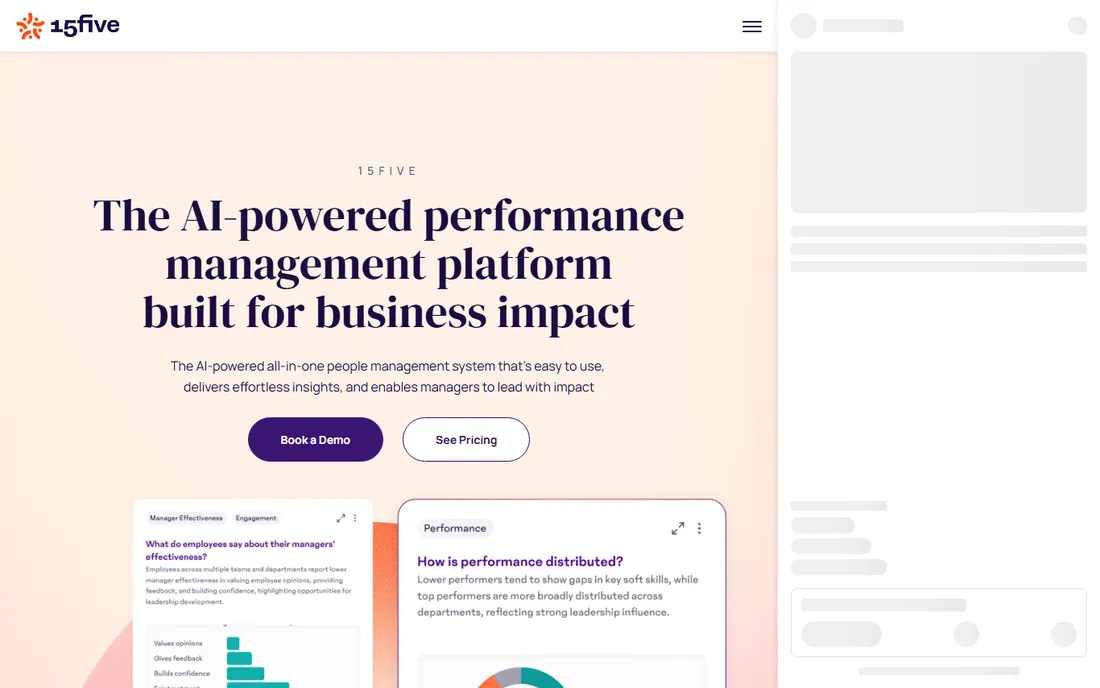
15Five treats OKRs as part of performance, not a separate system. Goals live alongside weekly check-ins, 1-on-1s and reviews, so progress gets discussed in the meetings that already happen. That integration is the selling point: OKRs fail when they live in a tool nobody opens, and 15Five puts them where managers already work.
The pricing reality is that OKRs need the Perform tier at $11 a user; Engage at $4 covers check-ins without the goals machinery. There is no free plan. If you want OKRs plus performance management in one system and your managers will run the check-in habit, it is coherent. If you want standalone OKRs, the dedicated tools below are cheaper and simpler.
What we like- Weekly check-ins make OKRs a habit, not a document
- Combines goals with performance reviews and engagement
- Manager coaching tools support the ritual
Watch out for- OKRs sit inside the Perform tier, so the real price is $11
- No free plan
- The check-in cadence needs manager buy-in to work
#2
Lattice
Best for: Mid-market companies wanting OKRs alongside reviews and engagement
Visit lattice.com
Starting price$8/person/month (OKRs & Goals module, billed annually)
Free planNo (no free plan or trial; demo only)
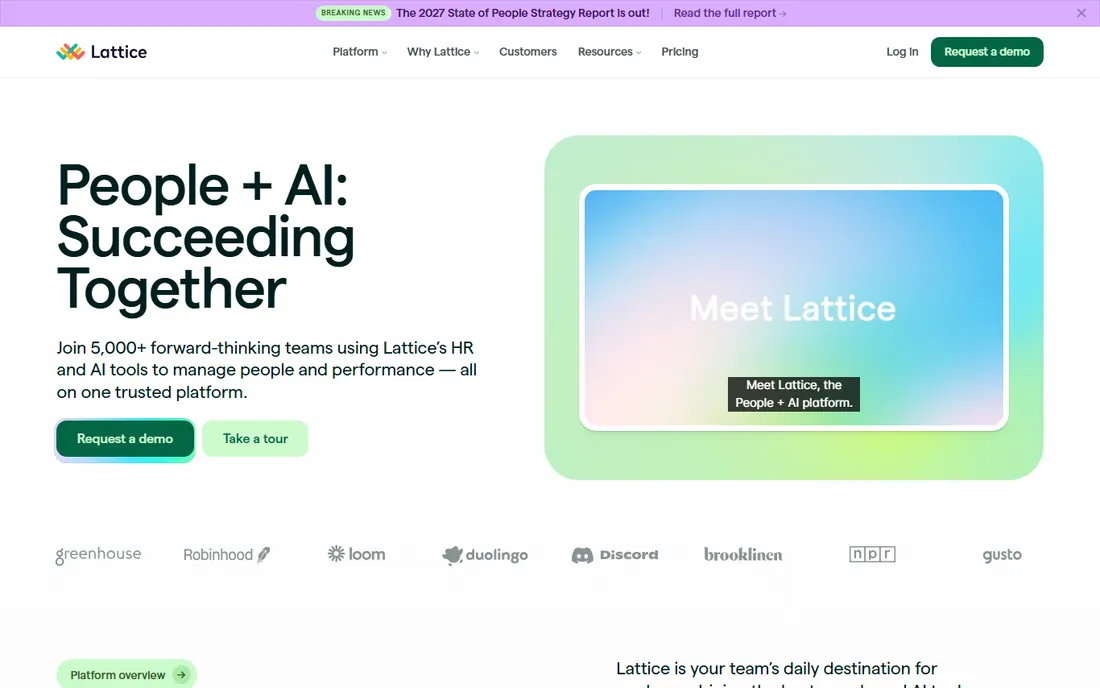
Lattice's OKR module at $8 a person plugs goals into the performance system: reviews reference goal progress, 1-on-1s discuss blockers, engagement data explains the context. For companies already on Lattice, adding the module is the natural move. The interface is the cleanest in the category, which matters for adoption.
Bought standalone, $8 a person is expensive for goal tracking; the dedicated tools do it for less or free. There is no trial, only demos. The value proposition is the integration: if performance management is your core system and goals should live inside it, Lattice is the premium choice. Otherwise the standalone OKR tools deliver the methodology without the platform price.
What we like- OKRs integrated with performance reviews, 1-on-1s and engagement
- Clean interface with strong adoption
- Modular pricing lets you buy goals alone
Watch out for- $8 a person for the module alone adds up
- No trial
- Annual contracts with enterprise minimums on the broader platform
#3
Weekdone
Best for: Small teams that want simple OKRs without enterprise weight
Visit weekdone.com
Starting priceFree (up to 3 users); $90/month (4-10 user package)
Free planYes (free for up to 3 users); 14-day free trial
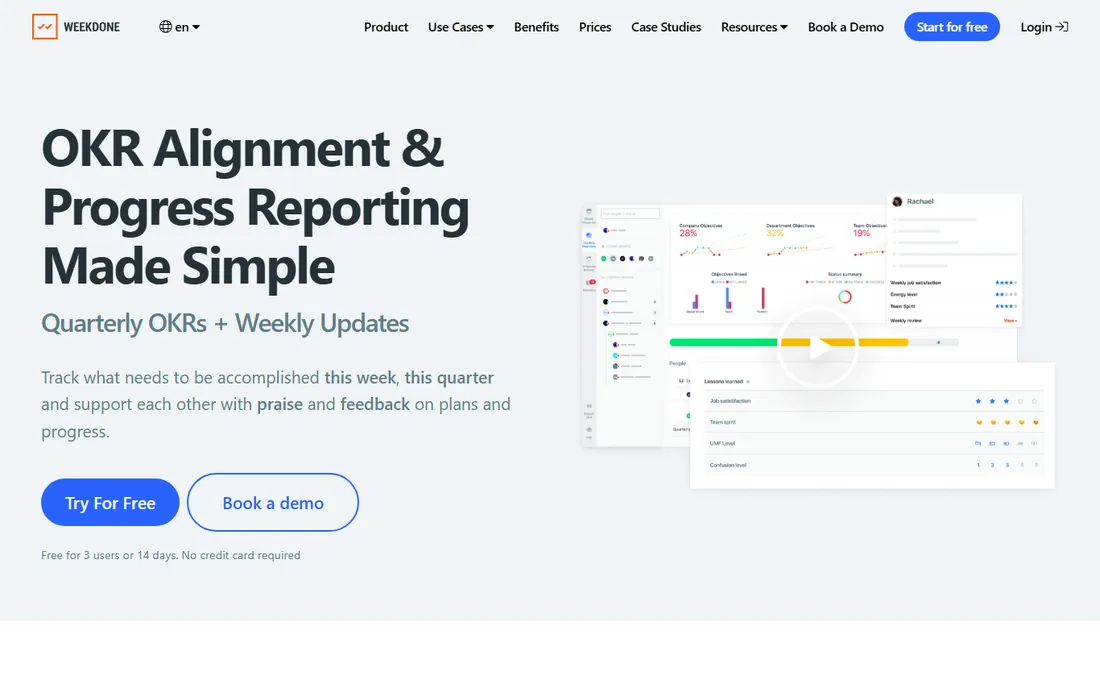
Weekdone is OKR software without the enterprise ceremony. Teams set objectives, check in weekly, and watch progress on dashboards that take minutes to understand. The free tier for up to 3 users covers founding teams and pilots, and the package pricing ($90 a month for 4-10 users, scaling by band) is predictable.
The band pricing means a 4-person team pays the same as a 10-person team, which is either fine or annoying depending on your headcount. Feature depth is deliberately limited: no strategy maps, no advanced analytics. For a small team adopting OKRs for the first time, that simplicity is the point. Complexity is what killed the spreadsheet; Weekdone does not repeat the mistake.
What we like- Free for teams up to 3 users
- Package pricing is simple and predictable
- Weekly check-ins and progress dashboards built in
Watch out for- Package pricing means paying for the band, not the headcount
- Feature depth trails the enterprise platforms
Starting priceFree (up to 5 users); Premium $9/user/month (billed annually)
Free planYes (free up to 5 users, full OKR workflow)
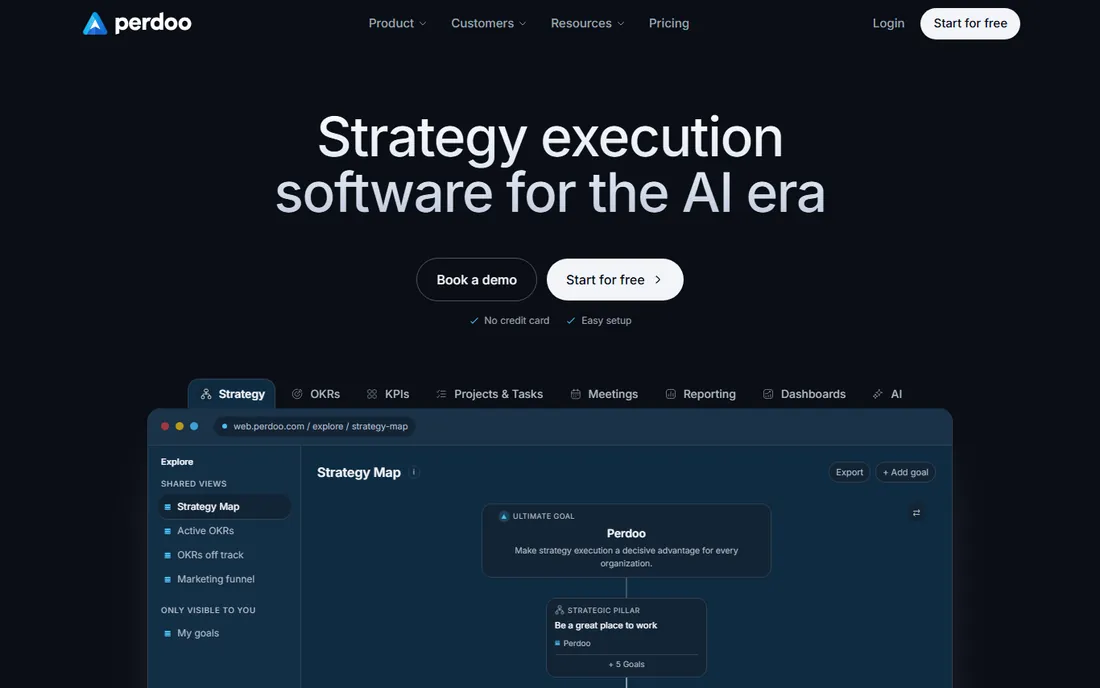
Perdoo adds the layer most OKR tools skip: strategy. Strategy maps connect company vision to team objectives to individual key results, so people see why their goals matter. KPIs track alongside OKRs for the metrics that need monitoring rather than stretching. The free tier for 5 users includes the full workflow, which is generous.
The commercial terms have edges: 5 paid licenses minimum on Premium, no monthly billing (quarterly is the shortest term). At $9 a user annual, a 20-person team pays $180 a month. For a startup that wants OKRs tied to strategy from day one, Perdoo is the most thoughtful free starting point. Just confirm the license minimums fit your team size.
What we like- Free tier covers 5 users with the full OKR workflow
- Strategy maps connect daily work to company vision
- KPI tracking alongside OKRs
Watch out for- Minimum 5 paid licenses on Premium
- No monthly billing (quarterly minimum term)
- View-only licenses needed for wider visibility
#5
Microsoft Viva Goals
Best for: Nobody buying today (retired December 31, 2025)
Visit microsoft.com
Starting priceN/A (product discontinued)
Free planN/A
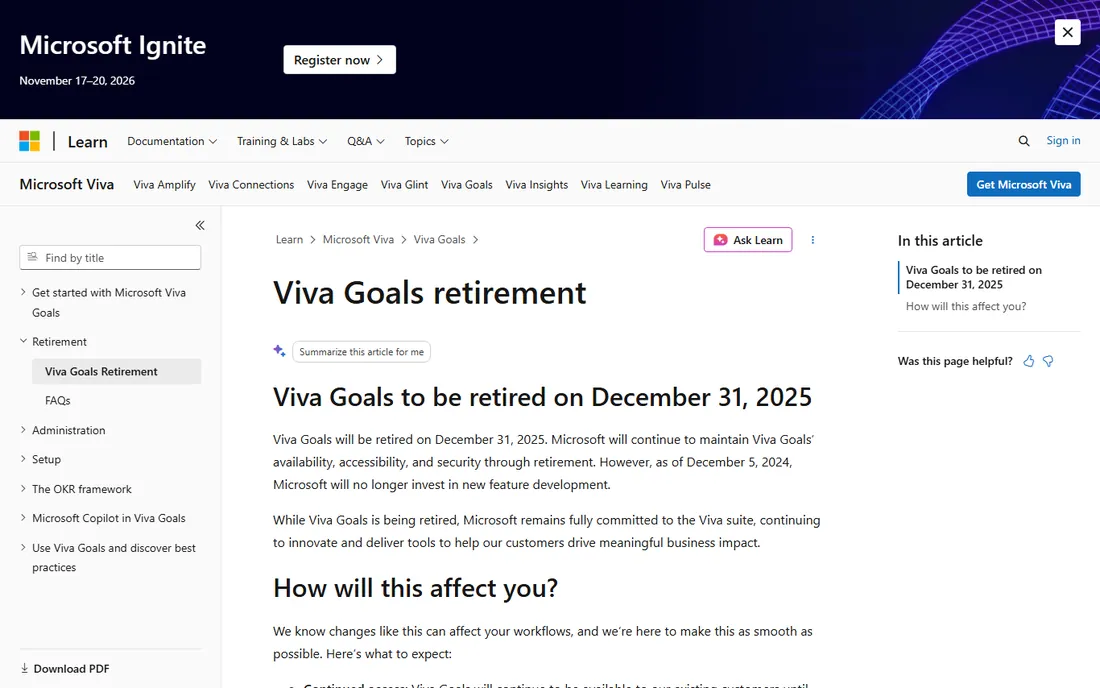
Microsoft Viva Goals (formerly Ally.io, acquired 2021) was retired on December 31, 2025. It is on this list because it still appears in old comparisons and Microsoft 365 shops keep asking about it. Do not buy it, do not plan around it, and do not follow guides that recommend it.
If you were on Viva Goals, migrate now. The natural Microsoft-adjacent alternatives are limited, so most teams should evaluate the dedicated tools on this list: Weekdone or Perdoo for simplicity, Lattice if you are already in that ecosystem, Mooncamp for European data residency. Export your goals and check-in history before access ends; historical OKR data is valuable for setting next year's targets.
What we like- Was the natural OKR choice for Microsoft 365 shops
- Ally.io heritage had solid OKR fundamentals
- Teams integration was convenient
Watch out for- Retired end of 2025
- No new buyers accepted
- Existing customers need a migration target now
Starting price$0 (Essentials, free forever); Scale $9/user/month
Free planYes (Essentials free forever); 14-day free trial
Quantive (formerly Gtmhub) offers the category's best free tier: Essentials free forever with real OKR functionality, not a crippled demo. Automated KPI integrations pull metrics from your tools so check-ins reflect reality without manual entry, and whiteboards support the planning sessions where OKRs get set. Scale at $9 a user adds the advanced features.
One caveat: a 2026 acquisition by WorkBoard is reported but single-sourced and unverified; if true, the roadmap may converge with WorkBoard's enterprise platform. Confirm the product direction before building long-term processes on it. For now, the free tier is the best $0 OKR offer available, and Scale is priced fairly against the mid-market tools.
What we like- Essentials free tier is the most generous in the category
- Automated KPI integrations pull data without manual updates
- OKR check-ins and whiteboards included
Watch out for- Scale at $9 a user matches paid competitors
- Acquisition by WorkBoard reported (single source, unverified) bears watching
#7
WorkBoard
Best for: Enterprises doing full strategy execution, not just OKRs
Visit workboard.com
Starting priceSee website (custom quote)
Free planFree trial (reported, 30-day enterprise trial); no free plan
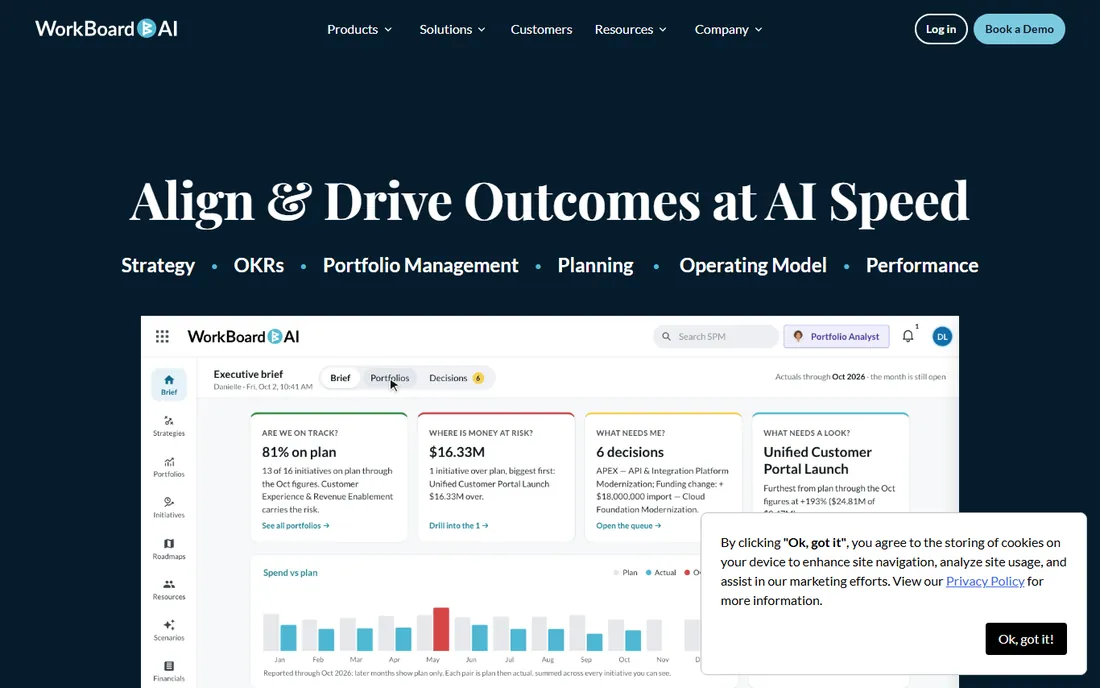
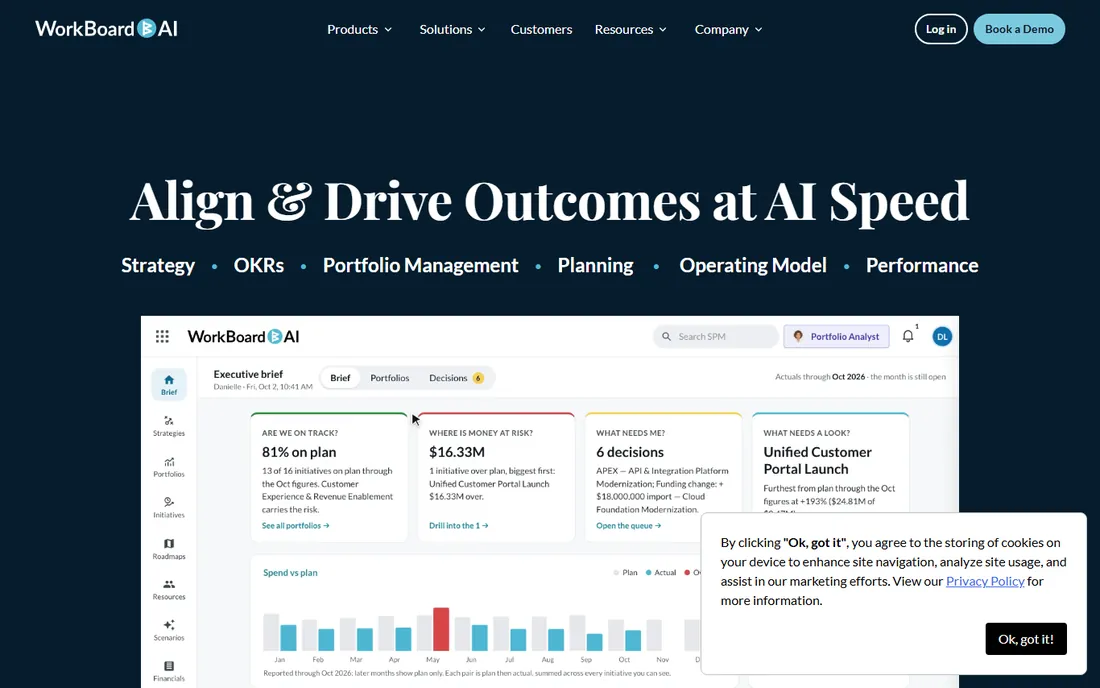
WorkBoard sells strategy execution, with OKRs as one component alongside outcome dashboards, smart meeting agendas and coaching programs. The agentic AI features and Microsoft Copilot OKR agent point at where the category is heading. For enterprises running formal strategy processes, the breadth justifies the platform.
For everyone else it is too much product. Pricing is quote-only with third-party reports ranging from $9 to $49 a user, which signals "call us" rather than a real price. The sales cycle is enterprise-length. If your company does strategy reviews with hundreds of participants, evaluate it. If you need to track team OKRs, the tools above do it at a fraction of the cost and effort.
What we like- Strategy execution platform beyond OKRs: dashboards, meeting agendas, coaching
- Agentic AI features and Microsoft Copilot integration
- Built for enterprise scale
Watch out for- Quote-only pricing with enterprise sales cycles
- Overkill for teams that just need OKR tracking
- Third-party price reports vary wildly
#8
Mooncamp
Best for: European mid-market teams wanting honest per-user pricing
Visit mooncamp.com
Starting price€7/user/month (Essential, billed annually; ~$8.10 USD)
Free planFree trial (14 days); no free plan
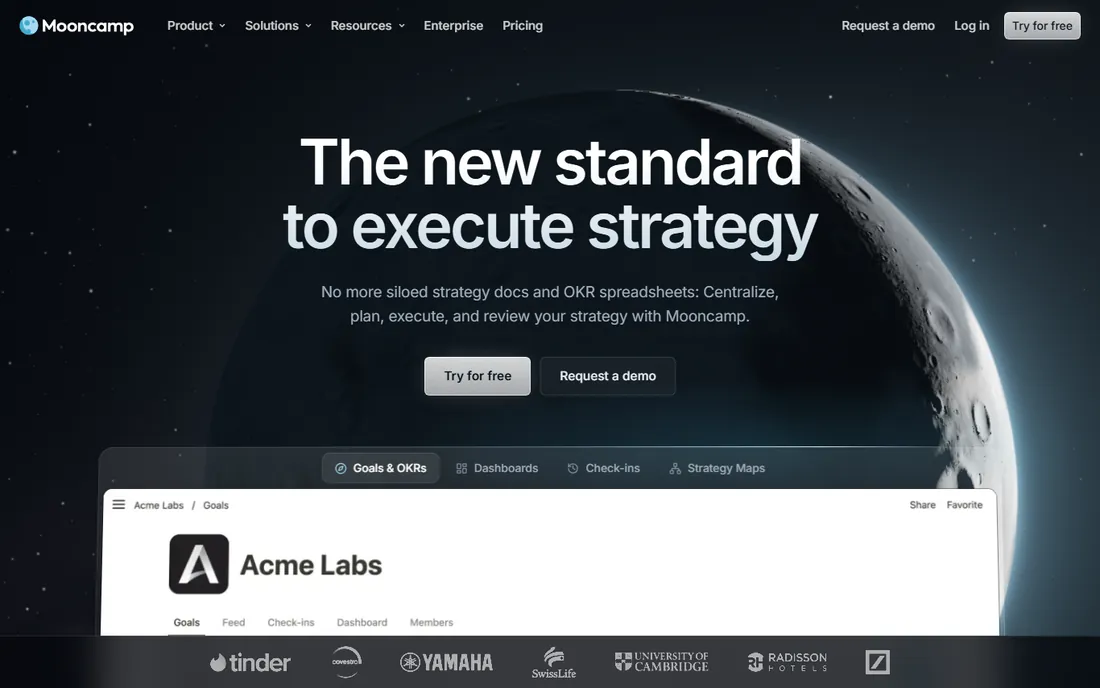
Mooncamp is the straightforward European option: €7 a user a month on Essential, €10 on Professional, published plainly with no sales gauntlet. Custom goal views adapt the methodology to how your company actually works, and the Teams and Slack integrations cover the collaboration layer. For EU companies wanting data residency and honest pricing, it is the natural pick.
The trade-offs are real: EUR-first billing, no native AI features, no public API and no dedicated mobile app (PWA only). The 5-user minimum on paid plans excludes the smallest teams. US buyers should confirm procurement handles EUR billing. For a European mid-market team that wants OKRs without enterprise theater, Mooncamp is refreshingly direct.
What we like- Transparent EUR per-user pricing with no quote wall
- Flexible custom goal views
- Teams and Slack integrations
Watch out for- EUR-first billing complicates US procurement
- No native AI features and no public API
- 5-user minimum on paid plans
The Microsoft Viva Goals retirement
Microsoft retired Viva Goals on December 31, 2025, and the aftershocks are still moving through the market. Ally.io customers who rode the acquisition into Viva Goals now need a new home, and Microsoft 365 shops lost their default OKR answer. The practical impact is a forced re-evaluation, which is actually healthy: many teams were on Viva Goals by inertia rather than fit.
If you are migrating, resist the urge to replicate Viva Goals feature-for-feature. List what you actually used: usually goal tracking, check-ins and dashboards. That short list maps cleanly to Weekdone, Perdoo or Quantive at a fraction of enterprise cost. Export historical data first, run a pilot with one team, and use the migration as the excuse to simplify the OKR process itself. The retirement is annoying; the simplification opportunity is real.
Frequently asked questions
How much does OKR software cost?
From $0 to hundreds a month. Weekdone (3 users), Perdoo (5 users) and Quantive (Essentials) all offer genuinely free tiers. Paid plans run $7 to $11 a user a month (Mooncamp €7, Lattice $8, Perdoo and Quantive $9, 15Five Perform $11). WorkBoard is quote-only enterprise. A 20-person team pays $0 to $220 a month depending on the tool.
What is the difference between OKRs and KPIs?
OKRs are goals you stretch toward: ambitious, time-bound, and expected to be partially achieved. KPIs are metrics you monitor: steady-state numbers that should stay healthy. Perdoo and Quantive track both deliberately. The common failure is turning KPIs into OKRs ("achieve 99.9% uptime" is a KPI, not an objective) or setting OKRs with no measurable key results.
How often should teams check in on OKRs?
Weekly. The methodology only works as a habit: a short weekly check-in where owners update progress, flag blockers and adjust. Tools with built-in check-ins (Weekdone, 15Five, Quantive) enforce the rhythm. Quarterly-only reviews produce the abandoned spreadsheet; weekly check-ins produce the culture. If your team will not check in weekly, no software will save the program.
Do we need OKR software or will a spreadsheet work?
A spreadsheet works until about 10 people, then it breaks: no reminders, no dashboards, no history, no accountability. The free tiers on this list remove the cost objection entirely. The software's real value is not the features but the habit it enforces: check-in reminders, visible progress and a single source of truth. If the spreadsheet is already abandoned, the software is the fix.
What should Viva Goals users migrate to?
Export your data first, then pilot one of the dedicated tools: Weekdone or Perdoo for simplicity, Quantive for the generous free tier, Lattice if you are already on their platform, Mooncamp for EU data residency. Run the pilot with one team for a quarter before rolling out. Use the migration to simplify: most teams discover they used 20% of Viva Goals' features.
OKR software vs. the spreadsheet
The spreadsheet is the incumbent every tool here competes with, and it loses on exactly three things. First, reminders: nobody updates a spreadsheet voluntarily, while software nags owners weekly. Second, visibility: a spreadsheet buried in Drive is not a dashboard the CEO checks Monday morning. Third, history: software keeps the record of what was attempted and learned, which is how next year's OKRs get better.
The spreadsheet wins on exactly one thing: cost, and the free tiers here erase even that. Weekdone, Perdoo and Quantive all run small teams at $0 with more structure than any spreadsheet. The honest reason teams stay on spreadsheets is not money but avoidance: software makes commitments visible, and visibility is uncomfortable. Buy the software when leadership is ready for that visibility; until then, no tool helps.
How we chose
We started with the categories buyers actually search: OKR software, OKR tools, and goal tracking software. For each candidate we checked the vendor's own pricing page, verified plan names and prices against recent pricing roundups and public reviews on G2 and Capterra, and compared feature lists, free tier limits and team-size fit. Where a price could not be verified on the vendor's page we wrote "See website" rather than guessing. The shortlist mixes dedicated OKR tools with performance platforms, because a startup and an enterprise are not buying the same thing.
Sources we checked (10)
- https://www.15five.com/pricing/
- https://www.lattice.com/pricing/
- https://www.weekdone.com/pricing/
- https://www.perdoo.com/pricing/
- https://www.microsoft.com/en-us/microsoft-viva/goals/
- https://www.quantive.com/pricing/
- https://www.workboard.com/pricing/
- https://www.mooncamp.com/pricing/
- https://www.g2.com/categories/okr
- https://www.capterra.com/okr-software/
Is your product missing or out of date?
We review this list regularly. Vendors can request a listing, send updated pricing or ask about featured placement.

Shihab Mia · Founder, Rankite
Shihab has spent more than a decade helping SaaS and e-commerce brands grow through search. He writes Rankite's software buying guides from pricing pages, documentation and public user reviews. More about Shihab.